Engine Clicks but Won't Crank - Testing the Battery, Cables, Neutral Switch, Solenoid and Starter
A click (or nothing) when you turn the key is usually a power delivery problem, not a dead engine. Work from the battery and cables through the neutral switch, start relay and solenoid to the starter motor using simple voltage-drop tests, and learn how to jump-start safely when gasoline vapor may be around.
Time
1 h
Shop would charge
$100-600
Applies to
Outboard, Sterndrive (I/O), Gas inboard, Marine diesel
Safety first: The starting circuit carries hundreds of amps. A wrench across a battery post, a jumper clamp touching the wrong metal or a screwdriver across solenoid terminals makes a big spark, and in an engine compartment with gasoline vapor that spark can cause an explosion. On sterndrives and inboards, run the blower for at least 4 minutes and sniff the bilge and engine compartment before any test or jump start; if you smell fuel, stop and get the leak fixed. Never jump or charge a battery that is cracked, leaking, swollen, frozen or smells of rotten eggs. Wear safety glasses, take off rings and watches, and keep hands away from belts, flywheels and the propeller. If you are stranded on the water, call TowBoatUS or Sea Tow, and in an emergency use VHF channel 16 or dial 911.
Owners often ask
- I turn the key and just hear a click, but the engine won't crank. Is it the starter or the solenoid?
- How do I safely jump-start my boat battery?
This guide walks you through it. Still stuck? Ask the AI Mechanic about your engine.
Tools
- Digital multimeter with a DC volts setting and long test leads
- Wire brush or battery terminal cleaner
- Wrenches or sockets for battery and cable terminals
- Battery charger
- Safety glasses and gloves
- Flashlight
- Portable jump pack or a second battery and heavy jumper cables (for emergencies)
- Spark plug socket (to check whether an engine turns by hand)
Parts & supplies
- Hex nuts and lock washers for battery terminals (not wing nuts)
- Corrosion inhibitor spray or grease for terminals
- Fuses of the correct rating
- Marine-rated solenoid, relay or starter specified for your engine (only if testing proves one has failed)
Before you start
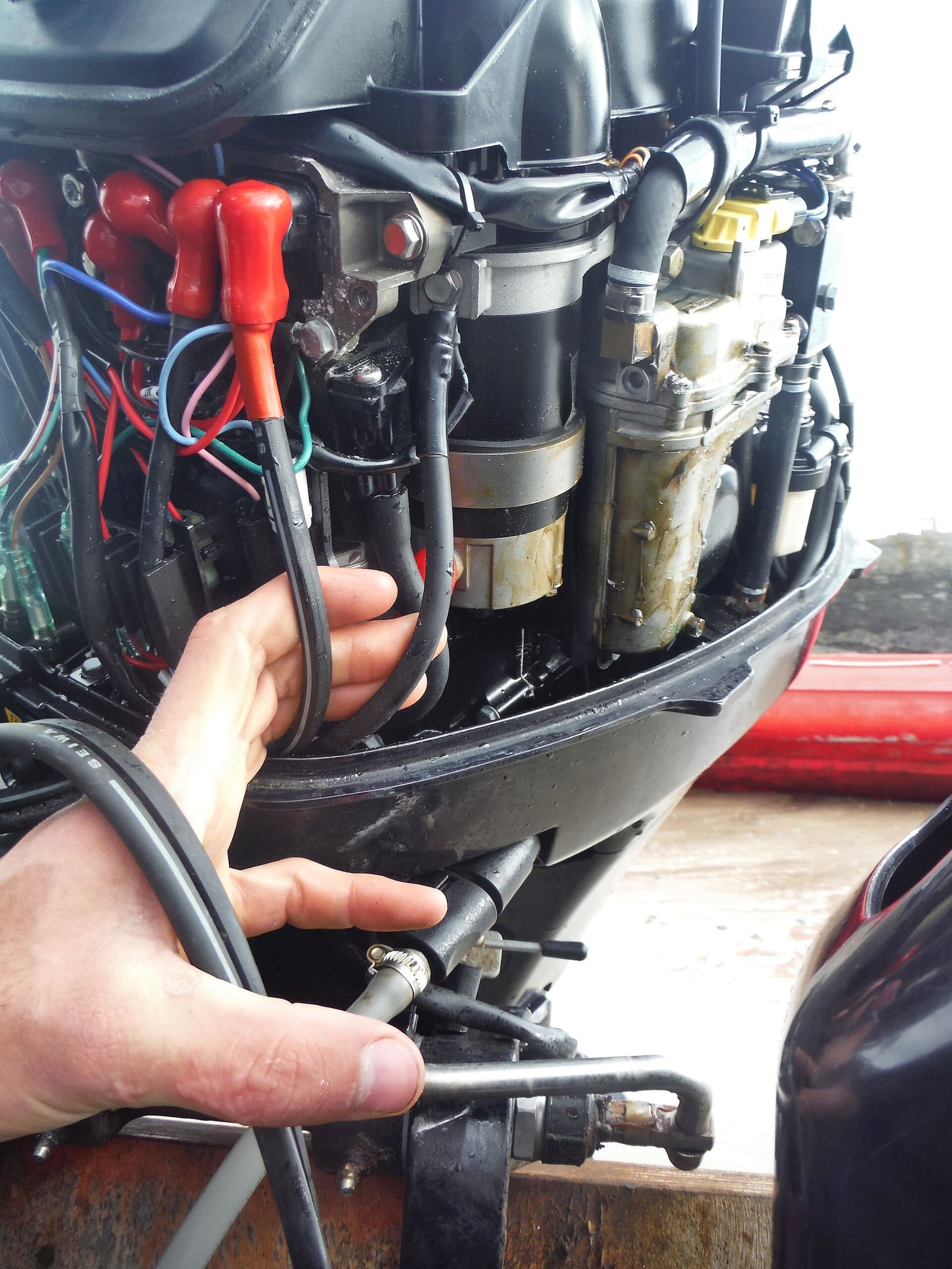
How the starting circuit works. When you turn the key to START (or press the start button), a small current flows through the key switch, the neutral safety switch and usually a fuse and a start relay to the starter solenoid. The solenoid is a heavy-duty electrical switch, often mounted on or next to the starter. When it closes, it connects the thick battery cable straight to the starter motor, which spins the engine. On many outboards, the solenoid sits separately on the powerhead under a rubber boot.
Listen to what it's telling you:
- Nothing at all, no click: the small control circuit isn't reaching the solenoid. Think battery switch, neutral switch, key switch, fuse, start relay or a harness plug.
- Rapid clicking or chattering: the solenoid pulls in, the voltage collapses, and it drops out again. Almost always a weak battery or a bad connection.
- One solid click, no crank: the solenoid closes, but enough current isn't reaching the starter (cables, grounds, burned solenoid contacts), the starter itself has failed, or the engine can't turn (see step 10).
- Starter whirs but the engine doesn't turn: the starter drive isn't engaging the flywheel.
- Slow, labored cranking: low battery or high resistance in the cables and connections.
Salt Water Sportsman quotes a Yamaha product manager pointing out that modern engines are increasingly battery-dependent, so any interruption in power can prevent starting. Most "starter problems" turn out to be battery and connection problems. For problems where the engine cranks normally but won't fire, use the engine-wont-start and no-spark guides instead.
Steps
Salt Water Sportsman lists these first, and they solve a surprising number of no-crank days:
- Battery switch turned ON (or to the correct battery).
- Shift lever in neutral. Try moving it firmly to neutral, or jiggling it in neutral while turning the key.
- Kill switch lanyard clipped on, on engines where it affects starting.
- Fuses on the engine, at the helm and in the battery area. Know where they are before you need them.
Set the meter to DC volts and put the probes on the battery posts themselves, not on the cable clamps.
- At rest: a fully charged 12-volt battery reads about 12.6 volts or a bit more.
- While a helper turns the key to START: SAIL Magazine's Nigel Calder explains that a healthy battery dips to around 12 volts and then slowly declines while cranking.
- Voltage crashes: the battery is discharged or worn out, or (rarely) the starter has a dead short. Charge it fully and test again; if it crashes again, replace it. Yamaha recommends a load test if you have any doubt, which any auto parts store can do.
- Voltage doesn't change at all and nothing turns: the current isn't flowing. Look at the switch, solenoid and starter (steps 6 to 9).
- Voltage dips but doesn't crash, and the engine turns slowly or not at all: there is too much resistance somewhere. Do the voltage-drop tests in steps 4 and 5.
A good resting voltage alone does not prove the battery is good. It must hold up under load.
Turn the battery switch off. Disconnect the negative cable first and reconnect it last. Then take apart and clean:
- Both battery terminals and cable ends
- The battery switch terminals
- The positive cable at the solenoid and starter
- The engine ground (where the negative cable bolts to the engine block or powerhead)
Yamaha warns that a terminal can be corroded yet look clean, and that corrosion can rot the copper strands inside a wire's insulation. Clean both faces to bare, shiny metal, refit with hex nuts and lock washers (not wing nuts), tighten, and coat with a corrosion inhibitor. Salt Water Sportsman notes that a click when you turn the key often points to a loose battery connection, and the fix is to wire-brush the terminals even if they look clean.
Voltage-drop tests find bad connections that you can't see. Calder points out that with the meter on volts, it's very hard to damage the meter or yourself, and that the readings only mean something while the starter is cranking.
- Put one probe on the negative battery post and the other on clean bare metal on the engine block (scratch a little to make good contact).
- Have a helper crank the engine.
- The reading should be well under 1 volt. Higher means resistance in the ground path.
Calder says the most common trouble spot is where the negative cable bolts to the engine, followed by the battery post connection. After a failed test, feel the cables and connections (carefully): warmth means resistance. Clean that joint to bare metal and test again.
- Put one probe on the positive battery post and the other on the big positive stud on the starter (where the heavy cable or strap from the solenoid attaches).
- Crank. Again, the drop should be well under 1 volt.
- If it's high, narrow it down by measuring across each part while cranking:
- Across the two big terminals of the solenoid: Calder says anything more than a tenth or two of a volt means the solenoid contacts need attention. In SAIL's Ask Sail column, he says the reading should be at most a few tenths, certainly no more than 0.5 volt.
- Across the battery switch's main terminals: again no more than a tenth or two of a volt. Calder suggests turning the switch on and off a dozen times and retesting, since that can clean the contacts; if it stays high, replace the switch.
- Across each cable, end to end, and across any fuse in the circuit.
Long cable runs on boats are often undersized. If a cable gets warm while cranking, it may need to be replaced with a heavier one.
If the solenoid doesn't click at all, find the small wire on the solenoid (the "start" or "S" terminal). Put the red probe on it and the black probe on clean engine ground, and have a helper turn the key to START.
- Close to battery voltage, but no click: the solenoid's coil has failed, or the solenoid isn't grounded (some ground through their mounting bracket). Clean the mount and retest before replacing it.
- Little or no voltage: the problem is upstream, in the key switch, neutral safety switch, start relay, fuse, or a corroded harness plug.
Calder also describes an intermittent version: on some engines, undersized wiring between the key switch and the solenoid drops the voltage so much that the solenoid drops out, so the engine cranks some days and not others. The fix is better wiring or an added relay, installed by someone who knows marine wiring.
The neutral safety switch only lets the engine crank in neutral, so you can't start in gear. On outboards and sterndrives it is usually in the remote control box or on the engine's shift linkage. A worn control, a stretched or misadjusted shift cable, or corrosion can keep it from closing even when the lever looks like it's in neutral.
- Move the lever firmly into neutral and try again.
- With a meter, a technician can check whether the switch passes voltage in neutral and blocks it in gear.
- If the shift cable needs adjusting, see the shift-cable-adjustment and remote-control-box-service guides.
Never bypass the neutral safety switch to get going. Starting in gear can throw people overboard or into the propeller.
Many fuel-injected outboards, sterndrives and inboards use a small start relay and a fuse between the key switch and the solenoid. Your owner's manual or the label on the fuse box shows where they are. A blown fuse or a relay with corroded pins stops the click entirely. Replace a fuse only with the same rating; if it blows again, stop and have the wiring checked.
If the battery holds up, the voltage drops are low, the solenoid clicks and full battery voltage reaches the starter's big terminal while cranking, but the starter doesn't spin, the starter motor itself is likely bad (worn brushes, a stuck drive or a seized motor). Calder notes that a starter with a dead short makes battery voltage crash and gives off a distinctive burned smell.
- Starter spins but doesn't turn the engine: the drive gear isn't engaging the flywheel. On an older boat, also confirm the battery cables aren't reversed: a previous owner may have spliced in cables with the wrong colors, and some starters then spin backward and never engage. Trace each cable from the battery post to the engine rather than trusting its color.
- Grinding: worn or damaged teeth on the drive or flywheel.
If the battery was ever connected backward, Mercury's FAQ says to check the engine's fuse or fusible link first and to have a dealer inspect the boat, because reversed polarity can damage the regulator/rectifier, the tachometer, the engine computer and wiring, plus electronics on the boat.
Starter replacement is a job for a pro or an experienced owner with the service manual. On sterndrives and inboards, the starter, solenoid and alternator must be marine ignition-protected parts. Boating Magazine warns that replacing engine-space components with non-marine automotive parts creates an explosion risk.
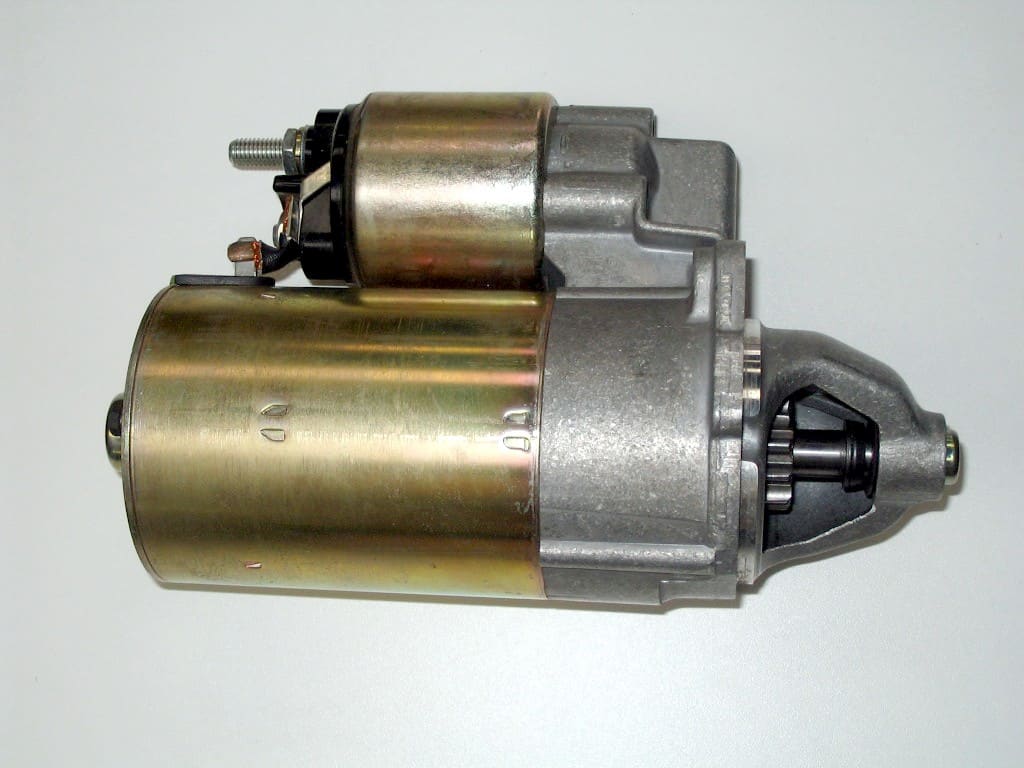
A starter motor with its solenoid mounted on top. The big stud takes the battery cable, the small terminal takes the trigger wire from the key circuit, and the drive gear at the front meshes with the flywheel. This one is from a car; marine starters look similar but are built ignition-protected. Photo: Willdre / Wikimedia Commons · CC BY-SA 3.0 A single click with the starter unable to move the engine can also mean the engine is locked, often by water in a cylinder from a flooded exhaust, a failed head gasket or a cracked part. SAIL Magazine describes how the starter alone did no harm, but the engine firing on the next attempt bent a connecting rod. So:
- Stop cranking.
- On a gasoline engine, remove the kill clip and the spark plugs and try turning the engine gently by hand (on an outboard, by the flywheel). Water spitting from a plug hole confirms it.
- On a diesel, SAIL's article describes opening the decompression levers (if fitted) and turning the engine by hand; water coming out means it was hydrolocked. The same article explains that repeated cranking of a diesel that won't fire keeps pumping raw water into the exhaust, so close the raw-water seacock if it doesn't start after a couple of tries, and reopen it once it runs.
- If you find water, call a pro quickly. Water left in the cylinders causes rust damage within days (see the water-in-engine-oil and submerged-engine-recovery guides).
Use the safest option first:
- Dual-battery boats: switch to the other battery or to "Both/Combine," as Salt Water Sportsman suggests, instead of using cables. See the battery-switch-dual-battery guide.
- Portable jump pack: follow its instructions. Many have an on/off switch; connect both clamps with it off, then switch it on, so any spark doesn't happen at the clamp.
- Jumper cables from another battery: heavy cables, and only after ventilating.
Before connecting anything on a sterndrive or inboard, run the blower (Boating Magazine recommends four to six minutes) and sniff. If you smell fuel, don't jump. Then:
- Connect red to the dead battery's positive post, then to the good battery's (or pack's) positive.
- Connect black to the good battery's (or pack's) negative.
- Make the last connection to clean, unpainted metal on the dead engine's block (the engine ground), away from the battery and away from fuel lines and the fuel filter.
- Crank in short bursts (about 10 seconds at a time unless your manual says otherwise) with rests between.
- Remove the cables in the reverse order.
Don't "jump" the solenoid with a screwdriver across its terminals. It makes a large spark right at the engine, and on many engines it bypasses the neutral safety switch, so the engine can start in gear.
Once you find the fault, repair it with marine-grade parts: tinned wire, sealed heat-shrink terminals, hex nuts with lock washers, and the solenoid, relay or starter your engine maker specifies. Label wires before you unplug anything. Coat finished connections with a corrosion inhibitor. Then charge the battery fully and do a final cranking test with the voltage-drop readings, and write them down with the date for next time.
Common mistakes
- Buying a starter or solenoid before cleaning the battery terminals and engine ground.
- Trusting a resting voltage reading. A battery can show good volts and still collapse when cranking.
- Doing voltage-drop tests without cranking. They only work under load.
- Using wing nuts on battery terminals.
- Jumping the solenoid with a screwdriver, or jump-starting a sterndrive or inboard without running the blower and sniffing first.
- Bypassing the neutral safety switch and forgetting about it.
- Fitting an automotive starter, solenoid or alternator on a gasoline inboard or sterndrive.
- Cranking over and over when the engine is locked, or on a diesel that won't fire with the raw-water seacock open.
- Grabbing the engine-wont-start checklist when the engine actually cranks fine. Clicks mean power delivery; cranking without firing means fuel, spark or compression.
When to call a pro
- Any fuel smell in the bilge or engine compartment: don't crank or jump until it's fixed
- A battery that is swollen, cracked, leaking, frozen or smells of rotten eggs
- Cables or connections that get hot, melt or smoke while cranking
- Starter, solenoid or neutral safety switch replacement on sterndrives and inboards (ignition-protected parts required)
- An engine that won't turn over by hand, or water found in the cylinders
- Fuses or relays that keep failing, or intermittent no-crank faults you can't reproduce
- A new starter, solenoid or main fuse that burns out soon after fitting: stop swapping parts and have the engine checked for liquid in the cylinders, a seized engine or a wiring fault
- A battery that was connected backward, even briefly
- Stranded on the water: TowBoatUS or Sea Tow, and in an emergency VHF channel 16 or 911
Tips
- Keep a charged jump pack aboard, and check its charge at the start of each month you use the boat.
- Learn where your fuses, start relay and solenoid are while the boat is at the dock, not when you're stuck offshore.
- Write down your good voltage-drop readings after a repair. Next time, a quick comparison shows what changed.
- After a cold, wet layup, clean and protect the battery and engine ground connections before the first start of the season.
- A failed marine starter can often be rebuilt by a local starter and alternator shop for much less than a new one, and you keep the correct marine (ignition-protected) unit. Bring the old starter and the engine serial number, since flywheel size and rotation (sterndrive or inboard) decide which replacement fits.
- Adding electric start to a pull-start outboard? Use the engine maker's own kit for your exact model. Owners who fit generic online kits often end up with a starter that won't disengage or no neutral safety switch, so the engine can start in gear.
Official references
We read these to write this guide. Your engine's own manual always wins.
- SAIL Magazine – Starting Woes (voltage-drop testing the cranking circuit, Nigel Calder)
- SAIL Magazine – Ask Sail, Engine Trouble (intermittent solenoid and switch wiring, Nigel Calder)
- SAIL Magazine – Hydrolock Headache
- Salt Water Sportsman – 10 Common Solutions for Boat Engine Problems
- Yamaha Outboards – Maintenance Matters, Electrical System
- Boating Magazine – How to Prevent a Boat Fire (blower, ignition-protected parts)
- Mercury Marine – Service & Support FAQs (reversed battery connections)
Safety: BoatMend is for information only and does not replace a certified marine technician. You are responsible for your safety and your boat. Read the full disclaimer.
Last updated 2026-10-24
Related guides
Engine Won't Start or Won't Crank - Troubleshooting Guide
Find out why your boat engine will not turn over or will not fire, starting with the simple things owners miss most, like the kill switch lanyard and battery switch. Many no-starts are fixed at the ramp in minutes without a tow.
Marine Battery Care: Test, Charge and Store for Winter
Check your boat battery's health, charge it the right way for its type (flooded, AGM or lithium), and store it so it is ready in spring. Most "boat won't start" calls start with a neglected battery.
How to Find and Fix Corroded Electrical Connections on a Boat
Track down the green crust and loose terminals behind flickering lights, dead gauges and slow cranking with a simple voltage-drop test, then remake the connection the marine way: tinned wire, a proper crimp, adhesive-lined heat shrink and a protective coating.
How to Use a 1-2-Both Battery Switch and Run Two Batteries
Learn what the 1, 2, Both and Off positions really do, a simple routine that keeps one battery ready to start the engine, how to check that both batteries are charging, and when an automatic charging relay makes life easier. Rewiring high-current cables is a job for a marine electrician.
Is My Engine Charging the Battery? Test the Charging System With a Multimeter
A step-by-step way to find out whether your outboard's stator and rectifier/regulator or your inboard's alternator is really charging the battery, what the voltage readings usually mean, and when the problem is just a dirty connection. Exact test specs come from your engine's service manual.
Engine Cut-Off Switch (Kill Switch) and Lanyard: The Law, Testing and Daily Use
How the engine cut-off switch (ECOS) and its lanyard or wireless fob work, when federal law requires you to wear it (boats under 26 feet, 3 hp or more, on plane), how to test it before every trip, and why a spare clip aboard matters.
How to Check and Adjust Boat Shift and Throttle Cables
Hard shifting, a lever that will not go fully into gear, or a gear that lands in a different spot every time usually point to the control cables. Learn how to find out whether the problem is the cable, the control box or the engine, how to adjust the cable ends, and when it is time to replace both cables.
Remote Control Box Troubleshooting: Stiff Lever, Won't Crank, Trim Switch
The throttle and shift control at the helm (side-mount or binnacle) takes a beating. Learn how to find out why the lever is stiff, why the engine will not crank even with a good battery, why the trim button on the handle quit, and when the whole control box should be replaced along with its cables.
Bilge Blower and Engine Compartment Ventilation on Gas Inboards and Sterndrives
Learn why gas boats have a "run the blower 4 minutes" label, how to check that the blower and vent ducts actually move air out of the engine compartment, and how to replace a blower safely with an ignition-protected marine unit.
Battery Goes Dead While the Boat Sits - How to Find a Parasitic Drain
If your boat battery is flat every time you come back, something may be quietly drawing power while you are away. Learn how to tell a bad battery from a drain, find the circuit with a multimeter and the fuse panel, and fix the usual culprits without disabling your bilge pump.
Milky Engine Oil or Water in the Oil - What It Means and What to Do
Milky, creamy or rising engine oil usually means water is getting into the engine. Learn why you should stop running it right away, how to tell harmless condensation from a real leak, and which parts are the usual suspects: head gaskets, exhaust risers and manifolds, intake manifold gaskets, oil coolers and freeze cracks.
Marine Diesel Won't Start: Troubleshooting From Battery to Fuel
Work through the usual reasons a Yanmar, Volvo Penta, Westerbeke, Beta or similar marine diesel won't crank, or cranks but won't fire, starting with the free and simple checks. Most no-starts come down to the battery, preheat, air in the fuel or a fuel shutoff solenoid.