Engine Won't Start or Won't Crank - Troubleshooting Guide
Find out why your boat engine will not turn over or will not fire, starting with the simple things owners miss most, like the kill switch lanyard and battery switch. Many no-starts are fixed at the ramp in minutes without a tow.
Time
45 min
Applies to
Outboard, Sterndrive (I/O), Gas inboard
Safety first: If you smell gasoline, see fuel in the bilge, or see a leak, do not crank the engine or flip switches; a spark can ignite the vapors. Ventilate, fix the leak or call a pro. On sterndrives and inboards, always run the blower for at least 4 minutes before cranking. If you are stranded on the water, call TowBoatUS or Sea Tow; in an emergency use VHF channel 16 or dial 911.
Owners often ask
- My engine cranks over fine but won't start. What do I check first?
- I turn the key and it just clicks. Is it the battery or the starter?
This guide walks you through it. Still stuck? Ask the AI Mechanic about your engine.
Tools
- Digital multimeter
- Wire brush or terminal cleaner
- Basic wrench and socket set
- Spark plug socket
- Spare spark plugs and fuse of the correct rating
- Flashlight
Parts & supplies
- Spark plugs (if fouled)
- Fuses of the correct rating
- Water-separating fuel filter (if contaminated)
Before you start
First decide which problem you have:
- Won't crank: you turn the key and the engine does not spin at all (silence, a click, or a whine). This is almost always electrical or a safety switch. Start at step 1.
- Cranks but won't start: the engine spins normally but never fires. This is usually fuel, spark or a safety system. Start at step 7.
Cranking for long periods can overheat the starter and drain the battery. Crank in bursts of no more than about 10 seconds with a short rest between, unless your manual says otherwise. On outboards, crank only with cooling water available (in the water, in a test tank or on flush muffs; the built-in flush port is for engine-off flushing on most models, so crank on it only if your manual allows it).
Steps
The emergency stop lanyard (clip) must be attached to the switch. On many engines it will not even crank without it; on others it cranks but will not fire. Push the clip firmly into place. This is the number one no-start cause.
Most engines will not crank in gear. Move the shift lever firmly into neutral. If it still does not crank, wiggle the lever through neutral while holding the key, because a worn neutral safety switch sometimes needs the lever in an exact spot.
Turn the battery switch to ON (or 1, 2, BOTH). Turn the key to the ON position (not start). Do the gauges, lights and warning beep come on? No power at all points to the battery, battery switch, cables or main fuse.
Measure across the battery posts with a multimeter. A fully charged 12-volt battery reads about 12.6 volts at rest. Below about 12.2 volts it may not crank a large engine. If the starter turns slowly or just clicks, charge the battery or jump it with a jump pack, then have it load tested.
A resting reading alone can fool you. If you can, have a helper turn the key while you watch the meter: a battery that looks fine at rest but drops sharply while cranking is weak, and a load test will confirm it. Auto parts stores and dealers can do one.
Loose or corroded connections cause most "it worked yesterday" problems. Check both ends of the positive and negative battery cables, the battery switch terminals, and the engine ground. Clean to bright metal and tighten firmly. A terminal that looks clean can still be corroded underneath. If your battery posts still use wing nuts, swap them for hex or nylon locking nuts, which do not shake loose.
Check the engine's main fuse and any fuses or circuit breakers in the key switch or helm circuit (see your manual for locations and ratings). Replace a blown fuse only with the same rating; if it blows again, stop and call a pro.
A single click when you turn the key, with a charged battery, often points to the starter solenoid or starter motor. That is usually a shop repair.
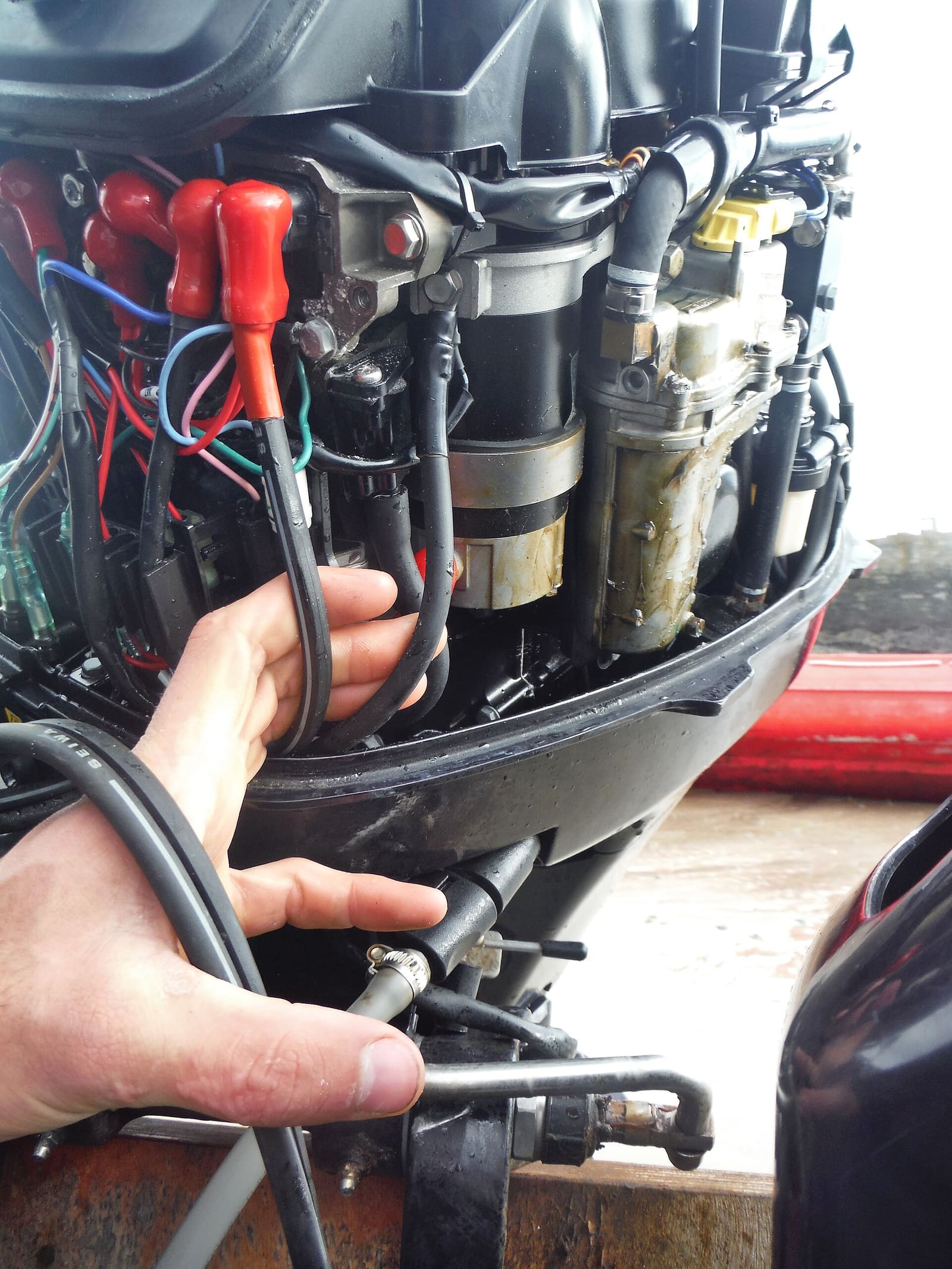
Under the cowling: the starter motor (center) and the red-booted cable terminals at the solenoids. Clicks but no crank usually point here. Photo: PtiBzh / Wikimedia Commons · CC0 1.0 Engine cranks but will not fire? Start with the basics:
- Is there fuel in the tank? Gauges can be wrong; check by eye or dipstick if you can.
- Is the fuel valve (if equipped) open?
- Is the portable tank vent open? On a built-in tank, look at the vent fitting on the hull side: Boating Magazine points out that insect nests or wax can partly block it.
- Is the fuel line kinked, and are the quick-connect fittings fully clicked in at the tank and engine?
On outboards, squeeze the primer bulb until it is firm. If it never gets firm, there is an air leak or a bad bulb or fitting. If it collapses and stays flat, the tank vent may be closed or the pickup blocked. Check for fuel drips at every connection; any leak means stop and fix it before cranking.
Also look at the bulb itself. The arrow on it must point toward the engine; a bulb installed backward cannot push fuel. A bulb that has turned hard and stiff, or squeezes but barely pumps, has worn-out internal one-way valves, according to BoatUS, and its old rubber can also crumble into the fuel. Replace it (ideally with a matching fuel line) rather than trying to soften it.
Carbureted engines may need the choke or the primer (push-to-choke key, or fast idle lever) when cold. Fuel-injected engines usually need no throttle: cranking with the throttle open can flood some engines. If you think it is flooded, follow your manual's flooded-start procedure. Check your manual for your engine's exact method.
Look at the water-separating filter bowl or the on-engine filter. Water, rust or gunk means contaminated fuel. Replace the filter. If there is a lot of water, the tank needs to be drained and cleaned; ethanol-blended fuel can absorb water and separate into a layer at the bottom of the tank. A quick check: draw a little fuel into a clear glass jar and let it settle for about half an hour. Clear water or a cloudy layer at the bottom means the fuel is contaminated.
Fuel that sat for months without stabilizer can go stale and gum up carburetors and injectors. Signs include a sour or varnish smell. Fresh fuel from a portable tank connected straight to the engine is a quick test. Old, gummy fuel systems usually need a dealer to clean.
Remove a plug (with the kill switch clip removed so the engine cannot start). A wet, fuel-soaked plug suggests flooding or no spark; black and sooty suggests a rich mixture or weak spark; oily suggests other problems. Replacing old plugs with new, correctly gapped ones is a cheap test. Testing for spark safely requires an inline spark tester; do not hold plug wires by hand.
After winter storage, mouse or bird nests can block the exhaust outlets or air intake, and some owners tape over intakes or the flame arrester when winterizing. Remove anything that does not belong there.
Modern engines store fault codes and may show warnings on the display. If none of the above fixes it, you may have an ignition, sensor or compression problem that needs a dealer's diagnostic tool.
Common mistakes
- Reading 12.6 volts on a resting battery and assuming it is good. Only a load test, or watching the voltage while cranking, tells you that.
- Spending an hour on the engine when the kill switch clip is off or the shift lever is not fully in neutral.
- Buying a fuel pump, starter or ignition module before checking the cheap basics: battery, connections, fuel, spark.
- Leaving the portable tank vent closed, so fuel stops flowing after a few minutes or never arrives.
- Pumping the throttle on a fuel-injected engine and flooding it.
- Cranking for long stretches without rest, which overheats the starter, or cranking an outboard with no cooling water.
- Putting in a bigger fuse because the right one keeps blowing. That removes the fire protection; find the short instead.
- Hooking the battery up backward and then trying to start anyway. Reversed cables can damage charging and engine electronics, and Mercury says the damage varies by model, so it strongly recommends a dealer inspection before the boat goes back into service.
When to call a pro
- Any fuel smell, fuel in the bilge, or a leaking fuel line or filter: do not crank
- A fuse that blows again after replacement, melted wiring, or a hot battery cable (high current can start a fire)
- The starter clicks or spins without engaging the engine
- No spark with new plugs and good battery voltage
- The engine cranks unevenly or much faster than normal (possible compression or internal problem)
- You are on the water and cannot fix it: call TowBoatUS or Sea Tow, and in an emergency VHF 16 or 911
Tips
- Keep a spare kill switch lanyard on board, hidden somewhere you will remember.
- A small lithium jump pack fits in a dry bag and can save a day.
- Carry a spare water-separating filter and the right wrench for it.
- If your boat sat all winter, do a test start in the driveway on muffs before your first trip.
Official references
We read these to write this guide. Your engine's own manual always wins.
- BoatUS – What to Do if Your Outboard Won't Start
- BoatUS – 4 Steps to Take if Your Outboard Quits
- Yamaha Outboards – Maintenance Matters, Electrical System
- Yamaha Outboards – Maintenance Matters, Fuel and Fuel System
- Honda Marine – Fuel Recommendations
- Mercury Marine – Maintenance Made Easy, Battery Basics
- Mercury Marine – Maintenance Made Easy, Fuel Basics (checking fuel for water)
- BoatUS – Outboard Primer Bulbs
- Boating Magazine – Five Tips for Hard-Starting Outboard Motors
- Mercury Marine – Owner FAQs (all categories)
Safety: BoatMend is for information only and does not replace a certified marine technician. You are responsible for your safety and your boat. Read the full disclaimer.
Last updated 2026-10-23
Related guides
Engine Starts Then Dies - Troubleshooting Guide
Track down why your boat engine fires up and then stalls, whether at idle, when you shift into gear, or after a few minutes of running. Most causes are in the fuel supply and can be checked with no special tools.
Loss of Power, Hesitation or Misfire - Troubleshooting Guide
Figure out why your engine bogs down, stumbles, will not reach full rpm or runs rough. Work from simple checks like trim, prop and fuel filter to ignition and engine protection modes before paying for diagnostics.
Spring Commissioning - Getting Your Boat Ready for the Season
Wake your boat up after storage with a step-by-step check of the battery, fuel system, engine, drive and safety gear. Catching a cracked hose or dead battery in the driveway beats a tow on opening weekend, and saves a typical shop commissioning fee.
Engine Overheating - Troubleshooting Guide
Work through the most likely causes of a hot engine or overheat alarm, from a blocked water intake to a worn impeller or stuck thermostat. Acting fast and in the right order can save your engine and often gets you home without a tow.