Remote Control Box Troubleshooting: Stiff Lever, Won't Crank, Trim Switch
The throttle and shift control at the helm (side-mount or binnacle) takes a beating. Learn how to find out why the lever is stiff, why the engine will not crank even with a good battery, why the trim button on the handle quit, and when the whole control box should be replaced along with its cables.

Time
1 h 30 min
Shop would charge
$150-1200
Applies to
Outboard, Sterndrive (I/O), Gas inboard
Safety first: The neutral safety switch in the control box is what stops the engine from starting in gear. Never bypass it, jump it or leave it unplugged: a boat that starts in gear can lurch into a dock or a person in the water. Do all checks with the key out, the kill switch clip removed and the battery switch off, except for the short electrical tests that need power. If the engine starts in gear, or the lever will not come back to neutral, do not use the boat until it is fixed. If you lose control on the water, shut the engine off with the key or kill switch and call TowBoatUS or Sea Tow; in an emergency use VHF 16 or dial 911.
Owners often ask
- The battery is good but nothing happens when I turn the key. Could it be the neutral safety switch?
- The trim button on my throttle handle stopped working but the switch on the engine works. What should I check?
This guide walks you through it. Still stuck? Ask the AI Mechanic about your engine.
Tools
- Screwdrivers and a small socket set
- Digital multimeter
- Flashlight and phone camera
- Masking tape and a marker (to label wires and cables)
- Electrical contact cleaner and dielectric grease
- Marine grease
Parts & supplies
- New cotter pins and cable-end clips
- Replacement neutral safety switch or trim switch for your control model (if needed)
- Replacement control box and matching cables (if needed)
Before you start
The remote control box is the lever at the helm that sends shift and throttle commands to the engine. Most boats have one of these:
- Side-mount control: a single lever on the right side of the cockpit, often with the key switch, kill switch and a trim button built in. Common on outboard runabouts and fishing boats.
- Binnacle or top-mount control: sits on top of the console or dash. Single-lever (one handle does shift and throttle) or twin-lever (separate shift and throttle levers).
Inside the box there are gears or cams, two cable connections, a neutral safety switch and, on many models, wiring for the trim switch in the handle. Electronic (digital) controls have no cables at all and are a dealer job.
The control box, the cables and the engine all work together, so the first job is always to find out which part is causing the problem. This guide goes from the cheapest checks to the most involved. For adjusting the cables themselves, see the shift and throttle cable guide.
Steps
Write down exactly what happens: stiff in every position, stiff only into gear, will not crank, trim works from the dash but not the handle, and so on. Find the brand and model of the control (often on a label under the handle cover or on the back of the box). Download its installation or owner's manual; it shows the cover screws, cable connections and switch locations.
Many controls have a neutral lock trigger or collar under the handle that you must squeeze or lift before the lever moves out of neutral. If it is sticky or broken, the lever feels jammed. Many single-lever controls also have a throttle-only (warm-up) mode: you pull the handle out or press a button in neutral to rev the engine without shifting. If that mode is half engaged, the lever may not shift. Work both several times and make sure they release cleanly.

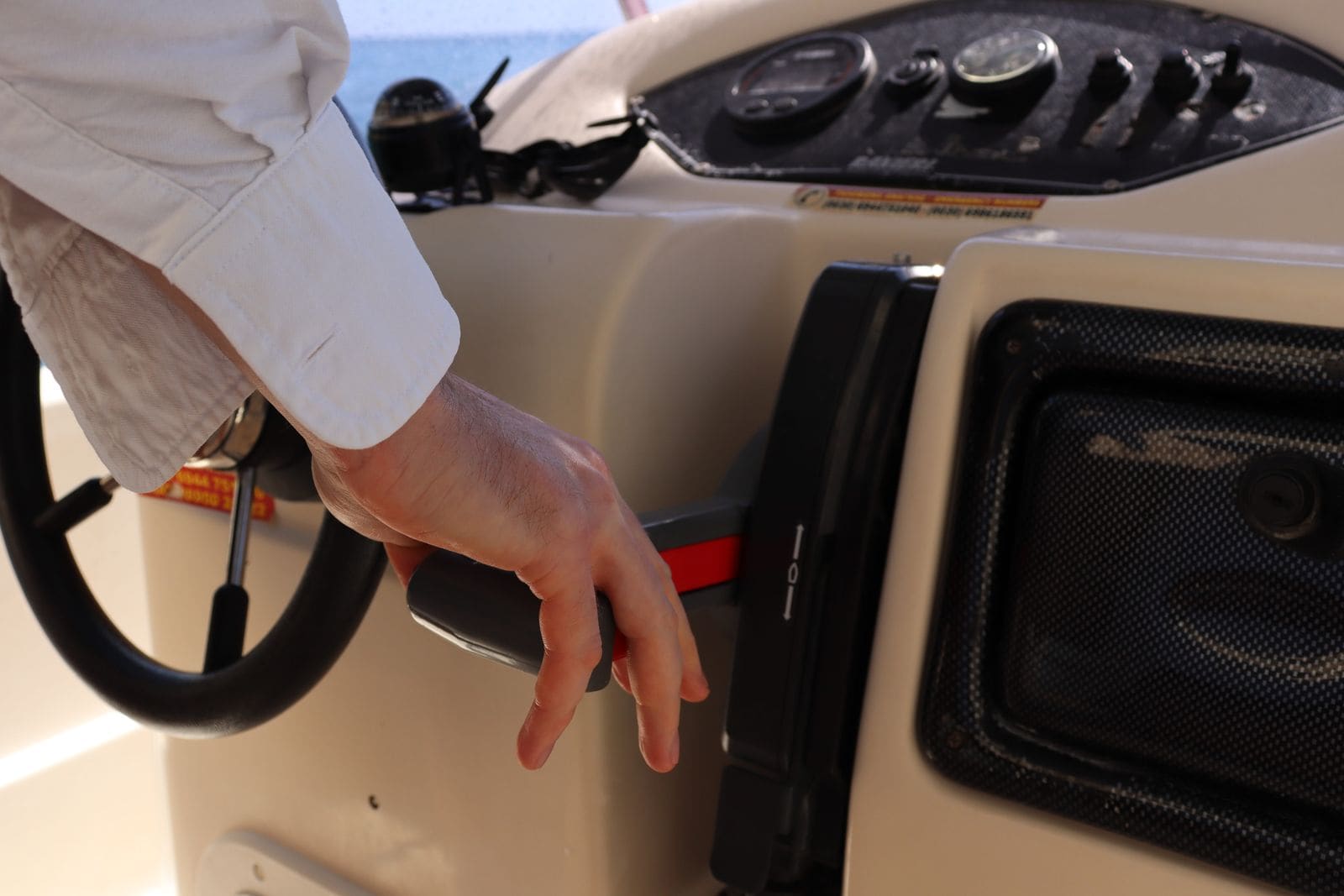
A single-lever control: one handle shifts and works the throttle. Photo by Mehmet Ali Turan on Pexels · Pexels License If the battery is good and nothing happens when you turn the key, the two usual causes are the kill switch clip missing or not seated, and the lever not fully in neutral. Push the lever firmly into the neutral detent and try again. If the engine cranks only when you press the lever hard into one exact spot within the neutral detent, the neutral safety switch or its adjustment is suspect (step 7). Never try to crank with the lever out of neutral. Also confirm the battery switch is on and the battery is charged (see the engine won't start and marine battery guides).
Disconnect the shift cable at the engine end (photograph it first) and move the lever. Then do the same with the throttle cable.
- Lever now moves easily: the box is fine. The cable or the engine side is binding.
- Still stiff with both cables disconnected at the engine: the cable is stiff or the box is. Next, disconnect the cables at the control box (step 6) and move the lever with no cables attached.
- Box stiff with no cables attached: the problem is inside the control box.
A loose or cracked mount makes the lever feel sloppy and can pinch the cables. Tighten the mounting screws. Look for cracks in the housing, water stains, and green corrosion where the wiring enters. Side-mount boxes often live low in the cockpit where rain and washdown water collect.
With the battery switch off, remove the cover or the box from its mount as the manual shows. Take photos before removing anything. Look at how each cable end is held: usually a clip, a retainer or a cotter pin on the cable end, and a clamp on the cable jacket.
- Cable ends should be fully seated on their pins, with clips in place.
- The jacket clamp should be tight so the jacket cannot slide.
- Gears, cams and pivots should move without grinding or binding.
Clean old, dried grease and dirt off the moving parts and apply fresh marine grease where the manual shows. A box full of salt crystals or rust inside has usually had water in it for years.
The neutral safety switch is a small switch that only closes when the lever is in neutral, completing the starting circuit. To test it:
- Unplug its two wires (label them first).
- Set your multimeter to continuity or ohms.
- With the lever in neutral, the switch should show continuity (a beep or near zero ohms).
- In forward and reverse, it should show open (no continuity).
If it never shows continuity, or is intermittent when you tap it, replace it with the correct part for your control. If it tests fine, look for a broken wire or corroded connector in the start circuit; on many outboards that circuit runs through the engine harness plug at the back of the box. After any repair, confirm the engine cranks only in neutral, never in gear.
If the trim works from a dash switch or the engine's own switch but not from the handle, the problem is the handle switch or its wiring through the box. Check:
- The trim harness connector behind the box: clean it with contact cleaner and add dielectric grease.
- Wires that run through the handle pivot, which can break from years of lever movement.
- The switch itself, tested with the multimeter: continuity only when you press up or down.
If the trim does not work from any switch, the problem is elsewhere; see the trim and tilt guide (relays, fuse, pump motor).
On many outboard side-mount controls, the key switch, kill switch, neutral safety switch, trim switch and warning horn all connect to the engine through one harness plug. A corroded or loose plug can cause no-crank, trim and alarm problems at the same time. Unplug it with the battery switch off, inspect the pins for green corrosion or bent pins, clean, add dielectric grease and reconnect firmly.
Reinstall the cables in the box exactly as they were, with new cotter pins or clips. Then check the adjustment at the engine: in neutral, the cable end should drop onto the engine's shift lever without pushing or pulling it, and the throttle should rest at its idle stop. Follow the shift and throttle cable guide and your engine manual.
With the boat tied securely and the area behind it clear:
- The engine should start only in neutral.
- The lever should click positively into forward, neutral and reverse and land in the same place every time.
- The prop should stop turning in neutral.
- Pause in neutral for about a second when switching between forward and reverse, as BoatUS recommends.
- The trim button should move the engine both ways.
Replace the control box when it is stiff inside even after cleaning and greasing, the housing is cracked, the internal gears are worn (the lever has play or the detents are vague), or water has corroded it inside. Discover Boating's advice is worth following: when you replace the controls, replace the cables too, because they are just as old. Match the new control to your engine brand (the harness plug and the cable travel differ), and decide whether to keep side-mount or switch to binnacle.
Owners of older boats (1970s–1990s Johnson/Evinrude, early Quicksilver/Mercury Commander boxes and similar) often find internal parts are no longer sold. Your options are usually a used or rebuilt box of the same model, or a current or aftermarket box that is specifically listed for your engine brand and year (for example, aftermarket replacements for Yamaha's common side-mount box). Confirm the harness plug, key switch functions and cable travel match before you buy.
Common mistakes
- Bypassing a bad neutral safety switch with a jumper wire "just for now".
- Jumping pins in the engine harness plug to start the motor from the back of the boat during service. That skips the neutral safety switch and often the kill switch too. If you need to start it at the transom, use a remote starter made for your engine (ask your dealer), keep the engine in neutral with cooling water supplied, and have a helper ready at the helm with the kill switch.
- Replacing the control box when the real problem was a stiff cable or a dry engine linkage.
- Not photographing the cable connections and wires before taking the box apart.
- Reusing old cotter pins or forgetting a clip, so a cable falls off underway.
- Spraying lubricant into the cable ends and expecting it to cure a stiff cable (it only goes a few inches in).
- Buying a control for the wrong engine brand, with a different harness plug or cable travel.
- Shifting straight from forward to reverse without a pause in neutral.
- Forcing the lever. MasterCraft's control instructions say that if the lever won't move with the neutral lock lifted, don't shove it: the problem may be under the deck. On its inboards it also warns against shifting with the engine off, which wears the shift gears faster.
- Holding high rpm in neutral with the throttle-only (warm-up) feature. MasterCraft says to use it sparingly and never park the engine at wide-open throttle out of gear.
When to call a pro
- The engine starts in gear, or the lever will not return to neutral.
- Electronic (digital) throttle and shift controls.
- Dual-engine controls, or boats with a second helm station.
- Wiring changes in the key switch or engine harness that you cannot trace with a wiring diagram.
- Converting from side-mount to binnacle or changing engine brands (new harness, new cables).
- Burned wires, melted connectors or a burning smell behind the dash: turn the battery switch off and do not use the boat.
Tips
- Squeeze the neutral lock and work the lever through all positions a few times every trip; controls that are used stay free.
- Keep a spare set of cotter pins and cable-end clips with your tools.
- Once a year, grease the cable ends at the engine. MasterCraft's routine: boat out of the water, engine off and cool, safety (kill) switch disconnected and the lever in neutral; coat the cable ends and connections with waterproof marine grease and the pivots with light grease, then move the lever from full forward to full reverse a few times to work it in.
- Cover a side-mount control when the boat is stored outside; much of the damage comes from rain.
- Write the control brand and model in your boat file so you can order the right switch or cables later.
Official references
We read these to write this guide. Your engine's own manual always wins.
Safety: BoatMend is for information only and does not replace a certified marine technician. You are responsible for your safety and your boat. Read the full disclaimer.
Last updated 2026-10-24
Related guides
How to Check and Adjust Boat Shift and Throttle Cables
Hard shifting, a lever that will not go fully into gear, or a gear that lands in a different spot every time usually point to the control cables. Learn how to find out whether the problem is the cable, the control box or the engine, how to adjust the cable ends, and when it is time to replace both cables.
Engine Won't Start or Won't Crank - Troubleshooting Guide
Find out why your boat engine will not turn over or will not fire, starting with the simple things owners miss most, like the kill switch lanyard and battery switch. Many no-starts are fixed at the ramp in minutes without a tow.

How to Check and Top Up Power Trim and Tilt Fluid
Check and top up the hydraulic fluid in your power trim and tilt unit, then work through the simple checks when the motor won't go up, won't go down or slowly sinks. Most trim problems are a dead battery, a bad relay, low fluid or a release valve left open, and you can find those yourself.
How to Find and Fix Corroded Electrical Connections on a Boat
Track down the green crust and loose terminals behind flickering lights, dead gauges and slow cranking with a simple voltage-drop test, then remake the connection the marine way: tinned wire, a proper crimp, adhesive-lined heat shrink and a protective coating.
Marine Battery Care: Test, Charge and Store for Winter
Check your boat battery's health, charge it the right way for its type (flooded, AGM or lithium), and store it so it is ready in spring. Most "boat won't start" calls start with a neglected battery.
How to Troubleshoot Dash Gauges, a Dead Tachometer or a Wrong Fuel Gauge
Work through dead or wrong dash gauges from the cheapest check to the most involved: fuses and breakers, power and ground, the gauge-versus-sender test, the tachometer's pulse setting and the extra checks for digital network gauges. Most gauge problems turn out to be a bad connection, not a bad gauge.