Boat Spotlights and Searchlights: Care, Wiring Checks and Using Them Without Blinding Anyone
A good spotlight helps you find markers, moorings and debris at night and signal for help, but only if it works and you use it carefully. Learn how to care for remote-control searchlights and handheld spotlights, clean lenses, check fuses and wiring, and use the beam in short sweeps that never blind other boaters.
Time
45 min
Shop would charge
$100-300
Applies to
All engines
Safety first: Never shine a spotlight into the eyes of another boat's operator, even for a second; a blinded skipper can't avoid you. Don't run with a spotlight or light bar on continuously, and never use flashing blue lights (reserved for law enforcement). If a light's wiring is hot, melted or smells burnt, switch the circuit off and have it checked before using it again.
Owners often ask
- Do I need a spotlight for boating at night, and how do I use it without blinding other boats?
This guide walks you through it. Still stuck? Ask the AI Mechanic about your engine.
Tools
- Multimeter (digital volt-ohm meter)
- Screwdrivers and nut drivers
- Soft microfiber cloth, mild soap and fresh water
- Wire brush or fine abrasive pad for terminals
- Dielectric grease or corrosion-inhibiting spray
Parts & supplies
- Fuses of the rating the light maker specifies
- Spare batteries for a wireless remote (if used)
- Replacement bulb or LED module specified for your light (if applicable)
- Locking 12V plug and receptacle (optional, for corded handheld lights)
- Marine-grade tinned wire and heat-shrink crimp connectors (for repairs)
Before you start
Know your light. Recreational boats usually have one or more of these:
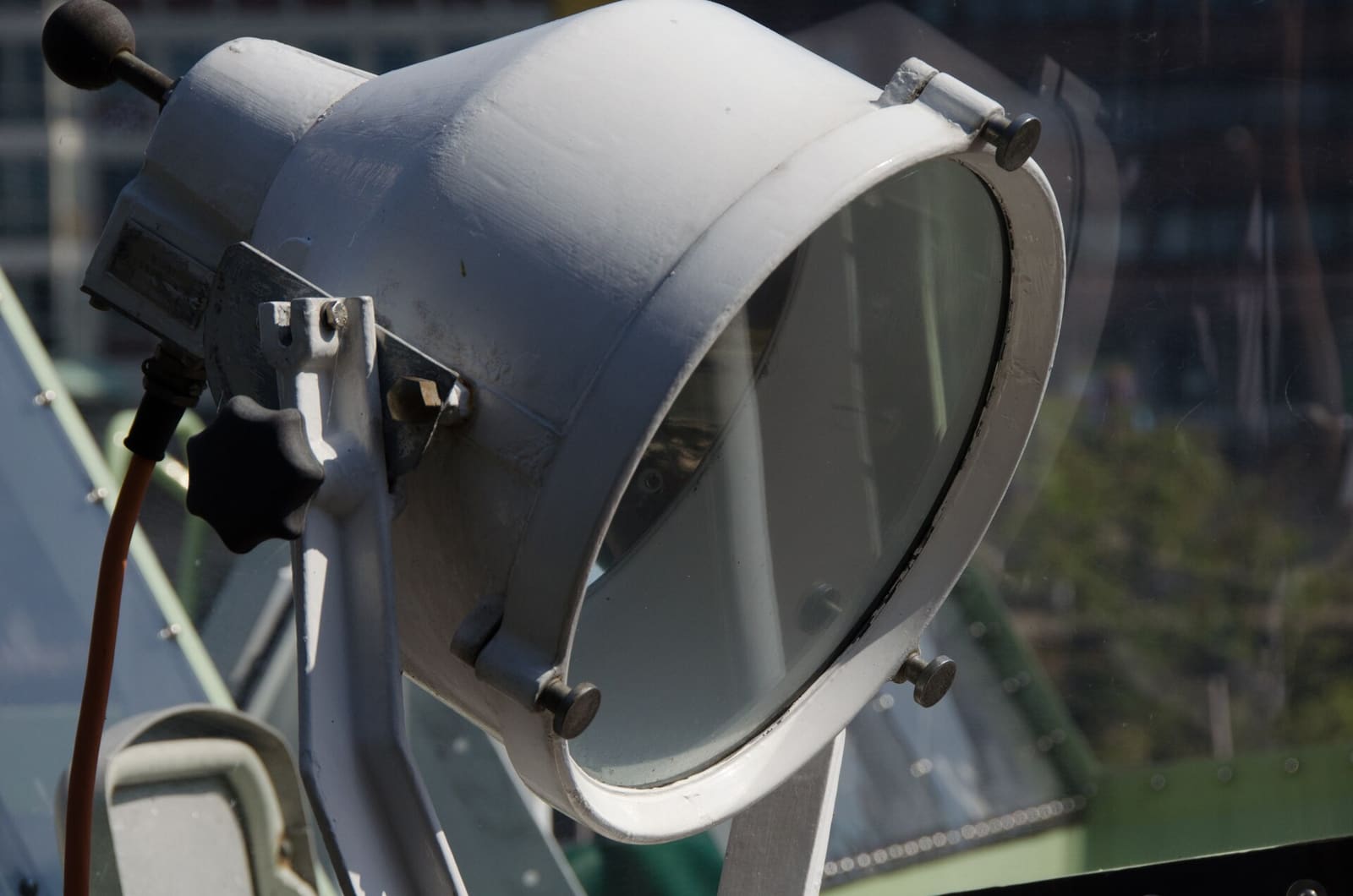
- Remote-control searchlight: mounted on the bow, hardtop, arch or tower, aimed with a joystick at the helm or a wireless remote. Some pan all the way around and tilt up and down.
- Manual pedestal searchlight: fixed mount with a handle you aim by hand, common on workboats and older cruisers.
- Corded handheld spotlight: plugs into a 12V (cigarette-lighter style) socket.
- Rechargeable or battery handheld spotlight: cordless, so you can use it anywhere on the boat, as long as it's charged.
What a spotlight is for. BoatUS suggests keeping a strong spotlight aboard for emergencies and for times when fast boats or ships may not see you. Boating Magazine lists finding navigation aids and landmarks, spotting things in the water and signaling for help or warning others of a hazard. It is not a headlight for running at speed. BoatUS and Discover Boating both point out that bright white light ruins your own night vision, and it can take several minutes for your eyes to readjust.
The rules. The Navigation Rules (33 CFR 83.20, Rule 20) say that between sunset and sunrise you may not show other lights that can be mistaken for navigation lights, that make them hard to see, or that interfere with keeping a proper lookout. Rule 36 lets any boat direct a searchlight toward a danger to get another vessel's attention, but in a way that doesn't "embarrass" (dazzle or confuse) that vessel. On inland waters, flashing blue is reserved for law-enforcement boats and alternating red and yellow for public-safety boats (33 CFR 88.05 and 88.07). ACR, a searchlight maker, notes that while most states don't ban light bars outright, operators can face careless-operation charges or liability if their lighting blinds someone or hides navigation lights.
Steps
At the dock and before you need it, switch the light on, sweep it through its full range and check that it's bright and steady. For a handheld, check the charge or batteries. Discover Boating recommends backup lighting: if the main spotlight fails at night, you want another light within reach.
Salt film, spray and fingerprints scatter the beam into glare. Rinse the lens with fresh water, wash gently with mild soap and a soft microfiber cloth, and rinse again. Don't use abrasive pads, scouring powder or strong solvents on plastic lenses; they scratch and haze them. Look for cracks or crazing: a crazed or hazy lens can throw a lot less light, and a cracked one lets water in.
Look for water droplets or fogging inside the lens, rust stains around screws and swollen or cracked gaskets. Moisture inside means a seal has failed. Some lights have replaceable gaskets or lens kits; others need to go back to the maker or be replaced. Don't seal a leaking light with household silicone over the lens edge unless the maker approves it.
Check that the base is firmly fastened and that the screws are bedded so water can't get into a cored deck or hardtop (see our through-bolting guide). Boating Magazine has seen small rail vibrations turn into a wildly shaking beam that's hard to keep on target, and suggests mounting the light directly to the deck rather than on a rail when possible.
- Recharge after every night use and once a month in season; many lithium and lead-acid packs don't like being stored empty.
- Check the cord, strain relief and plug for cuts and loose pins.
- Clean the boat's 12V socket: corroded sockets are a common reason a corded light flickers.
- Boating Magazine suggests a locking 12V plug and socket so the cord can't pull out at the worst moment, and choosing a well-armored light, because you will drop it.
For a wireless remote, replace its batteries at the start of each season. If the light stops responding, check the light's power first, then the remote. Many wireless lights need to be re-paired with their remote after power is cut or the batteries change; follow your light's instructions. For wired joysticks, look at the cable and plug behind the helm for corrosion or a pulled connector.
Park the light facing forward when you're done, so the next person who switches it on doesn't flash the beam into the cockpit or at a passing boat. Some newer searchlights do this for you: ACR's latest models have a "return to home" button that swings the light back to face forward, and one controller can run two lights separately or together. If you're replacing an older light, check the new one runs on your boat's voltage (some, like that ACR model, accept 12 or 24 volts) and whether it needs a separate master controller box or works straight from its pad and remote.
- Fuse or breaker. Find the fuse or breaker for the light at the panel or in-line near the battery.
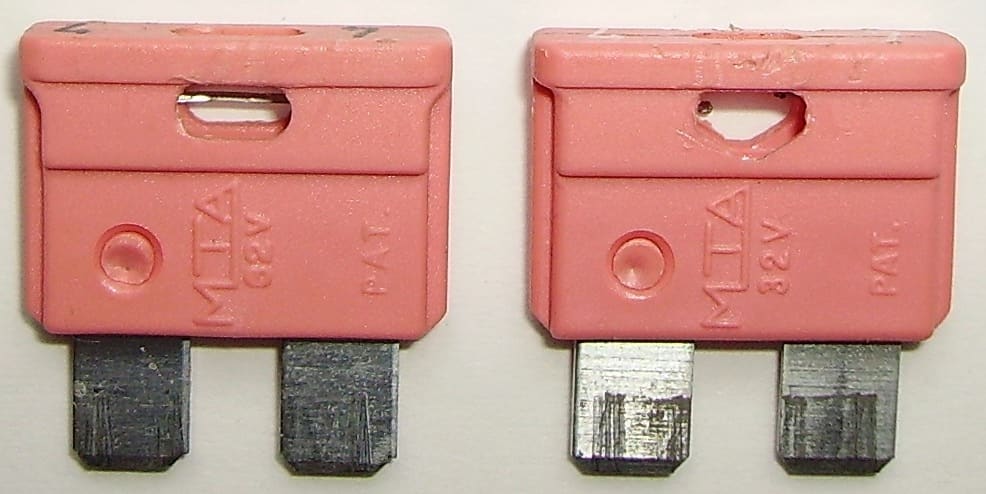
A blown blade fuse (right) next to a good one. Replace it only with the same rating. Photo: Cjp24 / Wikimedia Commons · CC BY-SA 3.0 - Switch. Check that power reaches the switch and comes out when it's on.
- Voltage at the light. With the light switched on, measure the voltage at its connector. Close to battery voltage means the light itself is faulty. Low voltage means a poor connection, an undersized wire or a weak battery.
- Ground. Follow the negative wire to the bus or battery and clean both ends.
Replace a blown fuse only with the rating the maker specifies. If a new fuse blows right away, there's a short; switch the circuit off and find it before trying again.
Boating Magazine's installation used marine-grade tinned wire sized for the light's current draw and run length, an in-line fuse in the positive wire sized for the light, crimp butt connectors with heat-shrink, and the negative run to a negative bus bar. Follow the same approach for repairs. Don't twist wires together with tape, and don't feed a light from an unfused battery post. See our 12-volt wiring basics guide.
Older halogen and HID searchlights have replaceable lamps; use only the type the maker lists, and avoid touching a halogen bulb's glass with bare fingers (skin oils can shorten its life). Many LED lights are sealed units with no user-serviceable parts. If you upgrade to LED, buy a quality marine light: cheap LEDs can interfere with VHF radio (see our LED lighting upgrade guide).
Discover Boating recommends using the spotlight sparingly: quick sweeps to find a marker or obstacle work better than leaving it on. Slow down at night so you have time to react to what the beam shows you. Turn it off as soon as you've found what you're looking for, and let your eyes readjust.
- Keep the beam low on the water and away from oncoming boats. BoatUS warns never to shine it into the eyes of another boat's operator.
- If you need to show another boat you're there, point the beam at your own boat or sails, or briefly toward the hazard, per Rule 36, not at their helm.
- If you must light up another boat, BoatUS (2024) adds a subtle point: also avoid its light-colored deck or cabin in front of the helm, because the bounce-back can dazzle the skipper almost as much as a direct beam. Sweep past rather than holding the beam on them.
- Boating Magazine notes that a light on a hardtop shining over a white bow can bloom into glare that blinds you. A bow light mounted low beside the anchor has the same problem: the beam hits the anchor and bounces back. Aim beyond the bow, or test the mounting spot at night before you install a permanent light.
- Never use a spotlight in a way that hides your own navigation lights.
Wide light bars and floodlights are great for docking, deck work and fishing, but ACR points out that they reflect off spray and the water and hurt night vision, especially in rain or fog. Use them at the dock or at slow speed when needed, then switch them off.
Rinse with fresh water, dry, and cover the light or bag a handheld. Charge rechargeable lights before storage and follow the maker's guidance on storage charge. Pull batteries from wireless remotes so they don't leak.
Common mistakes
- Running at speed with the spotlight on, then wondering why everyone is flashing back.
- Sweeping the beam across another boat's helm.
- Mounting the light on a vibrating rail or where it lights up the bow instead of the water.
- Leaving a rechargeable handheld flat in a locker until the night it's needed.
- Replacing a blown fuse with a bigger one.
- Using household silicone on a leaking lens and trapping moisture inside.
- Adding blue or flashing lights "for visibility."
When to call a pro
- Wiring behind a finished helm, hardtop or tower that you can't trace
- A fuse that blows again right after replacement, or wires that are melted or hot
- Water inside a sealed LED searchlight (usually a warranty or replacement issue)
- Installing a new remote-control searchlight on a cored hardtop or tower
Tips
- Add "test spotlight" to your BoatMend night-trip checklist.
- Keep a red-light headlamp aboard so you can read charts and gear without killing your night vision.
- Label the spotlight's breaker or fuse so a guest can find it in the dark.
- If you often run unfamiliar water at night, a light with a narrower, longer beam helps you pick out markers without lighting up the whole area.
- Shopping for a replacement? BoatUS (2024) explains that most makers rate lights to the voluntary ANSI FL1 standard. Lumens describe total light; candela describes how intense (far-reaching) the focused beam is. Compare lumens with lumens and candela with candela, never one against the other. A short visor past the lens cuts glare, several brightness settings stretch battery life, and brighter always means more heat and more power used.
- Mercury suggests a handheld with a red-light mode, so you can light the deck without ruining the driver's night vision.
- Before drilling for a fixed light, BoatUS suggests mounting it temporarily and trying it at night to check glare, vibration, spray and wiring access.
Official references
We read these to write this guide. Your engine's own manual always wins.
- BoatUS – Boating After Dark (spotlight use and night vision)
- BoatUS – A Spotlight On Spotlights (2024)
- Mercury Marine Dockline – 14 Safety Items You Probably Don't Have on Your Boat
- Boating Magazine – Choosing the Best Spotlights for Boats
- Boating Magazine – Install a Remote Control Spotlight on a Boat
- Discover Boating – 7 Night Boating Tips
- ACR Electronics – Marine LED Searchlights vs. Light Bars, a Compliance and Safety Perspective
- eCFR – 33 CFR 83.20, Application of the lights rules (Rule 20)
- eCFR – 33 CFR 83.36, Signals to attract attention (Rule 36)
- eCFR – 33 CFR Part 88, Annex V Pilot Rules (blue and red/yellow flashing lights)
- ACR Electronics – ACR Electronics Launches RCL-200 LED Searchlight (2026)
Safety: BoatMend is for information only and does not replace a certified marine technician. You are responsible for your safety and your boat. Read the full disclaimer.
Last updated 2026-10-25
Related guides
How to Test and Fix Your Boat's Navigation Lights
Learn which navigation lights your boat must show and when, then test them and fix the usual culprits such as corroded sockets, loose pole-light plugs and blown bulbs. Working lights are legally required at night and in poor visibility and are how other boats see which way you are heading.

How to Upgrade Your Boat's Lighting to LED (and Keep Your Nav Lights Legal)
Switch cabin, cockpit and courtesy lights to LED to cut battery drain and bulb changes, choose navigation lights that are actually USCG-certified (not just LED bulbs), check voltage range and dimmers, seal every connection, and run the Coast Guard's simple VHF test to make sure the new lights aren't deafening your radio or AIS.
Fuse Keeps Blowing? How to Troubleshoot a Boat Fuse Block or Breaker Panel
Work through a blown fuse or tripping breaker the safe way: confirm it, tell a short from an overload, isolate the device or wire at fault, replace a worn breaker or panel switch with the same rating, and label every circuit, without ever fitting a bigger fuse.
12-Volt Boat Wiring Basics: Circuits, Color Codes, Fuses and Wire Size
Learn how your boat's 12-volt system is laid out, what the ABYC wire colors mean, how fuses and breakers protect the wiring, why voltage drop and tinned wire matter, and how to read a wiring diagram, so you can troubleshoot smarter and know which jobs belong to a marine electrician.
How to Find and Fix Corroded Electrical Connections on a Boat
Track down the green crust and loose terminals behind flickering lights, dead gauges and slow cranking with a simple voltage-drop test, then remake the connection the marine way: tinned wire, a proper crimp, adhesive-lined heat shrink and a protective coating.
How to Mount Rod Holders, Fish Finders, Cleats and Antennas Without Causing Leaks
Add accessories to your boat the right way, with through-bolts, backing plates, sealed core and proper wire pass-throughs, so every new hole stays dry and strong. Also learn where you should never drill.
How to Inspect Wakeboard Tower, T-Top and Bimini Hardware
Towers, T-tops and biminis carry tow ropes, speakers, boards, electronics and wind loads, all on a handful of bolts. Learn how to check the welds, bases, backing plates, bolts, folding hinges and accessory loads before a crack or a loose bolt becomes an accident.
Man-Overboard Recovery Gear: Throwables, Lifesling, Ladders and MOB Alarms
Set up and check the gear that gets a person in the water back aboard - a throwable within reach, a floating rescue line or Lifesling-style sling, a boarding ladder someone in the water can pull down, and MOB alarms or AIS beacons - and practice the drill so it works when it counts.

USCG Required Safety Equipment Check by Boat Length
Walk through your boat and confirm you carry every piece of safety gear the US Coast Guard requires for your boat's length and type, and that none of it is expired or worn out. Missing or expired gear is one of the most common tickets on the water, and it is the gear you need when things go wrong.
Boat Horns and Sound Signals: Requirements, Testing and the Signals Every Skipper Should Know
Every boat needs a way to make an efficient sound signal, and bigger boats need a proper whistle or horn. Learn the Coast Guard requirements by boat length, how to test and fix an electric horn, why a canister air horn makes a good backup, and the basic passing, danger and fog signals.