USCG Required Safety Equipment Check by Boat Length
Walk through your boat and confirm you carry every piece of safety gear the US Coast Guard requires for your boat's length and type, and that none of it is expired or worn out. Missing or expired gear is one of the most common tickets on the water, and it is the gear you need when things go wrong.
Time
45 min
Applies to
All engines
Safety first: This guide covers the federal minimum. Your state may require more (for example, child life jacket ages, boater education cards or extra gear), so check your state boating agency too. If you ever smell fuel, see smoke, or are taking on water, put on life jackets, call USCG on VHF channel 16 or 911, and use your distress signals. Do not test-fire flares except in a real emergency; it can trigger a search.
Owners often ask
- What safety gear does the Coast Guard require on my boat?
This guide walks you through it. Still stuck? Ask the AI Mechanic about your engine.
Tools
- Tape measure (to confirm boat length)
- Flashlight
- Pen and paper or the BoatMend checklist
Parts & supplies
- USCG-approved wearable life jackets in the right sizes
- USCG-approved throwable device (boats 16 feet and longer)
- USCG-approved fire extinguishers of the right rating
- Visual distress signals (coastal and Great Lakes waters)
- Whistle or horn (and a bell on larger boats)
- Spare navigation light bulbs or a spare LED fixture
Before you start
Measure your boat. Requirements change at 16 feet, 26 feet, 39.4 feet (12 meters) and 65 feet. Length is measured from bow to stern along the centerline, not counting outboard motors, swim platforms, pulpits and other add-ons. Your registration usually lists it.
Know where you boat. Visual distress signals are required on coastal waters, the Great Lakes, the territorial seas, and connected waters until they narrow to less than two miles wide. Most inland lakes and rivers do not require them federally.
Get a free Vessel Safety Check. The US Coast Guard Auxiliary and US Power Squadrons (America's Boating Club) will check your boat for free. It is not a boarding and there is no ticket. It is a great way to confirm this list.
Steps
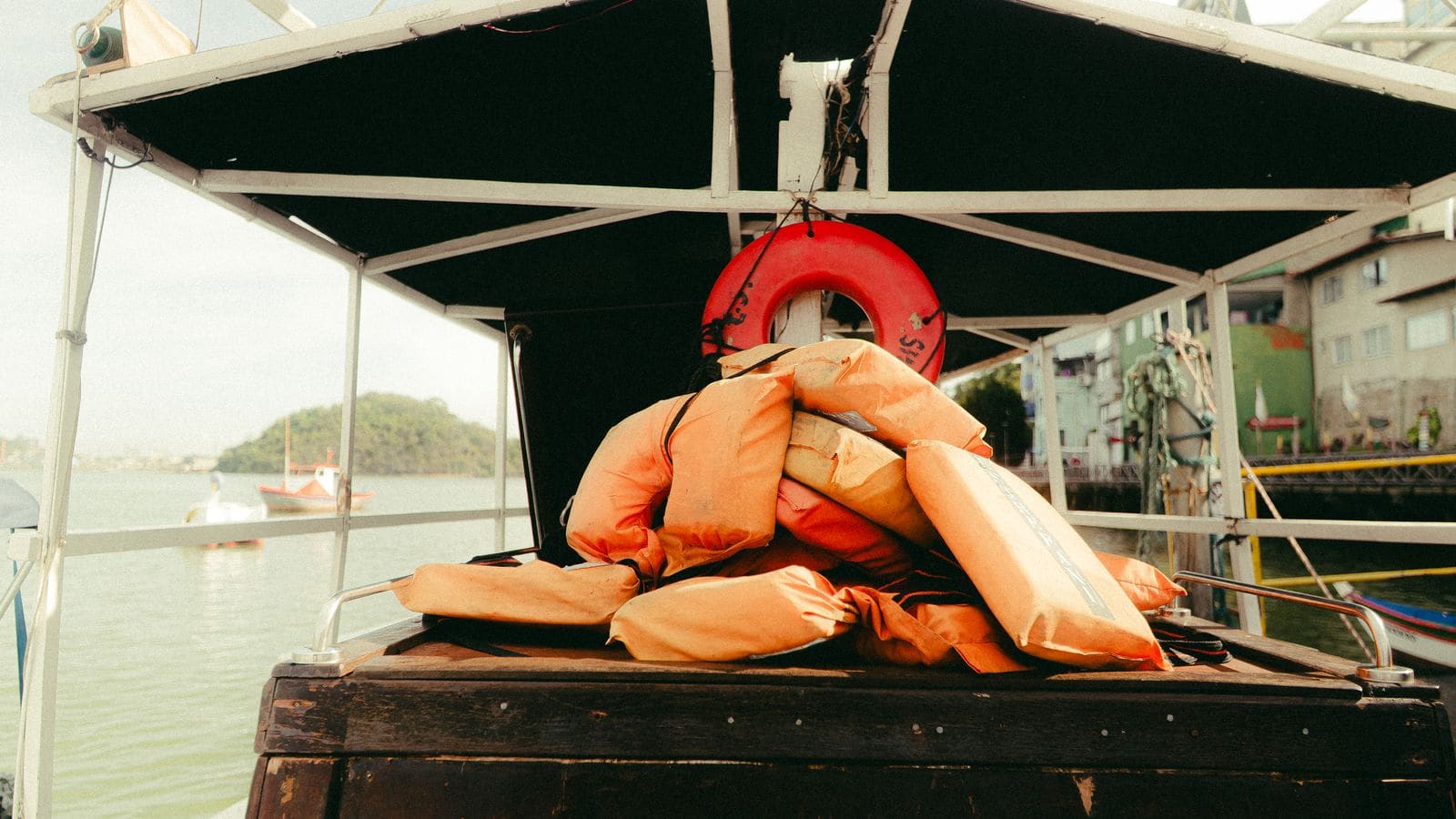
You need one USCG-approved wearable life jacket for each person aboard, in good condition and the right size for that person. Check the label for USCG approval and the size or weight range. Look for rips, broken buckles or straps, and stiff, waterlogged or moldy foam. Take them out of the plastic bags and keep them where people can reach them quickly, not in locked lockers or under other gear.
The USCG suggests testing foam life jackets for wear and buoyancy at least once a year and throwing out any that are waterlogged, faded or damaged. The best test is in the water: put it on, float, and make sure your mouth stays clear. Newer USCG-approved labels may describe the device as a "life jacket" or a "buoyancy aid" instead of the old Type I to V numbers; read the label to see who it is meant for, since some buoyancy aids are not intended for weak swimmers.
Inflatables only count if they are worn (or as the label says) and generally only for people 16 and older. Check the CO2 cylinder is screwed in tight and not used, the arming indicator is green, and the service date on the label has not passed. The USCG is clear that an inflatable with an empty cylinder or any status indicator that is not green is not serviceable and does not count toward your required life jackets. Replace any used cylinder with the re-arm kit for that model.
Federal rules require children under 13 to wear a life jacket while the boat is underway, unless they are below deck or in an enclosed cabin. Many states set their own age. Try each child's jacket on them: it should not ride up over the chin when you lift it by the shoulders.
Boats 16 feet and longer (except canoes and kayaks) must also carry a USCG-approved throwable device, such as a ring buoy or a throwable cushion. It must be immediately available, so keep it near the helm or cockpit, not locked under a seat. Never use a throwable cushion as a regular seat; that crushes the foam.
Boats with inboard engines, permanently installed fuel tanks, or enclosed spaces where fumes can collect need fire extinguishers. Boats under 26 feet with an outboard, portable tanks and no enclosed spaces are exempt, but carrying one is still smart. The USCG minimum is:
Boat length No fixed system in the engine room With a fixed system Under 26 ft 1 (5-B rating) 0 26 to under 40 ft 2 (5-B) or 1 (20-B) 1 (5-B) 40 to 65 ft 3 (5-B), or 1 (20-B) plus 1 (5-B) 2 (5-B) or 1 (20-B) One 20-B can replace two 5-B extinguishers. A 10-B counts only as one 5-B. Confirm your exact count with the USCG fire extinguisher FAQ.
- Boats model year 2018 and newer must carry extinguishers labeled 5-B, 10-B or 20-B that are date-stamped. Older labels that say only "B-I" or "B-II" do not count on these boats.
- Boats model years 1953 to 2017 may carry 5-B/20-B units or older B-I/B-II units in good condition.
- Disposable (non-rechargeable) extinguishers must be removed from service 12 years after the date of manufacture, usually stamped on the bottom of the bottle or near the label.
- Rechargeable extinguishers do not expire at 12 years but need annual service by a certified technician.
The gauge needle must be in the green. The locking pin and tamper seal must be in place. The nozzle should be clear, the bottle free of heavy rust or dents, and the bracket solid. If a disposable unit reads in the red or has been used even briefly, replace it.
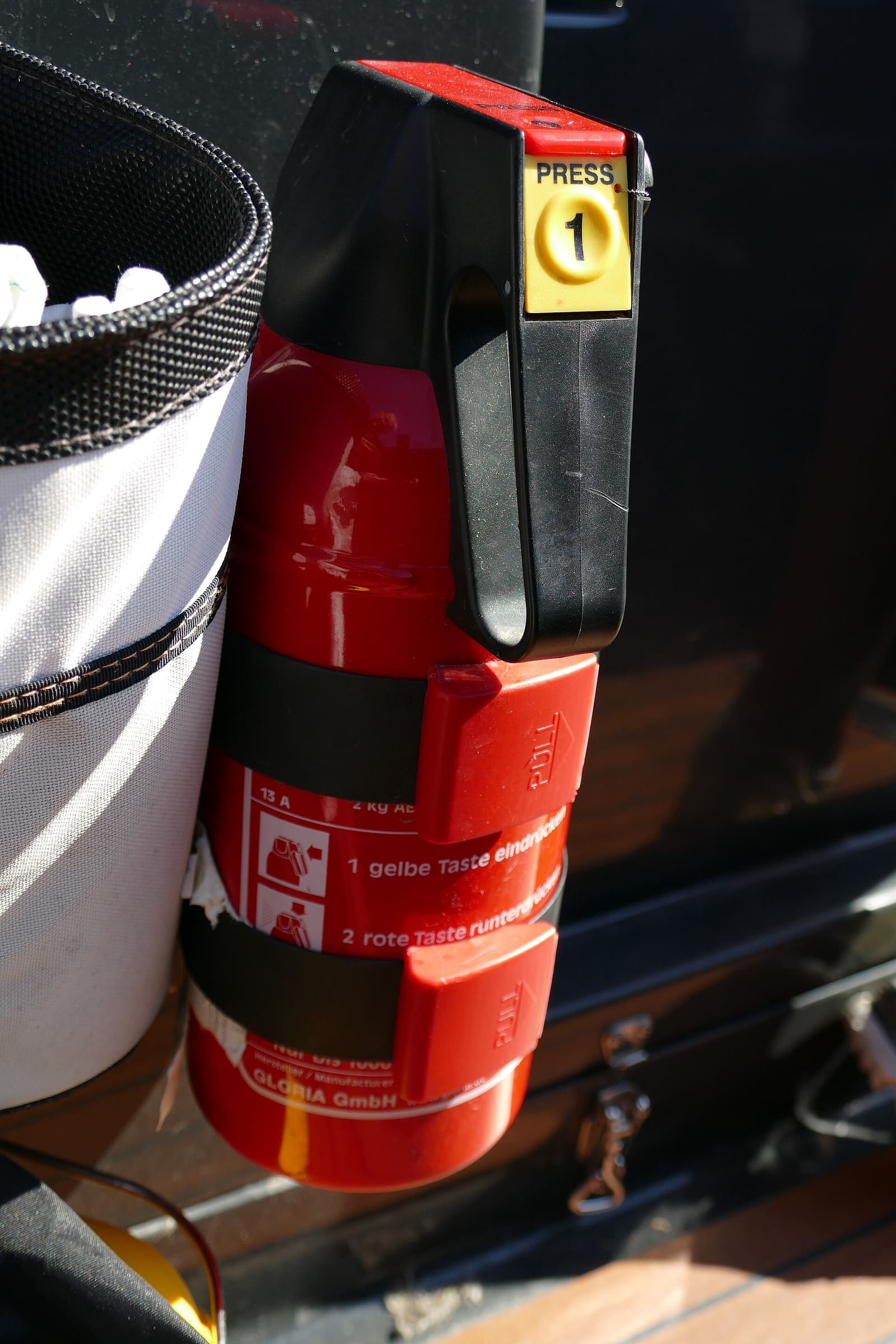
Photo: Kritzolina / Wikimedia Commons · CC BY-SA 4.0 Boats 16 feet and longer on covered waters need day and night signals. Boats under 16 feet need night signals when out between sunset and sunrise. Common ways to meet the rule:
- Three hand-held or aerial red flares that are rated for day and night use, or
- An orange distress flag (day) plus an electric distress light that flashes SOS (night), or
- Three orange smoke signals (day) plus an electric distress light (night)
Check the expiration date printed on every pyrotechnic device. Pyrotechnics are typically good for 42 months from manufacture; expired ones do not count toward the requirement. Store them dry and easy to reach.
Boats under 39.4 feet (12 meters) need an efficient sound device, such as a whistle or an air horn. A voice does not count. Boats 39.4 feet and longer need a whistle or horn audible for at least half a mile (one nautical mile at larger sizes) and boats over about 65 feet also need a bell. Test the horn, and keep a spare whistle or a can-style air horn aboard in case the electric horn fails.
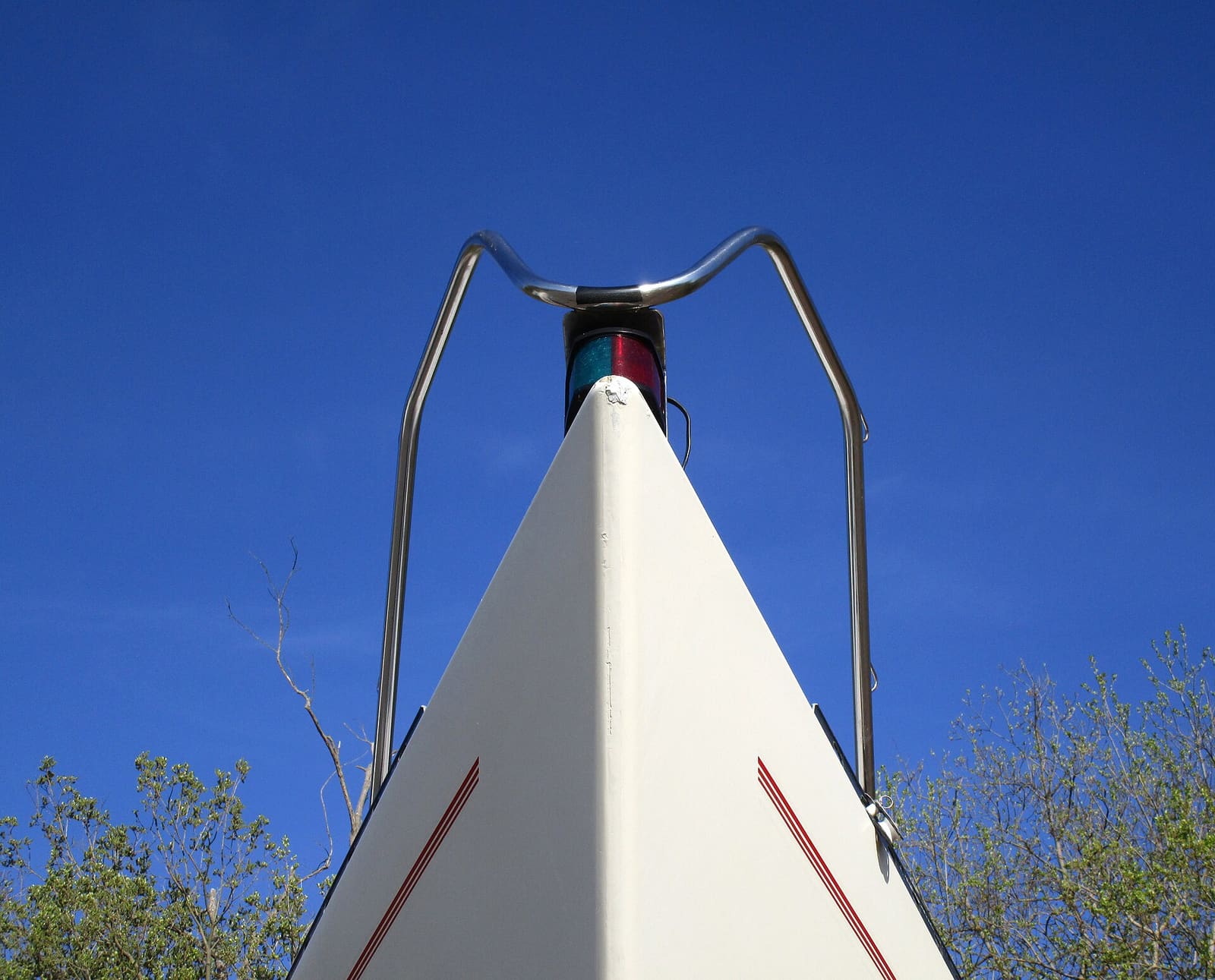
Navigation lights are required from sunset to sunrise and in fog, rain or other restricted visibility. Turn them on and walk around the boat. Confirm red is on the left (port), green is on the right (starboard), and the white light works. See our navigation lights guide for which lights your boat needs and how to fix them.
Boats under 26 feet with 3 horsepower or more that have an engine cut-off switch must use it (clip the lanyard to the driver or use the wireless fob) when running on plane or above displacement speed. Start the engine and pull the lanyard: the engine should stop. Check the lanyard for cracks and that the clip closes. Replace the battery in wireless fobs.
Gasoline boats with enclosed engine or fuel compartments need ducted ventilation, and most also need a powered blower. Look for loose, crushed or disconnected vent hoses. Turn on the blower and feel for airflow at the outside vent. Always run it for at least 4 minutes before starting the engine, and sniff the engine compartment first.
Inboard gasoline engines must have a USCG-accepted backfire flame arrestor on the air intake (outboards do not). Open the engine hatch and confirm it is in place, tightly attached, not cracked, and not clogged with oil or dirt. If it is dirty, follow your engine manual for cleaning.
Have your registration aboard and your numbers displayed. Boats 26 feet and longer must post an oil discharge placard and a MARPOL garbage placard. Boats 39.4 feet (12 meters) and longer must carry a copy of the Navigation Rules. Log the date and what you replaced in BoatMend.
Common mistakes
- Life jackets still in the store packaging or locked in a hatch. Officers will count them as not readily accessible, and you cannot get to them in a hurry.
- Old B-I and B-II extinguishers on a 2018 or newer boat. They do not meet the rule on newer boats even if the gauge is green.
- Ignoring the date on disposable extinguishers. A 13-year-old bottle with a green gauge is still expired.
- Keeping expired flares as the only flares. You can keep old ones as extras, but you must also carry enough unexpired signals.
- Treating the throwable cushion as a seat or storing it under gear. It must be ready to throw.
- Inflatable jackets stowed in a locker. Most only count when worn.
- Forgetting the kill switch lanyard. It is now required on most small boats when on plane, and it is what stops the boat if you go overboard.
When to call a pro
- A fire extinguisher has been discharged or the fixed engine-room system has a fault light: have it serviced by a certified fire equipment technician
- The blower does not run, vent hoses are missing, or you smell fuel in the engine compartment: do not start the engine; call a marine mechanic
- The flame arrestor is missing or damaged
- You are unsure what your state requires: contact your state boating agency or book a free USCG Auxiliary Vessel Safety Check
Tips
- Write the purchase date on every flare kit and extinguisher with a marker so you can see their age at a glance.
- Do a quick head count of life jackets against passengers before you leave the dock, every trip.
- Turn in expired flares through local hazardous waste programs; many marinas and safety events collect them.
- Consider an electronic visual distress light (USCG-approved): it does not expire like flares, but still check its batteries.
Official references
We read these to write this guide. Your engine's own manual always wins.
- USCG Boating Safety – Fire Extinguishers Requirements for the Recreational Boater FAQ
- USCG Boating Safety – Frequently Asked Questions
- USCG Boating Safety – Engine/Propulsion Cut-Off Devices
- USCG – A Boater's Guide to the Federal Requirements for Recreational Boats
- BoatUS Foundation – Required Equipment
- BoatUS Foundation – Flares & Distress Signals
- USCG Boating Safety – Life Jacket Wear / Wearing your Life Jacket
Safety: BoatMend is for information only and does not replace a certified marine technician. You are responsible for your safety and your boat. Read the full disclaimer.
Last updated 2026-10-23
Related guides
How to Test and Fix Your Boat's Navigation Lights
Learn which navigation lights your boat must show and when, then test them and fix the usual culprits such as corroded sockets, loose pole-light plugs and blown bulbs. Working lights are legally required at night and in poor visibility and are how other boats see which way you are heading.
Launch Day and Haul-Out Checklist for Trailer Boats
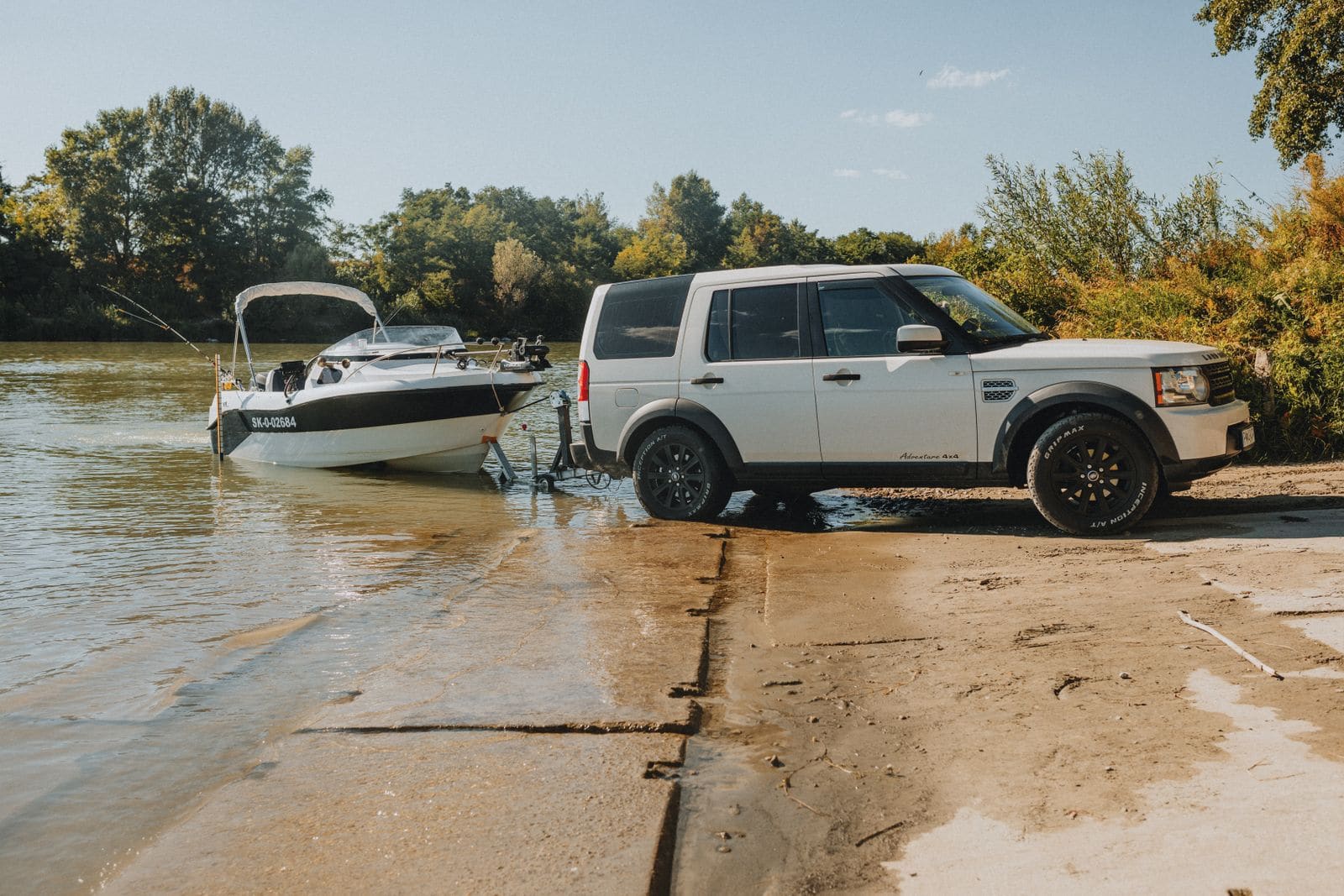
A step-by-step checklist for getting your boat off the trailer and back on again safely and quickly, from the drain plug and tie-downs to the blower and ramp etiquette. Following it in order prevents the classic mistakes that sink boats and back up the ramp.
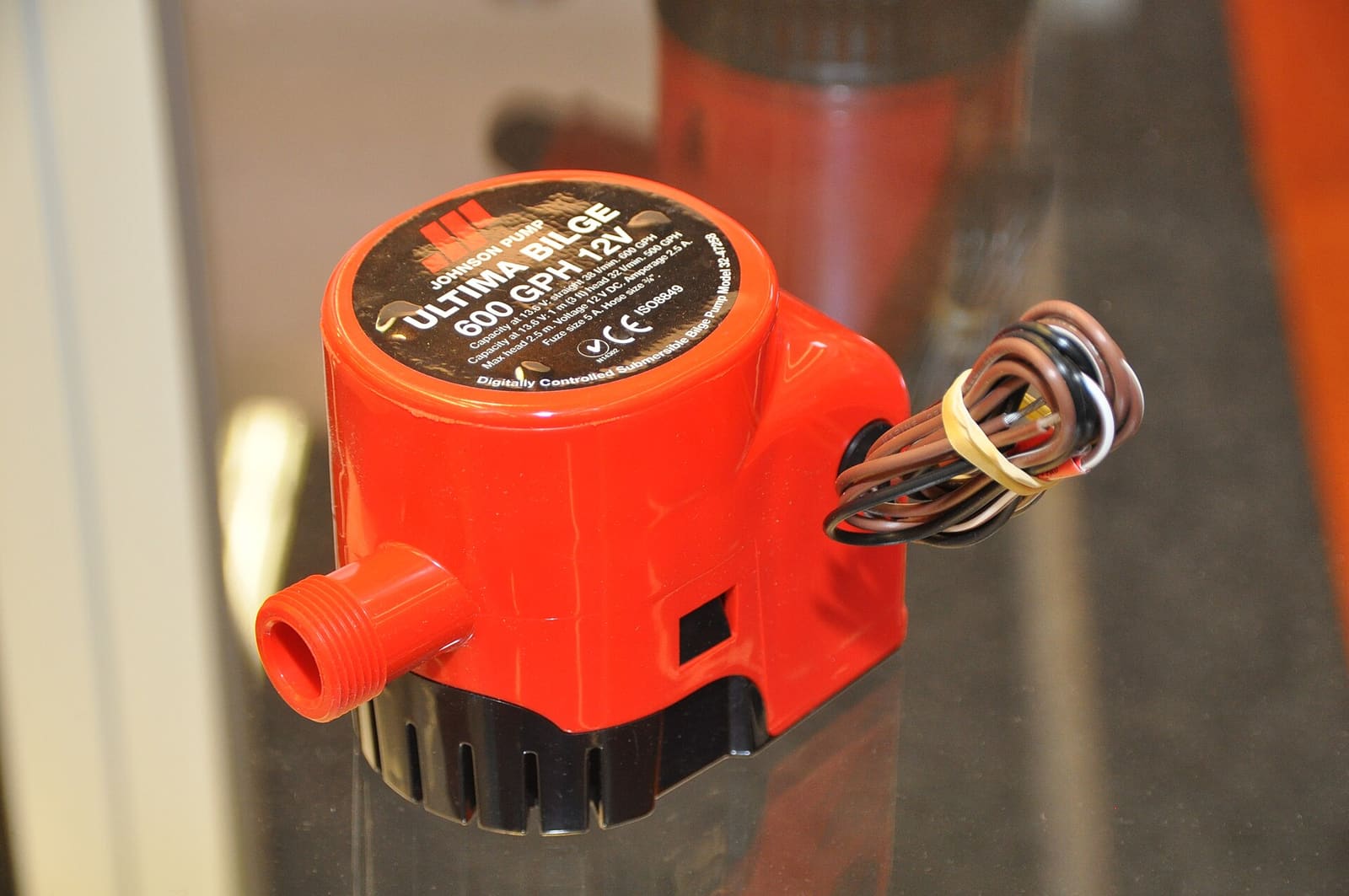
How to Test and Clean Your Bilge Pump and Float Switch
Make sure your bilge pump actually moves water overboard, both on the manual switch and automatically through the float switch. A working bilge pump is one of the most important safety systems on any boat that stays in the water.