Jet Outboard Care: Grease, Intake Grate, Impeller Clearance and Shallow-River Habits
A jet outboard trades the propeller and gearcase for a pump, so it needs different care. Learn how mounting height works, why the pump bearing needs frequent grease, how gravel and a worn impeller steal thrust, how to clear the intake safely, and when an adjustment is a shop job.
Time
45 min
Shop would charge
$150-900
Applies to
Outboard, Jet boat
Safety first: The impeller sits right behind the intake grate, and its edges are sharp. Never reach into the intake or the nozzle unless the engine is off, the key is out and the kill-switch lanyard is pulled; use a stick, not your fingers. A jet steers only while it pushes water, so if you chop the throttle in a tight spot, the boat keeps going where it was pointed. In fast or shallow rivers everyone should wear a life jacket. If you hit a rock hard and the boat takes on water, head for shore if you can and call 911 or the Coast Guard on VHF 16.
Owners often ask
- How often should I grease the bearing on my jet outboard?
- My jet outboard revs high but the boat is slow. Is it the engine or the pump?
- My jet outboard cavitates when I take off or turn. What causes it?
This guide walks you through it. Still stuck? Ask the AI Mechanic about your engine.
Tools
- Grease gun loaded with the grease your jet manual specifies
- Flashlight or headlamp
- Wooden or plastic stick for clearing debris (never your fingers)
- Socket set for the intake grate bolts
- Long feeler gauges (only if your manual describes a clearance check)
- Clean rags
- Gloves
Parts & supplies
- Marine grease specified in your jet manual
- Replacement grate bolts, shims or anodes only as your manual specifies
Before you start
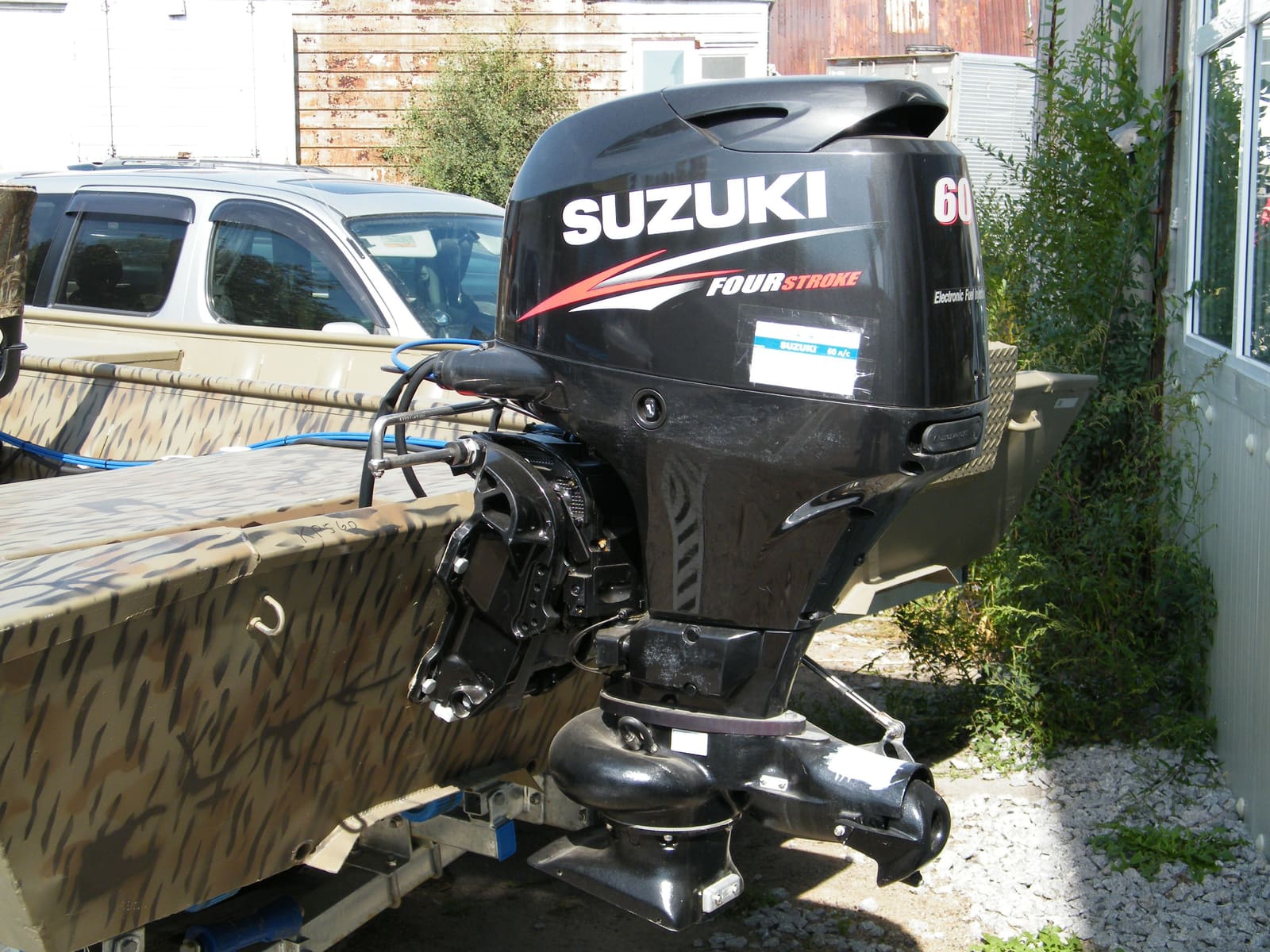
How a jet outboard differs. The powerhead on top is a normal outboard engine. Below it, where a prop outboard has its gearcase, a jet outboard has a pump: water comes up through a grate in the bottom of the pump, an impeller on the driveshaft spins inside a close-fitting liner, and the water shoots out a nozzle at the back. Mercury's pitch is that nothing hangs below the hull, so you can run water a prop boat can't. Yamaha lists its jet models as "direct drive" with forward, neutral and reverse, so there is no gearcase oil to change.
What you give up. A pump is less efficient than a prop. Yamaha publishes "power at the pump" figures well under the engine's rating (its F150 jet makes 105 hp at the pump, the F40 jet 30 hp). Honda labels its jets the same way, by expected performance: Boating magazine reported its 40 jet uses the BF60 powerhead. So a "40 jet" has a bigger engine on top than the name suggests, which matters for weight and fuel. Expect less top speed and more fuel use than the same engine with a prop. That is normal, not a fault.
Find the jet section of your manual. Grease intervals, the grease type, the clearance check and the flushing method are all in the jet drive pages of your owner's manual and service manual. Use them for every number. This guide explains the jobs; the manual gives the specs. For inboard jet boats (two-engine sport boats), see the jet boat care guide instead.
Steps
A jet outboard does not follow the prop-motor rule of setting the anti-ventilation plate relative to the hull bottom. Its height is set so the front edge of the intake sits at a particular spot relative to the bottom of the hull, which your jet maker specifies. Yamaha sells its jets by the transom they fit (20-inch or 25-inch), not as short or long shafts.
You don't need to measure anything if the boat runs well. Signs the height may be wrong:
- Too high: the pump sucks air, rpm jumps and the boat loses grip, especially in turns or rough water.
- Too low: lots of spray around the motor, extra drag and a pump that grabs more gravel.
Changing height means re-drilling or a jackplate change. Let a dealer who rigs jets do it, with the jet maker's figures.
The pump needs smooth, solid water flowing into the intake. Anything mounted on the hull bottom ahead of the pump (a transducer, a keel guard, a damaged strake, a big dent) can trip that flow and feed air into the pump. Look along the bottom ahead of the motor for dents, bent strakes and add-ons. Jets work best on flat or shallow-V hulls; a deep V can make them suck air in turns. Honda Marine's field-service manager put it plainly in Boating magazine: a jet works on a flat bottom or a slight V, but not on a true deep-V. If you are thinking of converting a deep-V boat to a jet, talk to a dealer who rigs jets first.
With the engine off, key out and lanyard pulled, tilt the motor up and look at the grate. It should have:
- all bars straight, with none bent, cracked or missing
- every mounting bolt present and tight
- no weeds, fishing line, bark or rocks jammed between the bars
Outlaw Eagle, a river jet boat builder, lists a clean, undamaged grate with tight hardware as a basic check. A bent grate lets rocks through to the impeller. Never run with the grate removed.
The driveshaft runs in a bearing inside the pump, with a grease fitting on the outside of the pump housing. Jet pumps need grease far more often than a prop outboard's grease points, because there is no gearcase full of oil around that bearing. Published advice varies: a Honda Marine field-service manager told Boating magazine (2018) that the bearing should be lubed after every use, and Outlaw Eagle suggests every 10 to 20 hours, more often in harsh conditions. Intervals differ by brand and model, so the jet section of your manual is the one to follow; if you are unsure, greasing after each day on the water is the safe habit.
- Outlaw Eagle adds a simple check: after a run, feel the pump housing. If it is noticeably warmer than usual, a seal or bearing may be starting to fail, so have it looked at.
- Wipe the fitting clean, then pump in the grease type your manual names, the number of strokes it says.
- On many units, old grease pushes out through a vent hose or opening. Look at it: normal grease looks like the new grease. Milky, gray or watery grease means water is getting past the seals. Note it and grease again sooner; if it stays milky, have the seals checked.
- Outlaw Eagle warns that both too little and too much grease cause trouble, so count your strokes rather than pumping until something gives.
Most gravel damage happens at low speed, not on plane. At idle and while coming off plane, the pump pulls water (and gravel) up from the bottom.
- Get on plane in water deep enough for the motor, and come off plane only where it is deep enough to sit.
- Don't idle, power-load onto a trailer or try to "push off" a gravel bar with the jet. Shut down, tilt up and walk or pole the boat off.
- Running over sand or gravel at low speed is what dulls impellers. Plan your stops and launches in deeper water.
A sudden loss of push, rpm that climbs with no added speed, or a new vibration usually means something is stuck on the grate or in the impeller.
- Throttle to idle, shift to neutral, shut the engine off, take out the key and pull the lanyard.
- Tilt the motor up.
- Clear the grate with a stick. Look up past it with a flashlight for anything wedged in the impeller.
- A rock jammed between the impeller blades usually needs the grate removed (engine still off) and a tool to pry it out. Don't force it if it won't come; a stuck rock can chip the impeller or score the liner.
The PWC intake grate guide has more on clearing debris safely.
On many jet outboards the cooling water pickup is in or near the pump, so the same debris that clogs the grate can starve the engine of water. Check the telltale (pee stream) every time you start and after you've run through weeds or gravel. If it is weak or stops, shut down and clear the intake; if the overheat warning comes on, see the engine overheating guide.
The impeller works best with a very small gap between its blade tips and the liner around it. Gravel and sand round off the blade edges and wear the liner, and the gap grows. Thrust drops a little at a time until the boat struggles to plane with a load.
What you can safely look at (engine off, key out, lanyard pulled, grate off):
- Blade edges: sharp and even is good. Rounded, chipped or bent leading edges mean wear.
- The liner: look for deep scoring or gouges.
- The gap: many jet pumps let you lower the impeller deeper into the tapered liner by moving thin shims from one side of the impeller to the other. Your service manual gives the target gap and how to measure it with long feeler gauges.
Re-shimming and touching up dull blades are jobs many river boaters learn to do, but only with the service manual's procedure and specs. A badly gouged impeller or liner is replaced, not adjusted.
Two very different problems feel similar from the helm. Check the tachometer:
- Rpm is normal or higher than usual, but the boat is slower: the pump is slipping. Look for a clogged or bent grate, weeds on the impeller, a dull impeller with too much clearance, hull damage ahead of the intake, or a motor mounted too high (steps 1 to 8).
- Rpm is lower than normal at full throttle: the engine is not making its power. Work through the loss of power guide (fuel, filters, plugs, warnings).
Write down your normal top rpm and speed with a typical load when the pump is fresh. That baseline makes the next diagnosis much easier.
Look at the nozzle for cracks or rock damage and make sure the reverse gate (the scoop that swings down over the nozzle) moves freely through forward, neutral and reverse with the shift lever. Lubricate the linkage pivots where your manual shows. A sticking gate can leave you without neutral or reverse at the ramp. The shift cable adjustment guide covers basic cable checks.
A jet outboard cannot use ordinary prop-style flush muffs, because there is no gearcase water inlet to cover. Your manual describes the flushing attachment for your model and whether the engine runs while you flush. Built-in flush ports are an engine-off method unless your manual says otherwise. After salt or brackish water, Outlaw Eagle also suggests running in fresh water for a few minutes when you can. Mercury builds its jets with anodes and corrosion coatings; check and replace the anodes as described in the anodes guide.
Follow the winterize outboard guide for the powerhead (fuel stabilizer, fogging, oil change on a four-stroke). For the pump:
- Grease the bearing before storage, so fresh grease, not water, sits in it all winter.
- Tilt the motor down so the pump drains, and make sure the grate and nozzle are clear.
- Look over the impeller and liner while the boat is out, and order shims or parts before spring.
Common mistakes
- Using the prop-outboard mounting rule on a jet and wondering why it sucks air
- Skipping pump grease because "the gearcase doesn't need it often" (a jet has no gearcase, and its bearing needs grease far more often)
- Idling across gravel bars or power-loading onto the trailer, which sands the impeller dull
- Running with a bent or missing grate bar after a rock strike
- Reaching into the intake with the engine still able to start
- Blaming the engine for low speed when the tach shows the pump is slipping
- Expecting prop-motor top speed and economy from a jet
When to call a pro
- Mounting height or jackplate changes
- An impeller or liner with chips, deep gouges or a bent blade
- Re-shimming if you don't have the service manual or long feeler gauges
- Milky grease that keeps coming back, or grinding or rumbling from the pump (bearing or seal wear)
- Any rock strike that cracked the pump housing, nozzle or hull, or let water into the boat
- Overheating that continues after the intake and telltale are clear
Tips
- Carry a spare set of grate bolts, a stick for clearing debris, and a grease gun in the boat.
- Log your top rpm and speed every few trips; a slow drop is the first sign the impeller clearance needs attention.
- Jets lose steering when you let off the throttle. Practice docking at low throttle with a little power on until it is second nature.
- Before you buy a used jet rig, look at the impeller edges and ask when it was last shimmed.
Official references
We read these to write this guide. Your engine's own manual always wins.
- Yamaha Outboards – Jet Drive Outboards (power at the pump, transom fit, direct drive)
- Mercury Marine – Jet Outboards (25-105hp)
- Mercury Marine – Jet 65-80hp (scroll intake, corrosion protection)
- Mercury Marine – Jet 25-40hp
- Boating Magazine – Honda Jet Outboards (bearing lube after every use, deep-V hulls, rated by pump output, 2018)
- Outlaw Eagle – Jet Pump Maintenance (river jet boat builder, 2025)
Safety: BoatMend is for information only and does not replace a certified marine technician. You are responsible for your safety and your boat. Read the full disclaimer.
Last updated 2026-10-26
Related guides
Jet Boat Care - Flushing, Clearing the Pump, Oil, Steering Nozzle and Storage
A practical care routine for twin-engine sport jet boats like Yamaha models: pre-ride and post-ride checks, flushing both engines the safe way, clearing debris from the pumps, spotting a worn wear ring, keeping the nozzle and reverse bucket working, and getting the boat ready for storage.

Jet Ski and Jet Boat Pump Care: Clearing the Intake Grate and Checking the Impeller and Wear Ring
Clear weeds, rope and rocks from the intake grate of a Sea-Doo, Yamaha WaveRunner, Kawasaki Jet Ski or jet boat, and learn to spot a damaged impeller or worn wear ring. A clogged or worn pump is the usual reason a jet craft revs high but goes slow.
How to Choose the Right Outboard Shaft Length
Measure your transom, match it to a 15, 20, 25 or 30-inch shaft and check where the anti-ventilation plate ends up. The right length keeps the prop biting clean water and the cooling intakes fed; the wrong one means ventilation, overheating, drag or spray.
How to Grease Your Outboard's Lubrication Points
Grease the swivel bracket, tilt tube, steering and shift linkages, trim rams and prop shaft splines on your outboard. Grease keeps salt and water out of the moving joints. A 30-minute job once or twice a season prevents seized steering, stuck props and corroded brackets.
Loss of Power, Hesitation or Misfire - Troubleshooting Guide
Figure out why your engine bogs down, stumbles, will not reach full rpm or runs rough. Work from simple checks like trim, prop and fuel filter to ignition and engine protection modes before paying for diagnostics.
Prop Ventilation vs. Cavitation - Why Your Engine Revs Up and the Boat Loses Grip
Sudden RPM spikes, blowouts in turns, or a prop that slips when you accelerate are usually ventilation, not cavitation. Learn to tell them apart, then work through the fixes in order: trim, load, prop damage, the hull ahead of the prop, engine height, and finally a different prop.
Engine Overheating - Troubleshooting Guide
Work through the most likely causes of a hot engine or overheat alarm, from a blocked water intake to a worn impeller or stuck thermostat. Acting fast and in the right order can save your engine and often gets you home without a tow.
How to Winterize an Outboard Engine
Protect your outboard from freeze damage, stale fuel and internal corrosion over the off-season. Most owners can do it in an afternoon with basic tools, compared with a shop bill that often runs several hundred dollars.
How to Inspect and Replace Sacrificial Anodes (Zincs)
Check the anodes on your outboard, sterndrive or inboard running gear, replace them when they are half gone, and choose the right metal for the water you boat in. Fresh anodes are cheap insurance against expensive corrosion damage to your lower unit, drive and prop.
Engine Cut-Off Switch (Kill Switch) and Lanyard: The Law, Testing and Daily Use
How the engine cut-off switch (ECOS) and its lanyard or wireless fob work, when federal law requires you to wear it (boats under 26 feet, 3 hp or more, on plane), how to test it before every trip, and why a spare clip aboard matters.