Inboard and Sterndrive Engine Mounts: Signs of Failure and How to Inspect Them
The rubber mounts under an inboard or sterndrive engine soak up vibration and hold the engine in line with the drive. Learn the warning signs of a failing mount, how to inspect all of them in under an hour, and why a mount replacement always ends with an alignment check.
Time
1 h
Shop would charge
$400-2500
Applies to
Gas inboard, Sterndrive (I/O), Marine diesel
Safety first: Inspect mounts only with the engine off, the key out and the battery switch off, and let a hot engine cool before you reach around the exhaust. The only running check here, the backdown test, needs strong dock lines and cleats, a helper at the helm, and everyone's hands, hair and clothing well clear of belts, pulleys and the shaft. A mount that has broken completely can let the engine shift and pull on fuel, exhaust and cooling hoses: if you smell fuel or find water coming in, stop, shut down and call TowBoatUS, Sea Tow or the Coast Guard on VHF 16 (911 in an emergency).
Owners often ask
- My inboard clunks when I shift into gear and shakes at idle. Could it be the engine mounts?
- Do I need to realign the engine after replacing the motor mounts?
- Do I have to replace all four engine mounts if only one is bad?
This guide walks you through it. Still stuck? Ask the AI Mechanic about your engine.
Tools
- Bright flashlight or headlamp and an inspection mirror
- Phone for photos and short videos
- Rags and degreaser to clean around the mount bases
- Thin feeler gauge set
- Wrenches or sockets to check that mount fasteners are snug
- Pry bar and a wooden block (small engines only)
- A helper
Parts & supplies
- None for the inspection
- Replacement mounts for your exact engine and transmission (installed and aligned by a shop)
Before you start
What mounts do. An inboard or sterndrive engine does not bolt straight to the boat. It sits on (usually) four mounts. BoatUS describes the typical mount as a threaded stud set into a block of rubber or a similar material, bolted between the engine bracket and the engine bed through metal plates. That rubber lets the engine move a little while soaking up its vibration, and it protects the engine from shock loads when the boat slams into waves. On most installations the mounts are also where alignment is set: a nut on each stud raises or lowers that corner of the engine, and slotted bases let it shift side to side.
Why they matter more than they look. BoatUS warns that ignoring damaged mounts can lead to engine damage, reduction gear failure from misalignment and even a twisted shaft. A mount that sags lowers its corner of the engine and pulls the engine out of line with the shaft or drive, so mount trouble and alignment trouble usually travel together (see the engine alignment guide).
How long they last. There is no single answer. BoatUS found makers quoting anything from about 1,000 hours or 4 years to 10 years or more, and notes that rough-water use, hard running and fluid leaks shorten that a lot. Follow your engine maker's schedule and your own inspections.
Not an outboard job. Outboards hang on their own mounts in the midsection; that's a different part and a different check (see the outboard motor mounts guide). This guide is for engines that sit inside the boat: gas inboards and V-drives, sterndrive engines and inboard diesels, including sailboat auxiliaries and generators.
Steps
BoatUS lists four classic signs of a failing mount:
- The engine lurches when you start or stop it. At steady speed the torque holds a worn mount in place, so it can feel normal, but the engine rocks or jumps at start-up and shutdown.
- New vibration or noise, especially at start-up and idle. BoatUS notes a badly worn mount can make a distinctive metallic sound.
- Visible damage: cracked or separated rubber, rust, a bent or broken stud, a cracked bracket.
- Too much movement underway, especially in rough water or when accelerating hard, sometimes with a thump as the engine hits something next to it.
Owners also report a clunk when shifting between forward and reverse, and a drivetrain that suddenly feels harsher. Those can come from mounts, but also from the shift cable, coupler or transmission, so treat them as a reason to inspect, not a diagnosis. Note when it happens (rpm, gear, sea state). A mechanic will use those notes.
Engine off and cool, key out, battery switch off, and tell anyone aboard not to touch the controls. Open the engine hatch or remove the box. On sterndrive boats the front mounts are usually on the stringers near the front of the engine and the rear mounts are at the back of the engine, near the transom assembly. On inboards there is normally one at each corner. Count them and photograph each one before you start, so you can compare later.
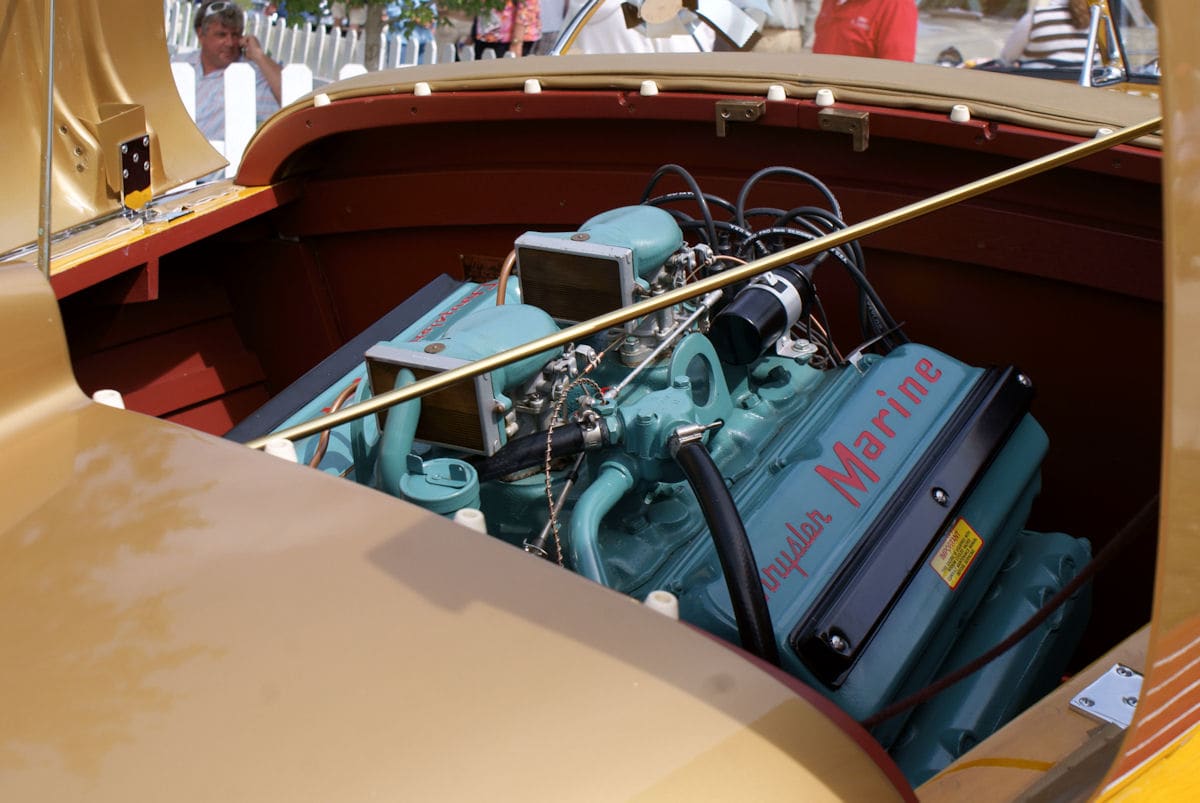
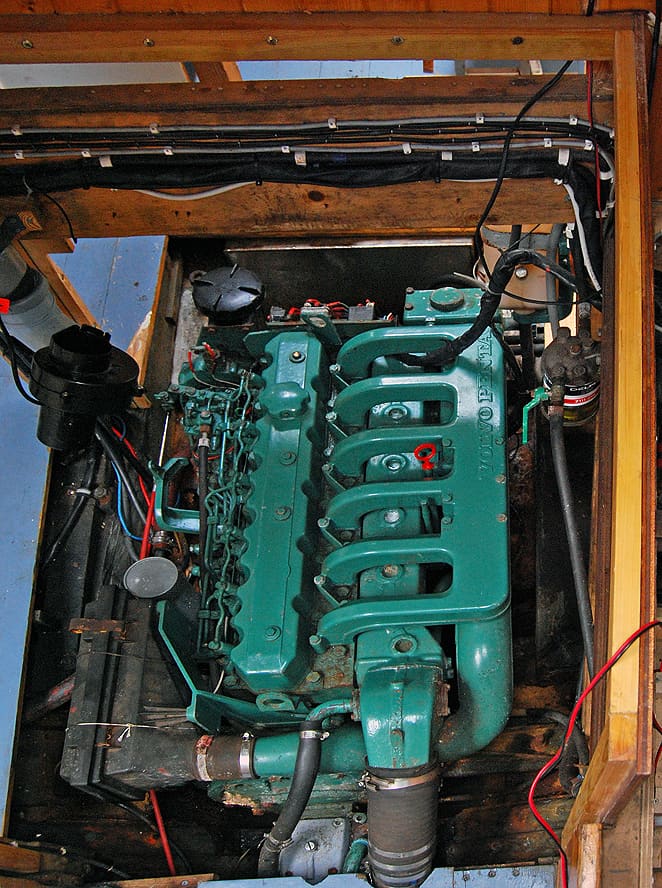
On a typical inboard the mounts sit low on the stringers beside the engine, out of sight, which is why they get forgotten. Photo: Valder137 / Wikimedia Commons · CC BY 2.0 Wipe away oil and grime around the base of each mount. You need to see the rubber, the metal plates, the stud and the bolts that hold the mount to the bed. Leave a little of the old grime undisturbed for a moment first, because of the next step.
BoatUS suggests checking whether the grime or residue on the engine bed around the mount base has been rubbed away. A clean, shiny patch or a ring next to a washer means the mount is shifting. On a fiberglass engine bed you may even find fiberglass dust. Rubber crumbs on the bed point the same way.
Look closely, with the mirror where you can't see directly, for:
- cracks, cuts or splits in the rubber
- rubber that has separated (peeled away) from its metal plate
- rubber that is swollen, soft or sticky, usually from oil, diesel or coolant dripping on it
- rubber that has squashed down so the engine bracket sits low on the stud
BoatUS describes sliding a thin feeler gauge into any gap between the rubber and the metal; if the gap is more than a few millimeters deep, the mount should be replaced. Cracks can be hard to see, so take close-up photos and zoom in.
Check each stud, bracket and base plate for rust, cracks, gouges, bends or a broken stud. Look at the height-adjusting nuts: a marine diesel mechanic quoted by BoatUS says they should turn freely and be free of rust, because an alignment can't be done properly on a mount whose nuts are seized. He recommends replacing a mount if the nuts won't move. Check that the lock nuts or locking tabs above and below the bracket are still tight; Boating Magazine notes these are what hold the alignment once it's set.
Also note where the engine bracket sits on each stud. Power & Motoryacht says a bracket that has sunk all the way down the stud means the rubber has lost its spring and the mount should be replaced, while one sitting fairly high is usually fine. The opposite extreme is a problem too: a UK marine surveyor quoted by Practical Boat Owner warns that a bracket set right at the top of a long stud puts huge leverage on the mount, and that height should be made up with proper packing under the mount, not by running the bracket up the thread. If yours sit near either end, ask the mechanic about it at the next alignment.
Make sure the bolts or lag screws holding each mount to the engine bed are snug. Don't crank on them; just confirm none is loose or missing. Boating Magazine warns that if a lag bolt just spins when you put a wrench on it, the wood inside the stringer may be rotten. That's a structural problem, not a mount problem; stop and get a surveyor or yard involved (see the transom and stringer rot guide).
A mount covered in rust or soaked in oil is telling you about a leak above it. BoatUS shows a rusty mount whose cause was a leaking raw-water pump dripping salt water onto it. Look straight up from any dirty mount for a weeping pump, hose, filter or seal, and fix the leak. Fischer Panda's generator guidance makes the same point: isolation mounts that have been in contact with diesel or engine oil should be replaced once the leak is fixed, because the rubber keeps breaking down.
BoatUS suggests comparing each mount to the others. One that looks lower, more cracked or rustier than its neighbors is suspect. On twin-engine boats, compare port and starboard engines too; Boating Magazine's yard source does exactly this.
On gas engines and the smaller diesels found in sailboats, the BoatUS mechanic uses a pry bar to lift the engine slightly while watching each mount for separation or a broken stud. Use a wooden block under the bar so you don't damage the engine bed or a pan, lift only a little, and never pry against fuel lines, hoses, wiring or the oil pan. On larger diesels you usually can't get enough leverage; use the next step instead.
Broken studs are hard to see. BoatUS calls the backdown test the best way to stress the mounts: with the boat tied securely to a strong dock, run in reverse at moderate rpm (the mechanic it quotes uses roughly 1,200 to 1,500 rpm on diesels) while a helper watches the engine from a safe spot. The mounts should hold the engine tight with very little movement. Only do this if your lines and cleats are up to it, keep the run short, and stop if anything looks wrong. If the engine jumps, rolls or knocks, you have a mount problem.
New mounts change the engine's height and position, so every mount replacement must be followed by an alignment check. On an inboard the mechanic aligns the transmission coupling to the shaft, ideally with the boat floating, as Boating Magazine recommends. On a sterndrive, the engine is aligned to the gimbal bearing with an alignment tool, which Mercury says matters for coupler life, and Mercury notes that damage from poor alignment isn't covered by its warranty. Replace mounts with the parts specified for your engine and transmission; Power & Motoryacht explains that mounts are rated for the engine's weight and power, so a mount that merely fits the bolt holes may be wrong. Its source recommends replacing all four when one has failed so the rubber is equally springy everywhere, and the Practical Boat Owner surveyor says at minimum replace the pair (both front or both rear). In salt water, P&M notes cast aluminum bases outlast stamped steel ones. Ask the shop to check the shaft, cutless bearing and shaft seal (or the gimbal bearing and coupler) while they're in there.
Record the date, engine hours, photos and what you found for each mount in BoatMend. Next season, compare the photos. Slow changes are easy to miss without them.
Common mistakes
- Assuming the mounts are fine because the engine "runs smooth at cruise". Worn mounts often show up only at start, stop and in reverse.
- Replacing mounts and skipping the alignment, so the new mounts, coupling and shaft seal start wearing right away.
- Fixing the mount but not the oil, fuel or raw-water leak that ruined it.
- Overtightening mount fasteners into old, possibly soft wood.
- Blaming the mounts for vibration that's really a dinged prop or bent shaft (see the alignment and propeller guides), or the reverse.
- Ignoring a mount whose adjusting nuts are rusted solid; it will make the next alignment impossible.
When to call a pro
- Any cracked, separated, collapsed or oil-soaked mount, or a broken or bent stud
- Mount bolts or lag screws that won't tighten, or soft wood around the engine bed
- An engine that moves a lot in the backdown test, or knocks against something underway
- Any mount replacement: it involves supporting the engine's weight and must be finished with an alignment
- Fuel smell, water coming in, or a hose pulled tight because the engine has shifted: treat it as urgent and call for help
Tips
- Take a short video of the engine at start-up, idle and shutdown when all is well. It's the easiest baseline to compare against.
- Check the mounts every time you change the oil; you're already in the engine space.
- Don't forget the generator: it sits on its own smaller mounts that wear the same way.
- If you're buying a used boat, ask the surveyor to watch the engines during the sea trial and to look at the mounts.
- Wrapped a rope or net around the prop? Practical Boat Owner's surveyor advises checking the mounts afterwards: the sudden pull on the drivetrain can damage them.
Official references
We read these to write this guide. Your engine's own manual always wins.
- BoatUS – Check Your Boat Engine Mounts
- BoatUS – Troubleshooting Boat Vibrations
- Boating Magazine – How to Diagnose and Fix Inboard Shaft Vibration
- Mercury Marine – Service and Support FAQs (engine alignment and coupler)
- Fischer Panda – Preparing Your Marine Generator for the Boating Season
- Power & Motoryacht – Save Money Quietly (engine mount maintenance)
- Practical Boat Owner – Replacing Your Boat's Engine Mounts
Safety: BoatMend is for information only and does not replace a certified marine technician. You are responsible for your safety and your boat. Read the full disclaimer.
Last updated 2026-10-26
Related guides
Engine Alignment on Sterndrives and Inboards: What to Check and When
A sterndrive engine must line up with its gimbal bearing and coupler, and an inboard engine with its prop shaft. When it drifts out of line you get vibration, noise and worn-out couplers, bearings and seals. Learn the warning signs, the checks you can do yourself and why the alignment itself is a job for a pro with special tools.

How to Check for Worn Outboard Motor Mounts
A clunk when you shift, buzzing vibration at idle or a motor that wobbles side to side can mean the rubber mounts between the outboard and its bracket are worn out. Learn how to rule out the cheap causes first, check the mounts yourself and know when replacement belongs in a shop.
How to Check a Boat for Transom and Stringer Rot
Many older fiberglass boats have wood inside the transom, stringers and deck, and water that gets in slowly rots it. Learn the tap test, the flex test, how to read a moisture meter and the other warning signs, and why a rotten transom or stringer is a structural job for a pro, not a weekend patch.
How to Check the Cutless Bearing, Prop Shaft and Strut
Find out if new vibration or rumbling from the stern is a worn cutless bearing, a bent shaft, a loose strut or poor engine alignment, using simple checks you can do at the dock and at haul-out. Catching bearing wear early protects the shaft, the seal and the transmission.
How to Check, Adjust and Repack a Stuffing Box (and Care for a Dripless Shaft Seal)
Learn the right drip rate for a traditional packing gland, how to adjust it safely, when to repack it, and how to inspect and service a dripless shaft seal. The shaft seal is one of the few holes in an inboard boat that moves, and a neglected one can sink a boat at the dock.
How to Inspect Sterndrive Bellows, Gimbal Bearing, U-Joints and Shift Cable
Learn to spot a cracked sterndrive bellows before it lets water into the boat, and to recognize the warning signs of a worn gimbal bearing, U-joints and shift cable. A failed bellows is one of the top reasons boats sink at the dock, and a 20-minute inspection can catch it.

Strange Engine Noises - What a Knock, Tick, Rattle, Whine, Grind or Squeal Can Mean
Learn what common boat engine noises often point to, which ones mean shut down now, and the safe checks you can do yourself before describing the problem to a mechanic.
How to Inspect and Clean a Raw-Water (Sea) Strainer
The sea strainer is the cheap screen that keeps weeds, shells and plastic out of your engine, generator and A/C pumps. Learn how to clean it safely with the seacock closed, reseal the lid so it can't suck air, spot a cracked bowl before it floods the boat, and winterize it.