How to Check a Boat for Transom and Stringer Rot
Many older fiberglass boats have wood inside the transom, stringers and deck, and water that gets in slowly rots it. Learn the tap test, the flex test, how to read a moisture meter and the other warning signs, and why a rotten transom or stringer is a structural job for a pro, not a weekend patch.
Time
1 h
Applies to
All engines · Fishing boat, Bowrider / runabout, Center console, Cabin cruiser, Sailboat, Jet boat
Safety first: A rotten transom can crack or tear away under the thrust of the engine, and rotten stringers let the hull flex and fail in waves. That can mean losing the engine overboard, flooding or sinking. If you find transom flex, cracks around the motor mounts, or soft stringers, do not use the boat until a marine surveyor or a qualified fiberglass shop has inspected it. Do not stand under a boat on a trailer or on stands that are not secure. If you are taking on water underway, put on life jackets and call the Coast Guard on VHF 16 or dial 911.
Fuel smell, water coming in, CO alarm or smoke? Stop, get everyone in life jackets and call USCG on VHF 16 or 911. For a tow: Sea Tow or TowBoatUS.
Owners often ask
- My floor feels soft. Do I have rotten stringers or a rotten transom?
This guide walks you through it. Still stuck? Ask the AI Mechanic about your engine.
Tools
- Plastic or phenolic mallet, or a surveyor's sounding hammer
- Bright flashlight
- Painter's tape and a marker
- Phone camera and notebook
- Moisture meter (optional; results need careful interpretation)
- Screwdriver (to remove inspection plates and hatches)
Before you start
What is rotting? Many fiberglass boats, especially older ones, were built with plywood or wood cores sealed inside fiberglass:
- The transom (the flat back of the boat) carries the full thrust and weight of the outboard or sterndrive.
- The stringers run lengthwise under the deck and are the hull's backbone, stopping it from twisting and flexing.
- The deck (floor) is often wood-cored too.
Water gets in through every screw hole, drain plug, transducer, motor bolt and hardware fitting that was not properly sealed. The entry point is not always near the motor: when the WEST System technical team rebuilt a rotted Chris-Craft transom, the water had come in around the rub rail screws. Swim platform, ladder and rod holder screws are other common culprits. Once inside, it cannot dry out, and the wood slowly rots from the inside while the fiberglass skin still looks fine.
Which boats are at risk? Mainly older fiberglass boats with wood cores. BoatUS notes that by the early 2000s many production builders had moved to foam composite cores, which are basically rot-proof, so major structural repairs on those are rare. All-aluminum boats do not have this problem, though some have wooden transoms or floors; check those too.
This guide helps you find rot. Repairing a transom or stringers means cutting the boat open, removing the rotten wood and laminating new structure. BoatUS calls soft stringers, decks, bulkheads and transoms major and costly repairs that often cost more than the boat is worth.
Steps
Clean the transom so you can see it. Look for:
- Cracks in the gelcoat around the motor mounting bolts, the corners of the transom and the drain plug. Spider-web or star cracks radiating from the motor bolts are a classic sign of a transom that flexes.
- Brown or rusty stains weeping from screw holes, the drain plug or the motor bolts. That is often water carrying rot out of the core.
- Fresh caulk smeared over old holes, or many old unused holes.
- A transom that looks bowed or pushed in where the motor mounts.
On an outboard boat with the motor tilted down and the boat on its trailer, grab the lower unit and push and pull it firmly, leaning some body weight into it, while a helper watches the top edge of the transom and the motor brackets. On a sterndrive, a helper can push and pull on the drive.
A sound transom does not move. If the top of the transom flexes, the gap between the motor bracket and the transom opens and closes, or you hear creaking, treat the transom as structurally compromised.
Tap the transom with a plastic mallet or sounding hammer every inch or two, in a grid, from the inside and outside where you can reach. Solid laminate over good wood gives a sharp, crisp click. A dull thud means a void, separated layers (delamination) or wet, rotten core. Mark the dull areas with painter's tape and photograph them.
Compare with an area you know is solid, like the hull bottom: you are listening for a change in sound, not a perfect note.
Look closely at the motor mounting bolts and the drain plug tube from inside the boat. Wet wood, black or crumbly wood around the bolt holes, or water seeping out when you remove a fitting are bad signs. Do not drill test holes in someone else's boat. On your own boat, a surveyor may take a small core sample to confirm what the meter and tap test suggest.
Walk slowly over the whole deck, especially near the transom, around the fuel tank access and along the centerline where the stringers run underneath. Feel for spots that give, bounce or feel spongy under your feet. Tap test the deck as well. Soft deck spots often mean the wood underneath is wet, and the stringers below may be too.
Open every hatch, inspection plate and the bilge. Look at the stringers where you can see them:
- Cracks in the fiberglass along the stringers or where they meet the hull
- Fiberglass that sounds hollow or has separated from the hull
- Black, mushy or crumbly wood showing through
- Standing water that does not drain, or sawdust-like debris in the bilge
- Cracks in the gelcoat or resin on top of a stringer, especially at the engine mounts. It may be only surface resin, but it can also be wet wood that froze and split the laminate, and either way it is a path for water: have it checked before you buy
- Soaked, heavy foam around the stringers. Waterlogged flotation foam and rotten stringers usually go together (see our waterlogged foam guide)
Press on exposed stringer edges with a screwdriver handle (not the tip). Firm is good; soft or crumbly is not.
A moisture meter held against the fiberglass gives a reading that rises when there is water in the laminate or the core below it. It is a useful clue, but not proof: readings change with the meter type, the laminate thickness, paint, temperature, and whether the boat was just washed or rained on. Take readings on a dry day, after the boat has been out of the water, and compare suspect areas to known-good areas of the same boat.
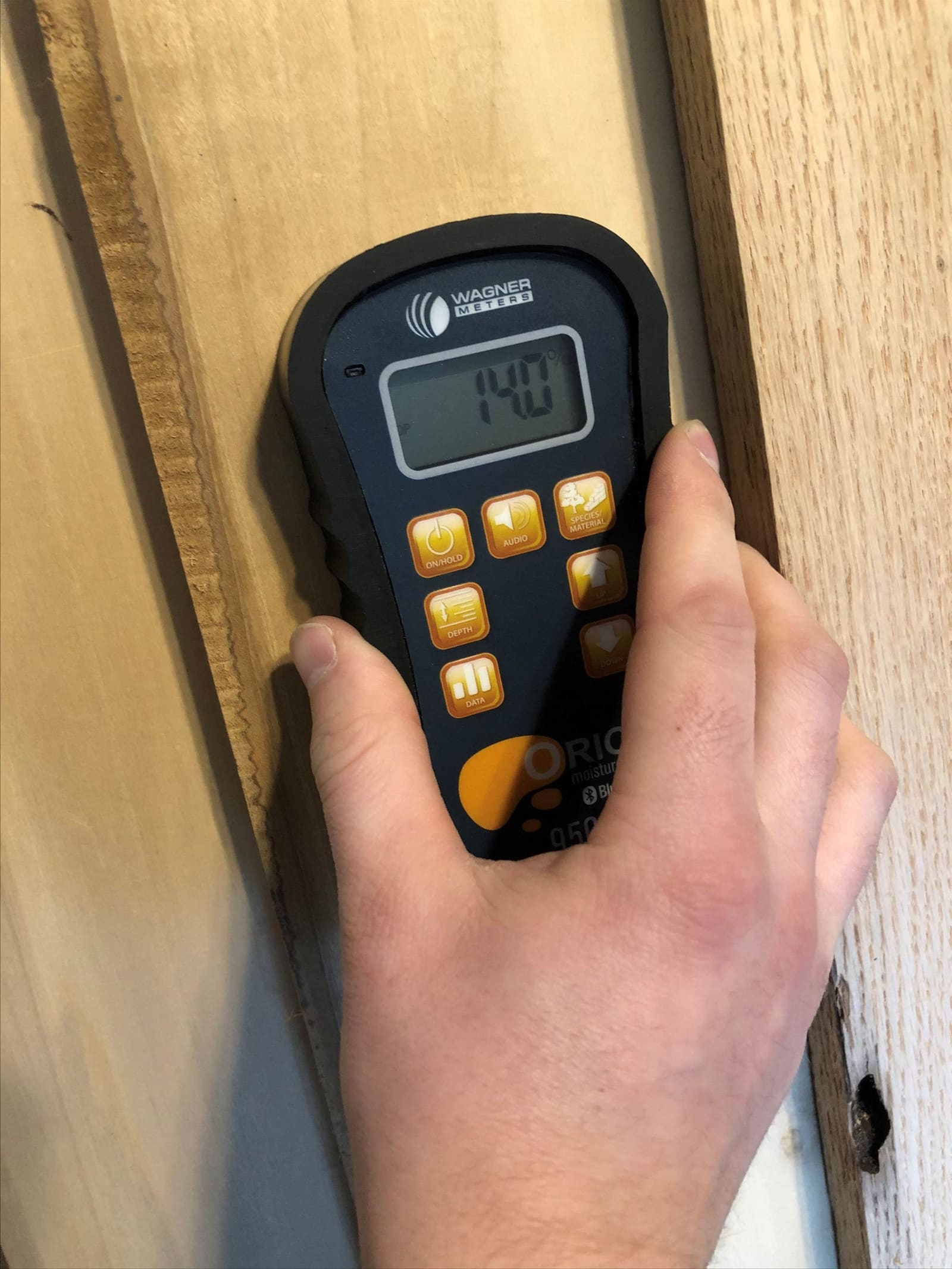
A pinless moisture meter is pressed flat against the surface. On a boat, compare suspect spots with known-dry ones, and confirm with other tests. Photo: Hrco / Wikimedia Commons · CC BY-SA 4.0 High readings plus a dull tap sound plus flex or stains is a strong combination. That is the time to bring in a professional.
If you have found no warning signs so far, take note on your next run: the hull sides should not visibly ripple or shift when you hit waves, and you should not hear new creaks from under the deck. BoatUS notes that hull sides that ripple and shift in waves are a sign of rotten stringers.
Map the problem areas on a simple sketch of the boat: transom, deck and each stringer. Add photos. This helps a surveyor or repair shop give you a realistic quote, and it is the record you need if you are deciding whether to buy, sell or repair.
- No signs of rot: keep it that way. Re-seal any screw, drain or transducer hole that looks dry or cracked with a marine sealant, and keep the bilge dry. Our deck hardware rebedding and through-bolting guides show how to seal fasteners so the core stays dry; on its own transom rebuild, the WEST System team coated the inside of every hole drilled through the wood with epoxy for the same reason.
- A small, local soft spot away from the structure (for example, in a seat or a small deck area): a fiberglass shop may be able to repair it locally.
- Transom flex, cracks around the motor mounts, soft stringers or a soft deck over a large area: this is structural. Get a marine surveyor or a reputable fiberglass shop to inspect it before you use the boat again, and get a written quote. Compare the repair cost with the value of the boat; with many older boats, BoatUS notes the repair costs more than the finished boat is worth.
Do these checks before you make an offer, and make any deal subject to a survey. Discover Boating lists a water-logged transom among the significant problems a professional survey is meant to catch. Unless you want a big restoration project and have the skills and budget for it, walk away from a boat with structural rot.
Common mistakes
- Assuming the transom is fine because the gelcoat looks shiny. Rot starts inside.
- Pouring resin or "penetrating" sealers over wet, rotten wood instead of removing it. The rot continues underneath.
- Drilling new holes for transducers, ladders or brackets and not sealing them properly.
- Adding a heavier engine than the transom was designed for.
- Leaving the drain plug hole and other fittings unsealed, or letting rain water sit in the boat.
- Treating a soft deck as cosmetic when the stringers underneath are wet too.
- Trusting one moisture meter reading without other evidence, in either direction.
- Starting a stringer job without measuring the deck thickness first and cutting into the hull, wiring or a built-in fuel tank.
- Deciding to "baby it for one more season" with a known soft stringer or transom. Rot does not stay partial, and the failure usually comes at speed, in waves, with people aboard.
When to call a pro
- Any flex in the transom, cracks around the motor mounting bolts, or the motor bracket moving
- Soft or cracked stringers, a soft deck over a large area, or hull sides that ripple in waves
- Water coming in that you cannot explain, or rot found near the drain plug or through-hulls
- You are buying the boat: hire a SAMS or NAMS marine surveyor before you pay
- Any repair that involves cutting the deck or transom, replacing core or stringers, or working near a built-in fuel tank
- Taking on water underway: life jackets on, call the Coast Guard on VHF 16 or dial 911
Tips
- A plastic mallet is gentler on gelcoat than a metal hammer and works just as well for tapping.
- Check the transom every spring when you service the engine. Catching a leaking screw hole early is cheap; a new transom is not.
- When you mount anything on the transom, seal the hole well with a marine sealant so water cannot reach the core.
- Check that the outboard's mounting bolts are still tight each season (to the torque in your engine's installation manual). A motor that works loose hammers the transom, cracks the gelcoat around the bolts and opens a path for water.
Official references
We read these to write this guide. Your engine's own manual always wins.
Safety: BoatMend is for information only and does not replace a certified marine technician. You are responsible for your safety and your boat. Read the full disclaimer.
Last updated 2026-10-24
Related guides
How to Inspect a Used Boat Before You Buy
A step-by-step checklist for looking over a used boat, from paperwork and the hull ID number to the transom, engine, compression test, sea trial and trailer. Know what to check yourself, what the red flags mean, and when to pay a marine surveyor.
How to Repair Small Gelcoat Chips and Scratches
Fill and blend small chips, dings and scratches in your boat's gelcoat with a repair kit so they stop letting water into the fiberglass and look close to new. Also learn to spot damage that is structural and needs a pro.
How to Inspect and Exercise Seacocks, Through-Hulls and Hose Clamps
Check every hole in your hull below the waterline, work each seacock open and closed, and inspect the hoses and clamps attached to them. A single failed fitting or hose is one of the most common reasons boats sink at the dock.
How to Test and Clean Your Bilge Pump and Float Switch
Make sure your bilge pump actually moves water overboard, both on the manual switch and automatically through the float switch. A working bilge pump is one of the most important safety systems on any boat that stays in the water.

How to Clean, Remove Oxidation and Wax Your Boat's Gelcoat (Plus Pontoon Tubes)
Wash your hull the right way, bring back chalky, faded gelcoat with compound, and seal it with wax so it stays glossy and protected from the sun. Includes how to clean and protect the aluminum tubes on a pontoon boat.

Launch Day and Haul-Out Checklist for Trailer Boats
A step-by-step checklist for getting your boat off the trailer and back on again safely and quickly, from the drain plug and tie-downs to the blower and ramp etiquette. Following it in order prevents the classic mistakes that sink boats and back up the ramp.
How to Find and Fix Leaking Deck Hardware (Rebedding Cleats, Stanchions and Tracks)
Track down the cleat, stanchion base or track that is dripping into the cabin, then remove it, seal the deck core and bed it again with the right sealant so the leak stops for years instead of weeks. Catching it early protects the deck core from rot.

How to Mount Rod Holders, Fish Finders, Cleats and Antennas Without Causing Leaks
Add accessories to your boat the right way, with through-bolts, backing plates, sealed core and proper wire pass-throughs, so every new hole stays dry and strong. Also learn where you should never drill.

How to Tell if Your Boat's Flotation Foam Is Waterlogged
Learn the signs that the foam under the floor or seats of a small boat has soaked up water, how to check without tearing the boat apart, what the Coast Guard flotation rules mean for you, and why replacing foam is usually a big job for a pro.