Is My Vehicle Rated to Tow This Boat? Towing Capacity, GCWR and Tongue Weight Explained
The towing number in the ad is only one of several limits. Learn which ratings matter (towing capacity, GCWR, GVWR, axle and tongue limits, hitch class and ball rating), how to weigh your real rig at a truck scale, and when you need trailer brakes and towing mirrors.

Time
1 h 30 min
Applies to
All engines
Safety first: Being over any one rating (not just the "towing capacity") can mean longer stopping distances, overheated brakes or transmission, light steering and trailer sway. Don't tow a rig you suspect is overloaded until you have weighed it. If a trailer starts to sway on the highway, ease off the gas, hold the wheel straight and let the rig slow down; don't slam the brakes. If there's a crash or the trailer comes loose, get clear of traffic and call 911.
Owners often ask
- My truck says it can tow 7,500 lb. Is that all I need to check before towing my boat?
- How do I weigh my boat and trailer at a CAT scale and figure out the tongue weight?
This guide walks you through it. Still stuck? Ask the AI Mechanic about your engine.
Tools
- Tow vehicle owner's manual (towing section)
- Phone camera (to photograph labels and plates)
- Tape measure
- Calculator
- Access to a certified truck scale (CAT or similar), or a tongue weight scale
Parts & supplies
- Hitch ball and ball mount rated at or above your loaded trailer weight (only if yours are underrated)
- Extended towing mirrors if the boat blocks your view (only if needed)
Before you start
Every tow vehicle has several weight limits, and you have to stay under all of them at the same time. The big number in the brochure ("tows up to 7,500 lb") is the best case for a specific configuration, often with only the driver aboard.
Here are the terms you'll see:
- Towing capacity (max trailer weight): the heaviest loaded trailer the vehicle is rated to pull. The trailer, boat, engine, fuel, water and gear all count.
- GCWR (Gross Combined Weight Rating): the most the loaded vehicle plus the loaded trailer may weigh together. Discover Boating points owners to this number in the vehicle owner's manual, because it includes the people and gear in the vehicle too.
- GVWR (Gross Vehicle Weight Rating): the most the tow vehicle alone may weigh, fully loaded. The trailer's tongue weight counts toward it.
- GAWR (Gross Axle Weight Rating): the limit for each axle. Tongue weight lands mostly on the rear axle.
- Payload: what's left between the vehicle's empty weight and its GVWR. Passengers, cargo, the hitch and the tongue weight all come out of it.
- Max tongue weight: set by the vehicle and separately by the hitch, ball mount and ball.
- Trailer GVWR: the trailer's own limit for trailer plus boat plus everything in it.
Towing rules for private trailers are mostly state law. NHTSA has said there is no federal safety standard for the act of towing a trailer, so brakes, chains, mirrors and lights are set by each state.
Steps
- Open the towing section of the owner's manual. Many makers list towing capacity and GCWR by engine, axle ratio, cab, bed and drive (2WD or 4WD). Find the row that matches your vehicle, not the best one in the chart.
- Look at the certification label on the driver's door jamb. It lists GVWR and front and rear GAWR. A nearby tire and loading label usually shows payload.
- Note whether you have the factory tow package. BoatUS points out that these packages can add parts you can't bolt on later, such as a different axle ratio, extra cooling, a heavier alternator, sway control and load-leveling suspension. The rating often assumes those parts.
Photograph every label and chart so you have them on your phone.
Find the trailer's capacity or VIN plate. EZ Loader, for example, puts its VIN sticker on the inside of the front frame rail on the passenger side, with a decal under the tongue. The plate shows the trailer's GVWR and usually tire size and pressure. Also check the tire sidewalls for their load rating.
If the boat plus gear comes close to the trailer's capacity, you have a trailer problem before you even get to the tow vehicle. Leave yourself a margin rather than running right at the limit (our pre-trailering checklist covers the usual rule of thumb).
Brochure "dry weight" leaves out a lot. Load Rite's method for sizing a trailer is a good reality check:
- Start with the boat's dry hull weight.
- Add the outboard or engine weight.
- Add fuel at about 7 lb per gallon of tank capacity and fresh water at about 8 lb per gallon.
- Multiply the total by 1.1 to allow about 10 percent for batteries, electronics, coolers and gear.
- Add the trailer's own weight (from the maker or the scale).
Owners are often surprised: a "3,000 lb" boat can easily be well over 4,500 lb on the road once the trailer, fuel and gear are counted.
A certified truck scale (CAT scales at truck stops are common) gives you real numbers for a small fee. Load the rig the way you actually tow: fuel, gear, coolers, passengers or their weight.
Weigh 1: the whole rig. CAT Scale's instructions for a truck and boat: steer axle on platform 1, drive (rear) axle on platform 2, boat trailer on platform 3, with everything on the scale. CAT notes its scales give axle weights and a total, not individual wheel weights. Very light rigs (under about 2,000 lb total) may need a call to their help desk.
Weigh 2: the vehicle alone. Unhitch in the lot (chock the trailer wheels first), then weigh just the vehicle with the same people and cargo aboard.
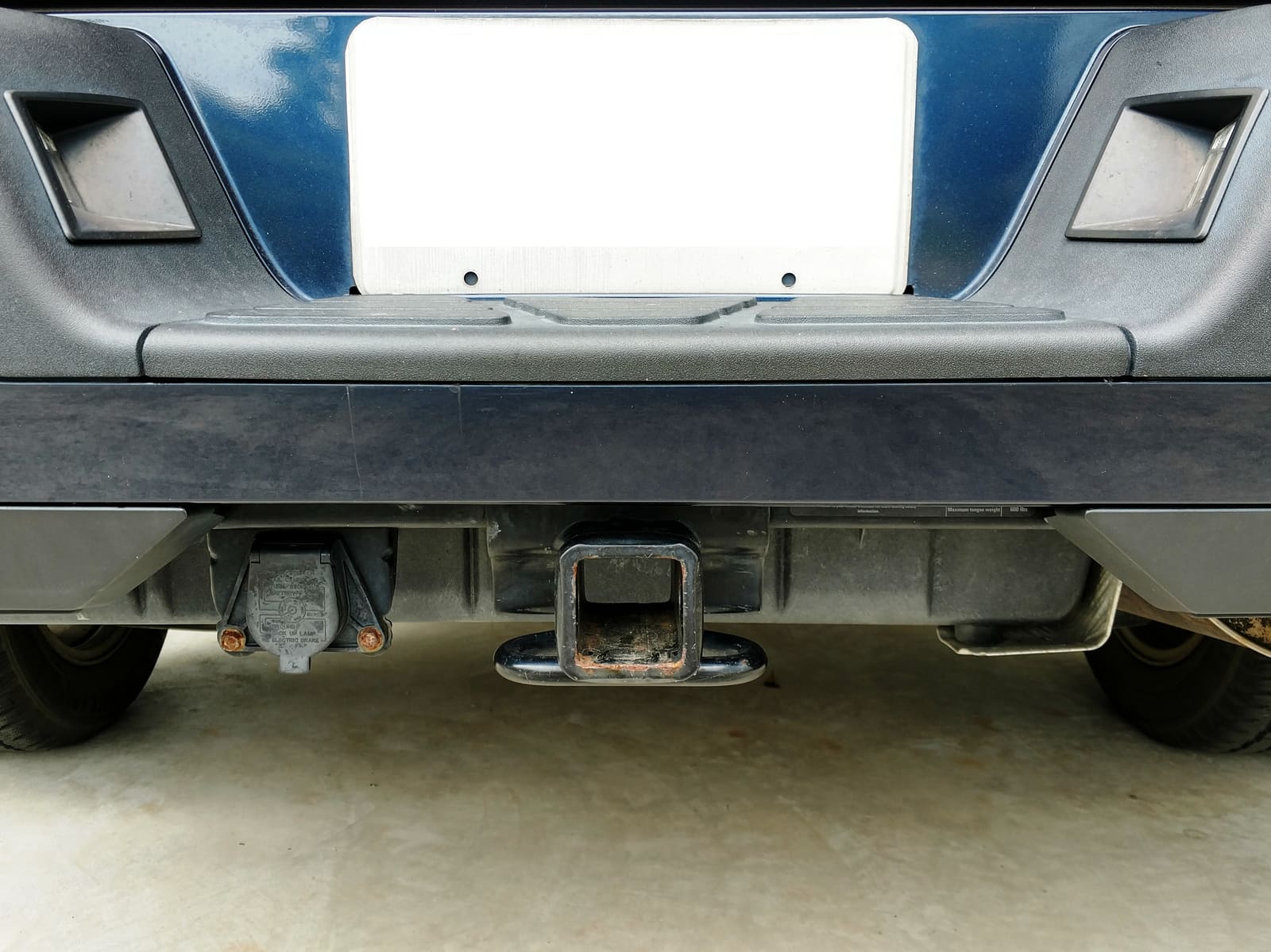
The hitch's ratings are on its label, usually on the cross tube near the receiver. Photo: McChizzle / Wikimedia Commons · Public domain From the two tickets you can work out everything:
- Combined weight = Weigh 1 total. Compare to GCWR.
- Loaded vehicle weight = platforms 1 + 2 from Weigh 1. Compare to GVWR.
- Rear axle weight = platform 2 from Weigh 1. Compare to rear GAWR.
- Tongue weight = (platforms 1 + 2 from Weigh 1) minus (Weigh 2 total). BoatUS uses this same "hitched minus unhitched" method.
- Loaded trailer weight = platform 3 from Weigh 1 plus the tongue weight. Compare to the vehicle's towing capacity and the trailer's GVWR.
A made-up example: Weigh 1 shows 3,300 + 3,700 + 4,200 lb = 11,200 lb total. Weigh 2 shows the truck alone at 6,550 lb. Tongue weight = 7,000 minus 6,550 = 450 lb. Loaded trailer = 4,200 + 450 = 4,650 lb. Now check each result against your own labels. If any number is over its limit, the rig is overloaded, even if the others are fine.
Leave a margin. Discover Boating's trailer-law page suggests not going over about 80 percent of the vehicle's maximum towing weight, and reminds you to weigh with the boat's fuel tank full and your usual gear aboard. Being "just under" the sticker number leaves nothing for hills, heat, headwinds or the cooler you add later. The same page notes that states also limit trailer length (roughly 30 to 60 feet, depending on the state) and the combined length of vehicle plus trailer (about 50 to 85 feet), and that most states treat a load wider than 8 feet 6 inches as a wide load needing permits or flags.
Divide tongue weight by loaded trailer weight. In the example, 450 divided by 4,650 is about 10 percent.
Sources differ a little on the target. BoatUS's tongue weight article says 7 to 10 percent of total trailer weight, while BoatUS's hitch article notes about 5 percent is normal for many trailered boats. Too little causes sway at highway speed; too much makes steering light and overloads the rear axle. Stay inside your vehicle's and hitch's tongue limits whatever the percentage.
To change it, move heavy gear fore or aft, empty water tanks, or move the winch stand so the boat sits farther forward or back. BoatUS says to do that at home, never on the shoulder.
The hitch, ball mount and ball are rated separately, and the lowest rating in the chain is your limit.
- Read the label on the hitch cross tube. Boating Magazine notes most receiver hitches show a weight-carrying rating, and many also show a higher rating that applies only with a weight-distributing system.
- Classes are a rough guide, not a rule. Published class ratings vary by source (BoatUS describes Class III as 5,000 lb and up; Boating Magazine lists Class III up to 6,000 lb), and BoatUS calls Classes IV and V more of a marketing term than an industry standard. Go by the label, not the class name or the receiver size.
- A bigger hitch never raises the vehicle's rating. If the truck is rated for 5,000 lb, a 10,000 lb hitch still means 5,000 lb.
- Boating Magazine says to forget step-bumper hitches for boats; they're relics.
- Ball size must match the coupler. Common sizes are 1-7/8, 2 and 2-5/16 inch. The coupler size is stamped near the latch and the ball is marked on top. Boating Magazine warns that a ball that's too small can let the trailer pop off; one that's too big won't let the latch close.
- Ball rating: the gross trailer weight rating stamped on the ball should be at least your loaded trailer weight, and the ball mount's rating should match the hitch.
- Shank diameter must match the hole in the ball mount. A loose shank can work loose or snap.
- Drop or rise: choose a ball mount that leaves the trailer frame level when hitched. A nose-high or nose-low trailer changes tongue weight and how the brakes and axles share the load.
Brake rules are state law and the thresholds differ. BoatUS says most states require brakes on trailers over 3,000 lb gross, and many experts recommend them from 1,500 lb up; a few states set the line lower than 3,000 lb. Some states also require brakes on every axle or a breakaway system. Check your own state's DMV or vehicle code, and the states you'll pass through.
Boat trailers usually use surge brakes (our surge brake guide) or electric-over-hydraulic brakes with an in-cab controller (our trailer brake controller guide).
A wide boat or trailer can block your normal side mirrors. Most states require that you can see the road behind your rig, and many set rules for mirrors when the load blocks the view. If you can't see past the boat on both sides from the driver's seat, add extended towing mirrors (clip-on or replacement) before the trip, and check your state's rules.
The heaviest moment is often pulling a wet boat up a slick ramp:
- A light 2WD vehicle with the drive wheels on algae can spin. 4WD or a lighter rig helps; so does keeping the vehicle's drive wheels out of the slimy zone.
- Front-wheel-drive minivans and crossovers have an extra catch: tongue weight lifts the front of the vehicle, right where the drive wheels are. BoatUS's ramp tips say a front-wheel-drive vehicle that spins may grip better with less tongue weight, the opposite of a rear-drive truck. If your rig only works with everything going right, it's too close to the limit (our solo launching guide has the full list of wheel-spin fixes).
- BoatUS notes that with surge brakes, the trailer brakes don't help while you back down a ramp; only the vehicle's brakes hold the whole rig. With heavier boats, that's a real strain.
- Boating Magazine warns that weight-distributing spring bars that are too stiff can cost rear-wheel traction on a slippery ramp, and some can bind surge brake couplers.
Take a short loaded drive at road speeds in a safe area. Feel for sway, a bouncing rear, light steering, or a soft brake pedal. BoatUS also suggests stopping after the first 50 miles or so of a trip to check the hitch, chains, tires, hubs and load. Weigh again any time you change the boat, engine, fuel tank, tow vehicle or what you carry.
Common mistakes
- Looking only at "towing capacity" and ignoring GCWR, payload and rear axle limits.
- Using the boat's brochure dry weight instead of a scale ticket.
- Forgetting that passengers, a full bed of gear and the tongue weight all come out of the truck's payload.
- Assuming a 2-inch receiver means "Class III" or that a big hitch raises the truck's rating.
- Mismatched ball and coupler sizes, or a 2-inch ball rated far below the trailer.
- Moving coolers and gear to the back of the boat, cutting tongue weight and inviting sway.
- Towing without brakes because the trailer "feels fine," when the state requires them at that weight.
When to call a pro
- Any scale number is over a rating and you're not sure how to fix it
- You need a hitch installed, a frame-mounted receiver added, or wiring for a 7-way plug and brake controller
- You're shopping for a tow vehicle or a bigger boat: ask the dealer for the exact rating of that configuration in writing
- The rig sways, wanders or brakes poorly after you've checked weights and tire pressures
- You're unsure what your state requires for brakes, chains or mirrors: call the DMV or state police commercial vehicle or equipment unit
Tips
- Save the scale tickets and photos of your labels in your phone; they make a hitch shop visit or a buying decision much faster.
- Weigh with a full fuel tank: it's the heaviest you'll ever tow.
- If you're close to the limits, carry gear in the boat's lockers only as needed, and drain livewells and water tanks before the road.
- Owners who swap between two trailers often keep a separate ball mount (with the right ball size and drop) labeled for each one.
Official references
We read these to write this guide. Your engine's own manual always wins.
- Discover Boating – How to Tow a Boat
- BoatUS – Choosing The Right Hitch To Tow Your Boat
- Boating Magazine – Choosing the Right Trailer Hitch
- BoatUS – Tongue Weight DIY
- BoatUS – Tips For Towing A Boat Trailer
- CAT Scale – How to Weigh
- Load Rite Trailers – FAQs (sizing a trailer to the boat's weight)
- BoatUS – The Lowdown On Trailer Maintenance (when states require brakes)
- BoatUS – Electric Over Hydraulic Brakes (ramp braking with surge brakes)
- EZ Loader – FAQ (where to find the trailer VIN label)
- NHTSA – Interpretation letter on trailer towing (towing rules are set by states)
- BoatUS – Ramp It Up! (2013, traction and tongue weight on the ramp)
- Discover Boating – Boat Trailer Laws, Rules and Regulations
Safety: BoatMend is for information only and does not replace a certified marine technician. You are responsible for your safety and your boat. Read the full disclaimer.
Last updated 2026-10-25
Related guides
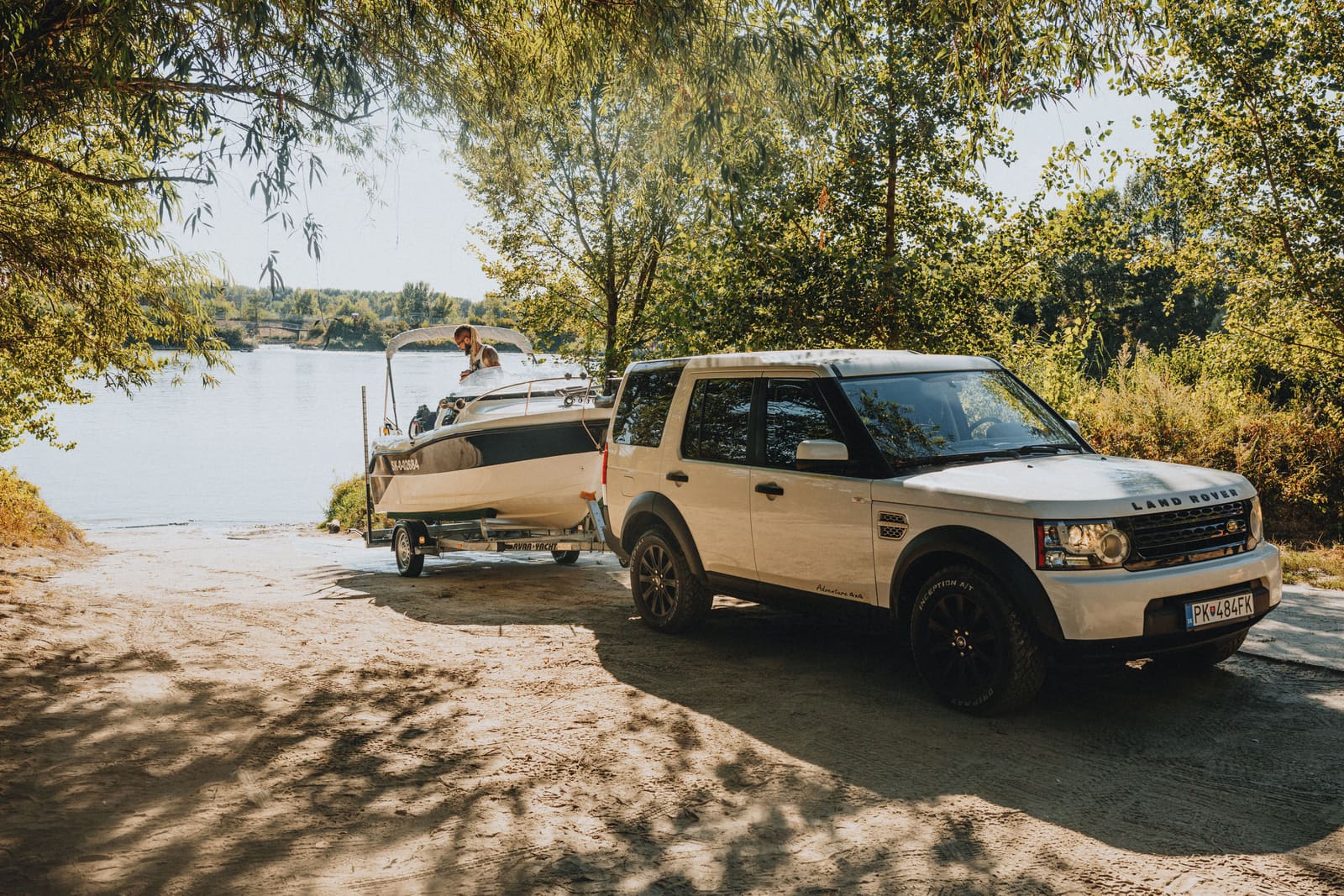
Get Your Boat Ready for the Road: Pre-Trailering Checklist
Most trailering trouble starts in the driveway: an engine left without support, a loose strap, a cover that balloons at 60 mph, gear that blows out or tongue weight that makes the rig sway. Work through this checklist before every trip and do a quick walkaround at each stop.
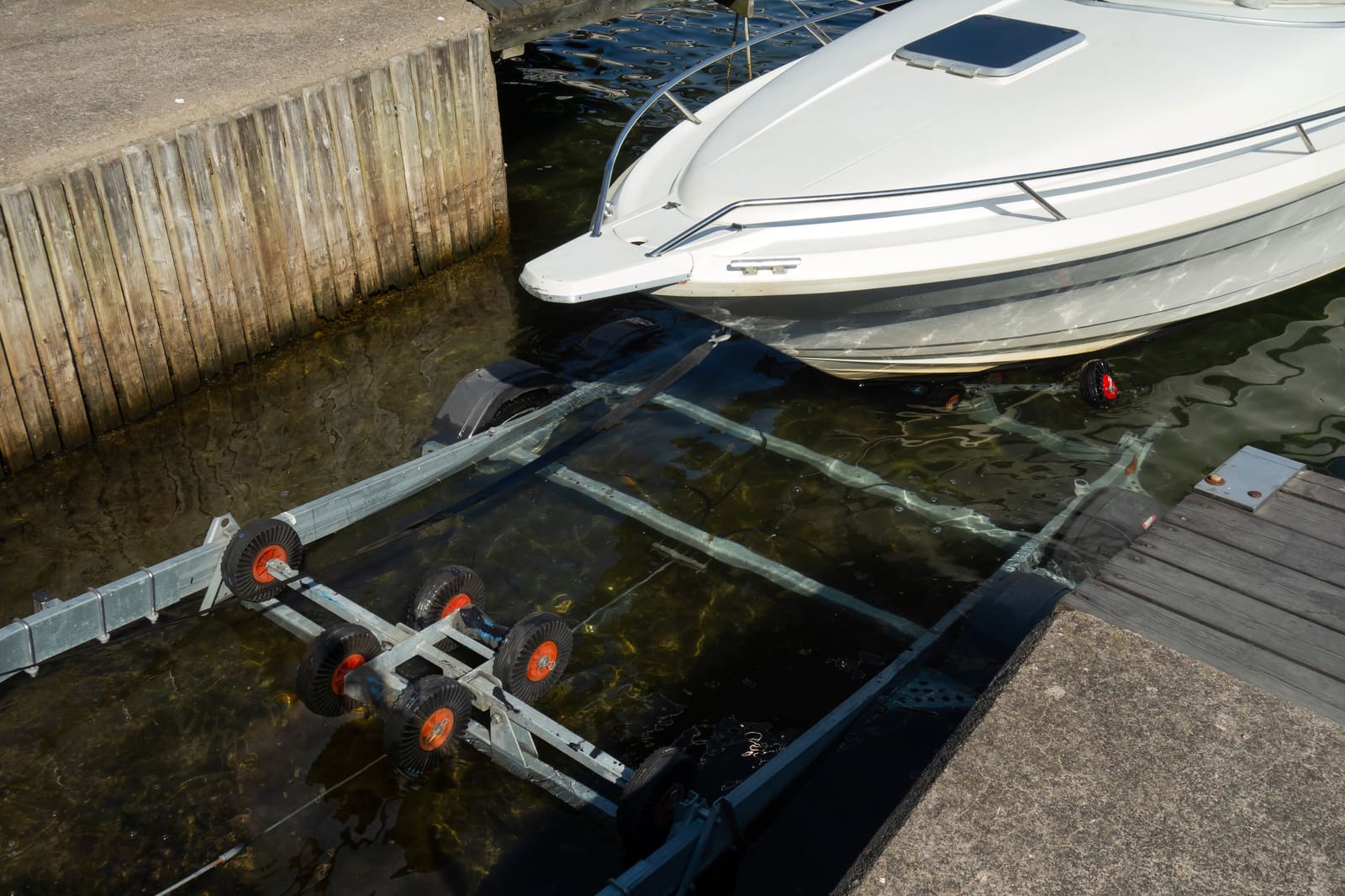
How to Check and Care for Boat Trailer Surge Brakes
Understand how the hydraulic surge brakes on your boat trailer work, check the fluid, use the reverse lockout correctly and rinse salt out of them after every dunk. Simple habits that keep the brakes from seizing, dragging or failing when you need them.
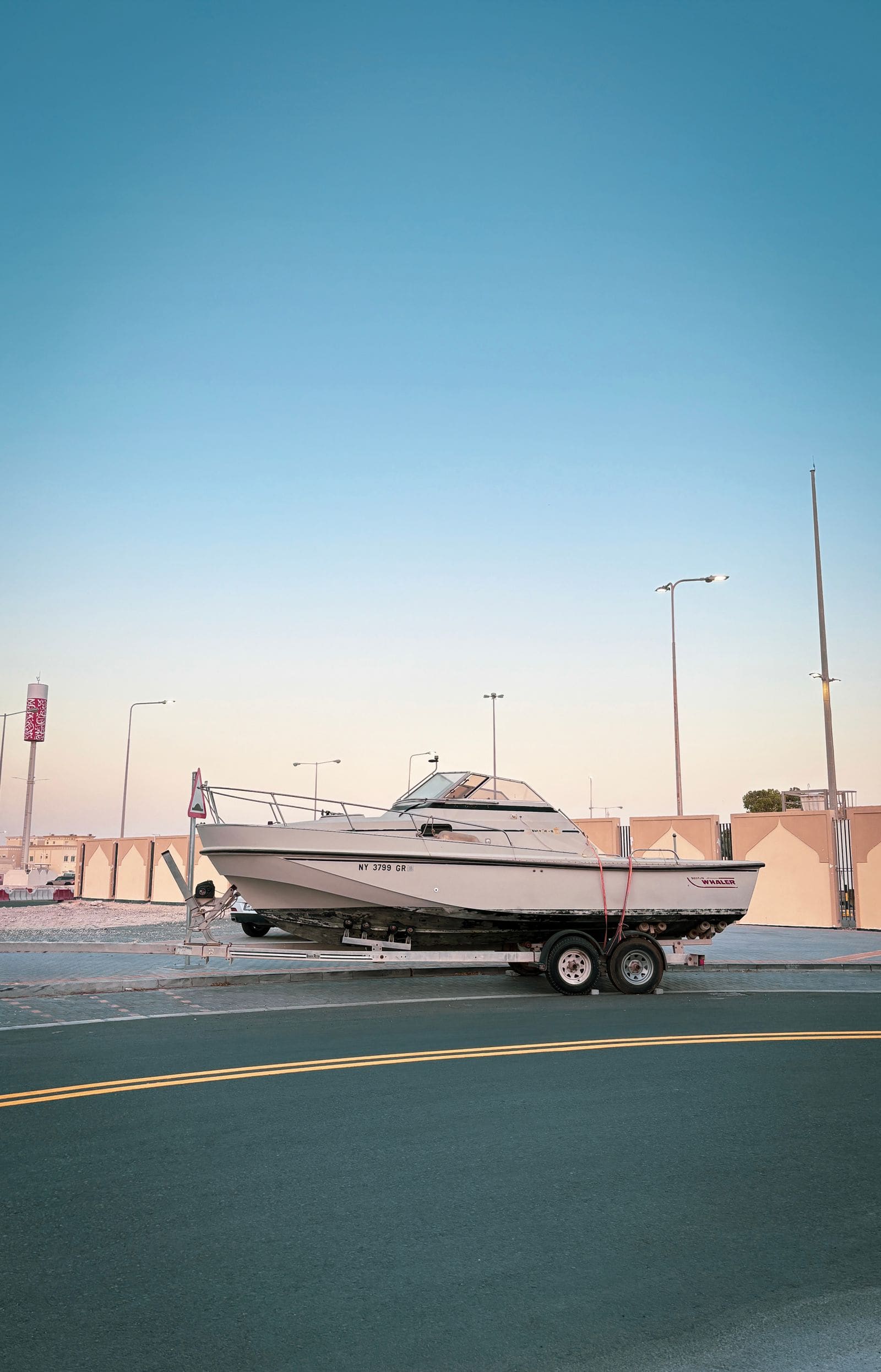
Electric-Over-Hydraulic and Electric Trailer Brakes: Controller Setup, Breakaway and Care
Why most boat trailers use surge or electric-over-hydraulic (EOH) brakes instead of plain electric drums, how to pick a compatible in-cab brake controller and set its gain, how to test the breakaway switch and battery, and how to keep the system working around saltwater.
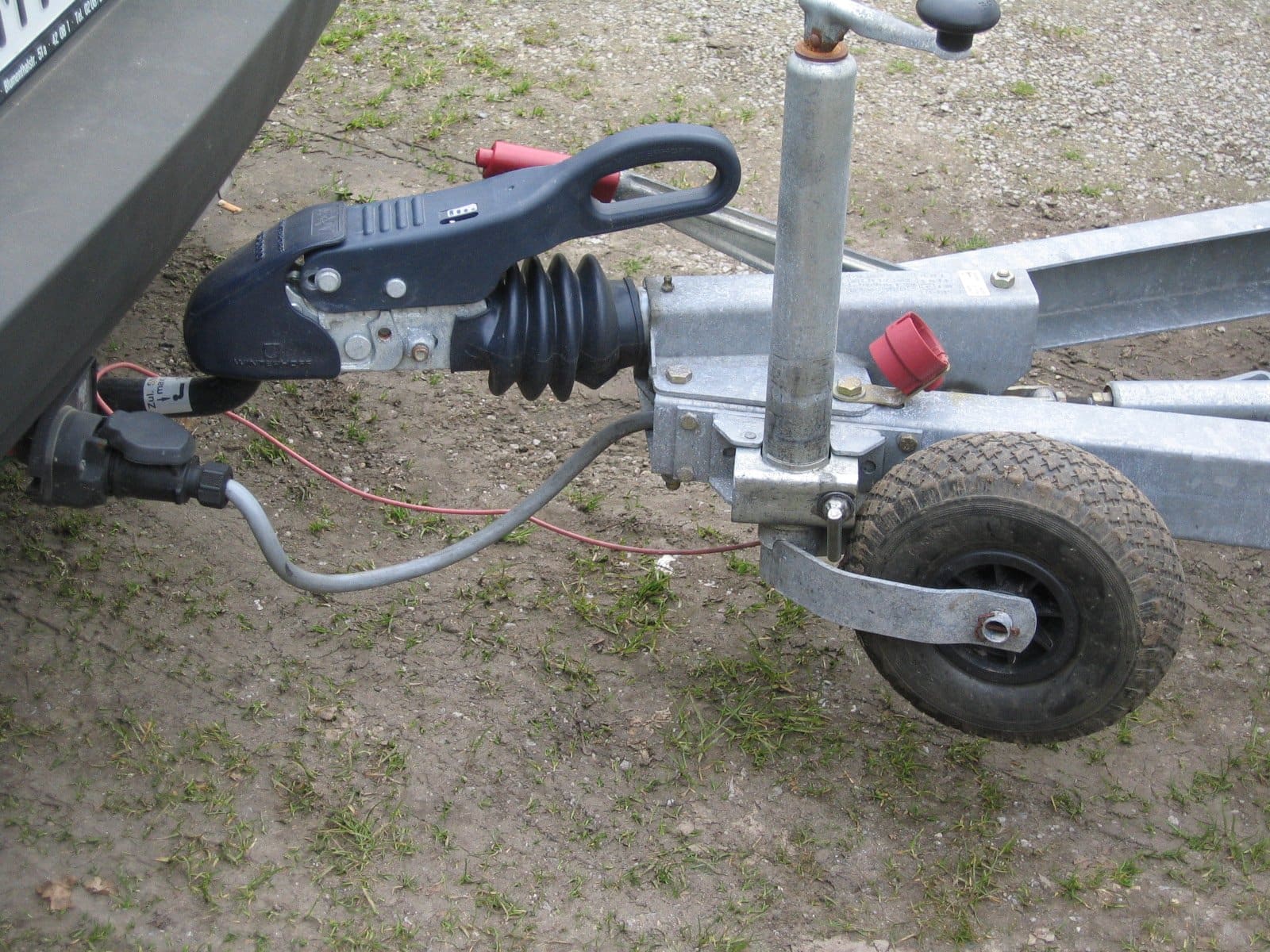
Trailer Tongue Jack and Coupler Care: Grease, Adjust and Know When to Replace
The tongue jack and coupler take a beating from weight, road grit and launch-ramp dunking. A few minutes of cleaning and grease a couple of times a season keeps the jack cranking smoothly and the coupler locking tight on the ball, and tells you when either part is worn out.
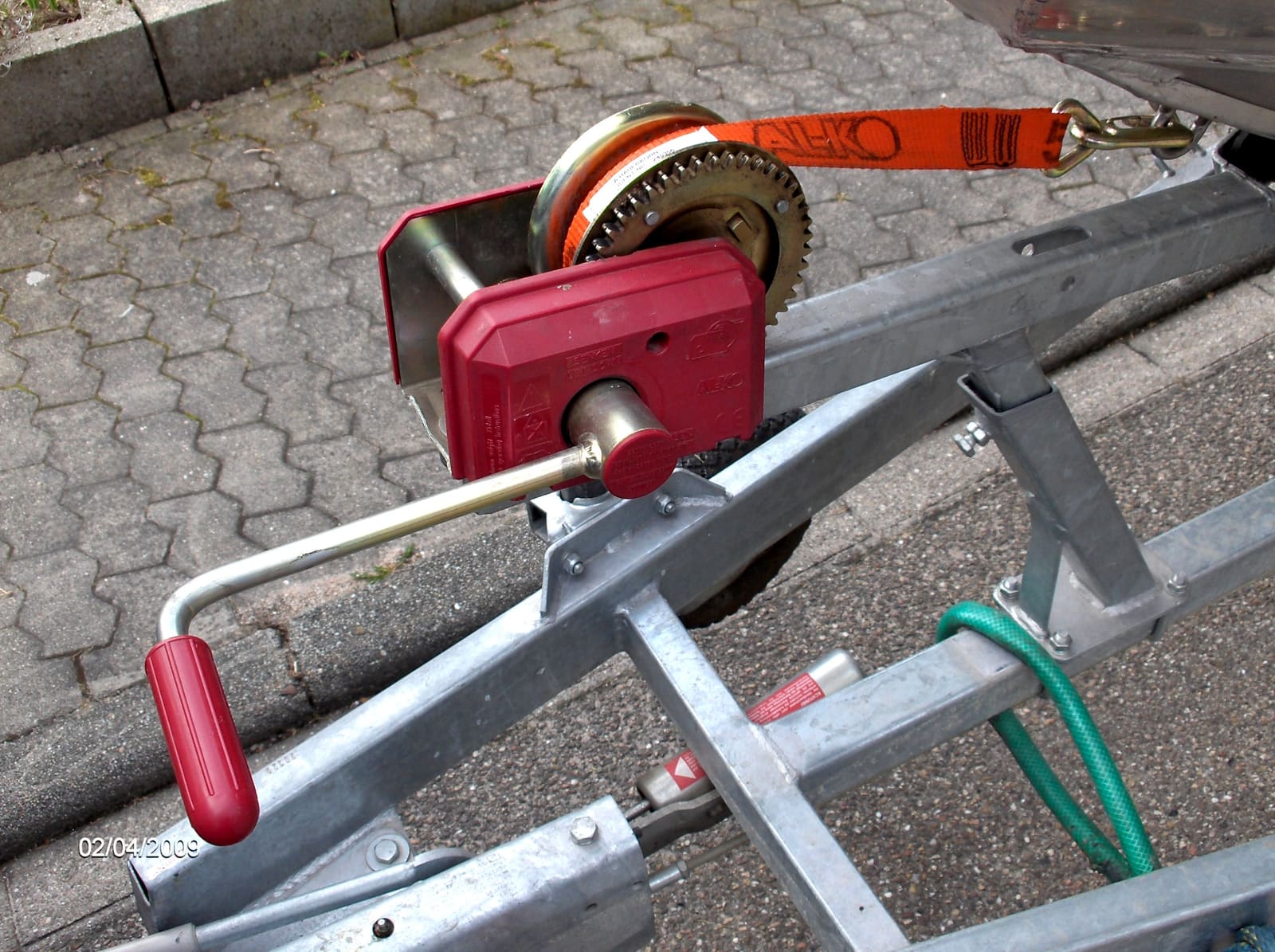
How to Inspect and Use the Trailer Winch, Strap, Tie-Downs and Safety Chains
Check the winch, strap or cable, bow safety chain, transom tie-downs and the safety chains to your vehicle, and learn how each one is meant to be used. These parts keep the boat on the trailer and the trailer behind your truck.
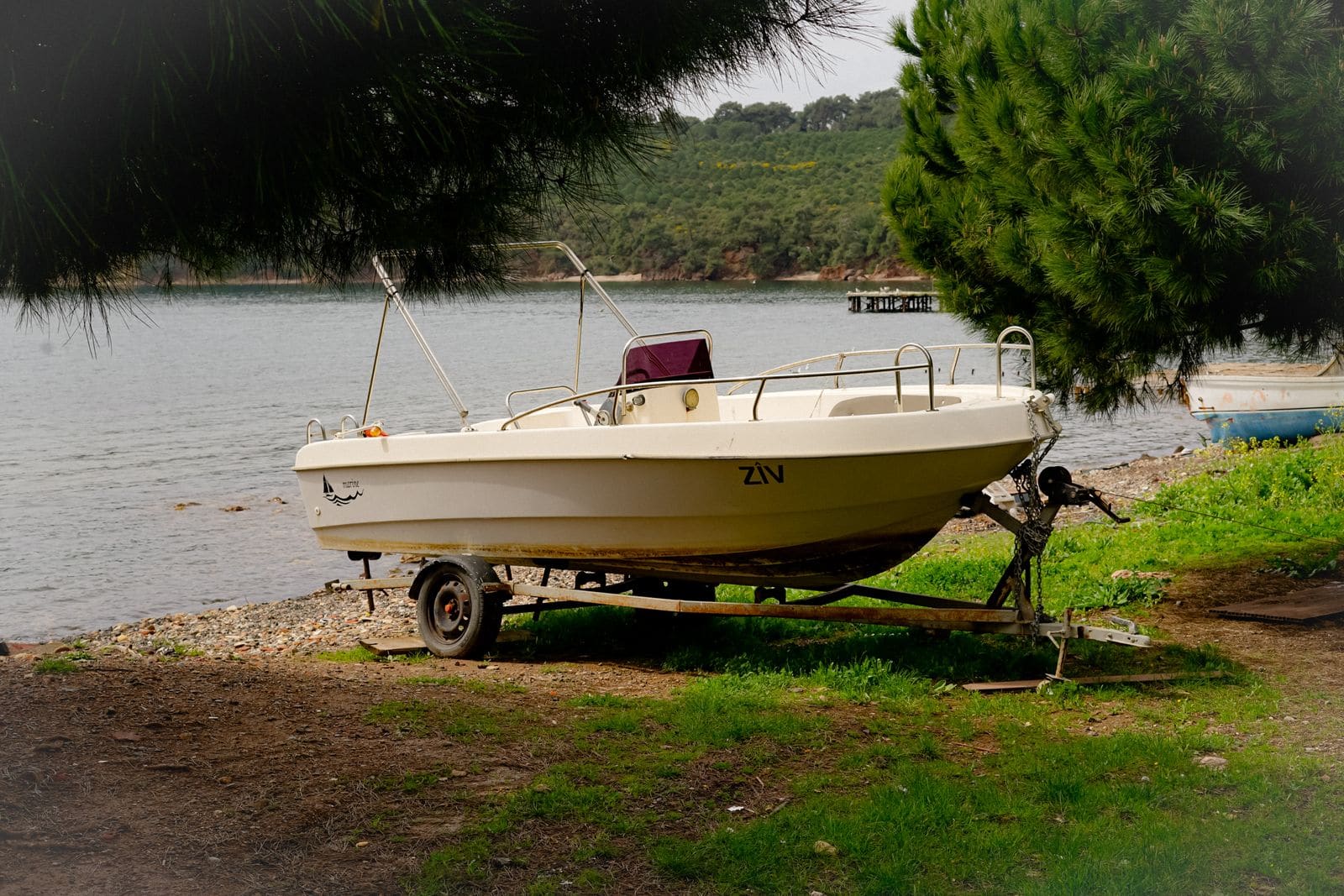
How to Inspect, Inflate and Replace Boat Trailer Tires
Check your trailer tires the way the pros do: the right type (ST), the right load range, the right cold pressure, and an honest look at their age. Tires are the number one reason boat trailers end up on the side of the highway.
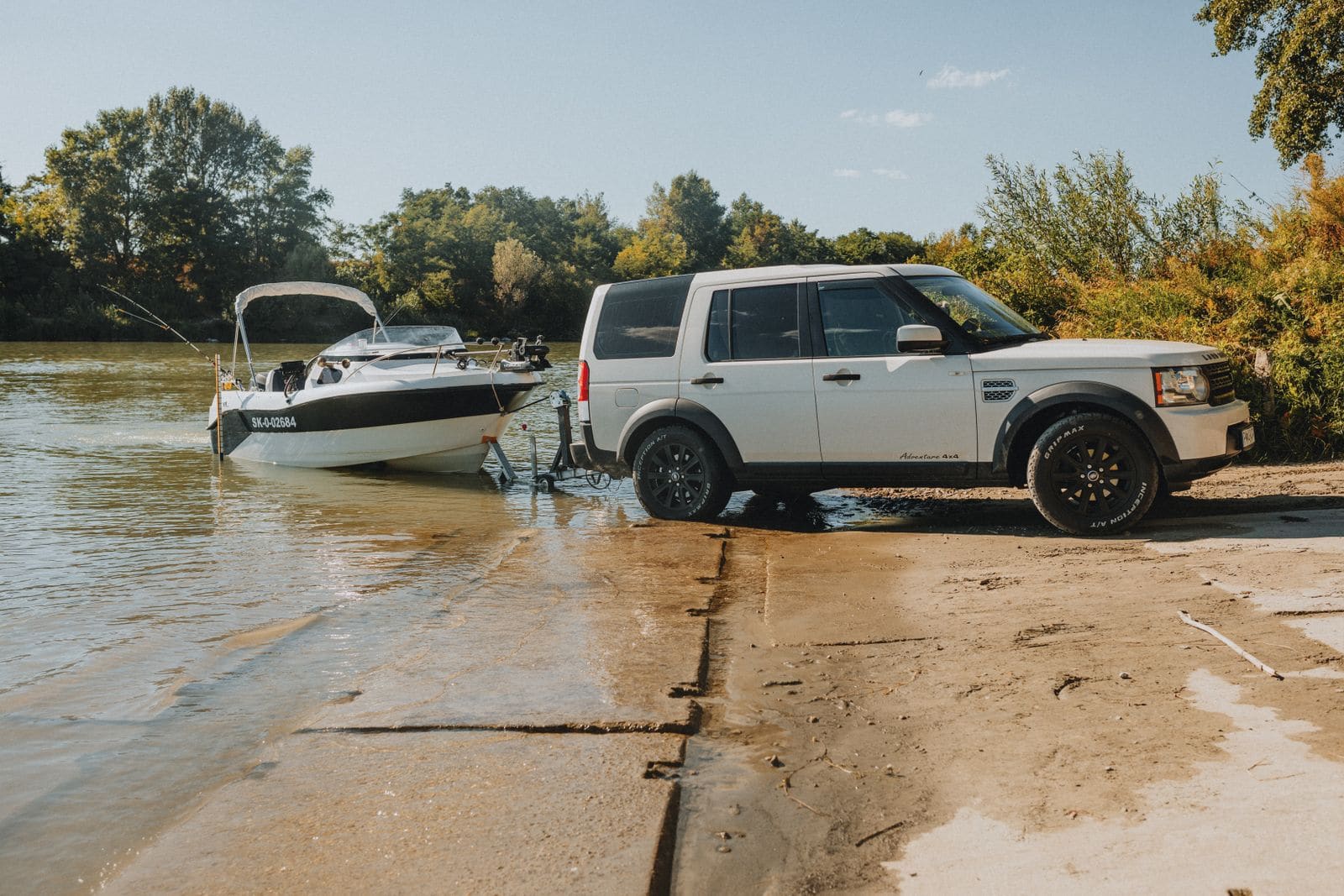
Launch Day and Haul-Out Checklist for Trailer Boats
A step-by-step checklist for getting your boat off the trailer and back on again safely and quickly, from the drain plug and tie-downs to the blower and ramp etiquette. Following it in order prevents the classic mistakes that sink boats and back up the ramp.