How to Inspect and Use the Trailer Winch, Strap, Tie-Downs and Safety Chains
Check the winch, strap or cable, bow safety chain, transom tie-downs and the safety chains to your vehicle, and learn how each one is meant to be used. These parts keep the boat on the trailer and the trailer behind your truck.
Time
45 min
Shop would charge
$50-200
Applies to
All engines
Safety first: A winch strap or cable under load stores a lot of energy. If it breaks or the hook slips, it can whip back hard enough to cause serious injury. Never stand in line with the strap and the winch, never step over a loaded strap, keep kids and helpers clear, and keep one hand on the crank handle until the ratchet is engaged (a released handle can spin and kick back). Never use the winch to lift or move people.
Owners often ask
- Is the winch strap enough to hold my boat on the trailer on the highway?
- Should the trailer safety chains be crossed under the tongue?
This guide walks you through it. Still stuck? Ask the AI Mechanic about your engine.
Tools
- Work gloves (leather is best around wire cable)
- Flashlight
- Wire brush and rags
- Light oil or the lubricant your winch maker recommends
- Wire rope lubricant (only if you have a wire cable)
- Wrenches to fit the winch and winch stand bolts
Parts & supplies
- Replacement winch strap or cable with hook, rated for your winch (when worn)
- Transom tie-down straps (when worn)
- Bow safety chain or strap with a working latch (if missing or worn)
- Hitch pin and clip, and S-hooks or clevis hooks for the safety chains (when worn)
Before you start
These parts do different jobs, and owners get in trouble when they mix them up:
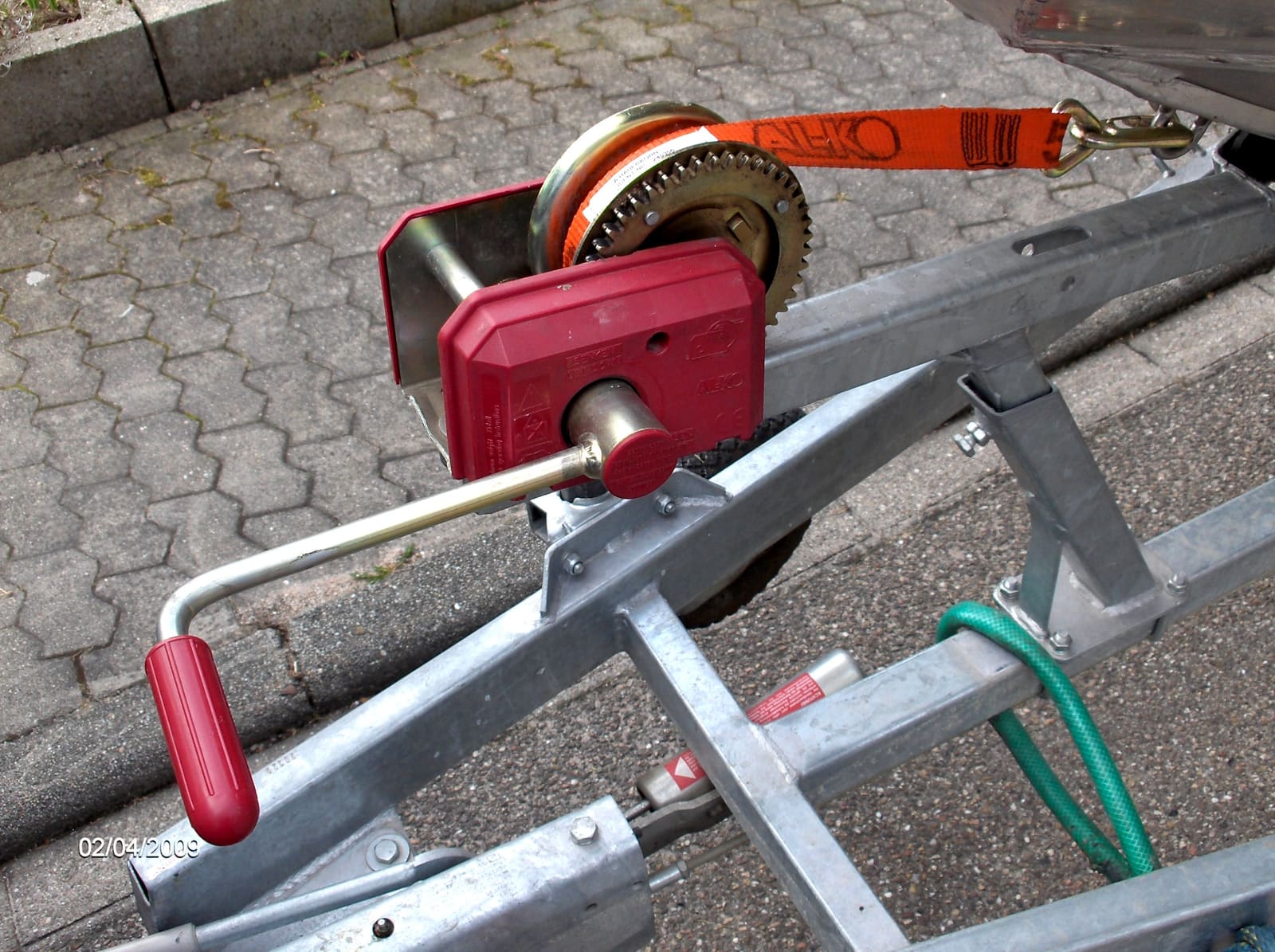
- Winch and strap (or cable): pulls the boat onto the trailer and lets it down at the ramp. It is not a tie-down. West Marine says this plainly, and trailer owner's manuals say the same.
- Bow safety chain (or bow strap): a short chain or strap from the winch post to the bow eye that holds the boat forward if the winch strap lets go.
- Transom tie-downs: straps from the back of the trailer to the stern eyes that keep the boat from bouncing or sliding back on the road. Some boats also need a strap over the gunwales.
- Safety chains (trailer to vehicle): two chains from the trailer tongue to the tow vehicle's hitch that keep the trailer attached if the coupler comes off the ball.
Strap, rope or cable. Polyester webbing straps are the usual choice now: they don't develop sharp broken wires, are gentler on hands and the bow, and handle fresh and salt water. Wire cable is strong but frays into sharp strands and needs regular lubrication. Polypropylene rope is light but breaks down in sun and abrasion.
How often: look at the strap, hook and chains every time you use the trailer (Dutton-Lainson says to inspect the strap and hook at each use). Do the full inspection below at the start of each season and after any hard retrieval.
Steps
With the boat off the trailer or fully supported, unwind the strap or cable all the way. Look and feel (with gloves) for:
- Strap: fraying, cuts, nicks at the edges, hardened or faded spots from sun, stitching coming loose near the hook, burn or glazed marks
- Cable: broken wires, kinks, flattened spots, bird-caging (strands opening up), rust, damaged swaged fittings
- Rope: fuzzy, stiff or faded sections, cuts, chafe
Replace it at the first sign of wear. Dutton-Lainson and West Marine both say so plainly. A strap is cheap; a boat sliding off the trailer at the ramp is not.
The hook should not be bent open, cracked or worn thin where it bears on the bow eye. If it has a safety latch, the latch should snap closed on its own. Replace the strap and hook together if the hook is damaged.
Crank in and out with no load. It should turn smoothly, and the ratchet pawl should click and hold. Flip the pawl to free-spool (if your winch has that) and back. Look for:
- A pawl that doesn't snap into the gear, or worn, chipped teeth
- Loose or missing bolts holding the winch to the stand
- A bent or cracked winch post or stand
- Rust on gears and shafts
Clean off dirt and old grease, then lubricate gears, the shaft and the pawl with the lubricant your winch maker recommends. Keep oil and grease off the strap.
The strap end must be fastened to the drum as the maker intended (usually a bolt through a loop). Wind it on evenly, not bunched to one side. Winch and trailer instructions commonly call for leaving a few full wraps on the drum at all times (three is a figure you'll often see), so the strap never pulls on its anchor bolt under load. Check your winch's own instructions for the exact number.
West Marine's rule of thumb is a winch rated for at least three-quarters of the loaded weight of your boat, motor, fuel and gear, and closer to the full weight for steep ramps or carpeted bunks. If you struggle to crank, the bunks may need slick pads or adjustment, or the winch may be undersized. Any replacement strap must be rated for your winch (Dutton-Lainson, for example, specifies a strap rated higher than the winch).
Also look at the angle. With the boat sitting fully forward against the bow stop, the strap should run roughly straight from the drum to the bow eye, pulling level or slightly downward, not up at a steep angle. If you changed boats, bunks or the bow stop, the winch post may need moving. The trailer maker's setup instructions or a trailer shop can set it up.
Check the chain links for rust, stretch or cracks, and check the snap hook or latch. It should reach the bow eye with only a little slack. A bow chain that hangs loose doesn't stop the boat from sliding back much before it catches.
Pull each strap out fully. Replace any with frayed webbing, sun damage, cracked hooks or ratchets that slip or are rusted stiff. Make sure the hooks fit your stern eyes and that the trailer anchor points are solid.
Look at every link, the welds or bolts where the chains attach to the tongue, and the hooks. Replace chains that are worn, stretched, rusted deep, or that have open or bent hooks. Mercury's trailer advice includes checking the safety chains for weak or broken links. Also check that the hitch pin and clip are present and the coupler latch locks.
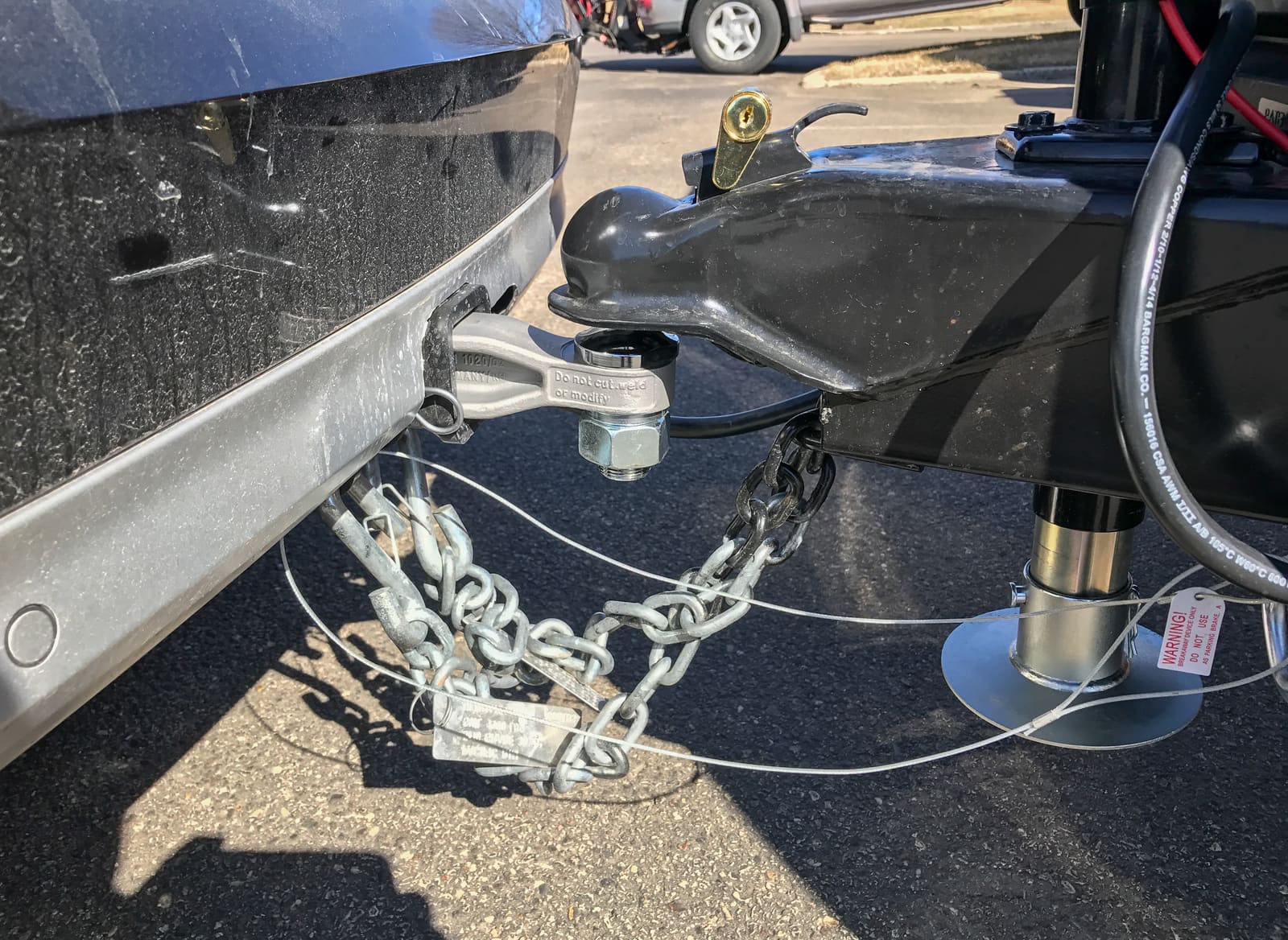
Photo: Tony Webster / Wikimedia Commons · CC BY 2.0 Every trip:
- Lock the coupler on the ball and fit the safety pin.
- Cross the chains under the tongue (left chain to the right side of the hitch, right chain to the left). If the coupler ever comes off, the crossed chains form a cradle that catches the tongue and keeps it off the road.
- Hook them to the hitch's chain loops with the hook opening facing up, or use clevis hooks with closed latches, so they can't bounce off.
- Leave just enough slack to turn sharply without the chains going tight, but not so much that they drag. If they're too long, Mercury suggests twisting them to take up slack.
If your trailer has brakes, clip the breakaway cable (if fitted) to the hitch, not to a safety chain.
After the boat is fully winched onto the bow stop:
- Make sure the ratchet is engaged and the strap is snug.
- Attach the bow safety chain or strap to the bow eye.
- Fasten both transom tie-downs to the stern eyes and snug them firmly, without crushing anything.
- Add a strap across the boat at the gunwales if your boat or trailer maker recommends it, with padding where it touches.
- Support or tilt the motor as your engine maker recommends for trailering.
Discover Boating's trailer tips call for a rope, chain or turnbuckle in addition to the winch at the bow, and straps across the beam if needed.
Straps settle as the boat seats on the bunks. Pull over somewhere safe after a few miles and snug everything again. Check at fuel stops on long trips.
After salt water, rinse the winch, strap, chains and hooks with fresh water. Let straps dry before you roll them up. When the trailer sits, keep the strap wound in and out of the sun if you can, or cover the winch.
Common mistakes
- Towing with only the winch strap holding the boat. The winch is for loading. Use the bow safety chain and transom tie-downs every time.
- Standing behind the winch in line with the strap while cranking or while someone drives the boat on.
- Letting go of the handle with the ratchet released. The handle can spin and hit you.
- Running the strap down to its last wrap on a long ramp.
- Leaving safety chains uncrossed, too long or dragging, or hooking them to the bumper or ball mount instead of the hitch's chain loops.
- Clipping the brake breakaway cable to a safety chain. It should go to the hitch so it can pull if the trailer separates.
- Replacing a worn cable with a cheap strap that isn't rated for the winch.
When to call a pro
- The winch post, bow stop or tongue is cracked, bent or rusted through near a weld
- The winch gears or pawl are worn and the winch slips under load
- You want to switch to a powered winch or move the winch stand (alignment matters for loading)
- The coupler doesn't lock on the ball, is cracked, or the hitch is the wrong size or rating
- Safety chain anchor points on the tongue are damaged and need welding
Tips
- Mark the strap a few feet from the hook with a bright paint pen. When you see the mark at the ramp, you know you're near the end.
- Keep a spare strap and a spare hitch pin and clip in your tow kit. Log the strap's install date in BoatMend.
- Tie-down straps with a rubber or vinyl-covered hook won't scratch gelcoat at the stern eyes.
- Wear gloves when handling wire cable. Broken strands cut deep.
Official references
We read these to write this guide. Your engine's own manual always wins.
- West Marine – How to Choose a Trailer Winch for Your Boat
- West Marine – DIY Safe and Trouble-Free Boat Trailering
- Dutton-Lainson – 6250 Heavy Duty Winch Strap and Hook (safety note)
- Mercury Marine – Boating Basics, Getting Ready to Tow
- Mercury Marine – Basic Boat Trailer Maintenance
- Discover Boating – Boat Trailer Tips
Safety: BoatMend is for information only and does not replace a certified marine technician. You are responsible for your safety and your boat. Read the full disclaimer.
Last updated 2026-10-23
Related guides
How to Inspect, Inflate and Replace Boat Trailer Tires
Check your trailer tires the way the pros do: the right type (ST), the right load range, the right cold pressure, and an honest look at their age. Tires are the number one reason boat trailers end up on the side of the highway.
How to Check and Care for Boat Trailer Surge Brakes
Understand how the hydraulic surge brakes on your boat trailer work, check the fluid, use the reverse lockout correctly and rinse salt out of them after every dunk. Simple habits that keep the brakes from seizing, dragging or failing when you need them.
How to Inspect and Repack Boat Trailer Wheel Bearings
Check, clean and repack your trailer's wheel bearings so a seized hub does not leave you stranded on the highway. Boat trailers get dunked in water every launch, which makes their bearings fail far more often than those on dry utility trailers.
How to Adjust and Replace Trailer Bunks and Rollers So Your Boat Sits Right
Set up your boat trailer so the hull is supported in the right places: bunks and rollers clear of the strakes, the transom fully supported, the bow snug against the winch stop and the weight balanced on the tongue. Also covers replacing rotten bunk boards and worn carpet or rollers.
How to Fix Boat Trailer Lights That Flicker, Dim or Don't Work
Track down the real cause of dead or flickering trailer lights, from a bad ground to a corroded plug, and fix it so the repair lasts. Working brake, turn and tail lights are required by law and keep the driver behind you from rear-ending your boat.
Launch Day and Haul-Out Checklist for Trailer Boats
A step-by-step checklist for getting your boat off the trailer and back on again safely and quickly, from the drain plug and tie-downs to the blower and ramp etiquette. Following it in order prevents the classic mistakes that sink boats and back up the ramp.