Electric-Over-Hydraulic and Electric Trailer Brakes: Controller Setup, Breakaway and Care
Why most boat trailers use surge or electric-over-hydraulic (EOH) brakes instead of plain electric drums, how to pick a compatible in-cab brake controller and set its gain, how to test the breakaway switch and battery, and how to keep the system working around saltwater.
Time
1 h
Shop would charge
$800-2500
Applies to
All engines
Safety first: Brakes that grab, drag or don't work at all can cause a jackknife or a crash. Do the gain test only in an empty lot or quiet road at low speed. Never tow with the breakaway battery dead or the breakaway cable hooked to the safety chains. Brake wiring and hydraulic work (new actuator, lines, bleeding) is best left to a trailer shop unless you've done it before. If a brake smokes or a wheel locks on the road, pull over safely, let it cool and call for help; don't keep driving on it.
Owners often ask
- Will my truck's built-in brake controller work with electric-over-hydraulic trailer brakes?
- How do I set the gain on my trailer brake controller?
- Does the breakaway battery on my trailer have to be charged for the brakes to work?
This guide walks you through it. Still stuck? Ask the AI Mechanic about your engine.
Tools
- Owner's manuals for the brake controller and the brake actuator
- Empty parking lot or quiet road for the gain test
- Multimeter (12 V check of the 7-way plug and breakaway battery)
- Dielectric grease
- 7-way plug tester (handy, not required)
- Hose with fresh water
Parts & supplies
- In-cab brake controller listed as compatible by your actuator or brake maker (if the vehicle doesn't have one)
- Breakaway battery of the type and rating the actuator maker specifies
- Brake fluid of the type printed on the actuator reservoir
- Replacement 7-way plug or socket if the pins are corroded
Before you start
Which system do you have? Look at the trailer tongue:
- Surge brakes: the coupler itself is a big actuator with a master cylinder. When the tow vehicle slows, the trailer pushes forward and squeezes the brakes. No in-cab controller. Our surge brake guide covers these.
- Electric-over-hydraulic (EOH): a sealed box (the actuator) mounted on the tongue, with an electric pump and fluid reservoir, plus a small breakaway battery box. It's wired to the 7-way plug and needs an in-cab brake controller. The brakes at the wheels are still hydraulic disc or drum brakes.
- Electric drum brakes: no hydraulic lines at all; wires run to magnets inside each drum. Also needs an in-cab controller.
Why boat trailers mostly use surge or EOH: BoatUS describes surge brakes as the most popular on boat trailers, because the whole system lives on the trailer and any vehicle with the right ball can tow it. Plain electric drum brakes put magnets and wiring inside drums that get dunked at every launch, which is why many boaters avoid them, especially in saltwater. EOH keeps the electrics up on the tongue and out of the water while giving you in-cab control.
When EOH makes sense: BoatUS reports that brake makers suggest EOH once the boat weighs more than about 3,500 lb. It also points out a ramp issue: with surge brakes, backing a heavy boat down a ramp uses only the tow vehicle's brakes, while EOH lets the trailer brakes help.
Does the law require brakes on your trailer? It depends on the state. BoatUS's used-trailer checklist says 3,000 lb is the threshold in 35 states, but some states want brakes on trailers as light as 1,500 lb and others allow up to 4,500 lb without them. Discover Boating adds that a few states have no brake rule at all, others require brakes on every trailer, and on tandem trailers some states require brakes on all axles while others accept one braked axle. Check your state DMV and every state you tow through.
Steps
This is the most common EOH headache. BoatUS found that compatibility varies between the actuator maker, the trailer maker and the vehicle's model year:
- Some factory-installed truck controllers don't work with some EOH actuators. One trailer maker quoted by BoatUS blamed a digital-versus-analog signal mismatch; some setups need an adapter.
- Check the actuator maker's list of compatible controllers before buying anything. Some EOH actuators call for a specific controller type and a minimum controller output.
There are two main controller styles:
- Proportional (inertia or pedal-based): senses how hard the vehicle is slowing and applies the trailer brakes to match. BoatUS notes these are what most factory tow packages use. Most owners find them smoother.
- Time-delay: ramps the trailer brakes up over time to a level you set. BoatUS warns that if it's set too low, the tow vehicle's brakes end up doing most of the work.
- The 7-way plug carries the brake controller's output to the trailer, plus a 12 V charge line for the breakaway battery and a ground.
- Wire size matters on EOH: the pump draws real current. Follow the actuator maker's wire gauge for the distance from the plug.
- A good ground is critical. For electric drum brakes, Dexter recommends running a common ground wire from the plug to the magnets rather than grounding each brake to the frame, and wiring the brakes in parallel.
- Keep the vehicle's socket covered when not towing; Discover Boating suggests a cap and a little dielectric grease to keep the pins clean.
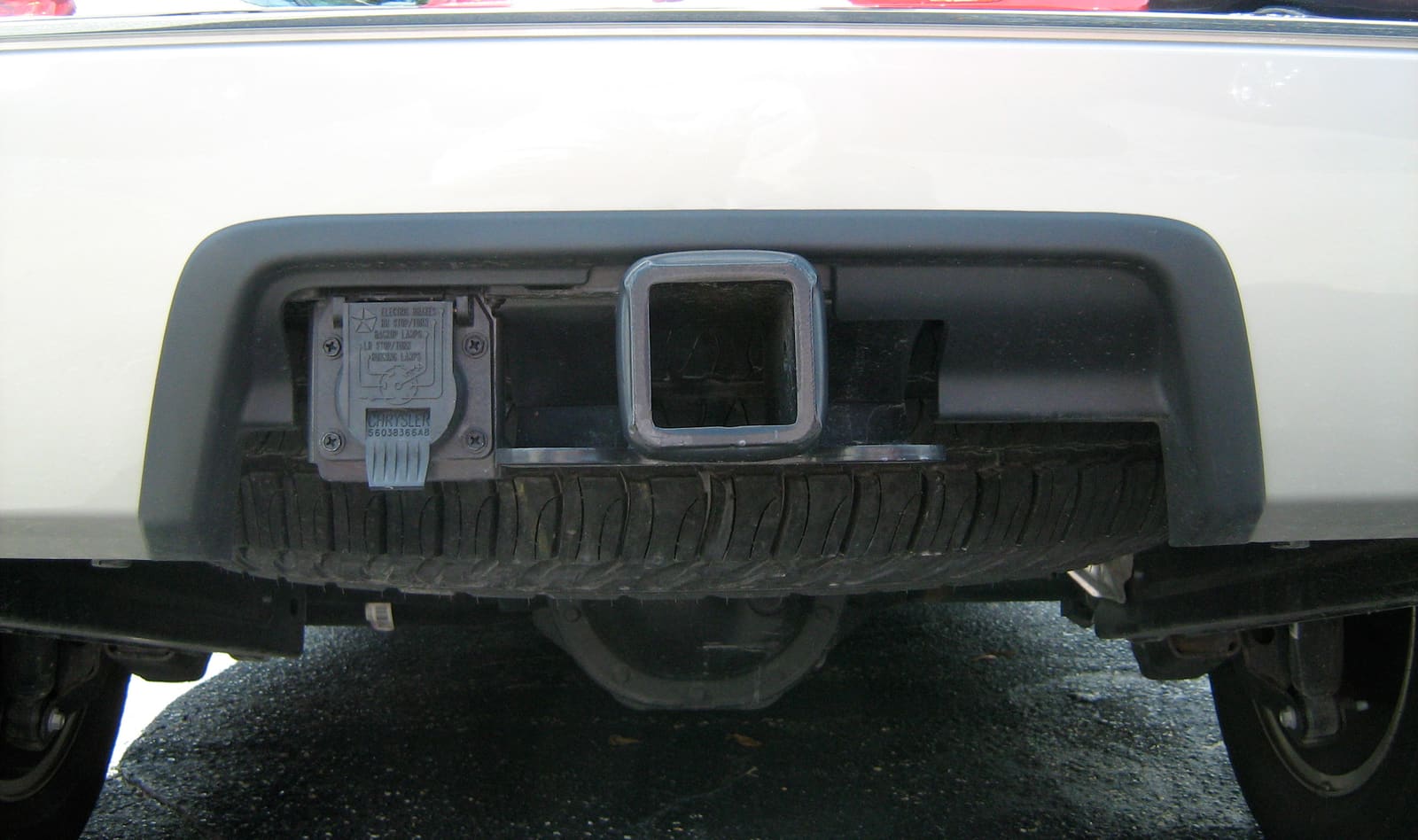
The 7-way socket carries the brake controller signal and the breakaway battery charge line. Photo: CZmarlin (Christopher Ziemnowicz) / Wikimedia Commons · Public domain BoatUS reports that EOH actuator makers ask that the unit not be submerged at the ramp. It's built to handle rain and road spray, but it isn't a submersible part. That's why it's mounted as far forward on the tongue as possible.
- Back down only as far as you need, so the actuator stays out of the water.
- Light rinsing is fine; BoatUS suggests not aiming a pressure washer at the actuator, including at invasive-species wash stations.
If the trailer ever comes off the ball, a breakaway switch on the tongue applies the trailer brakes on its own:
- A cable runs from a pin in the switch to the tow vehicle. If the trailer separates, the cable pulls the pin and the actuator pumps the brakes on.
- On EOH and electric brakes, a breakaway battery on the trailer powers that emergency stop. BoatUS notes a breakaway kit with its own battery is required on EOH trailers.
- Clip the cable to the tow vehicle's hitch or frame, not to the safety chains or ball mount, so it pulls only if the trailer actually separates.
- Give it enough slack for tight turns, but not so much it drags.
- When the 7-way plug is wired with a charge line, the tow vehicle tops up the battery while you drive. If that circuit isn't wired, the battery slowly goes flat.
- Check it at the start of each season and before long trips: many battery boxes have a test button or gauge, or you can check it with a multimeter. Follow the actuator maker's spec for voltage and battery type.
- Replace it on the maker's schedule or as soon as it won't hold a charge. A dead breakaway battery means no emergency braking.
- How long should it hold? For commercial trailers, the federal motor carrier rule (49 CFR 393.43) says breakaway brakes must apply immediately and stay applied for at least 15 minutes. It doesn't directly govern most private boat trailers, but it's a good yardstick for what a healthy battery should do. Your state's trailer rules decide what's legally required for you.
- Owners often ask whether the battery "has to be charged to work." Yes: on EOH and electric brakes, the breakaway stop runs on that battery alone, because the trailer has just lost its connection to the truck.
Read the controller manual first; settings vary by model.
- Mounting angle: inertia-sensing controllers must be mounted within the angle range their manual gives, and some need to be leveled or calibrated after installation.
- Mode: some controllers have a separate setting for EOH or electric brakes. Choose the one that matches your trailer.
- Boost (if fitted): start with it off or at the lowest setting until the basic gain is set.
"Gain" (also called power or output) sets how hard the trailer brakes can work. The general method, as Wikipedia summarizes it, is to set the gain as high as you can without the trailer brakes locking after a few test stops. Most controller manuals describe a version of this:
- Hitch the loaded trailer and go to an empty lot or quiet road.
- Start with the gain around the middle of the scale.
- Drive straight at a low speed (often around 20 to 25 mph; use your manual's number).
- Apply only the controller's manual lever or button fully, not the brake pedal.
- If the trailer wheels lock or the trailer jerks you hard, turn the gain down. If the stop feels weak and the trailer pushes, turn it up.
- Repeat until the trailer brakes are strong but just short of locking, then use the pedal for a few normal stops to confirm it feels smooth.
Dexter points out that a fully loaded trailer with healthy electric brakes may never lock up, because electric brakes are designed to slow the trailer at a controlled rate. In that case, aim for a firm, smooth stop that clearly helps the tow vehicle.
- Empty trailer, lower gain; loaded, higher. BoatUS gives an example of a numbered controller set around 3 or 4 with the boat off and around 8 with the boat on; your numbers will differ.
- Wet or gravel roads: reduce gain a little so the trailer wheels don't skid.
- If you feel the trailer pushing you when you brake, the gain is too low. If stops feel jerky or the trailer tugs back hard, it's too high.
- New pads or shoes need breaking in. Dexter says new electric brake shoes and magnets can take more than 100 stops to burnish fully, so retest the gain after a brake job.
With the trailer hitched and the 7-way plug connected (so the actuator is powered):
- Chock the trailer wheels or have a helper ready.
- Pull the breakaway pin briefly. On EOH you should hear the pump run; on electric drums you'll hear or feel the brakes engage.
- Try to roll the rig forward slowly: the trailer brakes should resist.
- Put the pin back right away. Leaving it out drains the breakaway battery and keeps the brakes applied.
If nothing happens, check the battery, the switch and the connections. Saltwater corrodes breakaway switches; a little dielectric grease on the switch contacts helps.
- BoatUS stresses rinsing brakes, springs and metal parts with fresh water after every launch, and Discover Boating says to rinse saltwater off brakes as soon as possible. Many boat trailers have a built-in flush fitting.
- Load Rite adds: don't put the trailer away wet. Tow it a few miles to air-dry the brakes and hardware.
- BoatUS notes drum brakes are hard to flush completely, which is one reason many saltwater owners choose discs.
At least every season (BoatUS's sources recommend a check at the start of each season and during it):
- EOH reservoir: check the fluid level and condition as the actuator manual shows. A falling level means pad wear or a leak.
- Lines and hoses: look for rust on steel lines, cracks on rubber hoses and wet spots at fittings. BoatUS notes EOH runs higher pressures than surge (about 1,000 psi for drums and 1,500 for discs, versus 400 to 800 for surge), so lines must be rated for it.
- Pads, shoes and rotors: BoatUS reminds owners that the trailer is behind you, so you may never hear a squealing wear indicator. Look.
- Electric drum brakes: Dexter explains how to measure voltage at a magnet with the engine running. It should rise smoothly from 0 to about 12 V as you slowly apply the controller; a sudden jump means harsh, grabby braking.
- Controller says "no trailer" or "open": corroded 7-way pins, a broken ground, or a cut wire along the tongue. Clean, grease and test the plug first.
- Brakes weak: gain too low, controller incompatible with the actuator, low fluid, air in the lines, or worn pads. Dexter says most electric brake problems that adjustment can't fix are electrical, so measure voltage and current.
- Brakes grabby: gain or boost too high, or a controller with a high starting voltage. Dexter notes a threshold above about 2 V can make brakes harsh.
- Brakes drag or hubs get hot: stuck caliper or wheel cylinder, often from corrosion. Get it to a shop.
- Surge trailer locks up backing uphill: that's the surge reverse lockout, not the EOH system. EZ Loader says its disc surge actuators use a reverse solenoid that needs the 5-way plug connected; check the vehicle's backup fuse (our surge brake guide has more).
Common mistakes
- Buying a controller (or relying on the truck's built-in one) without checking the EOH actuator maker's compatibility list.
- Dunking the EOH actuator at a deep ramp or pressure-washing it.
- Clipping the breakaway cable to the safety chains or the ball mount.
- Never checking the breakaway battery until the day it's needed.
- Leaving the gain at one setting whether the boat is on the trailer or not.
- Setting a time-delay controller so low that the tow vehicle does all the stopping.
- Putting a saltwater trailer away wet.
When to call a pro
- Installing a controller, actuator or 7-way wiring, or converting from surge to EOH
- Any brake line, hose or fitting leak, or brakes that won't bleed firm
- A brake that drags, smokes, or stays hot after a short drive
- Controller faults you can't trace to the plug or ground
- The trailer pushes or sways under braking even after the gain test
Tips
- Write your "boat on" and "boat off" gain settings on a piece of tape next to the controller.
- Pull the breakaway pin as part of your season-opening checklist, along with lights and tire pressure.
- Keep a spare breakaway pin and a small tube of dielectric grease in the tow vehicle.
- If you share the trailer with another tow vehicle, confirm that vehicle has a compatible controller before the trip, not at the ramp.
Official references
We read these to write this guide. Your engine's own manual always wins.
- BoatUS – Electric Over Hydraulic Brakes
- BoatUS – The Lowdown On Trailer Maintenance (surge, disc and drum brakes)
- BoatUS – Brakes 101, Trailering Maintenance
- Dexter – FAQs, Brakes (electric brake voltage, current, wiring and burnishing)
- Wikipedia – Trailer brake controller (types and gain adjustment)
- Discover Boating – Boat Trailer Maintenance (brakes and saltwater rinsing)
- EZ Loader – FAQ (surge actuator reverse solenoid and backup fuse)
- Load Rite Trailers – FAQs (don't put a trailer away wet)
- eCFR – 49 CFR 393.43, Breakaway and emergency braking (FMCSA)
- BoatUS – Buying A Used Trailer (2015; state brake thresholds)
- Discover Boating – Boat Trailer Laws, Rules and Regulations
Safety: BoatMend is for information only and does not replace a certified marine technician. You are responsible for your safety and your boat. Read the full disclaimer.
Last updated 2026-10-25
Related guides
How to Check and Care for Boat Trailer Surge Brakes
Understand how the hydraulic surge brakes on your boat trailer work, check the fluid, use the reverse lockout correctly and rinse salt out of them after every dunk. Simple habits that keep the brakes from seizing, dragging or failing when you need them.
Get Your Boat Ready for the Road: Pre-Trailering Checklist
Most trailering trouble starts in the driveway: an engine left without support, a loose strap, a cover that balloons at 60 mph, gear that blows out or tongue weight that makes the rig sway. Work through this checklist before every trip and do a quick walkaround at each stop.

Is My Vehicle Rated to Tow This Boat? Towing Capacity, GCWR and Tongue Weight Explained
The towing number in the ad is only one of several limits. Learn which ratings matter (towing capacity, GCWR, GVWR, axle and tongue limits, hitch class and ball rating), how to weigh your real rig at a truck scale, and when you need trailer brakes and towing mirrors.
How to Fix Boat Trailer Lights That Flicker, Dim or Don't Work
Track down the real cause of dead or flickering trailer lights, from a bad ground to a corroded plug, and fix it so the repair lasts. Working brake, turn and tail lights are required by law and keep the driver behind you from rear-ending your boat.
How to Inspect and Repack Boat Trailer Wheel Bearings
Check, clean and repack your trailer's wheel bearings so a seized hub does not leave you stranded on the highway. Boat trailers get dunked in water every launch, which makes their bearings fail far more often than those on dry utility trailers.
Replacing a Boat Trailer Axle: When You Need One and How to Order the Right Size
A bent, rusted-through or undersized axle can't be fixed with new bearings. Learn the signs, the difference between straight, drop and torsion axles, the measurements a supplier needs (hub face, spring centers), what to specify for saltwater, and why this is usually a trailer-shop job.
How to Find and Fix Corroded Electrical Connections on a Boat
Track down the green crust and loose terminals behind flickering lights, dead gauges and slow cranking with a simple voltage-drop test, then remake the connection the marine way: tinned wire, a proper crimp, adhesive-lined heat shrink and a protective coating.