Rudder, Rudder Bearings and Steering Gear Inspection (Sailboats and Inboards)
Check your rudder for play, water inside the blade and stock corrosion, inspect the rudder tube and its seal, and go over cables, sheaves, quadrant and stops so the steering does not fail when you need it. Includes how to find, fit and practice with the emergency tiller.
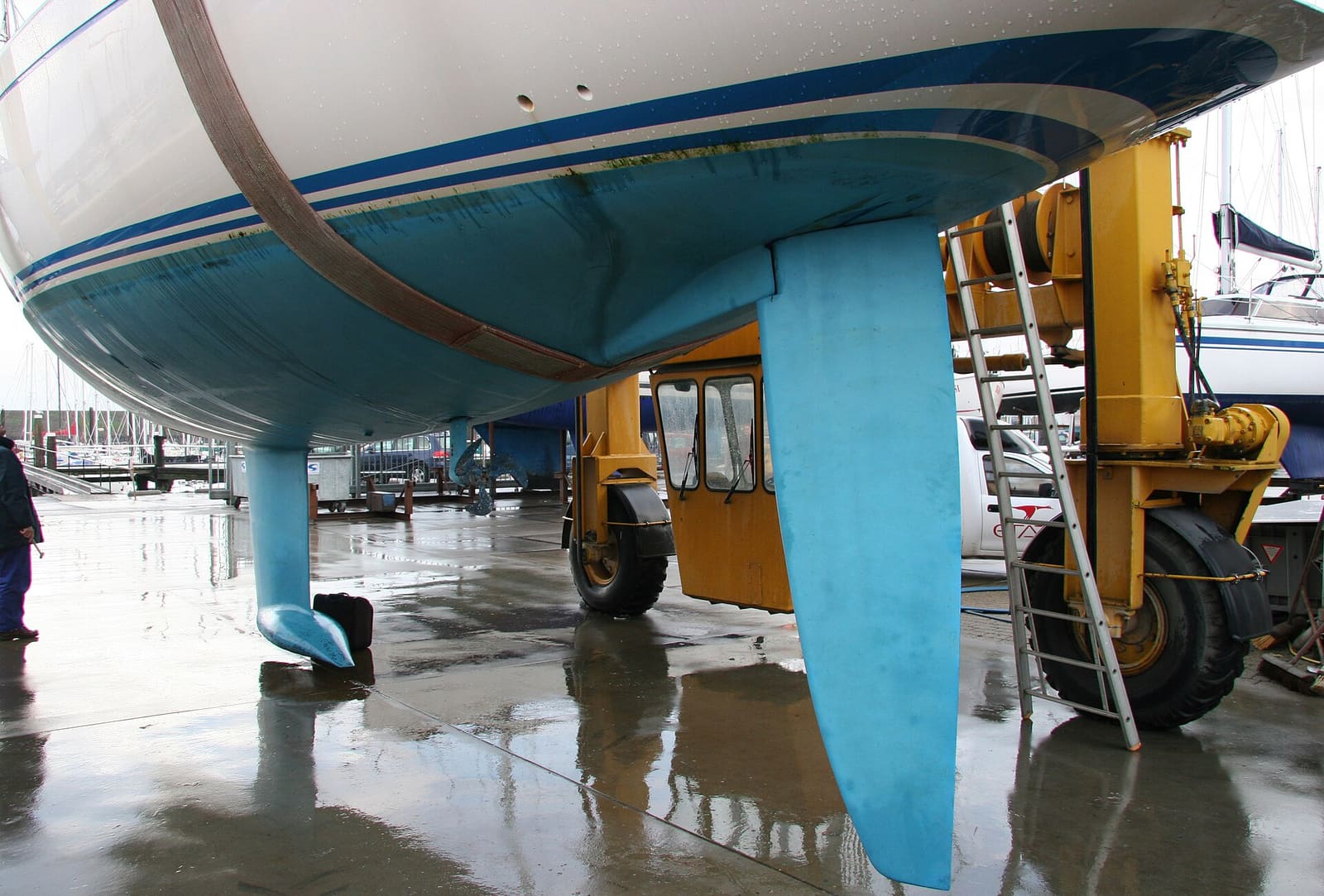
Time
2 h
Shop would charge
$300-1500
Applies to
All engines · Sailboat, Cabin cruiser, Yacht
Safety first: The rudder stock passes through a hole in the bottom of the boat. If you find water coming in around the rudder tube or stuffing box, a cracked tube, or a rudder that clunks or binds, treat it as a possible sinking or loss-of-steering problem: do not go out until it is fixed. If it happens underway, slow down, fit the emergency tiller if you need it, start the bilge pumps and call TowBoatUS, Sea Tow or the Coast Guard on VHF channel 16 (or 911) if you cannot control the boat or the water. Dropping a rudder is heavy, awkward work: leave it to the yard.
Owners often ask
- Rusty water keeps dripping out of my rudder after haul-out. What does that mean?
- How do I check my steering cables for broken strands, and how tight should they be?
This guide walks you through it. Still stuck? Ask the AI Mechanic about your engine.
Tools
- Bright flashlight or headlamp
- Inspection mirror
- Phone camera
- Plastic or rubber mallet, or a screwdriver handle (for sounding the blade)
- Cotton balls or a cotton rag (for checking steering cables)
- Wrenches and sockets that fit the quadrant or tiller-arm bolts
- A helper
Parts & supplies
- Steering lubricants your steering maker specifies
- Hose clamps (all stainless) for the rudder-tube seal, if fitted
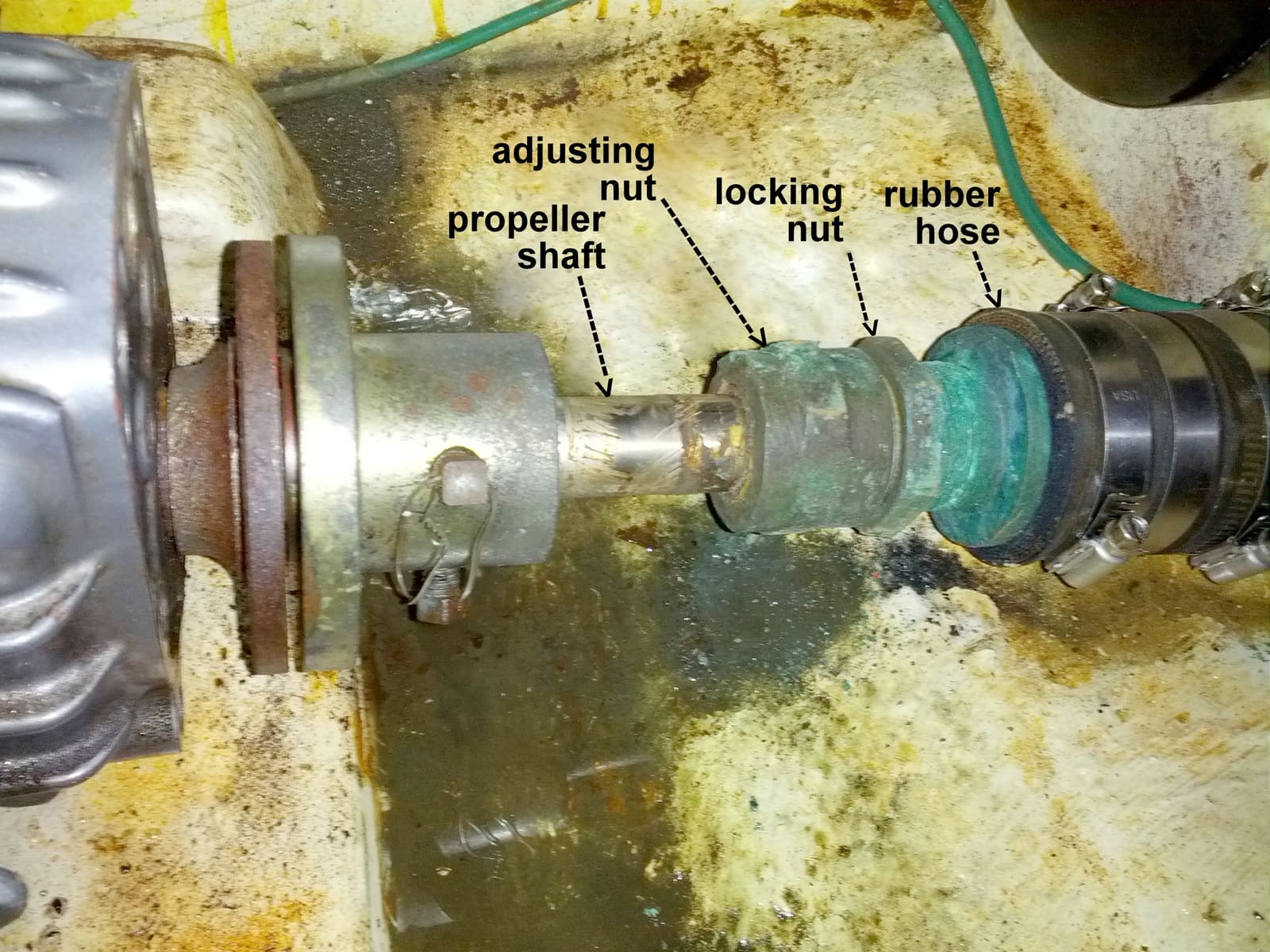
- Packing for a rudder stuffing box, if your boat has one
Before you start
The parts, in plain English.
- Rudder blade: the fin that steers. On most fiberglass boats it is a foam-filled shell built around a metal stock with welded internal plates (webs).
- Rudder stock (post): the shaft that comes up through the hull and turns the blade.
- Rudder tube and bearings: the tube the stock runs through, with a lower bearing near the hull and an upper bearing higher up. A seal at the top keeps water out: a stuffing box with packing, a rubber hose or bellows with clamps, or a lip seal.
- Steering gear: on sailboats, usually a wheel turning a sprocket and chain inside the pedestal, connected to wire cables that run around pulleys (sheaves) to a quadrant or radial drive on top of the stock. Others use a tiller, hydraulics or rack-and-pinion. Inboard powerboats usually use hydraulic or cable steering to a tiller arm on each rudder, with a tie bar joining twin rudders.
- Rudder stops: blocks that limit how far the rudder can swing, so the cables or hydraulics are not overloaded.
When to do it. Do the inside checks every spring and before any long trip. Do the outside checks every haul-out. BoatUS's steering article tells the story of a cable that parted on a calm day after years with no maintenance, a failure a yearly check would likely have caught. Edson, a major sailboat steering maker (its website now leads to Jacobe Marine), publishes a free steering inspection checklist and says boats with its steering need a yearly inspection of the critical parts, which a capable owner can do. It calls once or twice a season the bare minimum and suggests more often for racing boats, heavily sailed cruisers and boats in the tropics. Download the data sheet for your boat from the maker before you start, since cable sizes and parts vary.
Model differences. Spade rudders hang only from the stock. Skeg-hung rudders and many full-keel boats have extra support at the bottom. Hydraulic steering has its own checks; see our hydraulic steering guide.
Steps
Turn the wheel or tiller from lock to lock with the boat in the water. Notice:
- Stiffness or tight spots, which can mean a failing bearing, a bent stock or misaligned cables
- Clunks, grinding or squeaks
- Play: the wheel moving a little before the rudder responds
- Whether the rudder hits its stops before the wheel reaches the end of its travel
SpinSheet's steering guide notes that the rudder stops should engage before the wheel stops on both sides. If the stop engages on one side only, the chain is off center on the sprocket.
Out of the water, have a helper hold the wheel or tiller still. Grab the bottom of the blade and push it side to side, then fore and aft. Watch where the stock enters the hull. Note any clunk or visible movement of the stock in the tube. A little movement at the bottom of a long blade is normal on many boats, but a clunk, movement you can see at the hull or anything that has grown since last year means the bearings need a professional look. Your builder or a surveyor can tell you what is acceptable for your boat.
Also try to move the blade while holding the stock still from inside the boat (with a helper on the quadrant). If the blade moves on the stock, the internal plates may be separating from the stock. Good Old Boat calls this an early warning sign.
Finally, stand behind the boat in line with the keel and rudder and sight forward. BoatUS's self-survey article notes that a bent rudder post often shows up this way, and that a rudder canted to one side of the keel can mean a bad repair or a hard grounding. Spade rudders are also easy to damage while trying to spin a grounded boat back toward deep water, so check yours after any grounding.
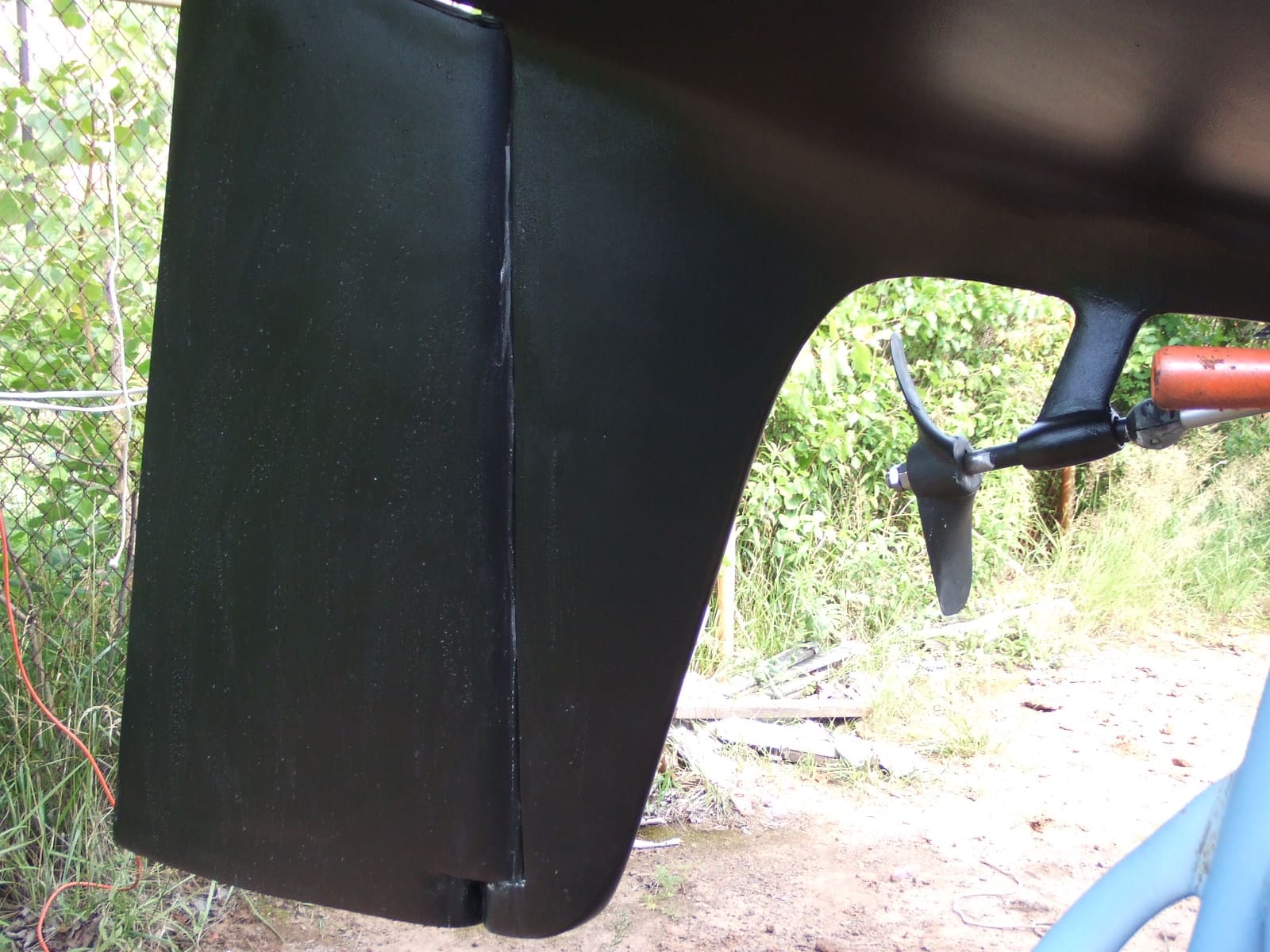
Photo: wrench2.0 / Wikimedia Commons · CC BY 2.0 Right after haul-out, look along the edges and the bottom of the blade:
- Water still dripping from seams or the bottom days after haul-out
- Rust-colored weeps, which can mean the metal inside is corroding
- Bulges or blisters, which suggest water has soaked in and the skin is separating
- Cracks or splits along the leading and trailing edges
Practical Sailor's advisor column points out that most rudders eventually let water in, that the welded web inside can corrode where it stays wet, and that trapped water can freeze and split the blade in cold climates. Draining a wet rudder treats the symptom, not the cause, so have a yard look at where the water is getting in.
Tap both faces of the blade all over with a small mallet or a screwdriver handle. Good Old Boat describes the difference: well-bonded areas give a sharp ping, while delaminated or waterlogged areas give a dull thud. Mark dull areas with tape and photograph them for your yard or surveyor.
Look where the stock comes out of the top of the blade and where it enters the hull. Look for cracks in the fiberglass, rust stains, pitting or a groove worn into the metal. Stainless stocks can suffer crevice corrosion where they stay wet without oxygen, and Safe Skipper notes that seawater sitting in the bearing tube can corrode a stainless stock over time. Bronze and aluminum stocks have their own corrosion issues, especially if dissimilar metals are mixed. A Practical Sailor editor's own rudder failed after dissimilar metals were used in the stock.
Open the locker or hatch above the rudder. With the boat in the water:
- Look for water around the tube, the stuffing box or the hose/bellows seal
- Check hose clamps for rust and the hose or bellows for cracks
- Look for cracks where the tube is glassed to the hull
- Push the top of the stock side to side; the upper bearing and its support should not move
A rudder stuffing box should not drip much at all, since the stock barely turns compared with a propeller shaft. Tighten or repack it following your builder's or packing maker's instructions, a little at a time, so the rudder still turns freely. If the tube or its support is loose or cracked, stop and call a yard.
With the cockpit sole or locker open, follow the cable from the pedestal to the quadrant.
- Broken strands: SpinSheet suggests running a cotton ball along each cable. If it snags, there are broken strands ("meat hooks") and the cable needs replacing. Don't run bare fingers along the wire.
- Chafe: look for wire rubbing on the pedestal, throttle linkage, sheave brackets or the hull.
- Tension: with the wheel hard over, the slack cable should just begin to droop, not hang loose or be bar-tight. Loose cables can jump off sheaves; very tight ones cause stiff steering and wear. Adjust at the tension eyes evenly on both sides if your system allows it, following the maker's guide.
- Chain: look for rust or stiff links where it runs over the sprocket inside the pedestal.
Many steering makers publish yearly inspection checklists and recommend specific lubricants. Use what your steering maker specifies; some lubricants damage plastic cable conduits. If your cables run inside conduits (common on smaller boats), check them for worn spots and tight bends. Edson's checklist suggests replacing conduit that is worn, or older than about 10 years on saltwater boats.
- Sheaves (pulleys): they should spin freely, with the cable centered in the groove. Metal dust under a sheave, a wobbly sheave or a cable riding on the edge means wear or misalignment. Check that the sheave brackets are firmly bolted.
- Quadrant or radial drive: check the clamp bolts on the stock are tight and the key (if fitted) is in place. Look for cracks, corrosion and cable grooves worn deep.
- Stops: make sure they are solid and the quadrant hits them on both sides, not the cable ends. If the stop has a rubber bumper, replace it when it is missing or crumbling.
- Pedestal and fasteners: Edson's checklist also covers tightening the pedestal bolts and cable clamps, checking the wheel brake, and looking for water leaking in around the pedestal base (reseal it with bedding compound if it leaks). Take photos and log the date and any parts you replace.
- Hydraulic steering: look for fluid leaks at the ram, hoses and helm, and check the fluid level as your manual describes.
- Autopilot drive: check its tiller arm or linear drive is tight on the stock and its mounting base is not cracking. See our autopilot guide.
- Inboard powerboats: check each rudder's tiller arm, the tie bar between twin rudders and its rod ends for play or rust, and the rudder ports (where each rudder stock passes through the hull) for leaks. Grease fittings on rudder ports and rod ends get the grease your builder specifies.
On wheel-steered sailboats, find the emergency tiller and the deck plate it goes through. Practical Sailor's advice: make sure it is easy to find and fit, store it where crew can reach it, mark the deck plate, and make sure the deck plate key or winch handle that opens it is aboard. Then test-fit it at the dock:
- Does it actually fit your rudder stock? Practical Sailor warns that some boats leave the factory with a tiller from a different model, or none at all.
- Can it swing through enough of an arc without hitting the pedestal, the cockpit seats or the backstay?
- On hydraulic or autopilot-equipped boats, do you know how to disconnect the ram or drive so the rudder can turn?
Do a short drill on a calm day: disconnect or let the wheel go free as your system allows, fit the tiller and steer a few circles. Most people are surprised how much effort it takes. Have a plan for extra leverage, such as a line led from the tiller to a winch. Practical Sailor also suggests knowing a backup: a socket or wrench that fits the top of the stock plus a boat hook can work if the tiller breaks.
Good Old Boat suggests dropping the rudder a few inches (or fully) at bottom-painting time to see the stock and the top of the blade. Dropping a rudder usually means loosening the steering, supporting a heavy blade and sometimes digging a hole under the boat, so it is a yard job on most boats.
If your checks point to worn bearings, Safe Skipper's bearing-replacement article lists what to sort out before haul-out: order or have parts machined early (some can only be measured once the rudder is out), work out how much clearance under the hull the rudder needs to drop, find out roughly how heavy it is (much of the weight is in the stock), and agree with the yard who supports the blade. Small yachts usually have plain plastic bush bearings (often acetal, sold as Delrin); larger yachts often have roller bearings, so get expert advice on the type before ordering.
Photograph the rudder, stock, tube and steering gear every season and keep notes in BoatMend. Changes over time are what matter most.
Common mistakes
- Ignoring a rudder that weeps rusty water "because it always does that."
- Running bare fingers along steering cable to feel for broken strands. Use a cotton ball or rag.
- Tightening steering cables bar-tight, which makes steering heavy and wears sheaves and bearings.
- Using the wrong lubricant on cables, conduits or bearings.
- Never having fit the emergency tiller until the cable breaks at sea.
- Overtightening a rudder stuffing box until the steering binds.
- Mixing metals in rudder fittings and stock repairs without professional advice.
When to call a pro
- Clunking, noticeable play at the hull, stiff or binding steering
- The blade moves on the stock, or there are cracks, bulges or rust weeps on the blade
- Water entering at the rudder tube, stuffing box or rudder ports that you cannot stop with a small adjustment
- Cracks where the tube meets the hull, or a loose upper bearing support
- Corroded or grooved stock, or any sign the rudder was damaged in a grounding
- Steering cable, chain or sheave replacement if you are not comfortable working in tight spaces
- Dropping the rudder or replacing bearings
Tips
- Keep a spare steering cable set and the tools to fit it aboard if you cruise far from help.
- Put a dab of paint across each quadrant clamp bolt and nut; if the paint line breaks, the bolt has moved.
- In freezing climates, ask the yard about draining a wet rudder for winter and resealing it before launch, but also find out why it is wet.
- Write the location of the emergency tiller and deck plate key on your safety briefing card.
Official references
We read these to write this guide. Your engine's own manual always wins.
- Safe Skipper – Rudders and Steering Systems, Part 1
- Safe Skipper – Rudders and Steering Systems, Part 3 (replacing bearings, wet cores)
- BoatUS Magazine – Be Your Own Surveyor (2021)
- BoatUS Magazine – What To Do If Your Sailboat Goes Aground
- Good Old Boat – Your rudder matters
- Practical Sailor – PS Advisor, Water-logged Rudder
- Practical Sailor – Offshore Log, Do You Know Where Your Emergency Tiller Is?
- BoatUS Magazine – Sailboat Steering, I Turn The Wheel And Nothing Happens
- SpinSheet – Care and Feeding of Your Steering System
- Edson (Jacobe Marine) – Product Tech Support, Manuals, Guides and Maintenance Sheets (Steering Inspection Checklist)
Safety: BoatMend is for information only and does not replace a certified marine technician. You are responsible for your safety and your boat. Read the full disclaimer.
Last updated 2026-10-24
Related guides
Stiff or Seized Mechanical Steering - Lubricate, Inspect and Replace the Steering Cable
Fix hard, notchy or loose cable steering on an outboard boat. Find out whether the engine, the tilt tube, the cable or the helm is the problem, clean and grease what can be serviced, and measure and install a new cable correctly when the old one is done.
Hydraulic Steering: Check Fluid, Bleed Air and Fix Stiff or Loose Steering
Check the fluid in your hydraulic steering helm, bleed out the air that makes steering spongy, and track down the usual causes of stiff, loose or noisy steering. Includes notes for boats with mechanical cable steering.
Autopilot Care: Calibration, Drive Maintenance and Common Faults
Keep your autopilot steering straight and safe, whether it is a tiller pilot, a below-deck linear drive or a hydraulic pump on a center console. Check the drive and rudder feedback, fix voltage drop, calibrate the compass, run a proper sea trial, and work out what common alarms and wandering courses really mean.
How to Check, Adjust and Repack a Stuffing Box (and Care for a Dripless Shaft Seal)
Learn the right drip rate for a traditional packing gland, how to adjust it safely, when to repack it, and how to inspect and service a dripless shaft seal. The shaft seal is one of the few holes in an inboard boat that moves, and a neglected one can sink a boat at the dock.
How to Check the Cutless Bearing, Prop Shaft and Strut
Find out if new vibration or rumbling from the stern is a worn cutless bearing, a bent shaft, a loose strut or poor engine alignment, using simple checks you can do at the dock and at haul-out. Catching bearing wear early protects the shaft, the seal and the transmission.
Sailboat Keel Bolts and the Keel-Hull Joint: Signs of Trouble and What to Do
Learn to spot the warning signs at your keel joint and keel bolts, from a "smile" crack and rust weeps to wet bilges and loose nuts, and what to check after any grounding. Explains why re-torquing, pulling bolts and dropping the keel are jobs for a surveyor and a yard.
What to Do When Your Boat Is Taking On Water: Emergency Steps and Prevention
A step-by-step emergency plan for water coming into the boat - life jackets on, call for help early on VHF 16, find and slow the leak, pump, and head for shallow water if needed - plus the maintenance checklist that prevents most sinkings.
Launch Day and Haul-Out Checklist for Trailer Boats
A step-by-step checklist for getting your boat off the trailer and back on again safely and quickly, from the drain plug and tie-downs to the blower and ramp etiquette. Following it in order prevents the classic mistakes that sink boats and back up the ramp.
How to Inspect a Used Boat Before You Buy
A step-by-step checklist for looking over a used boat, from paperwork and the hull ID number to the transom, engine, compression test, sea trial and trailer. Know what to check yourself, what the red flags mean, and when to pay a marine surveyor.