Right-of-Way on the Water: The Navigation Rules Every Recreational Boater Should Know
There are no lanes or stop signs on the water, so the Navigation Rules decide who keeps course and who gets out of the way. Learn stand-on and give-way, meeting head-on, crossing, overtaking, sail versus power, narrow channels, big ships, safe speed and keeping a proper lookout, with the rule numbers from the U.S. Inland Navigation Rules (33 CFR Part 83).
Time
30 min
Applies to
All engines
Safety first: No rule gives you the "right" to hit someone. Rule 2 and Rule 17 require every boat, including the one with priority, to do whatever is needed to avoid a collision. If you're unsure what another boat is doing, slow down or stop early. In an emergency, call the Coast Guard on VHF channel 16.
Owners often ask
- Who has the right of way when a boat is crossing from my right side?
- Does a sailboat always have the right of way over my powerboat?
This guide walks you through it. Still stuck? Ask the AI Mechanic about your engine.
Tools
- Copy of the Navigation Rules (required aboard self-propelled boats 12 meters / about 39 feet and longer)
- Sound-producing device (horn or whistle)
- Chart of your area (paper or chartplotter)
Before you start
Why learn this? The Coast Guard's 2024 statistics list operator inattention, improper lookout, operator inexperience and navigation rules violations among the top five primary contributing factors in boating accidents. Knowing who does what in a meeting, crossing or passing situation prevents most close calls.
Which rules apply? In U.S. inland waters, the Inland Navigation Rules apply; they're federal regulations in 33 CFR Part 83. Seaward of the demarcation lines shown on charts, the International Rules (COLREGS) apply. The two sets share the same rule numbers and are nearly identical for the situations in this guide; the Coast Guard Navigation Center publishes them side by side. We cite the Inland rule numbers below.
"Right of way" vs. stand-on and give-way. The rules mostly avoid the phrase "right of way." When two boats risk a collision, one is the give-way vessel (it must keep out of the way) and the other is the stand-on vessel (it must hold course and speed). Both have duties.
Copy aboard. The operator of a self-propelled boat 12 meters (about 39 feet) or longer must carry a copy of the Inland Rules aboard (Rule 1, 33 CFR 83.01(g)). It's a good idea on any boat.
Steps
Every vessel must keep a proper lookout by sight and hearing, and by all available means (radar, AIS, the radio), at all times. On a small boat that means:
- Look all the way around, including behind you, before turning or changing speed
- Assign a lookout when visibility is poor, when you're towing a skier, or when the skipper is busy docking
- Turn the music down enough to hear horns and engines
A safe speed is one that lets you take effective action and stop within a distance that suits the conditions. Rule 6 lists what to weigh: visibility, traffic (including clusters of fishing boats), how fast your boat can stop and turn, background lights at night, wind, sea and current, nearby hazards, and your draft compared with the depth. Local speed and no-wake zones are separate rules on top of this.
Use every means you have. The classic test: if the compass bearing to an approaching boat doesn't change appreciably, a risk of collision exists. Line it up with a fixed point on your boat (a stanchion or windshield frame); if the other boat stays in the same spot while getting bigger, you're on a collision course. If in doubt, assume the risk exists. Big ships and tows can be a risk even when the bearing is changing.
When you take action, do it early and make it large enough for the other skipper to notice, such as a clear turn or a big slowdown, rather than a series of small nudges. Turning alone often works if there's room. Slow down, stop or back down if you need more time. Keep watching until the other boat is past and clear.
When two power-driven vessels meet head-on or nearly so, each turns to starboard (right) and they pass port to port (left side to left side). At night you'd see both of the other boat's sidelights, or its masthead lights in line. If you're not sure whether it's head-on, assume it is and turn right. Under the Inland Rules, power-driven vessels in sight of each other and within half a mile signal their passing: one short blast means "I intend to leave you on my port side," and the other boat answers with the same signal if it agrees (Rule 34). The International Rules use the horn differently, so see our horn signals guide.
When two power-driven vessels cross, the one that has the other on its own starboard (right) side is the give-way vessel. It keeps out of the way and, if it can, avoids crossing ahead of the other boat; usually that means slowing down or turning right to pass behind it. BoatUS describes the "danger zone" as the arc from dead ahead to about 112.5 degrees on your starboard side: a boat crossing in that zone has priority over you. At night, if you see the other boat's red sidelight, you're the give-way vessel; if you see its green, you're the stand-on vessel but must still watch it closely.
Any vessel overtaking another must keep out of the way of the one being overtaken, whatever type each boat is. You're overtaking if you're coming up from more than 22.5 degrees abaft the other boat's beam (roughly from behind its side, where at night you'd see only its white sternlight). If in doubt, assume you're overtaking. You stay the give-way vessel until you're well past and clear, even if the angle changes as you pass.
- Give-way vessel (Rule 16): take early and substantial action to keep well clear.
- Stand-on vessel (Rule 17): keep your course and speed so the other skipper can predict you. But as soon as it's clear the give-way boat isn't acting, you may maneuver to avoid a collision, and if you get so close that the give-way boat can't avoid it alone, you must act. In a crossing, avoid turning to port (left) toward a boat on your port side.
BoatUS sums up the principle: it's more important to avoid an accident than to insist on the rules.
Except when overtaking or in narrow channels and traffic lanes, a power-driven vessel underway keeps out of the way of:
- a vessel not under command (broken down or otherwise unable to maneuver)
- a vessel restricted in its ability to maneuver (dredges, buoy tenders, vessels laying cable, and similar)
- a vessel engaged in fishing: this means with nets, trawls or lines that restrict maneuverability, not a boat trolling with rod and reel
- a sailing vessel
A sailboat with its engine running is a power-driven vessel, even with sails up. Between two sailboats under sail, Rule 12 decides: the boat with the wind on its port side gives way to the one with the wind on its starboard side, and when both have the wind on the same side, the windward boat gives way.
Canoes, kayaks and paddleboards are vessels too. The rules don't place them in this list, so BoatUS points to Rule 2 (good seamanship): powerboats give paddlers plenty of room and slow down, and paddlers stay out of marked channels where they can and cross them quickly.
In a narrow channel or fairway:
- Keep to the starboard (right) side as far as is safe and practical.
- A vessel under 20 meters (about 65 feet), or a sailboat, must not impede a vessel that can safely navigate only within the channel.
- Boats fishing must not impede other traffic in the channel.
- Don't cross a channel if it impedes a vessel that can only use the channel.
- Navigate with extra caution and sound one prolonged blast approaching a blind bend; boats around the bend answer with a prolonged blast (Rules 9 and 34).
- Don't anchor in a narrow channel.
On the Great Lakes, Western Rivers and other waters the Coast Guard designates, a power-driven vessel going downbound with a following current has the right-of-way over an upbound vessel (Rules 9 and 14), one of the rare places the rules use that phrase. Rule 14(d) also says the downbound boat proposes how the two will pass and sounds the passing signal first, so if you're heading upstream, wait for its signal and answer it.
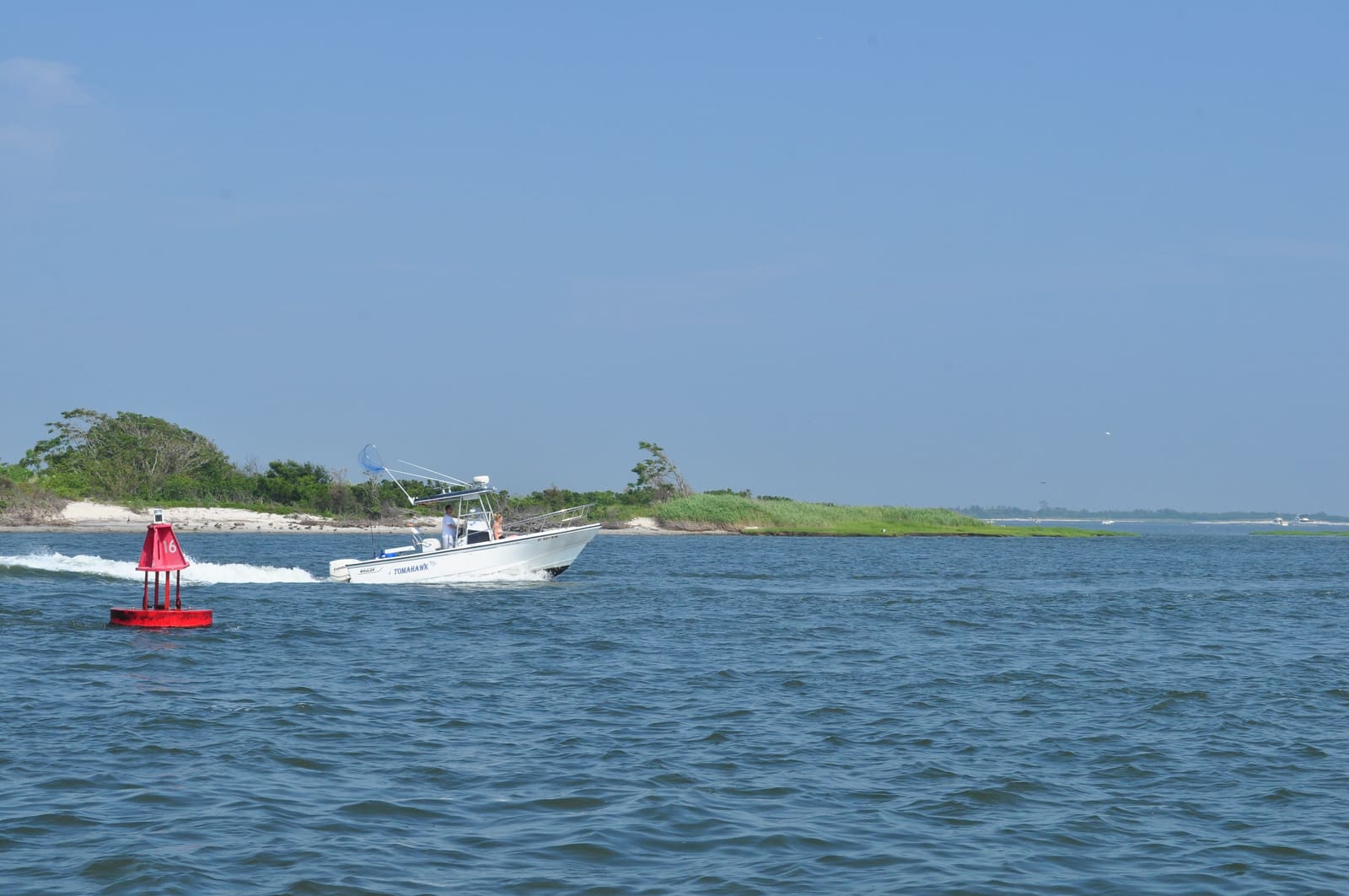
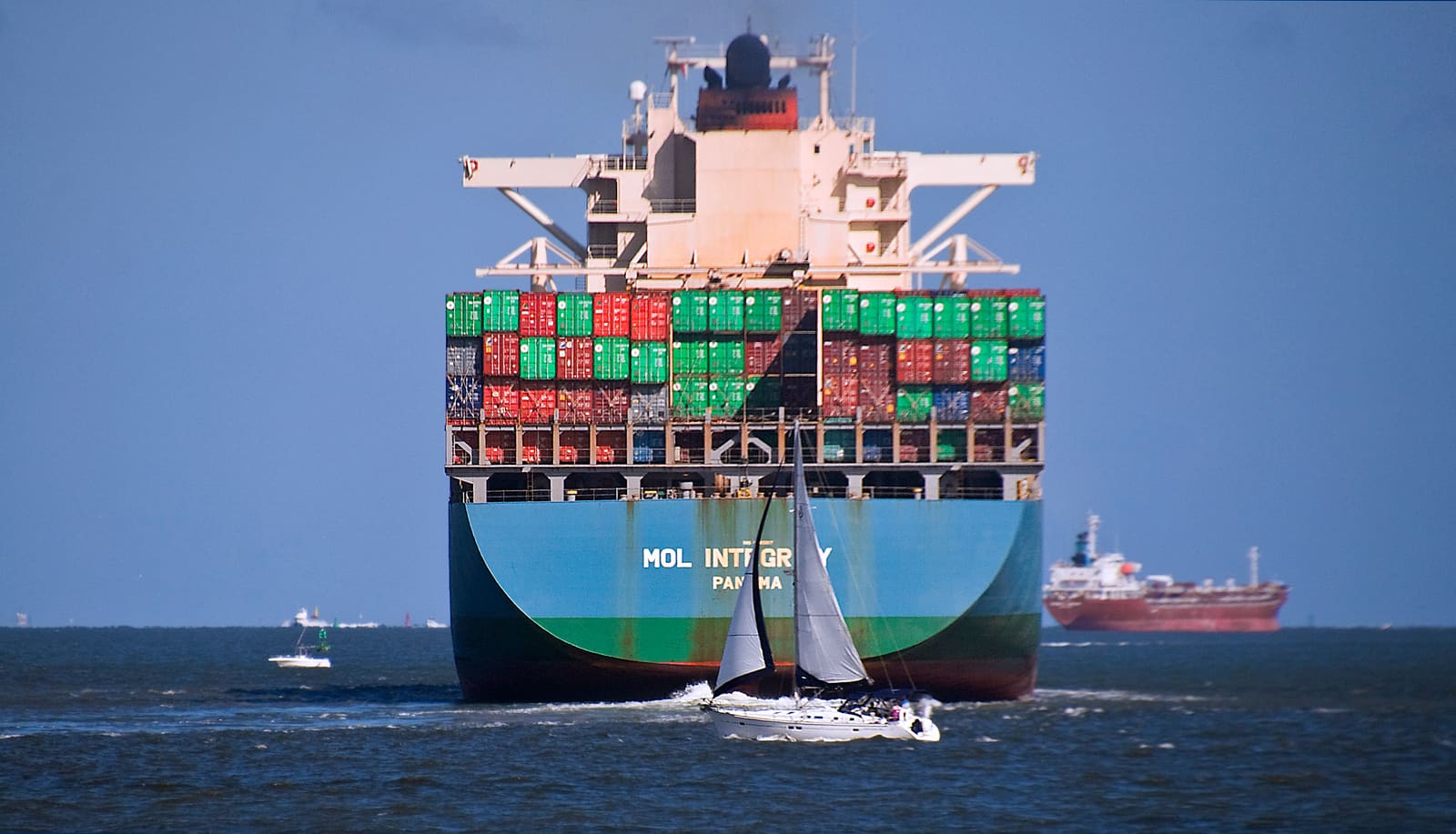
In a channel, keep to the starboard side and stay predictable. Photo: Joe Mabel / Wikimedia Commons · CC BY-SA 3.0 Ships and tows can't stop or turn quickly, may not see a small boat close under their bow, and often can only use the deep channel, so in practice the small boat keeps clear (Rules 9 and 18). BoatUS notes that recreational powerboats generally yield to other types of traffic. Remember too that a ship's bridge may be hundreds of feet behind its bow, so the crew may lose sight of you when you're close ahead. Practical habits:
- Cross a shipping channel quickly, at right angles, well ahead of or well behind traffic
- Never cut between a tug and its tow; the towline may be underwater
- Listen for five or more short, rapid blasts: it's the doubt signal, meaning the other vessel doesn't understand your intentions or thinks you aren't doing enough to avoid a collision (Rule 34(d)); act right away
- Keep your VHF on channel 16 (and the local bridge-to-bridge channel where ships talk) so you can hear or call them
Traffic lanes near big ports (Rule 10). Some harbor approaches have charted traffic separation schemes: one-way inbound and outbound lanes with a separation zone between them, like a divided highway for ships. Rule 10 (33 CFR 83.10) says a boat under 20 meters (about 65 feet) or a sailboat must not impede a power-driven vessel following a traffic lane. If you're not using the scheme, stay clear of it by as wide a margin as you can; if you must cross, do it as close to a right angle to the traffic flow as practical. Don't anchor in or near the lanes, and be extra careful near the ends of a scheme, where ships turn and converge. Your chart or chartplotter shows the lanes, usually in magenta.
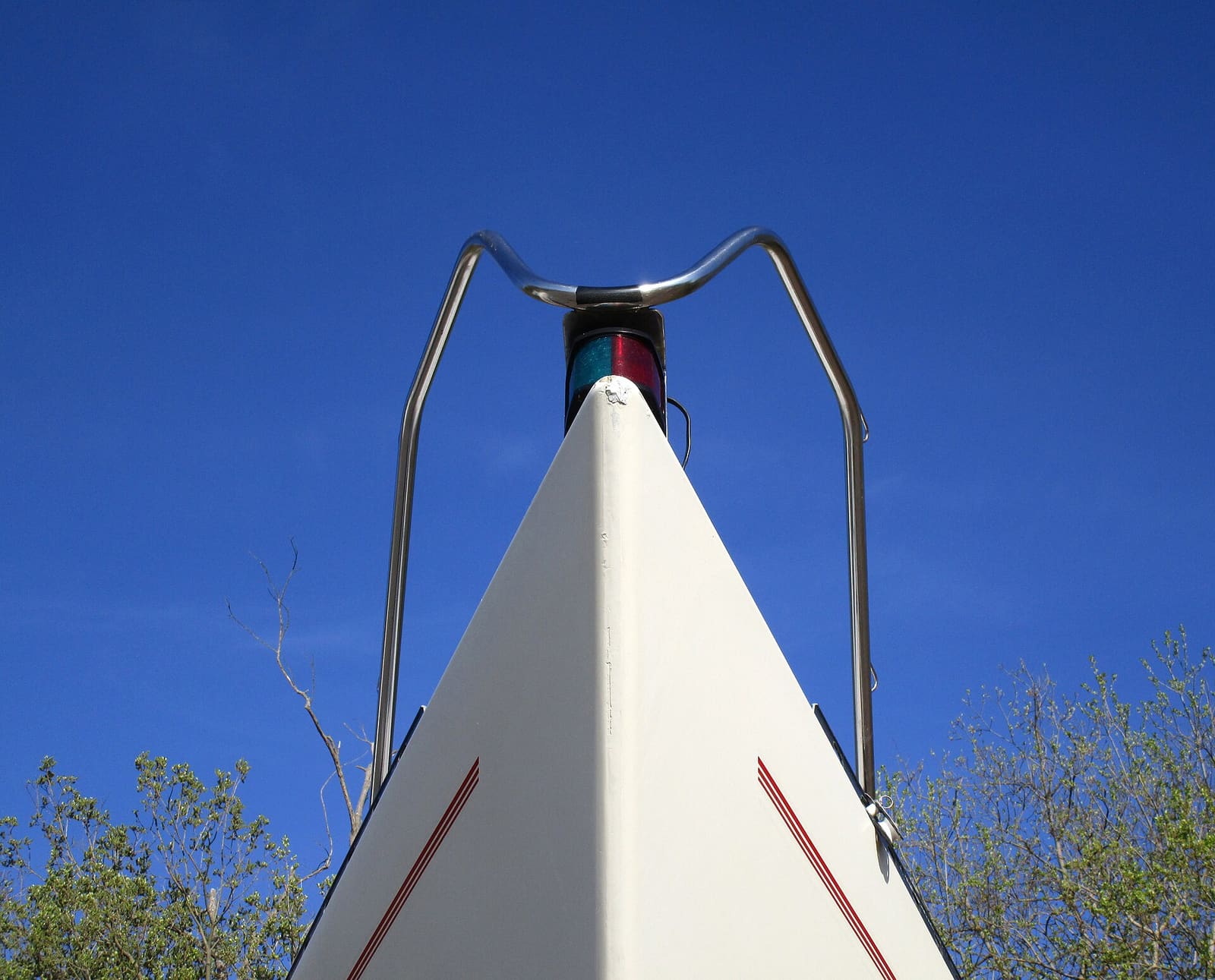
At night, read the other boat's lights to tell its heading and type (see our navigation lights and night boating guides). In restricted visibility, slow down to a safe speed, sound the fog signals and listen for others (see our fog guide). The rules for boats in sight of one another (Rules 11 to 18) don't apply in fog when you can't see the other boat; Rule 19 governs then.
As BoatUS puts it, every time you meet another boat ask: who is higher in the pecking order, and am I stand-on or give-way? Then make your move early, make it obvious, and keep watching until you're clear.
Common mistakes
- Assuming a sailboat always has priority, even when it's motoring.
- Treating a trolling sportfishing boat as a "vessel engaged in fishing."
- Cutting across a ship's bow or between a tug and its barge.
- Making tiny course changes the other skipper can't read.
- The stand-on boat holding course "on principle" right up to impact.
- Running full speed through an anchorage, a no-wake zone or fog.
- No lookout while towing a tube or skier.
When to call a pro
- A collision or near-collision with injuries or damage: call 911 or the Coast Guard on VHF 16, then see our boating accident report guide
- You're unsure which rules (Inland or International) apply where you boat: check the chart's demarcation lines or ask your local Coast Guard Auxiliary flotilla
- You want hands-on practice: take a classroom or on-water course from the Coast Guard Auxiliary, U.S. Power Squadrons or a sailing school
Tips
- Memorize: red, right, give-way; green, go (carefully) for crossing at night by sidelights.
- Pick a fixed point on your boat to check a constant bearing fast.
- Slow down early and make your intentions obvious; most other skippers will follow your lead.
- If a big ship is anywhere near a channel you need to cross, wait. It's never worth the gamble.
Official references
We read these to write this guide. Your engine's own manual always wins.
- eCFR – 33 CFR Part 83, Inland Navigation Rules
- eCFR – 33 CFR 83.10, Traffic separation schemes (Rule 10)
- eCFR – 33 CFR 83.14, Head-on situation (Rule 14)
- U.S. Coast Guard Navigation Center – Amalgamated Navigation Rules (International and U.S. Inland)
- U.S. Coast Guard Boating Safety – Navigation Rules
- BoatUS Magazine – Marine Navigation Rules (2015)
- BoatUS Magazine – Rules-Of-The-Road Refresher For Boaters (2015)
- U.S. Coast Guard News – Coast Guard reports fewest boating fatalities in more than 50 years (2024 statistics, July 2025)
Safety: BoatMend is for information only and does not replace a certified marine technician. You are responsible for your safety and your boat. Read the full disclaimer.
Last updated 2026-10-26
Related guides
Boat Horns and Sound Signals: Requirements, Testing and the Signals Every Skipper Should Know
Every boat needs a way to make an efficient sound signal, and bigger boats need a proper whistle or horn. Learn the Coast Guard requirements by boat length, how to test and fix an electric horn, why a canister air horn makes a good backup, and the basic passing, danger and fog signals.
How to Test and Fix Your Boat's Navigation Lights
Learn which navigation lights your boat must show and when, then test them and fix the usual culprits such as corroded sockets, loose pole-light plugs and blown bulbs. Working lights are legally required at night and in poor visibility and are how other boats see which way you are heading.
Boating at Night: Lights, Speed, Night Vision and Reading Other Boats
Get ready for a safe run after dark, from checking your navigation lights and dimming the helm to slowing down, reading other boats' lights and buoys, keeping life jackets on and leaving the alcohol ashore.
Boating in Fog: When to Stay In, Sound Signals, Safe Speed and Using Your Electronics
Fog can roll in on any lake, bay or coast. Learn when to stay at the dock, the fog signals the Coast Guard rules require, how slow is slow enough, how to use radar, AIS and your chartplotter without trusting them blindly, and when to simply anchor and wait it out.
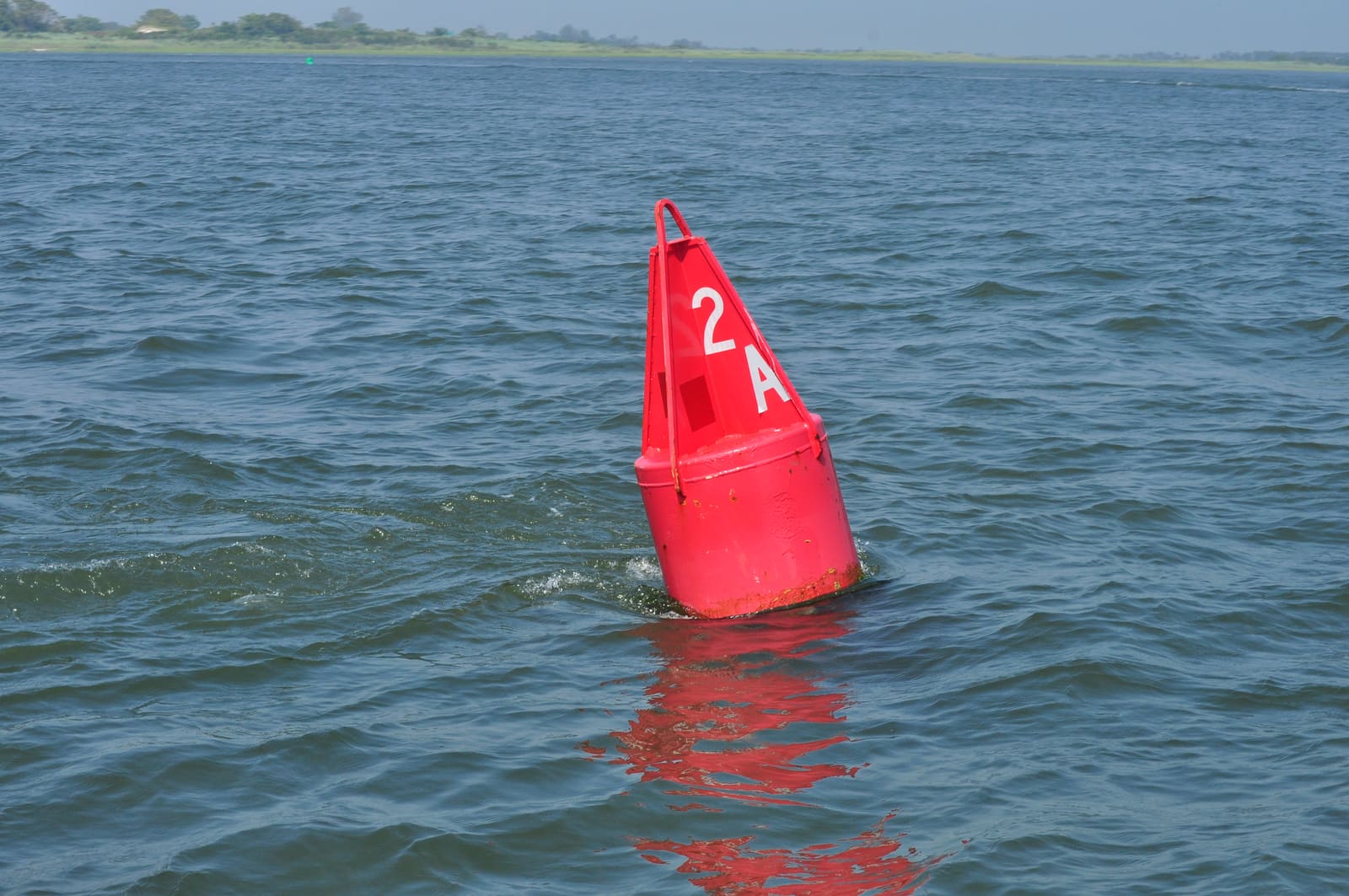
How to Read Buoys and Channel Markers: Red Right Returning and the U.S. Aids to Navigation System
Learn what the red and green buoys, daymarks and lights are telling you: red right returning, nuns and cans, odd and even numbers, preferred channel, safe water, isolated danger, the orange-and-white regulatory and information markers, the yellow symbols on the Intracoastal Waterway and how the Western Rivers system differs. Based on the Coast Guard's U.S. Aids to Navigation System rules (33 CFR Part 62).
Boater Education Cards: Who Needs One, How to Get It and When It Works in Other States
Most states require some boat operators to complete an approved boating safety course and carry proof. Learn how to find your state's rule (age, horsepower, boat type), pick a NASBLA-approved course, get the card, use it when you visit other states, and what rental and other exemptions usually look like. Practical guidance, not legal advice.
Reading Marine Weather Forecasts: Advisories, Wind, Waves and Go/No-Go
Learn where to get the official NOAA marine forecast for your waters, what small craft advisories and warnings really mean, how to read wind and wave numbers, and how to make a simple go/no-go call before you leave the dock.
Engine Cut-Off Switch (Kill Switch) and Lanyard: The Law, Testing and Daily Use
How the engine cut-off switch (ECOS) and its lanyard or wireless fob work, when federal law requires you to wear it (boats under 26 feet, 3 hp or more, on plane), how to test it before every trip, and why a spare clip aboard matters.
AIS on Your Boat: Receiver vs. Class B, MMSI Programming, Antennas and Checking You're Seen
Choose between a receive-only AIS and a Class B transponder, get the MMSI programmed the legal way, sort out the GPS and VHF antenna (or splitter), confirm other boats and the Coast Guard actually see you, and understand silent mode and AIS man-overboard beacons.
Recreational Radar Care: Radome and Open-Array Cleaning, Mounts, Cables and Alignment
Keep your boat's radar seeing small targets by cleaning the radome or open array the right way, checking the mount, cable and connectors for corrosion, and confirming that targets line up with the bow. Includes the safety rules for working near a radar that might transmit, plus winter care.
The Pre-Departure Safety Briefing: What to Tell Every Passenger (with a Printable Checklist)
A five-minute talk before you leave the dock turns guests into a crew that can help in an emergency. Cover life jackets, the engine cut-off switch, the fire extinguisher, how to call for help on the VHF, what to do if someone falls overboard, staying seated, seasickness and carbon monoxide near the stern, then use the printable checklist every trip.