Boating at Night: Lights, Speed, Night Vision and Reading Other Boats
Get ready for a safe run after dark, from checking your navigation lights and dimming the helm to slowing down, reading other boats' lights and buoys, keeping life jackets on and leaving the alcohol ashore.
Time
30 min
Applies to
All engines
Safety first: Falling overboard is far more dangerous at night because nobody can see you. BoatUS advises that everyone wear a life jacket after dark, even people who skip it in daylight. If someone goes over, shout "man overboard", point at them nonstop, throw a light and a throwable device, and call USCG on VHF channel 16 or 911 if you cannot get them back fast.
Owners often ask
- How do I tell which way another boat is heading at night from its lights?
- How slow should I go when running my boat after dark?
This guide walks you through it. Still stuck? Ask the AI Mechanic about your engine.
Tools
- Red or red-mode headlamp or flashlight
- Spotlight or searchlight (charged)
- Binoculars
- Chart or chartplotter with your route loaded
Parts & supplies
- Spare navigation light bulbs or a spare LED fixture, plus fuses
- Spare batteries for flashlights and handheld VHF
- Anchor light (if your stern light is not an all-round white)
Before you start
Know the three goals. BoatUS sums up night boating as three things: don't hit anything in the water, don't get hit by another boat, and don't let anyone fall overboard. Everything below serves one of those.
Start easy. Discover Boating suggests your first night runs be short trips on water you know well, on clear, calm nights. Learn the route in daylight first.
Plan for the unplanned. Many owners end up out after dark by accident: a long day, a breakdown, a slow ride home. Do the checks below every time you go out, even if you plan to be back by sunset.
Steps
The navigation rules require your lights from sunset to sunrise (and in restricted visibility). Turn them on and walk around the boat. Red should show on the left (port) bow, green on the right (starboard) bow, and white at the stern or on an all-round pole. A power boat under 12 meters (39.4 feet) may show an all-round white light plus sidelights instead of a separate masthead light and sternlight. BoatUS notes lights should be visible 1 to 2 miles away, but loose connections and crazed, cloudy lenses cut that a lot. Clean the lenses and fix weak lights before you go. See our navigation-lights guide for repairs.
Carry spare bulbs or a spare LED fixture and fuses, several flashlights (one with a red setting), spare batteries, and a charged spotlight. Discover Boating stresses having backups you can grab right away: if the main spotlight dies, you need another light immediately. Keep your sound device (horn or whistle) within reach of the helm, and make sure your flares or electronic distress light are in date.
Under Rule 20, you may not show other lights that can be confused with navigation lights or that get in the way of keeping a proper lookout. Discover Boating says to turn off headlights, spotlights and other lights that could interfere while you are underway. That includes bright deck lights, cockpit floodlights and colorful accent or underwater lighting. They wreck your night vision and can hide or confuse your navigation lights for other boaters.
Give your eyes time to adjust to the dark before you leave. BoatUS notes that a few seconds of white light can cost you several minutes of night vision. Use a red (or blue-green) headlamp for reading charts and finding gear. Put your chartplotter, sounder and phone in night mode and turn the brightness way down. Glance at screens briefly, then look back outside.
Logs, crab-pot floats, unlit moorings and rocks are nearly invisible at night. Discover Boating notes many experienced night boaters run at about half their daytime cruising speed. The navigation rules require a safe speed that lets you stop in time. They list background shore lights as one of the factors that make other boats and hazards harder to see. Going slower also makes the boat quieter, so you can hear surf, engines and other boats.
The driver should not be the only set of eyes. Put a sober, reliable person on lookout, ideally with binoculars, which gather light and help you pick out boats, buoys and landmarks. Turn off the music and keep talking quiet so you can hear. Have the lookout scan all the way around, including astern, where faster boats come up from behind.
Lights tell you which way another boat is pointing:
Red and green together (with white above): the boat is coming straight at you. Rule 14 says when two power boats meet head-on, each turns to starboard (right) and they pass port-to-port. If you are not sure whether it is head-on, assume it is.
Red only (plus white): you are seeing its port side. If it is on your right (starboard), Rule 15 makes you the boat that keeps out of the way. Slow down or turn so you pass behind it, not ahead.
Green only (plus white): you are seeing its starboard side. Hold your course and speed, but be ready to act if the other boat does not.
White only: you are probably behind a boat moving away from you, or looking at an anchored boat, or a small boat with only an all-round white. Treat it with care until you know which.
Flashing blue light: on U.S. inland waters, only law enforcement boats may show it (33 CFR 88.05). Slow down and be ready to stop.
Alternating red and yellow flashing light: a public safety or similar boat at work, such as assisting a disabled boat, firefighting or search and rescue (33 CFR 88.07). It gives that boat no right of way, but give it room.
Sailboats under sail show red and green but no white masthead light. Larger and commercial vessels show more lights. Learn them from the Navigation Rules or a boating course, and give tugs and ships plenty of room.
Do not assume everyone has lights on. BoatUS warns that a boat without lights may not be seen until it is too late, and Discover Boating says to stay alert for unlit vessels. Paddlers, anglers in small skiffs and boats with dead batteries are common culprits. This is another reason to keep your speed down.
Use the spotlight in quick sweeps to find a marker, a dock or debris, then turn it off. Long beams kill your night vision and reflect off spray and haze. Never shine it at the helm of another boat; you will blind that driver. If a fast boat or ship does not seem to see you, shine the light on your own boat or sails to show that you are there.
Stick to well-marked channels where you can. Discover Boating notes reflective tape on markers makes them much easier to find than cutting across open water. Lighted buoys and markers flash in a set pattern shown on the chart and the plotter, so you can match the flash to the right marker. Shore lights in the background make markers and boats hard to pick out, so double-check against the chart.
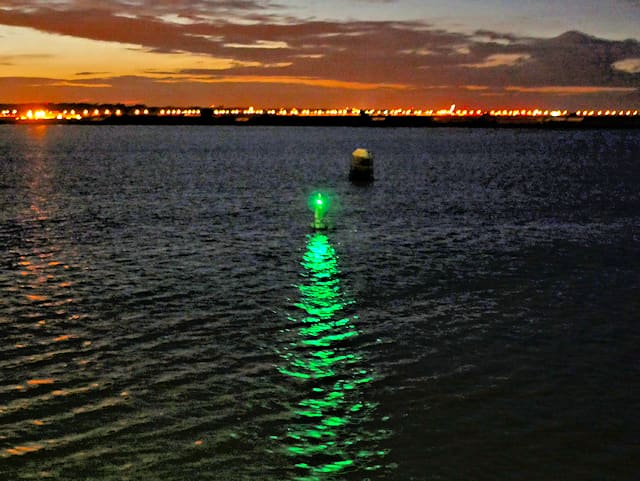
Match each flashing buoy to the chart; shore lights behind it make it easy to miss. Photo: David Dixon / Wikimedia Commons · CC BY-SA 2.0 Electronics help a lot at night, but charts can be out of date and buoys get moved. Use the plotter, depth sounder and, if you have them, radar and AIS together with your eyes and ears. Landmarks look different in the dark, and a far-off street lamp can look like an anchor light.
Everyone wears a life jacket, and the driver clips on the engine cut-off lanyard or wireless fob. Brief the crew on what to do if someone goes over, and keep a throwable device and a light ready to toss. Do not let people sit on the bow or gunwales at night.
Night boating needs all your concentration. The USCG notes that alcohol cuts night vision, depth perception and peripheral vision and makes it harder to tell red from green, exactly the skills you need after dark. The USCG also says alcohol is involved in about a third of recreational boating deaths, and boating under the influence is illegal in every state. The driver and the lookout should stay sober.
Before you head out, or as soon as you know you will be out late, tell someone ashore your route and expected return so they do not call a search for nothing, or do call one if you really are overdue. Carry an anchor and anchor light so you can stop and wait out problems instead of pushing on.
Anchoring after dark, even just to fish or watch fireworks? Rule 30 (33 CFR 83.30) calls for an all-round white light where it can best be seen. Your red and green sidelights go off, because they tell others you are moving. A boat under 7 meters (about 23 feet) is excused only when it is not in or near a channel, fairway, anchorage or anywhere other boats normally travel, and boats under 20 meters in a Coast Guard special anchorage area are excused too. In practice, if anyone could come your way, show the light.
Common mistakes
- Never testing the lights until the sun is going down. That is when you find the bad bulb or corroded socket.
- Running at daytime speed. Floating debris and unlit boats come up fast.
- Bright screens and deck lights. The helm glows, the driver is night-blind, and other boats cannot read your navigation lights.
- Leaving the spotlight on or aiming it at other boats.
- Only one person watching. The driver is busy steering, reading the plotter and talking.
- "It's just a short ride home" after drinks.
- Assuming the white light ahead is far away. Lights are hard to judge for distance at night.
When to call a pro
- A navigation light keeps failing, flickers or you see corrosion in the sockets or wiring: have a marine electrician check it, or see our navigation-lights guide.
- If you lose power, run aground or are disabled at night and are not in danger, call your towing service (TowBoatUS or Sea Tow) and turn on your anchor light.
- For a person overboard, collision, fire or taking on water, call USCG on VHF channel 16 or 911 right away and use your distress signals.
Tips
- Stick reflective tape on life jackets, throwable devices and the boarding ladder so you can find them with a flashlight.
- Practice a night run in a familiar area with an experienced friend before you go somewhere new.
- Run your route at dusk the first time so you see landmarks change as it gets dark.
- Store a small red flashlight at the helm on a lanyard so it is always in the same place.
- Keep a printed chart of your area aboard in case the plotter goes dark.
Official references
We read these to write this guide. Your engine's own manual always wins.
- BoatUS – Boating After Dark (2020)
- Discover Boating – 7 Night Boating Tips, How to Boat Safely at Night
- Discover Boating – How to Safely Use Your Boat Navigation Lights
- Discover Boating – Navigation Buoys 101, Red and Green Markers
- eCFR – 33 CFR 83.20, Lights and shapes, application (Rule 20)
- eCFR – 33 CFR 83.23, Power-driven vessels underway (Rule 23)
- eCFR – 33 CFR 83.06, Safe speed (Rule 6)
- eCFR – 33 CFR 83.14, Head-on situation (Rule 14)
- eCFR – 33 CFR 83.15, Crossing situation (Rule 15)
- USCG Boating Safety – Boating Under the Influence
- eCFR – 33 CFR 83.30, Vessels anchored, aground and moored barges (Rule 30)
- eCFR – 33 CFR Part 88, Annex V Pilot Rules (law enforcement and public safety lights)
Safety: BoatMend is for information only and does not replace a certified marine technician. You are responsible for your safety and your boat. Read the full disclaimer.
Last updated 2026-10-25
Related guides
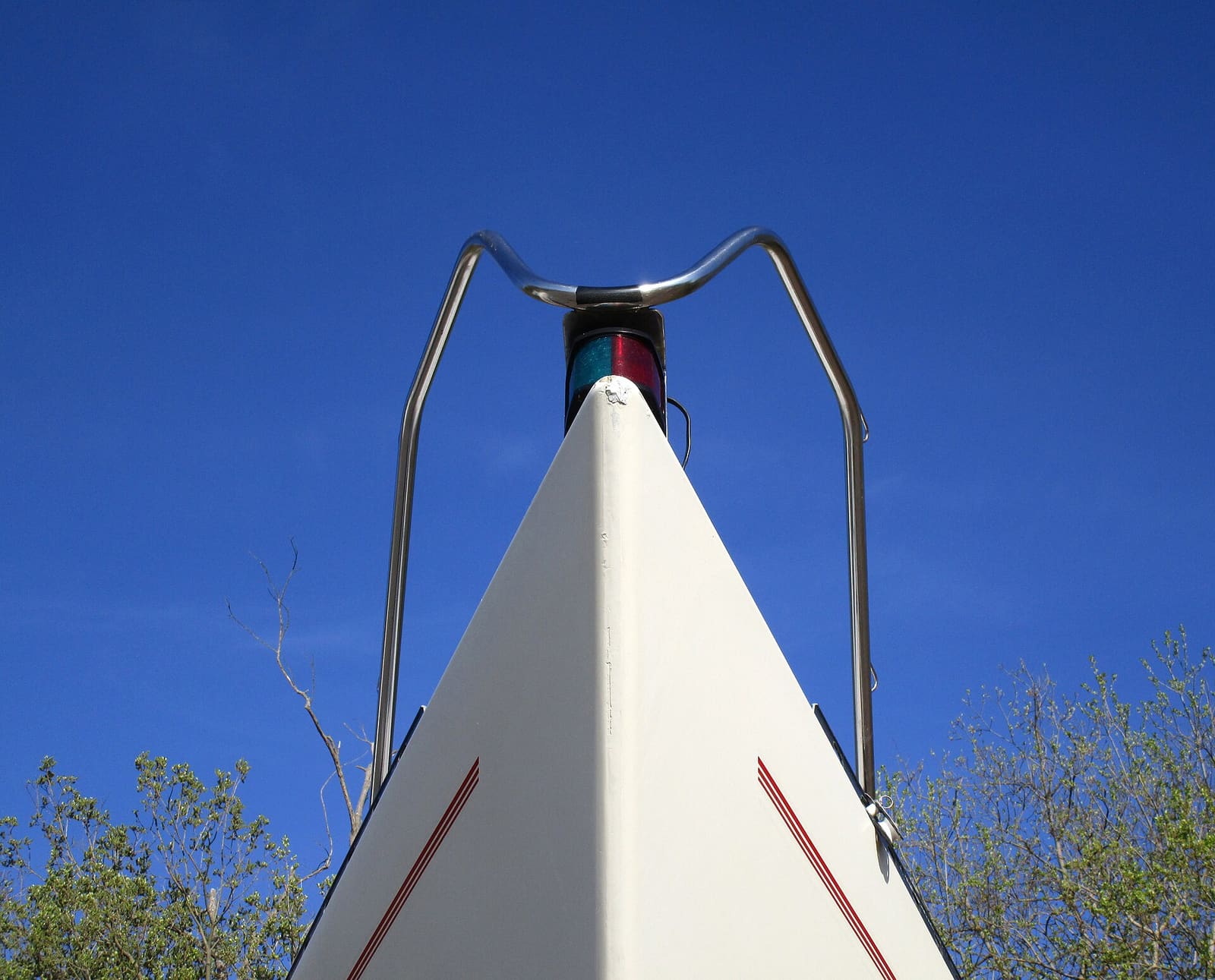
How to Test and Fix Your Boat's Navigation Lights
Learn which navigation lights your boat must show and when, then test them and fix the usual culprits such as corroded sockets, loose pole-light plugs and blown bulbs. Working lights are legally required at night and in poor visibility and are how other boats see which way you are heading.
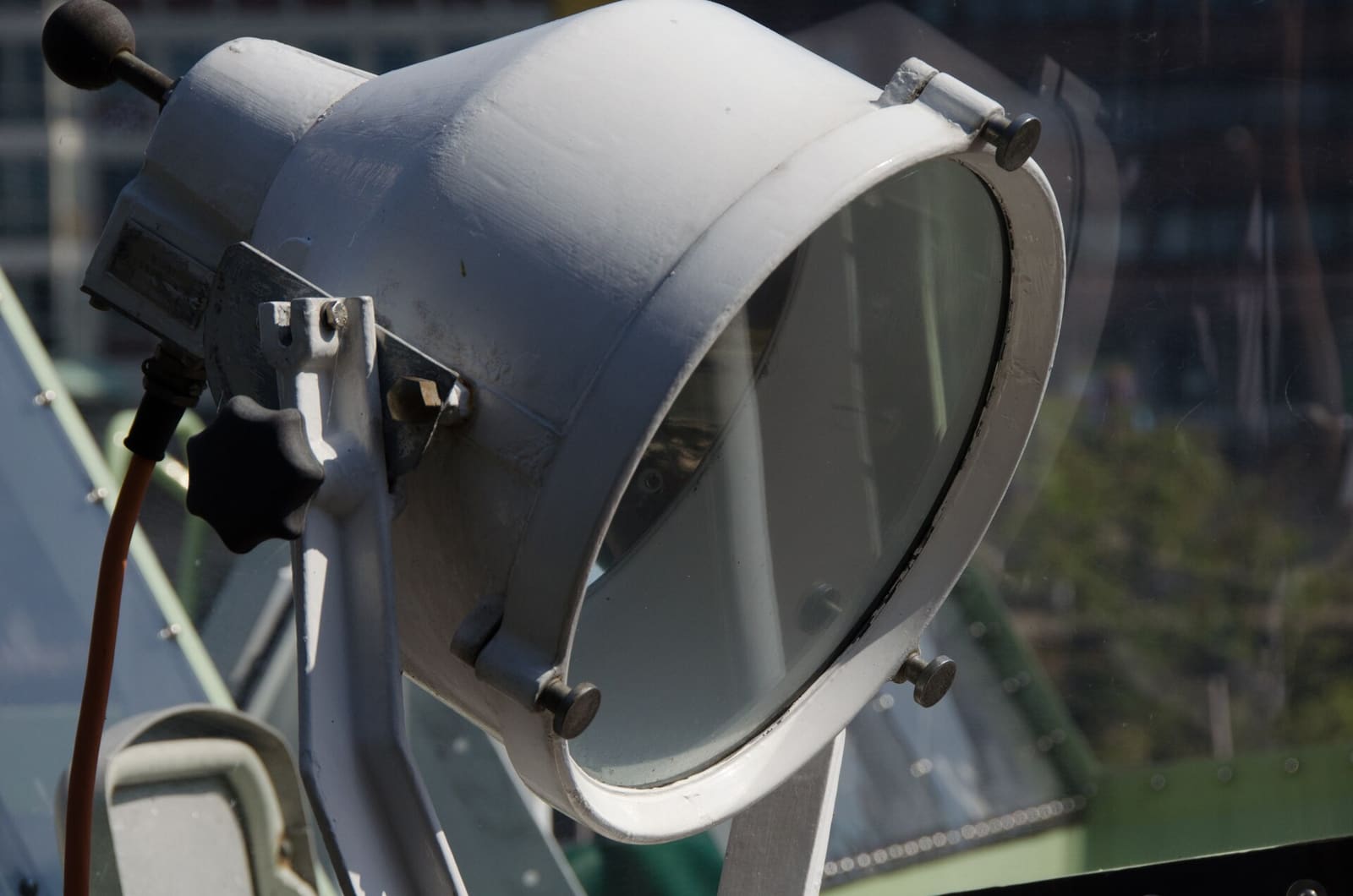
Boat Spotlights and Searchlights: Care, Wiring Checks and Using Them Without Blinding Anyone
A good spotlight helps you find markers, moorings and debris at night and signal for help, but only if it works and you use it carefully. Learn how to care for remote-control searchlights and handheld spotlights, clean lenses, check fuses and wiring, and use the beam in short sweeps that never blind other boaters.
Boating in Fog: When to Stay In, Sound Signals, Safe Speed and Using Your Electronics
Fog can roll in on any lake, bay or coast. Learn when to stay at the dock, the fog signals the Coast Guard rules require, how slow is slow enough, how to use radar, AIS and your chartplotter without trusting them blindly, and when to simply anchor and wait it out.
Boat Horns and Sound Signals: Requirements, Testing and the Signals Every Skipper Should Know
Every boat needs a way to make an efficient sound signal, and bigger boats need a proper whistle or horn. Learn the Coast Guard requirements by boat length, how to test and fix an electric horn, why a canister air horn makes a good backup, and the basic passing, danger and fog signals.
Engine Cut-Off Switch (Kill Switch) and Lanyard: The Law, Testing and Daily Use
How the engine cut-off switch (ECOS) and its lanyard or wireless fob work, when federal law requires you to wear it (boats under 26 feet, 3 hp or more, on plane), how to test it before every trip, and why a spare clip aboard matters.
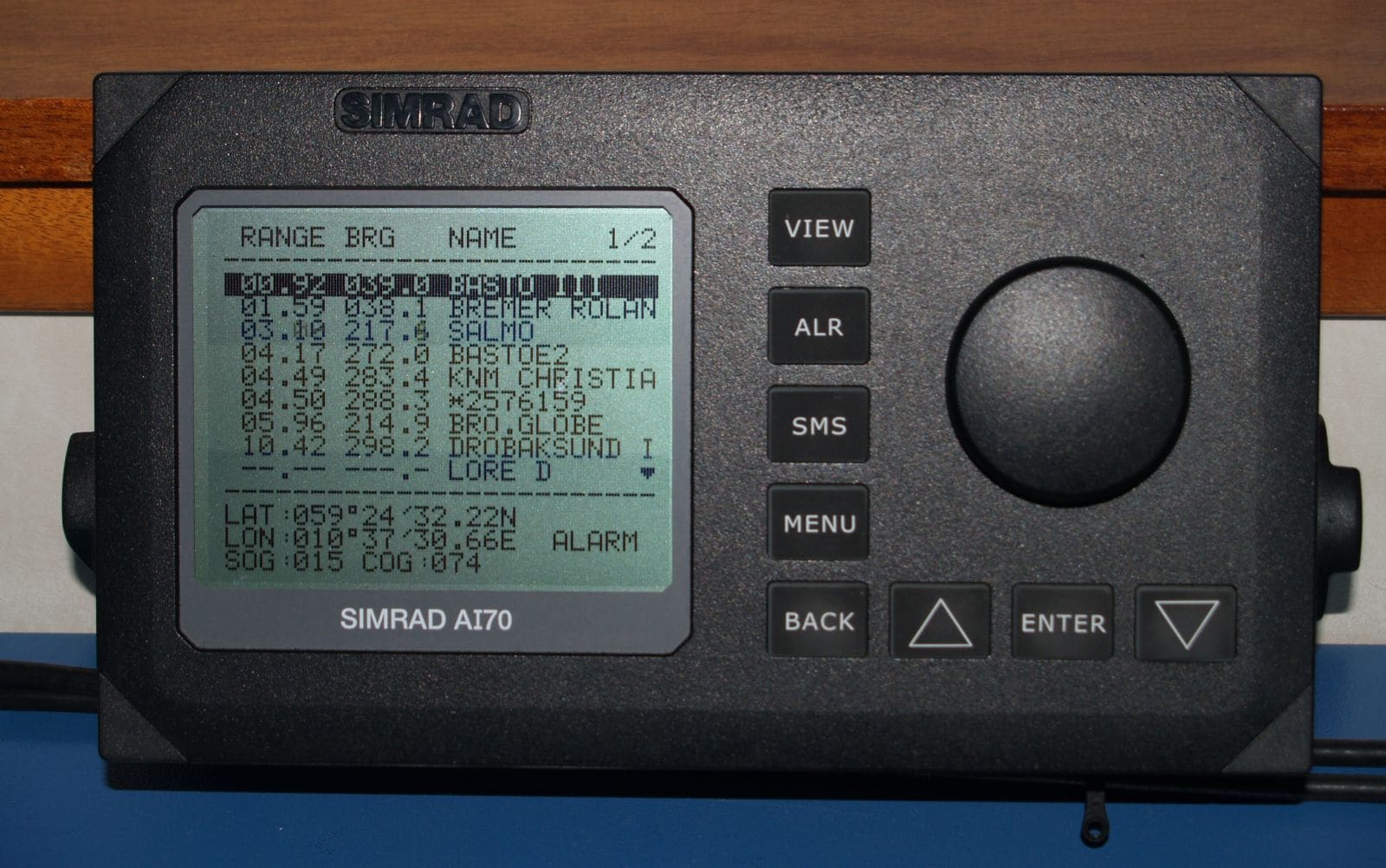
AIS on Your Boat: Receiver vs. Class B, MMSI Programming, Antennas and Checking You're Seen
Choose between a receive-only AIS and a Class B transponder, get the MMSI programmed the legal way, sort out the GPS and VHF antenna (or splitter), confirm other boats and the Coast Guard actually see you, and understand silent mode and AIS man-overboard beacons.
Recreational Radar Care: Radome and Open-Array Cleaning, Mounts, Cables and Alignment
Keep your boat's radar seeing small targets by cleaning the radome or open array the right way, checking the mount, cable and connectors for corrosion, and confirming that targets line up with the bow. Includes the safety rules for working near a radar that might transmit, plus winter care.
Man-Overboard Recovery Gear: Throwables, Lifesling, Ladders and MOB Alarms
Set up and check the gear that gets a person in the water back aboard - a throwable within reach, a floating rescue line or Lifesling-style sling, a boarding ladder someone in the water can pull down, and MOB alarms or AIS beacons - and practice the drill so it works when it counts.