Crossing Inlets and Bars Safely: Tide Timing, Coast Guard Bar Restrictions and When Not to Go
Inlets and river bars are where calm-looking days turn deadly. Learn why an ebb tide against an ocean swell builds breaking waves, how to check bar reports and Coast Guard restrictions, how to read the inlet before you commit, how to run it with life jackets on, and when to wait or go somewhere else.
Time
30 min
Applies to
All engines · Fishing boat, Center console, Bowrider / runabout, Cabin cruiser, Sailboat, Yacht
Safety first: If waves are breaking across the channel, don't go. Everyone wears a life jacket for the crossing, buckled, before you reach the bar. If you're caught in breaking seas or someone goes overboard, call the Coast Guard on VHF channel 16 right away. On bars the Coast Guard has restricted or closed, crossing is against federal law, not just a bad idea.
Fuel smell, water coming in, CO alarm or smoke? Stop, get everyone in life jackets and call USCG on VHF 16 or 911. For a tow: Sea Tow or TowBoatUS.
Owners often ask
- Why is the inlet calm in the morning but breaking waves when I come back in the afternoon?
- How big do the waves have to be before a bar crossing is too dangerous for my boat?
This guide walks you through it. Still stuck? Ask the AI Mechanic about your engine.
Tools
- Up-to-date chart of the inlet (paper or chartplotter)
- VHF radio (fixed or handheld)
- Binoculars
Parts & supplies
- USCG-approved life jacket for each person, worn
Before you start
What makes inlets dangerous. An inlet or river bar is where the ocean meets a narrow channel and a shallow, shifting bottom. Waves feel that rising bottom and steepen. Add a current running out against them and they can stand up and break, even on a sunny day with little wind. Tom Neale, writing in Soundings, calls inlets killers of boats and people, and points out that what you know about one inlet may be useless at the next.
The ebb-against-swell rule. NOAA explains that the falling tide produces an ebb current flowing out to sea, the rising tide a flood current flowing in, and that near inlets these currents can be strong. When the ebb runs out against incoming swell, the waves meet resistance and steepen; a flood running in with the swell tends to flatten it. That's why the same inlet can be gentle at 9 a.m. and dangerous at 3 p.m.
Distant storms count. Neale notes the wind can be calm or even blowing offshore and the inlet still turn nasty on an outgoing tide, because swell from a storm far away has arrived. Look at the swell height and period in the forecast, not just the local wind (our weather guide explains wave period).
Know your boat and yourself. Power & Motoryacht's Bill Pike stresses precise, available power. An underpowered or heavily loaded boat has less margin. If you or your boat are new to an inlet, cross it the first time on a calm day with someone who knows it.
Steps
Before the trip, check NOAA tide and current predictions for the inlet (our tides and currents guide shows how). Note when the ebb is strongest and when the current turns. As a general pattern, plan to cross near slack water or on the flood, and avoid the strongest ebb, especially if there's any ground swell. Also check whether it's a spring tide period (new or full moon); NOAA notes currents run stronger then.
Most trouble happens coming home: tired crew, a building afternoon sea breeze, and an ebb that started while you were fishing. Work out when the next ebb runs and plan to be back inside before it peaks, or to wait offshore until it eases. Put your planned crossing times on your float plan.
Read the NWS coastal waters forecast for wind, wave height and period, and any Small Craft Advisory. Long-period swell can stack up and break at inlets even when the forecast for open water looks fine. If a front is due or the swell is building through the day, the inlet will likely be worse on your return than when you left.
On the Pacific Northwest, the Coast Guard can restrict or close bars (33 CFR 165.1325 lists the regulated bars in Oregon and Washington):
- A bar restriction bans recreational and uninspected passenger boats from crossing (sometimes only boats under a set length). The Captain of the Port considers the size and type of boat, sea state, wind, wave period and tidal current.
- A bar closure bans all vessels, when conditions exceed what Coast Guard rescue boats can handle.
- The Coast Guard announces restrictions and closures by Broadcast Notice to Mariners on VHF channels 16 and 22A, and crews may be on scene to warn boaters.
- The National Weather Service Portland "Local Bar Observations" page posts Coast Guard bar conditions and lists a phone number for the latest report.
- Rough bar signs: the Coast Guard's guide to hazardous bars (2015 edition) describes diamond-shaped white signs with an orange border reading "ROUGH BAR" at several Oregon and Washington bars, with two alternating flashing yellow lights that generally come on when seas exceed 4 feet; at some bars, flashing lights mean a restriction is in effect. The same guide warns that lights being off is no guarantee the bar is safe.
- A rule of thumb from the same regulation: 33 CFR 165.1325 defines an "unsafe condition" for these bars as waves at or above boat length ÷ 10 + freeboard (in feet). Example: a 20-foot boat with 2 feet of freeboard (measured at the lowest point of the sides) hits that line at 4-foot waves. It's a legal threshold for Coast Guard decisions on those bars, not a promise of safety below it, but it's a sobering number to work out for your own boat anywhere.
Elsewhere, there's no single national bar-report system. Call or radio the local Coast Guard station, TowBoatUS or Sea Tow, the harbormaster or a local charter captain. A Coast Guard boarding officer can also order a boat back to the dock if its voyage is especially hazardous (33 CFR Part 177).
Inlets shift. Sandbars move after every storm, and the buoys may be moved to follow the channel. Ask the local Coast Guard station, the marina, a towing captain or charter skippers which side of the channel is deep, where it breaks first, and any recent changes. Check that your chart is current and read the Local Notice to Mariners for the area (our buoys guide covers both).
Before you reach the bar:
- Everyone puts on a life jacket, properly fastened. On the regulated Oregon and Washington bars, federal rules require life jackets on everyone in open areas when the Coast Guard is towing or escorting your boat across, and many skippers make it a rule every crossing.
- Everyone sits low, holds on, and stays off the bow
- Close hatches and secure loose gear and coolers
- Kids stay inside the cabin or center console with an adult, in their own life jackets
- Turn the VHF to channel 16, and note your position
Bill Pike's advice: before entering, stand off and watch the wave pattern for a while. From outside the break:
- Count the sets: waves often come in groups with calmer gaps between them
- Watch where the waves break; white water marks the shallow spots
- Look for the calmest, deepest line through the channel
- Watch other boats of your size: do they make it look easy or are they struggling?
If waves are breaking all the way across the channel, don't try it. Go to another inlet or wait.
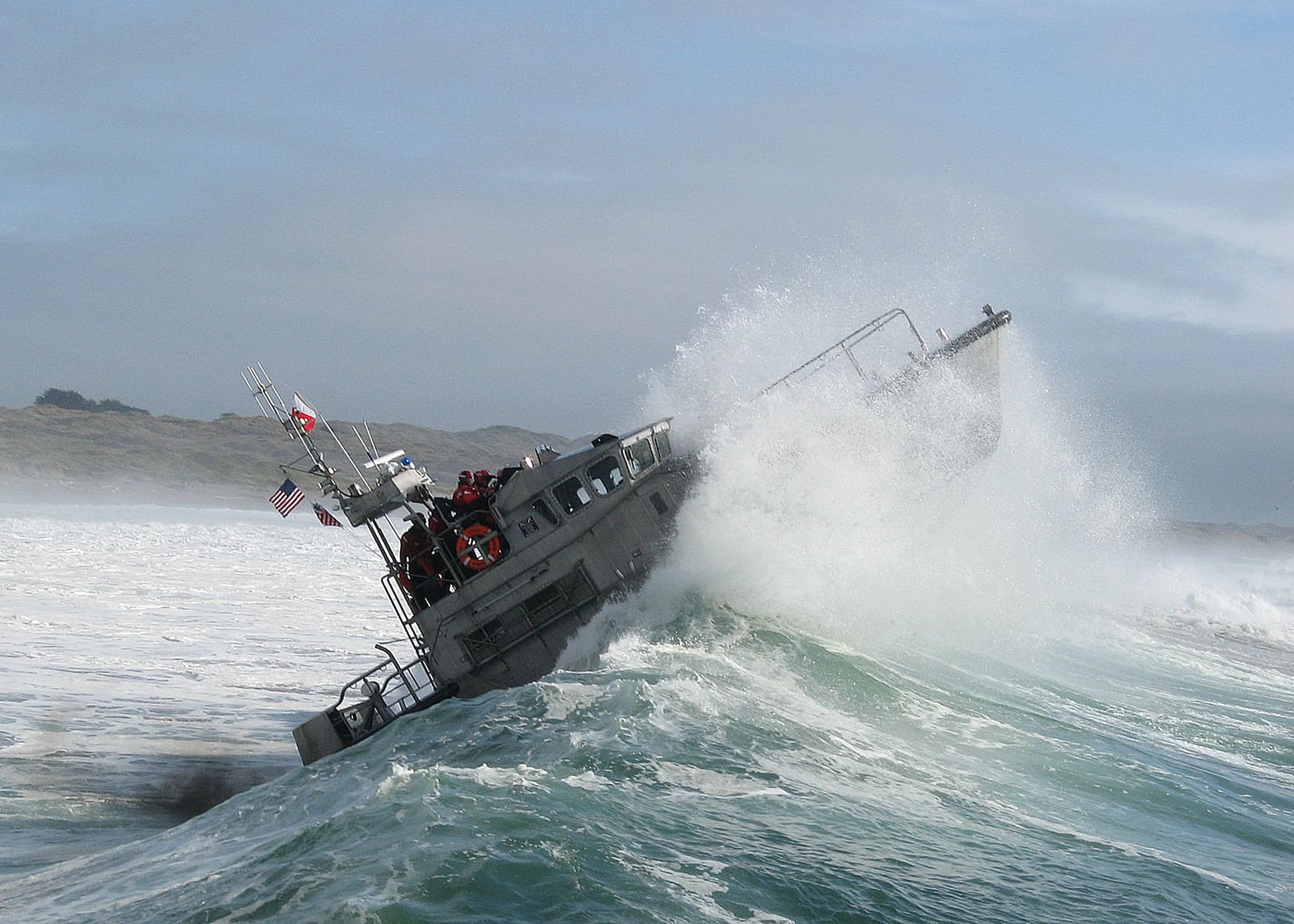
This is a 47-foot Coast Guard rescue boat built and crewed for surf, training at Bodega Bay. Breaking water like this is a no-go for recreational boats. Photo: U.S. Coast Guard / Wikimedia Commons · Public domain Cross-currents in inlets can push you toward jetties, rocks or shoals. Pick a range ahead (two fixed objects lined up, or the buoys) and watch whether you're sliding sideways; correct early. Jetty ends are especially dangerous because waves wrap around them and reflect off the rocks. Stay in the marked channel.
Crossing from the ocean is the riskier direction; following seas can lift the stern, push the bow down and swing the boat sideways (a broach). Pike describes the technique: ride the back of a wave and don't pass it until it breaks ahead of you. In practice:
- Time your run for the gap after a set
- Match the speed of the wave you're following, staying on its back, not on the face of the one ahead
- Use power precisely, neither too fast nor too slow; keep enough in reserve to escape a wave building behind you
- Keep the stern square to the waves
Once you commit to a rough inlet, Pike notes, there's usually no turning back, so make the decision before you enter.
Going out, Neale's advice is simple: if the inlet is bad and you're inside, stay there. If you do go:
- Wait for a lull between sets
- Take each wave on the bow at a slight angle, slowing as you climb so you don't launch off the top
- Don't let the boat get turned sideways to breaking waves
- Engine dies in the inlet: put out the anchor if it will hold you clear of the break, and call for help on VHF 16
- Boat swamped or capsized: stay with the boat, keep life jackets on, call Mayday if you can. Our capsize guide covers what to do.
- Someone overboard: keep them in sight, throw flotation, and call Mayday; don't drive into breaking surf after them
Don't cross, or wait, when:
- Waves are breaking across the channel
- The Coast Guard has restricted or closed the bar, or warns against it
- A strong ebb is running against swell or onshore wind
- Fog, darkness or heavy rain hides the waves and markers (our fog and night guides explain why)
- Your boat is low on fuel or has an engine problem
- You're tired, or the crew is seasick or inexperienced
Options: wait for slack or the flood, use a bigger, deeper inlet nearby, or stay put in a protected harbor. Waiting a few hours is always cheaper than a rescue.
Common mistakes
- Checking the inlet in the morning and assuming it'll be the same on the way back.
- Running out on a strong ebb because "the wind is offshore."
- Life jackets in the locker instead of on people.
- Cutting the corner near the jetty to save time.
- Following a bigger or faster boat through the break; their limits aren't yours.
- Trusting an old chart or GPS track in an inlet where the sandbars move.
When to call a pro
- Any capsize, swamping, person overboard or water coming in: Coast Guard on VHF 16 or 911
- Stuck outside with conditions too rough to enter and fuel running low: call the Coast Guard station or TowBoatUS / Sea Tow early, while you still have options
- New to an inlet: hire a local captain or take an on-water coastal navigation course
- Hit the bottom on a bar: check for leaks, and have the hull and running gear checked after
Tips
- Save a "bar check" routine: tide table, forecast, bar report, crew briefing, life jackets on.
- Write your inlet crossing times on your float plan.
- Ask the marina or Coast Guard station about the inlet when you arrive in a new area; most are happy to tell you.
- A boat with plenty of reliable power and a good trim setting is easier to control in following seas.
Official references
We read these to write this guide. Your engine's own manual always wins.
- eCFR – 33 CFR 165.1325, Regulated Navigation Areas; Bars Along the Coasts of Oregon and Washington
- eCFR – 33 CFR Part 177, Correction of Especially Hazardous Conditions
- National Weather Service Portland – Local Bar Observations
- NOAA Ocean Service Education – What are Tides? (flood, ebb and slack water)
- NOAA Ocean Service Education – Tidal Currents (spring and neap currents)
- Soundings – The Ins and Outs of Running Inlets (Tom Neale)
- Power & Motoryacht – How To Run an Inlet (Capt. Bill Pike, 2012)
- U.S. Coast Guard 13th District – Local Notice to Mariners Special Notice, Chapter III, Guide to Hazardous Bars (2015)
Safety: BoatMend is for information only and does not replace a certified marine technician. You are responsible for your safety and your boat. Read the full disclaimer.
Last updated 2026-11-06
Related guides
Reading NOAA Tide and Current Predictions for Trip Planning (MLLW, Slack Water and Bridge Clearance)
Tide is the water going up and down; current is the water moving sideways, and their timing doesn't always line up. Learn to find the right NOAA station, read high and low tides against chart datum (MLLW), find slack water and peak current, check bridge clearance against mean high water, and plan launches, anchoring and inlet crossings around them.
Reading Marine Weather Forecasts: Advisories, Wind, Waves and Go/No-Go
Learn where to get the official NOAA marine forecast for your waters, what small craft advisories and warnings really mean, how to read wind and wave numbers, and how to make a simple go/no-go call before you leave the dock.
How to Read Buoys and Channel Markers: Red Right Returning and the U.S. Aids to Navigation System
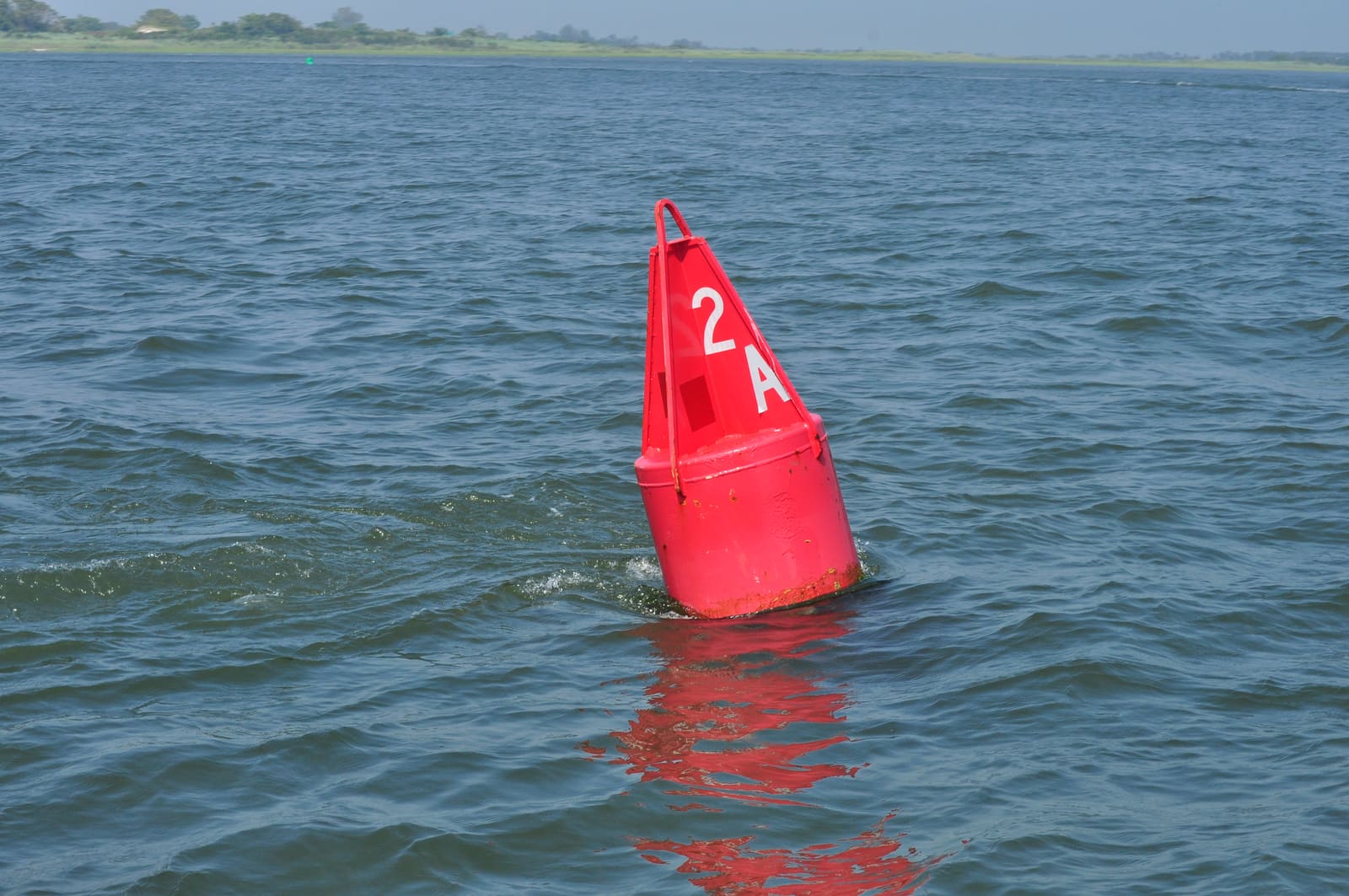
Learn what the red and green buoys, daymarks and lights are telling you: red right returning, nuns and cans, odd and even numbers, preferred channel, safe water, isolated danger, the orange-and-white regulatory and information markers, the yellow symbols on the Intracoastal Waterway and how the Western Rivers system differs. Based on the Coast Guard's U.S. Aids to Navigation System rules (33 CFR Part 62).
How to File a Float Plan: What to Include, Who Gets It and What They Do If You're Late
A float plan is a short written trip plan you leave with someone ashore, not with the Coast Guard. Fill in the free USCG Float Plan or the Coast Guard app, agree on a firm 'call for help by' time, check in when plans change, close the plan when you're home, and give your shore contact clear steps for reporting you overdue.
Set Up Your VHF Radio: MMSI, DSC, GPS Hookup and Radio Checks
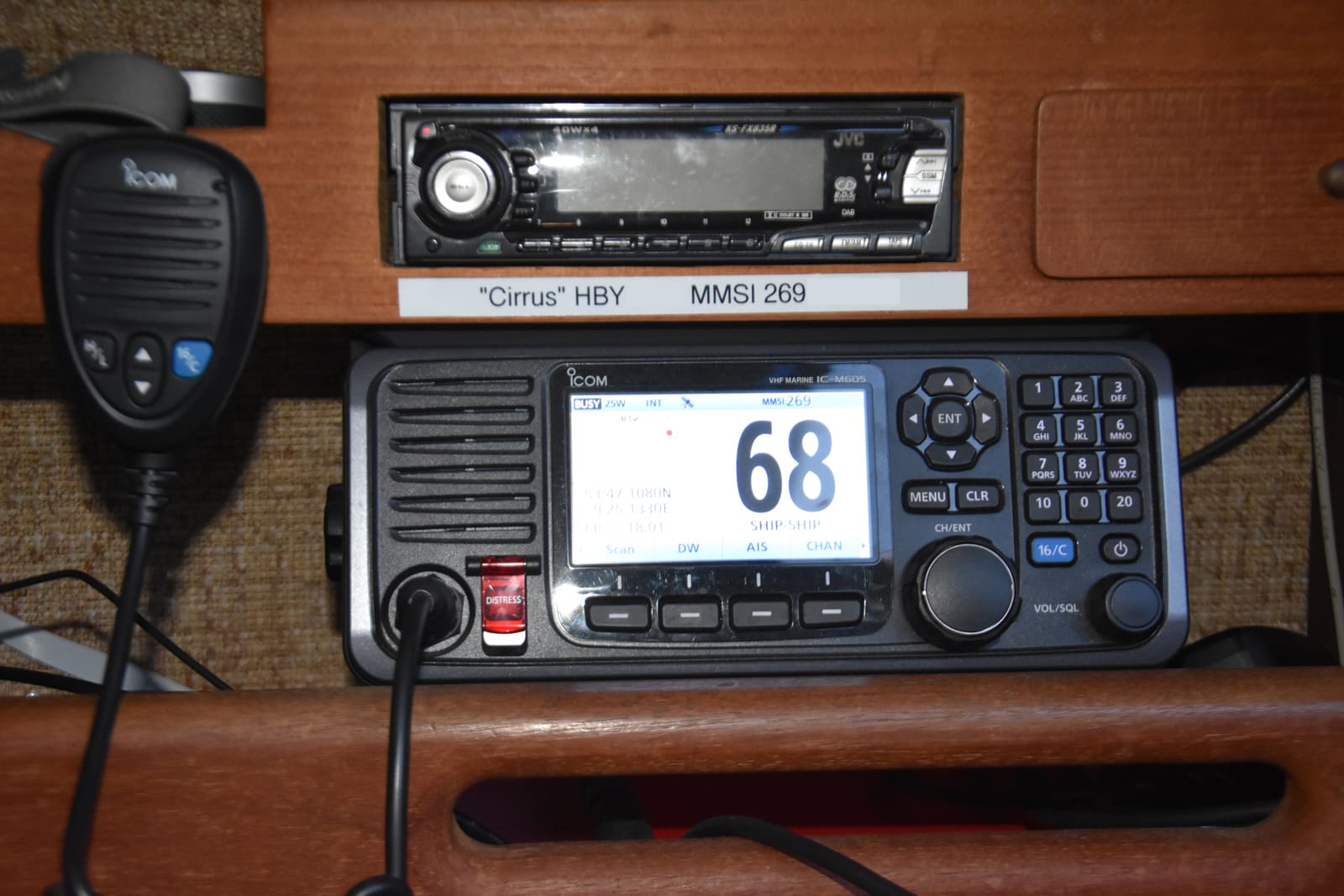
Get a free or low-cost MMSI number, program it into your DSC radio, connect your GPS so a distress alert sends your exact position, check the antenna, and learn the Channel 16 rules and the right way to do a radio check.
Capsized or Swamped: What to Do in the Water, and How to Keep It from Happening
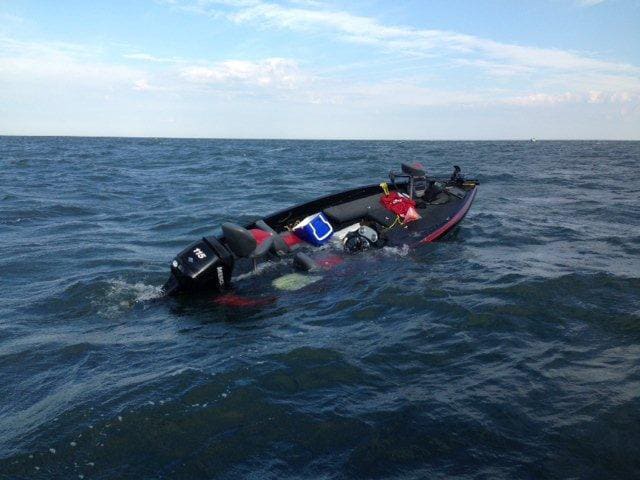
Most capsizes and swampings happen to small boats, fast, often on ordinary days. Learn the first moves that keep everyone alive (stay with the boat, count heads, life jackets, get out of the water, signal for help), how small sailboats are righted, why the cold-water "1-10-1" rule is a best case, and how loading, the drain plug and following seas cause most of these accidents.
The Pre-Departure Safety Briefing: What to Tell Every Passenger (with a Printable Checklist)
A five-minute talk before you leave the dock turns guests into a crew that can help in an emergency. Cover life jackets, the engine cut-off switch, the fire extinguisher, how to call for help on the VHF, what to do if someone falls overboard, staying seated, seasickness and carbon monoxide near the stern, then use the printable checklist every trip.
How to Choose and Fit Life Jackets for Children and Babies
Pick the right Coast Guard-approved life jacket for each child by weight, check the fit so it can't slip off, look for head support and a crotch strap on little ones, and learn the federal and state wear rules. Inflatables are not for kids, and a life jacket never replaces an adult watching.
What to Do When Your Boat Is Taking On Water: Emergency Steps and Prevention
A step-by-step emergency plan for water coming into the boat - life jackets on, call for help early on VHF 16, find and slow the leak, pump, and head for shallow water if needed - plus the maintenance checklist that prevents most sinkings.
Right-of-Way on the Water: The Navigation Rules Every Recreational Boater Should Know
There are no lanes or stop signs on the water, so the Navigation Rules decide who keeps course and who gets out of the way. Learn stand-on and give-way, meeting head-on, crossing, overtaking, sail versus power, narrow channels, big ships, safe speed and keeping a proper lookout, with the rule numbers from the U.S. Inland Navigation Rules (33 CFR Part 83).