Boat Registration Numbers and Validation Decals: Federal Display Rules, State Placement and Renewals
Display your state registration number and validation decal the way federal rules (33 CFR 173 and 174) and your state require: size, block style, contrast, spacing, placement on the forward half, decal position, what documented boats show instead (name and hailing port), what to carry aboard, and how to never miss a renewal. States add their own details, so check your state boating agency.
Time
1 h
Shop would charge
$50-150
Applies to
All engines
Safety first: Registration numbers are how law enforcement, rescuers and your insurer identify your boat; a boat with missing, wrong or unreadable numbers can be stopped and ticketed, and a stolen boat is harder to recover. Work on numbers with the boat on its trailer or a stable dock, not from a ladder on a slippery ramp. This guide is practical help, not legal advice: each state runs its own numbering system within the federal rules, so check your state boating agency for its exact decal placement and renewal rules.
Owners often ask
- Where exactly do the registration numbers and the state sticker go on my boat?
- My boat is Coast Guard documented. Do I still need state numbers or a decal?
- Do I have to register a kayak or jon boat that only has an electric trolling motor?
This guide walks you through it. Still stuck? Ask the AI Mechanic about your engine.
Tools
- Tape measure and a ruler
- Masking tape and a level or a straight reference line
- Glass cleaner or isopropyl alcohol and lint-free towels
- Plastic squeegee (usually supplied with vinyl numbers)
- Phone camera (photo of the finished numbers and your certificate)
Parts & supplies
- Pair of 3-inch (or larger) block-style vinyl registration numbers in a contrasting color
- Current state validation decals
Before you start
Who needs numbers. Federal rules (33 CFR 173) apply to boats with propulsion machinery of any type, and states run the numbering programs. BoatUS notes that every engine-powered boat in U.S. waters, and many other boats, must be registered with a state or documented with the Coast Guard. Many states also register some boats without motors (sailboats, or all boats). Your state agency's website lists who must register.
"It's only a trolling motor." Owners ask this all the time about kayaks, canoes and jon boats. The federal numbering rule (33 CFR 173.11) covers vessels with propulsion machinery of any type, so an electric trolling motor counts the same as a gas outboard. One narrow federal exemption (33 CFR 173.13) applies only where the Coast Guard itself issues numbers: a small tender under 10 hp used just to shuttle between a numbered boat and shore may show the mother boat's number with a "1" suffix. In practice your state sets the rules, so check before you clamp a motor on anything.
What you'll get from the state:
- A certificate of number (registration card) with your number, like
FL 1234 AB - Validation decals showing the registration is current
State registered or federally documented, never both kinds of markings. BoatUS explains that a boat is identified either by state registration numbers or as a Coast Guard documented vessel. A documented boat shows its name and hailing port instead of state numbers, though many states still require it to carry a state decal.
Steps
Before you put anything on the hull, compare the number on your certificate with the HIN on the certificate and the HIN on the boat. Texas reminds owners that the number on the decal must match the number on the certificate. A typo now means ordering everything twice.
Under 33 CFR 173.27, each number must:
- Be painted on or permanently attached to each side of the forward half of the boat
- Be in plain vertical block characters at least 3 inches tall
- Contrast with the background and be clearly visible and readable
- Have a space or hyphen between the letter and number groups equal to the width of a letter (other than "I") or a number (other than "1"), for example
DC 5678 EForDC-5678-EF - Read from left to right on both sides
And under 33 CFR 173.19, no other numbers may appear on the forward half of the boat. Leave off old registration numbers, racing numbers and phone numbers there.
- Font: plain block letters. No script, italics, outlines only, or shadow-only styles. BoatUS notes a multicolored or patterned background may need a solid block of color behind the numbers so they're readable.
- Size: at least 3 inches tall. Bigger is fine and easier to read on large boats.
- Color: dark numbers on a light hull or light numbers on a dark hull.
- Material: marine-grade vinyl, paint or metal characters. Minnesota, for example, accepts decals, metal or paint, and sets its own stroke width and spacing (stroke between 1/2 and 3/4 inch, 3 to 4 inches between letter and number groups, 1/2 to 3/4 inch between characters). Check whether your state has similar specs.
- Inflatables: BoatUS suggests getting numbers from the boat's maker in a material and adhesive made for that fabric.
Choose a flat, visible area on each side of the bow, above the waterline and below the rub rail, where a person in another boat can read it. If the hull shape hides numbers (some sailboats, PWCs or boats with big flares), 33 CFR 173.27 allows a backing plate attached to the forward half so the number is visible from each side.
BoatUS cautions that numbers on glass or plastic windows, or on placards (signboards), aren't considered permanent unless they're bolted or screwed to the hull or superstructure. Put them on the hull.
Federal standards for state systems (33 CFR 174.15) say validation stickers are about 3 inches square and are displayed within 6 inches of the number. Each state then sets the exact position. Examples:
- Texas: in line with the TX number and 3 inches toward the stern.
- Minnesota: toward the stern, no more than 4 inches from the first or last character, on each side.
- Florida: a county tax collector's vessel page says the decal goes on the port (left) side of the boat, and that Florida registrations expire at midnight on the owner's birthday (June 30 for boats titled to a business). Florida readers should confirm placement with their tax collector.
BoatUS notes that whether the decal goes in front of or behind the numbers depends on the state. Look up your state's rule before you apply the numbers, so you leave room.
Wash the area, then wipe it with glass cleaner or isopropyl alcohol and let it dry. Remove old numbers and adhesive first (see our decals and graphics guide). BoatUS's lettering how-to recommends the dry method for small items like registration numbers, which works down to about 45°F; larger graphics go on better with the wet method between about 65°F and 85°F.
Measure the same distance back from the bow and up from the waterline (or down from the rub rail) on both sides. Run a strip of masking tape as a level baseline. Tape the number strip in place and step back to check it from a distance. Leave the decal gap on the correct end.
With the number strip taped in position, run a piece of masking tape vertically through the middle as a hinge. Lift one half, peel the backing to the center, cut it off, and squeegee from the center outward. Repeat on the other half. Squeegee firmly, then peel the transfer tape back over itself slowly. Prick any bubbles with a pin and press them flat.
Apply each decal to clean, dry hull in the spot your state requires. Remove last period's decals unless your state says otherwise; old decals stacked next to the number can confuse an officer. Texas notes that antique-registered boats may put the decal on the left part of the windshield, a rare exception; follow your state's wording.
If your boat is Coast Guard documented:
- Remove state numbers. Federal rules (33 CFR 173.33) require the owner to remove the number and validation sticker when the boat is documented.
- Name and hailing port: for a boat documented only for recreation, 46 CFR 67.123 requires the name and hailing port marked together on a clearly visible exterior part of the hull, in Latin letters or Arabic or Roman numerals at least 4 inches tall. BoatUS notes there are no font or color rules, and the hailing port must include a place and a state (the state can be abbreviated). Many owners put name and hailing port on the stern and the name on both bows; that's allowed but not required for recreational boats.
- Official number: 46 CFR 67.121 requires the official number, preceded by "NO.", in block Arabic numerals at least 3 inches tall, permanently fixed on a visible interior structural part of the hull so that removing it would be obvious.
- State decal: many states still require documented boats used there to register and display a decal. Texas, for example, says documented boats that need Texas registration may show only the validation decal on both sides of the bow, not the TX number.
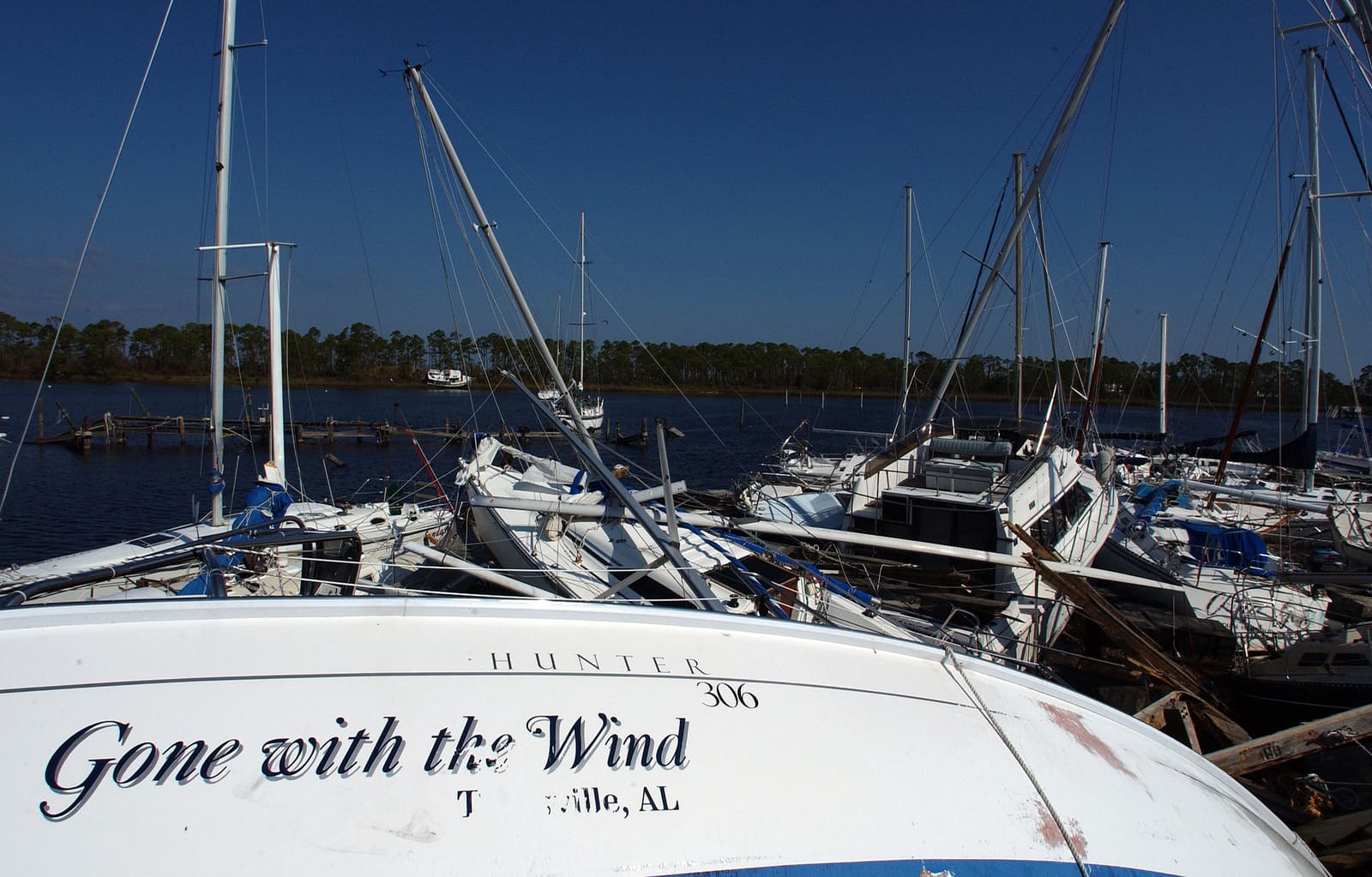
A documented recreational boat shows its name and hailing port (a place and a state) together on the hull instead of state numbers. Photo: Saul McSween / U.S. Navy / Wikimedia Commons · Public domain 33 CFR 173.21 requires the operator to have a valid certificate of number (or temporary certificate) on board, in hard copy or digital form, and to show it to a law enforcement officer on request. Some states have their own rules about digital copies, so keep a paper copy in a waterproof bag too. Rental boats under 26 feet rented for less than a week can keep the certificate ashore with a signed rental agreement aboard.
Under 33 CFR 173.29, the owner must notify the state within 15 days of an address change, theft or recovery, a lost or destroyed certificate, a transfer of ownership, or the boat's destruction or abandonment. When a boat moves to a new state of principal use, the old number stays valid there for 60 days; after that, register in the new state and remove the old numbers and decal (33 CFR 173.17 and 173.33).
- BoatUS says registration is usually renewed every year or two, depending on the state. Find your expiration date on the certificate and decal.
- Put a reminder in your phone a month before it expires, and another for the week before.
- Many states renew online and mail new decals; allow time for mail before your first trip.
- Documented boats renew with the Coast Guard's National Vessel Documentation Center. BoatUS (2020) reported that recreational documentation moved to five-year renewals in 2022. The current federal fee schedule (46 CFR 67.550, checked on the eCFR in October 2026) lets a recreational certificate be renewed for one to five years at $26 per year (so $130 for five years), with an extra charge for a late renewal. Fees can change, so confirm on the NVDC site before you pay.
- Ignore look-alike renewal letters. BoatUS warns that some third-party companies send official-looking documentation renewal notices that point to websites resembling the Coast Guard's and charge much more. The Coast Guard says these companies don't act for it and can't issue documentation. Renew directly.
Common mistakes
- Script, italic or outlined numbers, or numbers under 3 inches.
- No space or hyphen between the letter and number groups, or spaces that are too narrow.
- Numbers only on one side, or on the back half of the boat.
- Numbers or decals on a windshield or a removable sign.
- Old registration numbers left on the bow after a move or documentation.
- Decal too far from the number or on the wrong end for your state.
- Leaving the certificate at home, or letting the registration lapse over the winter.
When to call a pro
- Your hull is textured, multicolored, wrapped or an inflatable fabric: a sign shop or the boat maker can supply numbers and backing that stick and stay readable
- Old painted or ghosted numbers won't come off cleanly: a detailer can compound or refinish the area
- You're switching between state registration and Coast Guard documentation, or moving states: call your state agency (and the NVDC for documentation) before changing the markings
- Your numbers don't match your paperwork or HIN: contact your state agency before you go out
Tips
- Order numbers with a matching spare set; vinyl can tear during application.
- Photograph both sides after applying, with your certificate in the frame, for your records and insurer.
- Keep a copy of the certificate in your phone and a paper copy aboard.
- If your boat has a dinghy with a motor, check your state's registration rules for it; see our dinghy guide.
- A free Vessel Safety Check from the Coast Guard Auxiliary or Power Squadrons will confirm your numbers and decal look right.
Official references
We read these to write this guide. Your engine's own manual always wins.
- eCFR – 33 CFR 173.27, Numbers – display, size, color
- eCFR – 33 CFR 173.11, Applicability (propulsion machinery of any type)
- eCFR – 33 CFR 173.13, Exemptions (tenders under 10 hp)
- eCFR – 33 CFR 173.15, Vessel number required
- eCFR – 33 CFR 173.19, Other numbers prohibited
- eCFR – 33 CFR 173.21, Certificate of number required (hard copy or digital)
- eCFR – 33 CFR 173.29, Notification to issuing authority
- eCFR – 33 CFR 173.33, Removal of number
- eCFR – 33 CFR 174.15, Validation stickers
- eCFR – 46 CFR 67.123, Name and hailing port marking requirements
- eCFR – 46 CFR 67.121, Official number marking requirement
- Texas Parks and Wildlife – Numbers and Decals on Vessels
- Minnesota Rules 6110.0300 – Display of license number and validation decal
- BoatUS – USCG lettering requirements (state registered and documented vessels)
- BoatUS – U.S. Coast Guard Vessel Documentation FAQs (2020)
- BoatUS – Consumer alert on look-alike documentation renewal notices
- BoatUS – Boat Registration, Titling and Documentation (2019)
- BoatUS – Applying Boat Lettering (2013)
- eCFR – 46 CFR 67.550, Schedule of fees (documentation renewal)
- Nassau County (Florida) Tax Collector – Vessels (decal on the port side, renewal date)
Safety: BoatMend is for information only and does not replace a certified marine technician. You are responsible for your safety and your boat. Read the full disclaimer.
Last updated 2026-10-25
Related guides

How to Remove and Apply Boat Names, Graphics and Registration Decals
Take off old vinyl names and graphics without scratching the gelcoat, clean up the glue and the "ghost" outline, then apply new lettering straight and bubble-free, and display your registration numbers the way federal rules require.
Dinghy and Tender Rules: Lights, Registration, Capacity, Life Jackets and Kill Switch
Your dinghy is a boat in its own right. Learn which navigation lights it needs after dark (rowing or under power), when the outboard means it must be registered, and how capacity plates, life jackets and the kill-switch law apply to a small tender.

USCG Required Safety Equipment Check by Boat Length
Walk through your boat and confirm you carry every piece of safety gear the US Coast Guard requires for your boat's length and type, and that none of it is expired or worn out. Missing or expired gear is one of the most common tickets on the water, and it is the gear you need when things go wrong.
How to Prepare for a Free Vessel Safety Check
Volunteers from the Coast Guard Auxiliary and America's Boating Club will inspect your boat's safety gear for free, with no ticket if something is missing. Learn how to request a Vessel Safety Check, what the examiner looks at, how to get your boat ready and what to do with the fix list.

Used Boat Paperwork: Titles, Liens, HIN Checks, Bill of Sale and Registration
A practical checklist for the paperwork side of buying a used boat: state title or Coast Guard documentation, checking for liens and theft, verifying the hull ID number, writing a proper bill of sale, the trailer's own title, registering in your name, and transferring warranties and checking recalls. Rules vary by state, so confirm each step with your state agency.

Buying a Boat in Another State: Survey, Paperwork, Taxes, Registration and Getting It Home
A step-by-step plan for buying a boat that is hundreds of miles away: checking it remotely with a local surveyor, matching the HIN and VIN to the title, avoiding long-distance scams, paying the right sales or use tax, registering in your home state, the trailer's own paperwork, temporary permits, and legal towing or professional transport for wide boats. Rules vary by state, so confirm each step with the agencies involved.

How to Protect Your Boat, Motor and Trailer From Theft
Practical, layered security for boat owners: outboard locks, trailer coupler and wheel locks, disabling the boat, GPS trackers, engraving and marking, photo and serial number records, safer storage, and exactly what to report (HIN and serial numbers) if your boat is stolen.

Boats With No HIN: State-Assigned Hull Numbers for Homebuilt, Pre-1972 and Damaged-HIN Boats
What to do when a boat has no hull identification number, a homemade or kit boat needs one, an older boat predates the 1972 rule, or the number has been damaged or altered: the federal rules, how a state assigns a HIN, the inspection, the proof of ownership and build receipts to bring, how to fix the number to the hull, and the red flags that mean walk away. Practical help, not legal advice; every state runs its own process.

How to Get Rid of an Old Boat: Sell, Donate, Turn In or Scrap It the Right Way
An old boat nobody wants can cost you money for years. Learn your real options (selling as-is, donating, state vessel turn-in programs, landfill or dismantling), the tax rules on donations, how to cut your name off the registration and title, and why you should never abandon a boat.

Used Boat Purchase Agreement and Closing: Deposit, Contingencies, Bill of Sale and Who Pays What
A plain-English walk-through of buying a used boat on paper: getting ready before you offer, what the purchase and sale agreement should say, how the deposit is held and when it comes back, survey, sea trial, financing and insurance contingencies, paying off the seller's loan, the bill of sale, closing and transferring the paperwork, and the costs each side usually covers. Practical help, not legal advice; rules vary by state.