Used Boat Paperwork: Titles, Liens, HIN Checks, Bill of Sale and Registration
A practical checklist for the paperwork side of buying a used boat: state title or Coast Guard documentation, checking for liens and theft, verifying the hull ID number, writing a proper bill of sale, the trailer's own title, registering in your name, and transferring warranties and checking recalls. Rules vary by state, so confirm each step with your state agency.
Time
2 h
Applies to
All engines
Safety first: This guide is practical help, not legal advice. Boat title, registration and tax rules are set by each state and change over time; check with your state's boating or titling agency, and talk to a marine attorney or documentation professional for large or complicated purchases. Never hand over money before you have seen original ownership documents that match the boat and the seller. If a deal feels rushed or the paperwork does not add up, walk away.
Owners often ask
- How do I check if a used boat has a lien or is stolen before I buy it?
- The seller has no title for the boat or trailer. Can I still register it?
This guide walks you through it. Still stuck? Ask the AI Mechanic about your engine.
Tools
- Phone camera (photos of the HIN, serial plates and every document)
- Pencil and plain paper (for a HIN tracing if your state asks for one)
- Flashlight and a rag (to find and clean the HIN plate)
- Notebook or a copy of this checklist
Before you start
A boat can look perfect and still be a problem if the seller does not legally own it, a bank still has a loan on it, or it was stolen. Paperwork problems can mean you cannot register the boat, cannot insure it, or lose it entirely. Most of these checks cost nothing but time.
The three kinds of ownership paperwork you may see:
- State title: BoatUS says most states require titling, and Discover Boating notes most states require a title for boats over 16 feet. Some states title only certain boats, and a few are registration-only.
- State registration: BoatUS says all states have some form of registration for most boats. In a registration-only state, the registration card plus a bill of sale is often the main proof of ownership.
- U.S. Coast Guard documentation: a national form of titling for larger boats. BoatUS explains that a boat must measure at least 5 net tons (most boats over about 27 feet do) and be owned by a U.S. citizen to be documented, and lenders often require it.
The trailer and even the motor can have their own papers. BoatUS says most states title and register boat trailers separately, often through a different agency. Some states also title outboard motors: Texas, for example, requires separate titles for boats and for gas or diesel outboards.
Steps
On a phone call, ask the seller:
- Is the title (or documentation) in your name, in hand, with no loan on it?
- Is the trailer titled or registered, and in your name?
- Do you have the registration card, and the bill of sale from when you bought it?
Discover Boating suggests a phone call over email or texts, which scammers prefer. Ask the seller to send clear photos of the title or documentation, the registration and the HIN plate. Compare names and numbers before you drive anywhere.
Federal rules (33 CFR 181.29) require two identical HINs on each boat:
- Primary HIN: on boats with a transom, on the starboard (right) outside of the transom, within two inches of the top. Boats without a transom carry it on the starboard side near the stern; pontoons with replaceable hulls may have it on the aft crossbeam near the starboard tube.
- Duplicate HIN: in a hidden spot inside the boat or under a piece of hardware.
A modern HIN is 12 characters. The first three are the Manufacturer Identification Code (MIC), and the last characters encode when the hull was built and its model year. Clean the plate and photograph it in good light.
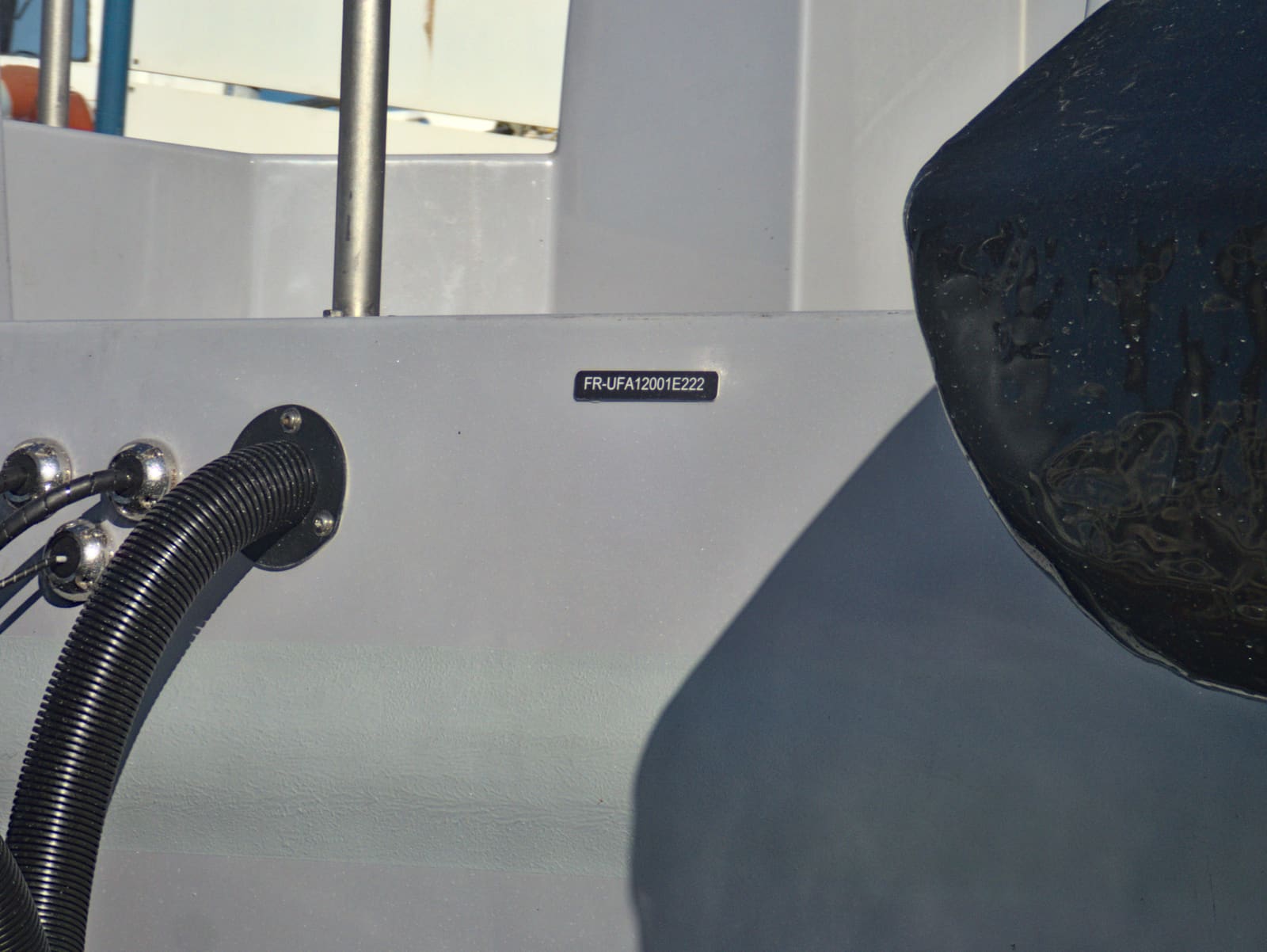
A hull ID plate on a French-built boat. After the country code (FR-, used on European boats, not on U.S. HINs) it follows the same 12-character pattern: maker code, serial number, build-date code and model year. Photo: PtiBzh / Wikimedia Commons · CC0 1.0 The rule says a HIN must be carved, molded, stamped or otherwise fixed so that changing or removing it would be obvious, and a separate plate must be fastened so removing it would scar the hull. Walk away and consider calling local police if:
- The HIN is missing, ground off, painted or filled over
- A plate has fresh screws, glue or a patch around it
- Characters look restamped or do not line up
- The transom has fresh gelcoat or paint right around the HIN area
The Coast Guard notes that one wrong character gives the boat a different identity, so a "small typo" on the title is not small. It has to be corrected through the state before you buy.
Check that these all match exactly, character by character:
- HIN on the transom = HIN on the title or documentation = HIN on the registration
- Outboard or engine serial numbers = the numbers on the seller's records (and on any motor title, in states that title motors)
- Trailer VIN plate = trailer title or registration
BoatUS also suggests cross-checking the HIN against other seller records such as insurance policies. Write all the numbers into your notes and photograph every plate. See our engine serial number guide for where to find engine tags.
A lien is a legal claim (usually a bank loan) against the boat. BoatUS explains that a title usually lists liens, and a bank loan normally must be paid off before the title can transfer.
- Look on the title for a lienholder (lender) section.
- Search the title and registration with the state where the boat is registered, as BoatUS recommends; many state agencies can confirm the title status and recorded liens.
- If a lien was paid off, ask for the lender's signed lien release. Texas, for example, asks for a separate notarized release of lien from the lienholder. On older boats the loan was often paid off years ago and the bank has since merged or been sold; it's still the seller's job to track down the bank that took over the loan and get the release before you pay. Some states will title the boat to you with the old lien still showing, but it then stays on your title and becomes your problem when you sell.
- If the seller still owes money, do the deal at the lender, or put a clause in the purchase agreement that the loan is paid off within a short, set time; BoatUS suggests exactly this, with any other liens cleared before the sale.
Never pay a seller who says "the bank has the title, I'll mail it later" unless the payoff is handled directly with the lender.
For a documented boat, ask for the current Certificate of Documentation and check that the seller is listed as owner. Then:
- Request an Abstract of Title. Under 46 CFR 67.301, anyone can ask the National Vessel Documentation Center (NVDC) for a General Index or Abstract of Title for a vessel. It shows the ownership history and recorded mortgages and liens while the boat was documented. It is not a complete history of every claim, so many buyers also use a documentation professional or attorney for bigger purchases.
- Order it online, or call the NVDC. The NVDC's own website says documentation requests and payments, including an Abstract of Title, now go through its online eStorefront; there is no walk-in service, and its old 304 phone number is no longer monitored. In October 2026 the site listed the toll-free line 800-799-8362 (the same number BoatUS gives), answered weekdays except Thursday during limited daytime Eastern hours. Check the NVDC contact page for current hours before you call.
- Use the Coast Guard Bill of Sale. BoatUS says the seller should complete a Coast Guard Bill of Sale (form CG-1340), a copy of which goes with your application for documentation (CG-1258). Form numbers change, so download the current versions from the NVDC site.
- Beware look-alike websites. BoatUS warns that private documentation services can look like the official Coast Guard site and may charge many times the official cost. They are legal, but you can file directly. The NVDC itself says it does not endorse these companies, they do not act for the Coast Guard, and they cannot issue any documentation.
Documented boats usually still owe state sales or use tax and need a state use decal in most states, per BoatUS.
There is no single public "stolen boat" lookup that covers everything. Practical steps:
- Ask your state boating agency or local police (sheriff, marine patrol or conservation officers) whether they can check the HIN against stolen-vessel records.
- The Coast Guard's HIN guidance for states lists checking the National Insurance Crime Bureau (NICB) database as one way issuing authorities verify a HIN. Ask your state agency or insurer whether they can run that check for you.
- Treat these as red flags: a price far below market, a seller who will not meet at their home, "lost" title, registration in someone else's name, an out-of-state seller who wants a wire transfer, or a seller who won't let you see the HIN.
- Watch for the classic online scams BoatUS keeps seeing. As a buyer: a cheap boat with great photos copied from a real ad, a seller who never talks on the phone (often "overseas" or "deployed"), and a seller who insists on one particular escrow or shipping company with a slick website that takes your money and vanishes. As a seller: a "buyer" who pays more than the asking price and asks you to send the difference to a shipper; the check or payment notice is fake. A buyer or seller with no interest in the title, registration or HIN isn't really doing a boat deal. For a boat in another state, BoatUS suggests sending a local accredited surveyor or someone you trust to confirm the boat exists and the seller holds the real title before any money moves.
Since 2017, federal rules (33 CFR 174.16) require state issuing authorities to verify a boat's primary HIN before issuing or updating registration for most boats built since late 1972. A boat with a bad or missing HIN can leave you unable to register it.
Even in states where the title has a sales section, a separate bill of sale protects both sides. Texas's guidance is a good model: a valid bill of sale lists the date of sale, the sale price, a description of the boat and motor (make, year and HIN or serial number), the buyer's name and the seller's signature, and it lists the trailer's price separately. Also include:
- Seller and buyer names, addresses and phone numbers
- The trailer's VIN
- Every item included (electronics with serial numbers, spare prop, safety gear, covers), as Discover Boating suggests
- "Sold as is" or any promises the seller made, in writing
- Signatures of everyone listed on the title
Many state agencies and BoatUS offer blank forms. Make two copies, both signed.
Get the trailer's title or registration signed over too, or a bill of sale where the state allows it. In some states trailers go through the motor vehicle agency while boats go through the wildlife or boating agency; Texas, for example, sends trailers to the Department of Motor Vehicles through county tax offices. A trailer without paperwork can mean a bonded title process or a trailer you cannot legally tow.
- Pay only when you have the original signed title (or documentation bill of sale), the bill of sale and any lien release in hand.
- Bigger boats usually go through a written purchase and sale agreement. BoatUS (2025) reminds buyers that an offer is a binding contract: have the storage, insurance and financing lined up before you make it, read the whole agreement, and don't count on the survey or financing "outs" to save your deposit. Without a broker, use an escrow or closing service that both sides trust (law offices and title or documentation companies offer it), not one the seller picks, and not the seller's own family lawyer. Many banks still want you in person to send a wire, so plan for it. Agree in writing whether slip or storage fees are prorated on closing day.
- If you can, go to the agency office together. Texas recommends it: problems with the title can be fixed by the seller on the spot, and the seller is sure the record leaves their name.
- Watch the deadlines. Texas, for example, requires the transfer to be filed within 45 working days of purchase or tax penalties and interest apply. Your state's deadline may be shorter or longer.
- Expect to pay sales or use tax, title and registration fees. Some states also require a HIN tracing or photo, especially for boats from out of state.
- If there is no title and the state requires one, the fix can be a slower, more expensive bonded title process. That is a reason to negotiate or walk away.
Arrange insurance before you tow the boat home.
Search the U.S. Coast Guard recall database by manufacturer, or by the MIC (the first three characters of the HIN), and check engine and equipment makers too. BoatUS explains that a Coast Guard safety recall covers boats and associated equipment less than 10 years old, and the maker has to fix it at no charge even if the defect is found years later; haulouts and travel are usually on you. Contact the manufacturer with the HIN to ask whether a recall repair has already been done. Then register yourself as the new owner with the boat and engine makers so you get future notices; BoatUS notes makers lose track of owners after a resale.
Do it right after the sale, because some plans have short windows. Mercury is a good example of how this works:
- The remaining Mercury Limited Warranty transfers to the next owner at no charge when you send a copy of the bill of sale (with the engine serial number and sale date), plus the new owner's name and address.
- Mercury Product Protection (extended coverage) Gold and Platinum plans can transfer to a new recreational owner within 30 business days of the sale, with a transfer fee.
- Mercury may refuse transfers for engines bought at auction, from a salvage yard, from an insurance company, as repossessions or through other third parties, and may ask for a dealer inspection at the owner's cost.
Yamaha, Suzuki, Honda, boat builders and electronics makers each have their own rules. Call a dealer for that brand with the serial numbers before you buy if the warranty is part of the value.
Common mistakes
- Paying first and "sorting out the title later."
- Accepting a HIN that is off by one character on the title.
- Forgetting the trailer's paperwork, or the motor's title in states that title outboards.
- Assuming a documented boat has no liens because the seller says so; request the Abstract of Title.
- Using a look-alike documentation website and paying several times the official fee.
- Missing the state's transfer deadline and paying penalties.
- Skipping the warranty transfer until the window has closed.
- Buying from someone whose name is not on the title, with no written authority to sell.
When to call a pro
- The HIN looks altered, is missing, or does not match: walk away and consider reporting it to local law enforcement
- There is an unpaid loan, a lien without a release, or the seller is not the person on the title
- The boat is documented and expensive, financed, or coming from another state or country: a marine attorney or documentation professional is worth the fee
- There is no title in a state that requires one
- The seller is an estate, a business or a legal representative: ask your state agency what proof of authority it needs
Tips
- Keep a folder (paper and a phone scan) with the title, bill of sale, registration, lien release, survey and warranty transfer. You will need it when you sell; see our sale records guide.
- Photograph the seller's ID next to the signed title, with their permission.
- Buying across state lines? Check the rules of both states. If the seller's state doesn't title boats but yours does, ask your agency what it accepts as proof of prior ownership (often the seller's registration plus a bill of sale) before you pay, and line up insurance that starts the day you pay, wherever the boat is.
- Look up your own state agency's boat titling page before you shop; requirements for HIN tracings, notarized signatures and deadlines differ a lot.
- For buys over a few thousand dollars, pay with a traceable method and get a receipt.
Official references
We read these to write this guide. Your engine's own manual always wins.
- BoatUS – After the Sale Details (titles, liens, trailers, documentation)
- BoatUS – Avoiding Buying and Selling Scams (2019)
- BoatUS – How To Make An Offer On A Used Boat (2025)
- Discover Boating – How to Buy a Pre-Owned Boat from a Private Seller
- eCFR – 46 CFR 67.301, Issuance of Abstract of Title
- eCFR – 33 CFR 181.29, Hull Identification Number Display
- eCFR – 33 CFR 174.16, Verification of Hull Identification Numbers
- U.S. Coast Guard Boating Safety – Hull Identification Number (HIN) state guidance
- U.S. Coast Guard Boating Safety – Recalls
- BoatUS – Recalls, Bulletins, and Advisories Explained
- Texas Parks and Wildlife – Buying and Selling a Boat/Outboard Motor in Texas (example of state rules)
- Mercury Marine – Mercury Limited Warranty and Mercury Product Protection Transfer
- U.S. Coast Guard – National Vessel Documentation Center (eStorefront, third-party services notice)
- U.S. Coast Guard – NVDC Address, Phone and Email Information
Safety: BoatMend is for information only and does not replace a certified marine technician. You are responsible for your safety and your boat. Read the full disclaimer.
Last updated 2026-10-25
Related guides
How to Inspect a Used Boat Before You Buy
A step-by-step checklist for looking over a used boat, from paperwork and the hull ID number to the transom, engine, compression test, sea trial and trailer. Know what to check yourself, what the red flags mean, and when to pay a marine surveyor.

How to Get Your Boat Ready to Sell (Records, Title and Prep)
Prepare your boat for sale the way buyers and surveyors expect: gather the title, registration and HIN paperwork, organize your maintenance records and receipts, fix the small stuff, detail the boat, get it ready for a sea trial and buyer's survey, and close the deal with the right documents.
How to Find Your Engine's Serial Number, Model and Year (and Get the Official Manual)
Find the ID label on your outboard, sterndrive, inboard diesel or PWC, read the model and serial number correctly, tell it apart from the boat's HIN, and use it to open the free official owner's manual. It's the first step for ordering the right parts and following the right maintenance plan.
How to Prepare Your Boat for an Insurance or Condition Survey
Get ready for a marine survey your insurer or lender asked for: what a SAMS or NAMS surveyor looks at, the common findings you can fix beforehand (hose clamps, seacocks, bilge, fire extinguishers, wiring), the paperwork to have ready, and how to handle the recommendations afterward.

How to Protect Your Boat, Motor and Trailer From Theft
Practical, layered security for boat owners: outboard locks, trailer coupler and wheel locks, disabling the boat, GPS trackers, engraving and marking, photo and serial number records, safer storage, and exactly what to report (HIN and serial numbers) if your boat is stolen.
Buying a Boat That Sat Outside for Years: What Fails, How to Inspect It and What It Really Costs
A boat that sat in a yard for years can be a bargain or a money pit. Learn what usually fails (fuel system, waterlogged foam, stringers and transom, wiring, upholstery, trailer), how to inspect and weigh it, when to pay for a survey, and how to price the repairs before you make an offer.
Avoiding Boat-Buying Scams: Fake Listings, Fake Escrow, Overpayment Checks and Safe Payment
How to spot and avoid the scams that target boat buyers and sellers: too-good-to-be-true listings, sellers who are always overseas, look-alike escrow and shipping websites, overpayment checks and fake payment notices. Covers verifying the boat, the title, the HIN and the seller, paying safely, and what to do fast if you already sent money. Practical help, not legal advice.
Used Boat Purchase Agreement and Closing: Deposit, Contingencies, Bill of Sale and Who Pays What
A plain-English walk-through of buying a used boat on paper: getting ready before you offer, what the purchase and sale agreement should say, how the deposit is held and when it comes back, survey, sea trial, financing and insurance contingencies, paying off the seller's loan, the bill of sale, closing and transferring the paperwork, and the costs each side usually covers. Practical help, not legal advice; rules vary by state.

Boats With No HIN: State-Assigned Hull Numbers for Homebuilt, Pre-1972 and Damaged-HIN Boats
What to do when a boat has no hull identification number, a homemade or kit boat needs one, an older boat predates the 1972 rule, or the number has been damaged or altered: the federal rules, how a state assigns a HIN, the inspection, the proof of ownership and build receipts to bring, how to fix the number to the hull, and the red flags that mean walk away. Practical help, not legal advice; every state runs its own process.

How to Get Rid of an Old Boat: Sell, Donate, Turn In or Scrap It the Right Way
An old boat nobody wants can cost you money for years. Learn your real options (selling as-is, donating, state vessel turn-in programs, landfill or dismantling), the tax rules on donations, how to cut your name off the registration and title, and why you should never abandon a boat.