How to Adjust and Replace Trailer Bunks and Rollers So Your Boat Sits Right
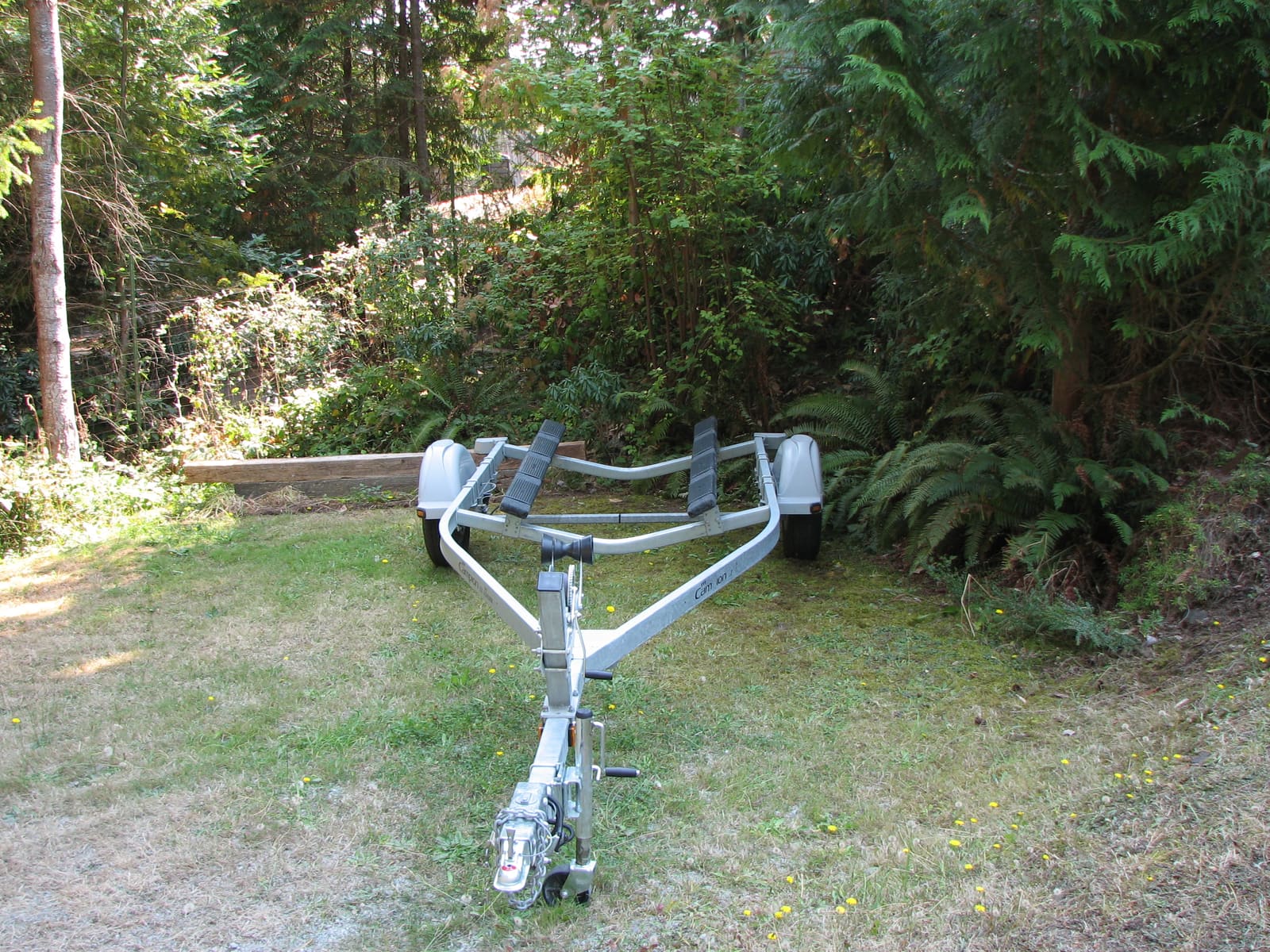
Set up your boat trailer so the hull is supported in the right places: bunks and rollers clear of the strakes, the transom fully supported, the bow snug against the winch stop and the weight balanced on the tongue. Also covers replacing rotten bunk boards and worn carpet or rollers.
Time
4 h
Shop would charge
$200-700
Applies to
All engines
Safety first: Never get under a boat or trailer held up only by a jack. Use jack stands or boat stands rated for the weight, on firm level ground, and chock the trailer wheels. Load Rite warns that badly adjusted supports or a boat sitting in the wrong spot on the trailer can damage the hull and cause serious injury, and it recommends having your dealer do the adjustment. If you can't support the boat safely while you work, have the boat lifted off by a marina or dealer. Always stand to the side of the winch line when winching: a snapped strap or hook can whip back.
Owners often ask
- How do I adjust the bunks so my boat sits right on the trailer?
This guide walks you through it. Still stuck? Ask the AI Mechanic about your engine.
Tools
- Tape measure and a marker or chalk
- Socket and wrench set (deep sockets for U-bolts)
- Penetrating oil
- Two floor jacks or bottle jacks, plus wood blocks
- Jack stands or boat stands rated for the boat's weight
- Heavy-duty staple gun with stainless or Monel staples (for bunk carpet)
- Drill, saw and safety glasses
- Tongue weight scale or a bathroom scale and lever setup (optional)
Parts & supplies
- Bunk boards (pressure-treated or composite) of the same size as the old ones
- Marine bunk carpet or bunk slides
- Replacement rollers and pins as needed
- New galvanized or stainless U-bolts, nuts and lag screws as needed
Before you start
A trailer has to match your boat's length, width and hull shape, as Discover Boating puts it. Signs that yours does not:
- The boat sits crooked, or one side rests on a fender.
- The transom hangs off the back of the bunks or rollers.
- The bow eye doesn't reach the winch stop, or the winch pulls up or down instead of straight.
- Loading is hard, the boat won't center, or the tow vehicle sways or squats.
- Bunk carpet is worn through, the boards are soft or split, or rollers are flat, cracked or seized.
Bunk trailers hold the hull on long carpeted boards; you float the boat on and off. Roller trailers hold it on rows of rollers and are easier to launch and load in shallow ramps or current. Load Rite notes that not every boat can ride on rollers, so ask your boat dealer or builder. It also limits its aluminum roller trailers to float-on, float-off use and does not recommend power-loading (driving the boat on) with an aluminum I-beam roller trailer; check what your trailer maker allows. Either way, check your boat builder's manual for the support points and the maximum transom overhang it allows.
Most big adjustments are easier with the boat off the trailer. Small tweaks (one bunk bracket, the winch post) can be done with the boat on, or with the boat floating at the ramp.
Steps
With the boat on the trailer on level ground, walk around it. Look along each bunk or roller row: does it touch the hull along its full length? Check the gap between the hull and each fender, and between the keel and the trailer crossmembers and tongue. Look at the transom. Take photos and measurements so you can compare later.
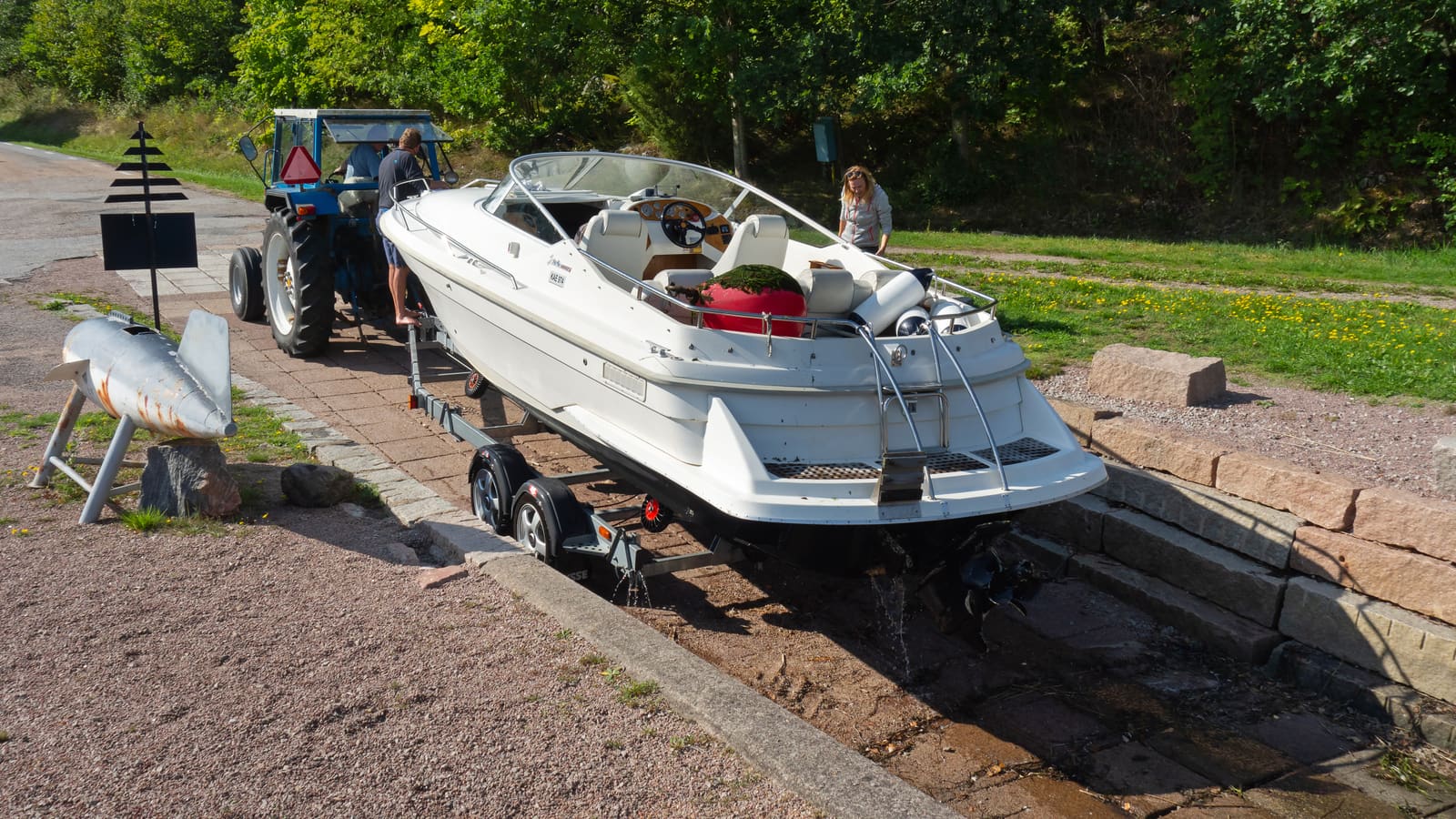
Photo: W.carter / Wikimedia Commons · CC0 The transom carries the engine's weight, so it should sit on the back of the bunks or rollers. ShoreLand'r's setup guide says the bunk or roller ends should be flush with the transom. If the hull sticks out past the supports, the trailer usually allows the bunks or the rear crossmember to slide back. Check your boat builder's manual for how much overhang, if any, is allowed.
Strakes are the narrow ridges that run fore and aft along the bottom of a fiberglass hull. Bunks and rollers should press on the flat areas between them, not on top of them. ShoreLand'r aims for about half an inch of clearance between a bunk and the nearest strake. Load Rite recommends spacing the main bunks as wide as practical while still clearing strakes and other hull features, which gives more side-to-side support. Not sure your boat sits right? Call the boat builder's customer support: some builders give exact bunk spacing at the transom and toward the bow for each hull, based on where the hull structure is.
Loosen the bunk bracket bolts so the bunks can swivel and slide up or down on their brackets. With the boat on the trailer (or floated on, then pulled out), the bunks should lie flat against the hull for their full length. Adjust the two sides equally so the boat sits level, then tighten. On roller trailers, Load Rite warns that one roller set higher than the rest can damage the bottom, so the load should be shared evenly. The keel should carry a share of the weight on the keel rollers where the trailer maker designed it to.
With the full weight of the boat (and engine) on the trailer, ShoreLand'r recommends at least 3/4 inch between the boat and each fender and between the keel and the front crossmember pad, and at least 2 inches between the keel and the tongue. If the hull touches anything other than the bunks, rollers and keel supports, keep adjusting.
Loosen the winch post bolts and slide it toward the boat until the bow stop sits just above the bow eye. ShoreLand'r then tightens the winch strap to hold that position so the strap runs level with the bow eye, tightens the post bolts, and checks the stop is still just above the eye. The winch should pull straight, not up or down. Leave the boat snug against the bow stop, with the strap tight, for towing.
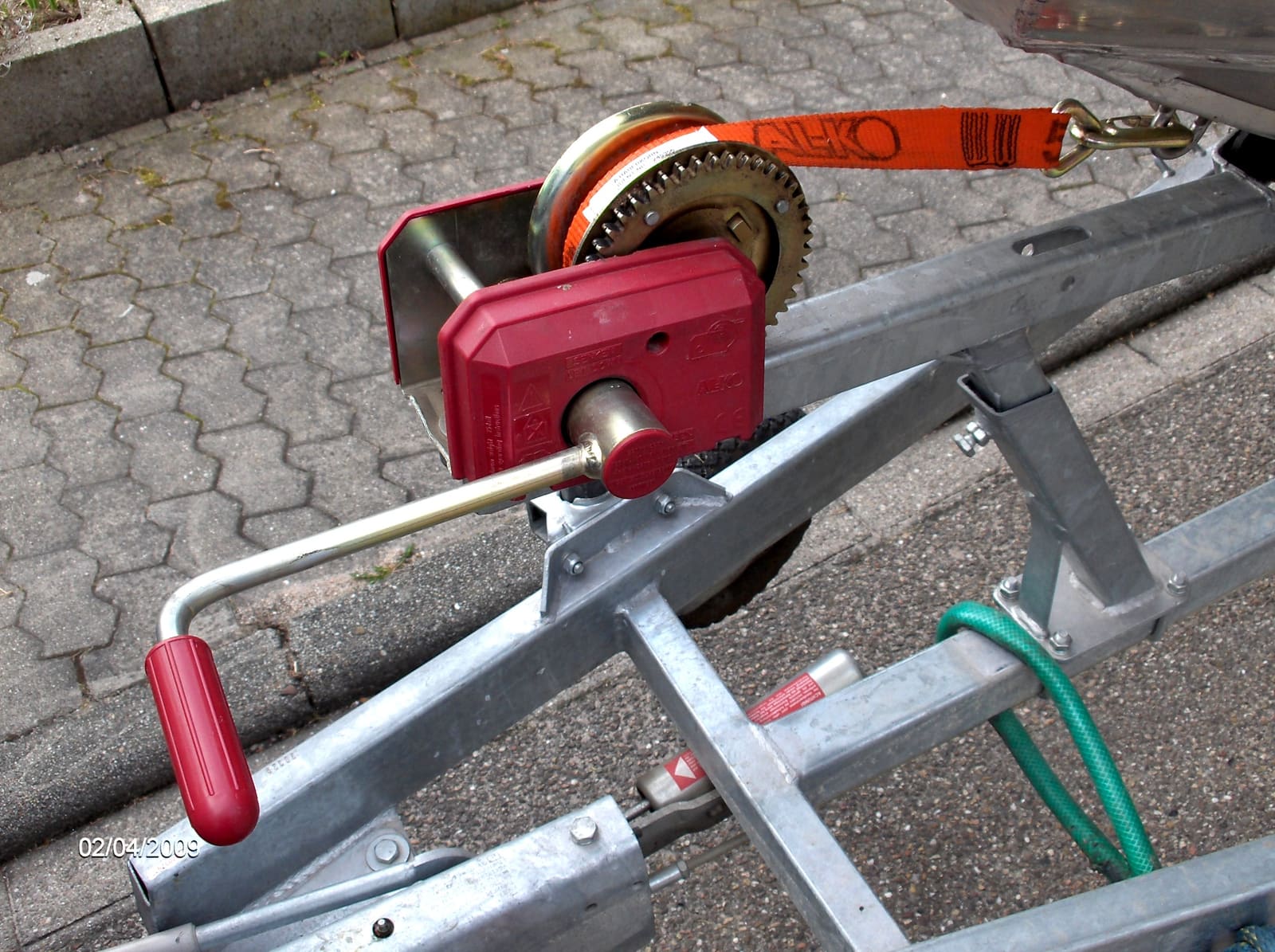
Photo: Wualex / Wikimedia Commons · Public domain Where the boat sits fore and aft changes the weight on the hitch. Too little tongue weight can make the trailer sway; too much makes the tow vehicle squat and push. ShoreLand'r suggests about 5 to 7 percent of the total boat, motor and trailer weight, and Load Rite's pages give figures between about 5 and 10 percent. Use your own trailer maker's figure. Measure with a tongue weight scale at towing height. On many trailers the axle position is moved to correct it, which is a bigger job: see "When to call a pro."
Worn-through carpet lets the wood or staples scratch the hull. With the bunk off (or the boat off), pull out the old staples and carpet. Wrap new marine bunk carpet tight around the board, with the seam and staples on the underside, and staple it with stainless or Monel staples so nothing touches the hull. Load Rite recommends bunk slides or covers instead of carpet on aluminum (metal) hulls, because wet carpet holds moisture against the metal.
Probe the boards with a screwdriver: soft, split or cracked wood needs replacing. Unbolt the old board, cut a new one to the same length and profile, and bevel or round the top edges if the old one was shaped. If your hull is aluminum, ask your trailer dealer which board, cover and fasteners suit a metal hull. Carpet the board (step 8), bolt it back on in the same position, and recheck steps 2 through 5.
Spin every roller by hand. Replace rollers that are flat-spotted, cracked, seized or worn down to the shaft, and their pins if they're rusted. Match the size and type, and keep each roller at the same height and angle as its neighbors so the load stays even.
BoatUS describes target bunks as a short pair of bunks near the front of the trailer in a V shape that catch the keel and center the boat as you load, which helps in current and wind. In BoatUS's how-to they mount on the crossmembers just forward of the axle, with the fronts close to the bow and within a few inches of the centerline, widening toward the back. Kits come with brackets and support tubes.
Back the trailer in until the bunks are wet but not floating the boat off, load the boat, and look at how it sits after you pull out on level ground. Adjust in small steps. Before every tow, check that the bow safety chain and transom straps are on: Load Rite stresses that the winch line is not a tie-down.
Common mistakes
- Letting the transom hang off the back of the bunks or rollers.
- Bunks pressing on the strakes, or uneven bunks that make the boat lean.
- Overtightening the U-bolts so they crush or bend the frame, or leaving them loose so bunks slip on the road.
- Stapling carpet on the top or sides of a bunk where the staples rub the hull.
- Moving the boat forward for "more tongue weight" without measuring it.
- Using the winch strap as the only thing holding the bow while towing.
- Jacking the hull on a single point or working under a boat held by a jack.
When to call a pro
- Any job that needs the boat lifted off the trailer if you don't have proper stands and help
- Moving axles, or fixing tongue weight that's far outside your trailer maker's range
- Cracked, rusted-through or bent frame members, crossmembers or winch posts
- A new boat on an old trailer, or a trailer that clearly doesn't fit the hull
- Hull damage (cracks, dents, blisters) where the hull has been sitting on a bad support
Tips
- Rinse the trailer with fresh water after every saltwater launch; BoatUS points out that spots where two different metals touch are especially prone to corrosion.
- Mark the good bunk positions with paint so you can see if anything slips.
- Check the bunk bracket and U-bolt nuts at the start of each season.
- Keep a spare roller and a few U-bolts in your trailer kit.
- Thinking about slick plastic bunk slides or covers instead of carpet? They make loading easier, but the boat also slides back much more readily. Keep the bow strap and safety chain hooked until the trailer is in the water and someone is ready to take a line.
- Roller trailers don't "ruin" hulls by themselves; uneven rollers do. If one roller in a row sits higher or lower than its neighbors, it carries a point load. Sight down each row with the boat off and correct it.
Official references
We read these to write this guide. Your engine's own manual always wins.
- ShoreLand'r – Boat-To-Trailer Step 2, Rear Crossmember and Bunk/Roller Position
- ShoreLand'r – Boat-To-Trailer Step 3, Figuring Tongue Weight
- ShoreLand'r – Boat-To-Trailer Step 4, Winch Post Adjustment
- Load Rite – Trailers 101
- BoatUS – Load Your Boat Like A Pro With Target Bunks
- Discover Boating – How to Safely Trailer Your Boat
Safety: BoatMend is for information only and does not replace a certified marine technician. You are responsible for your safety and your boat. Read the full disclaimer.
Last updated 2026-10-24
Related guides
How to Inspect and Repack Boat Trailer Wheel Bearings
Check, clean and repack your trailer's wheel bearings so a seized hub does not leave you stranded on the highway. Boat trailers get dunked in water every launch, which makes their bearings fail far more often than those on dry utility trailers.

How to Fix Boat Trailer Lights That Flicker, Dim or Don't Work
Track down the real cause of dead or flickering trailer lights, from a bad ground to a corroded plug, and fix it so the repair lasts. Working brake, turn and tail lights are required by law and keep the driver behind you from rear-ending your boat.
Launch Day and Haul-Out Checklist for Trailer Boats
A step-by-step checklist for getting your boat off the trailer and back on again safely and quickly, from the drain plug and tie-downs to the blower and ramp etiquette. Following it in order prevents the classic mistakes that sink boats and back up the ramp.

How to Clean, Remove Oxidation and Wax Your Boat's Gelcoat (Plus Pontoon Tubes)
Wash your hull the right way, bring back chalky, faded gelcoat with compound, and seal it with wax so it stays glossy and protected from the sun. Includes how to clean and protect the aluminum tubes on a pontoon boat.
How to Repair Small Gelcoat Chips and Scratches
Fill and blend small chips, dings and scratches in your boat's gelcoat with a repair kit so they stop letting water into the fiberglass and look close to new. Also learn to spot damage that is structural and needs a pro.