How to Inspect Boat Trailer Axles, Leaf Springs and Hangers
Check the parts that actually hold your boat off the road: the axle tube, leaf springs, hangers, shackles, bushings and U-bolts (or the rubber torsion axle on newer trailers). Learn what rust-through, broken leaves and worn shackles look like, how uneven tire wear points to a bent axle, and when it's time to replace instead of patch.
Time
1 h
Shop would charge
$150-900
Applies to
All engines
Safety first: Never crawl under a trailer that is held up only by a jack, and never jack on the springs, hangers or axle tube. Dexter warns that lifting on suspension parts can bend them. Chock the wheels, lift at the frame, and set jack stands under the frame before you reach under. If you find a broken spring, a cracked hanger, a U-bolt that has worked loose or an axle rusted through, don't tow the boat. Unload it on site or have the trailer hauled to a shop. If something fails on the highway, slow down gently, pull well off the road and call roadside help (such as TowBoatUS Trailer Assist or your auto club).
Owners often ask
- My trailer tires keep wearing on the inside edge. Is the axle bent?
- My trailer leaf springs are rusty. When do they need replacing?
- Can I flip my trailer axle to get more ground clearance?
This guide walks you through it. Still stuck? Ask the AI Mechanic about your engine.
Tools
- Flashlight or work light
- Wire brush and a rag
- Small hammer or screwdriver handle (for tapping rust)
- Floor jack and two jack stands rated for the loaded trailer
- Wheel chocks
- Pry bar (for checking shackle and bushing play)
- Tape measure
- Phone camera
- Safety glasses and gloves
Parts & supplies
- Replacement springs, shackles, bushings, bolts or U-bolts matched to your axle (only when needed)
- Rust-inhibiting spray or paint for surface rust
Before you start
A boat trailer suspension lives a hard life. It gets dunked in water, often salt, then sits wet. The parts that rust first are the ones you can't see from the ramp: the inside of the axle tube, the leaves where they rub together, and the bolts in the spring eyes.
Which suspension do you have?
- Leaf spring axle (most common). A round or square axle tube sits on a stack of curved steel leaves on each side. The front of each spring bolts into a hanger welded to the frame. The rear end connects through a pair of shackle plates that let the spring grow longer as it flexes. U-bolts clamp the axle to the springs. Tandem axles add an equalizer (a rocker between the two springs) so both axles share the load.
- Torsion axle (for example, Dexter's Torflex). No springs at all. A square axle tube bolts straight to the frame with brackets, and each wheel rides on a short arm. Inside the tube, rubber cords around a steel bar act as the spring. Dexter says that apart from checking the fasteners that hold it to the frame, a Torflex needs no other suspension maintenance (hubs, bearings, brakes and tires still need their normal care).
Find the axle label or stamping (Dexter puts a label or engraved number on the tube) and write down the capacity and the trailer's VIN placard numbers in BoatMend. You'll need them to order the right parts.
How often: a quick look before every trip, and this full inspection at the start of each season, after hitting a big pothole or curb, and any time tires start wearing strangely. Check your trailer maker's schedule too. BoatUS's Trailer Assist team adds two practical points: the best time for the quick look is right after you launch, when the empty trailer shows everything, and the U-bolts are often the first part to rust through, so they're worth a look several times a season. In their roadside call data, bearing and hub failures and tire problems cause most calls, but axles also show up on the list, and they warn that any metal part that gets dunked in salt water, springs and frame included, can fail.
Steps
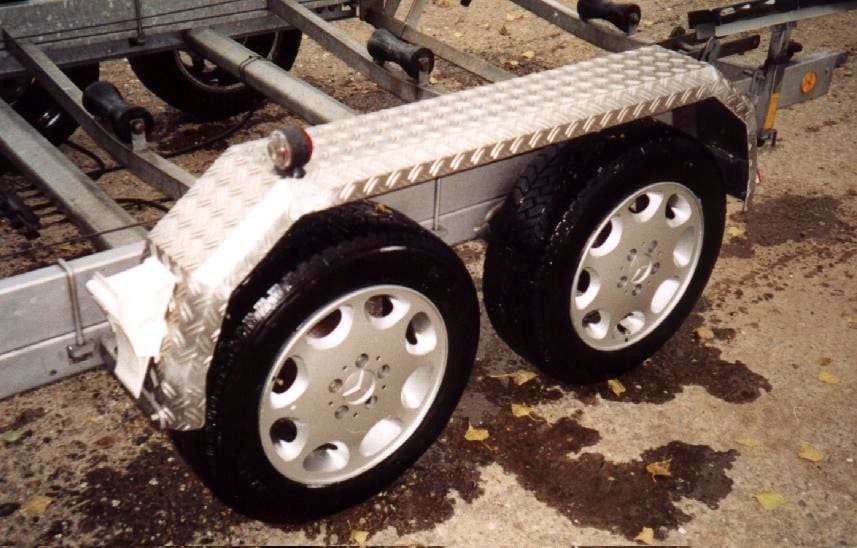
Park the loaded trailer on flat, hard ground with the tow vehicle attached. Walk around it and look at the stance. Does it sit level side to side? Is one fender much closer to its tire than the other? On a tandem, do both axles look like they carry the same weight? A trailer that leans or sits low on one corner often has a sagged or broken spring, a bent hanger or a worn-out torsion arm on that side.
Tires tell you what the axle is doing. Discover Boating and EZ Loader both point out that tires wearing unevenly, especially on the inside or outside edge, can mean a bent axle or an axle out of alignment, often after a hard hit on a curb or pothole. Look at every tire:
- One edge worn on one tire (or on both tires of one axle): possible bent axle, bent spindle or a spring that has shifted on the axle
- Feathered or scalloped tread: possible alignment or bearing problem
- Even wear on both edges or the center: usually tire pressure, not the axle (see the trailer tires guide)
Don't just replace the tires. New tires on a bent axle will wear the same way.
If you need to see between the springs and the frame, lift the frame (never the springs or axle) with a jack rated for the load, and set jack stands under the frame on both sides. Leave the wheels on the ground where you can, so the springs stay loaded and you can see how they sit. Put on safety glasses before you start scraping rust.
Wire-brush a few spots along the tube, especially near the spring seats and on the bottom where water sits. Tap along it with a small hammer or a screwdriver handle. Solid steel rings or gives a sharp knock. A dull thud, flaking layers, pinholes or a spot that dents when you tap it means the tube is rusting from the inside out.
BoatUS explains why: water trapped inside the axle tube rusts it from within, where you can't see it, and a rusted axle can snap on a pothole. Check whether your axle tube is fully sealed or has drain holes, and if it has drains, make sure they're open so the tube empties after each launch.
Also look for cracks around the spring seats and brackets, and for a tube that looks bent or kinked. Load Rite advises inspecting frames and axles for rust, damage and fractures, and replacing any structural part that has been stressed beyond its intended service.
A note on the bend: many axles have a slight upward bow in the middle on purpose. Dexter calls this camber. It's built in so the wheels stand straight once the axle is loaded. Don't mistake it for damage. A kink, a sharp bend near one end, or a tube that sags downward is different and needs a shop.
Look at each spring from the side and from below. Replace the spring (in pairs, both sides of the axle) if you see:
- A broken or cracked leaf, or a leaf that has slid out of line with the others
- A missing or broken spring clip (the small bands that keep the leaves stacked)
- Rust that has eaten into the steel: thick scale, pitting, or leaves that have thinned at the ends
- Gaps opening between leaves or leaves that look flattened
A spring that has lost its arch and sits nearly flat under load has lost its strength, even if nothing is broken.
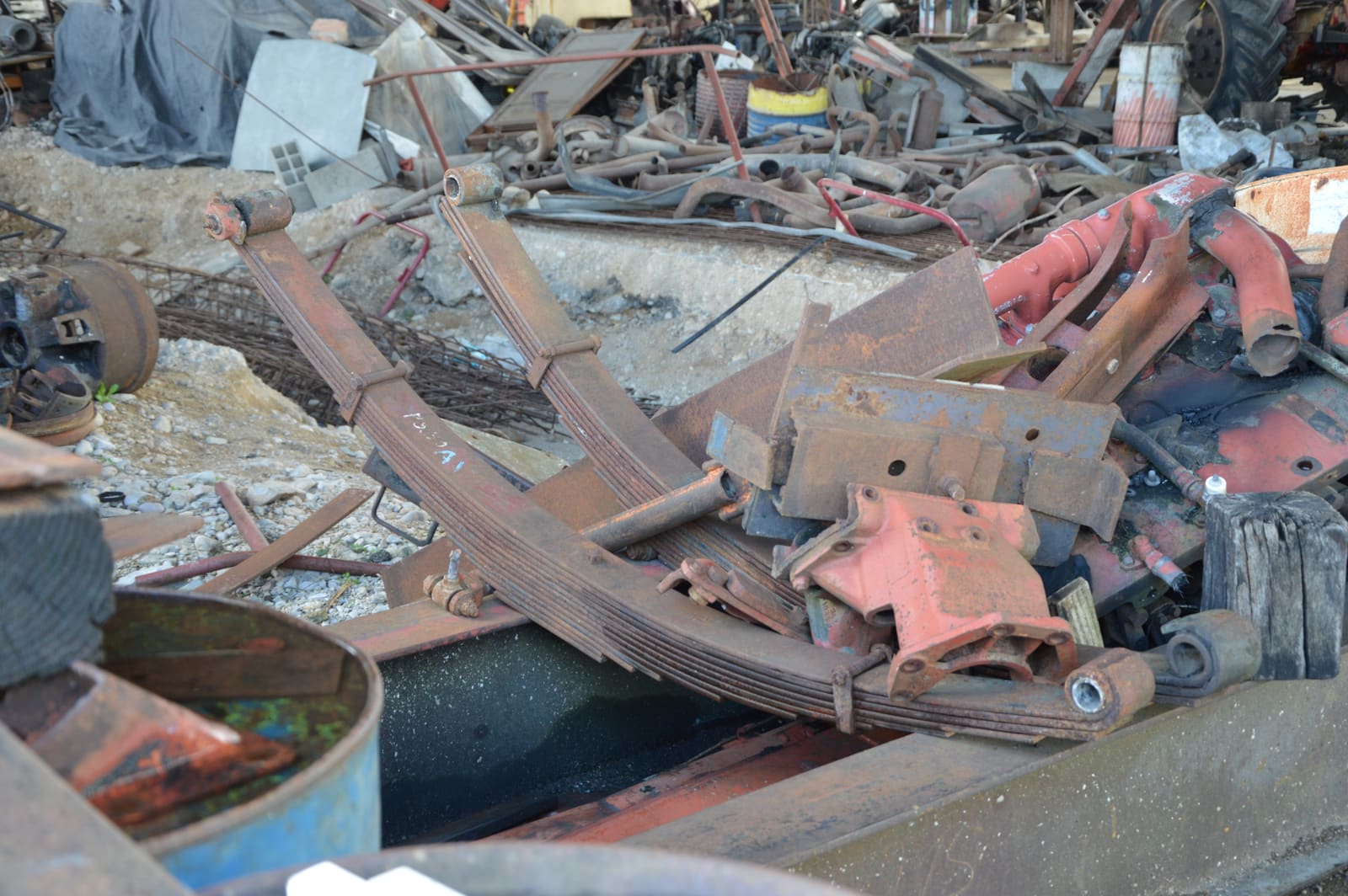
Photo: Spielvogel / Wikimedia Commons · CC0 1.0 Light surface rust on a sound spring is normal on a boat trailer. You can wire-brush it and coat it with a rust inhibitor. Heavy flaking rust between the leaves is not cosmetic. BoatUS notes that on a boat trailer the leaf springs usually rust out long before the frame, so worn-out springs on an older trailer are a sign of age rather than neglect, and replacing them is routine.
The hangers are the brackets welded to the frame that hold the spring ends. Look closely at the welds for cracks or rust lines, and check that each hanger is straight, not bent forward or back. Dexter notes that bent hangers, springs or axle tubes cause bad alignment and bad tire wear. On a tandem, check the equalizer for cracks, wear in its bolt holes and a worn center bushing. A cracked hanger weld is a stop-towing problem and needs a welder or trailer shop.
With the trailer weight on the wheels, put a pry bar between the spring eye and the hanger or shackle, and gently lever back and forth. Watch the bolt. Some movement as the bushing flexes is normal; clunking, a bolt that rattles in an egg-shaped hole, or metal-on-metal contact is not. Signs of wear:
- Holes in the shackle plates or hangers that have worn oval
- Bolts worn thin where they pass through the spring eye
- Nylon or bronze bushings that are cracked, missing or squeezed out
- Shiny wear marks where metal parts have been rubbing
Many trailers have spring bolts with grease fittings. If yours do, grease them as your trailer manual describes. Worn bolts, bushings and shackles are cheap compared with a spring eye that wears through, so replace them as a set when you see wear.
The U-bolts hold the axle on the springs. If they loosen, the axle can shift, which throws the wheels out of line and can let the axle slip off the spring seat. Look for:
- Nuts that are rusted away, missing or backed off
- A gap between the axle and the spring seat, or a shiny line showing the axle has moved
- U-bolts that are stretched, cracked or thinned by rust
- Rust streaks running from the nuts (a sign they've been moving)
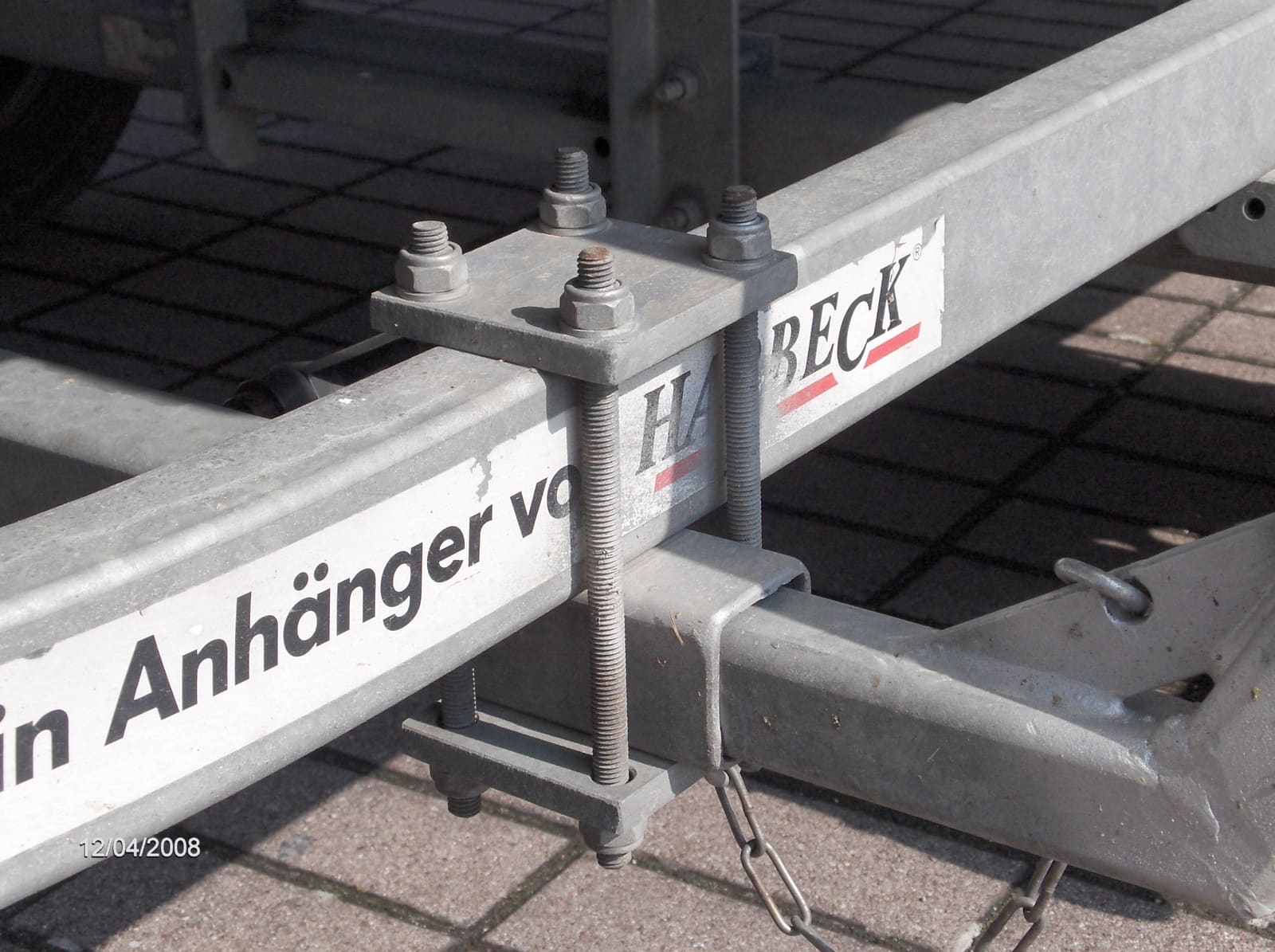
Photo: Wualex / Wikimedia Commons · Public domain Tighten them only to the value in your axle or trailer manual, evenly and in a crisscross pattern. U-bolts that have been run loose, or that have been removed, are usually replaced rather than reused. Don't guess at a torque number.
On a leaf spring trailer, measure from the center of the coupler (or a fixed point on the tongue) to the center of each hub on both sides. On a tandem, also measure hub-to-hub between the front and rear axle on each side. The numbers should match side to side. A difference you can easily see on the tape measure means an axle has shifted on its springs or something is bent. Note the numbers in BoatMend and have a trailer or alignment shop confirm.
If you have a torsion axle, the checks are different:
- Check every bolt and bracket that holds the axle to the frame for tightness, cracks and rust (this is Dexter's one routine suspension check for Torflex)
- Compare the angle of the arms on both sides. An arm that sits noticeably lower than its partner, or a tire that now sits much closer to the fender than it used to, can mean the rubber inside has taken a set or the arm is damaged
- Look for rust-through on the tube and arms, the same as a leaf spring axle
Dexter says not to weld anything to a Torflex axle or move its brackets: the heat damages the rubber inside. Torsion axles can't be rebuilt at home. When they're worn, the whole axle is replaced.
- Light surface rust, everything solid: clean, treat, keep an eye on it.
- Worn shackles, bushings or bolts: replace those parts as a kit, both sides.
- Broken leaf, flattened springs or loose U-bolts that moved the axle: replace springs in pairs and fit new U-bolts.
- Cracked hanger welds, a bent or rust-perforated axle, a bent spindle, or a worn-out torsion axle: trailer shop. Many owners replace the whole axle with a new assembly at this point, often with new hubs and brakes. Order by the axle's capacity, track width, spring centers and spring type, not by guesswork.
Replacement springs must match the originals in capacity and type. A heavier or lighter spring changes ride height and how the load is shared.
"Can I flip the axle to get more ground clearance?" Owners ask this a lot when a skeg or drive scrapes on a steep driveway. Moving a leaf spring axle from under the springs to on top of them (or the reverse) is possible on some axles with the maker's conversion kit, but Dexter notes that it changes the trailer's frame height and center of gravity, which can change how it tows, and its kits can't be used with reinforced spring seats. Turning a drop or cambered axle upside down is a different thing: it would point the built-in camber the wrong way, so don't do it without the axle maker's OK. A taller trailer also sits the boat differently at the ramp, so have a trailer shop confirm any change. Often the simpler answer is to raise the drive or motor to the trailering position your engine manual describes, or to approach the driveway at a gentler angle.
After every salt water launch, rinse the springs, hangers and axle with fresh water, aiming between the leaves and at the spring eyes. Once a season, brush and spray rusty spots with a rust inhibitor. Take a photo of each spring and hanger so you can compare next season, and log the date and anything you replaced in BoatMend.
Common mistakes
- Buying new tires over and over instead of finding out why they wear on one edge.
- Jacking the trailer under the springs or axle tube. It can bend them. Lift at the frame.
- Replacing one spring. Springs work in pairs; a new one next to a tired one makes the trailer lean and wears both faster.
- Reusing stretched U-bolts or tightening them with no torque wrench.
- Ignoring a "clunk" over bumps. It's usually worn shackles or bushings, and the noise means metal is wearing on metal.
- Painting over rot. Paint on a rust-perforated axle hides the problem until it breaks.
- Only checking the middle of a drop axle. Owners on forums keep finding drop axles rusted through near the ends, between the spring seat and the spindle, sometimes only after a wheel folds under on the road. Tap and look at the whole tube, ends included.
- Welding on a torsion axle or moving its brackets. Dexter says no.
- Fitting a different-capacity axle or springs without checking the trailer's VIN placard and the tires and wheels.
When to call a pro
- A broken spring leaf, cracked hanger weld or cracked frame member
- An axle tube with rust holes, a kink or a bend, or a bent spindle
- Uneven tire wear that returns after you've set the pressure and replaced the tires
- Hub measurements that don't match side to side
- U-bolts that came loose and let the axle move
- A torsion axle that sags on one side or has damaged arms
- Any welding job on the trailer
- You don't have the jack stands or space to work safely under a loaded trailer
Tips
- A simple pre-trip habit: glance at the spring stack and U-bolts on each side while you check tire pressure. It takes 30 seconds.
- Galvanized springs and stainless or zinc-plated hardware last longer in salt water. Ask your trailer dealer if they fit your axle.
- Some shackle kits come with "wet bolts" that have grease fittings. They're a good upgrade if your bolts are dry and squeak.
- Take photos of the axle label, spring ends and hanger spacing before you order parts. Most parts counters will ask for them.
- If the trailer will sit for months, park it on hard ground and keep the boat on it supported evenly. Long storage won't hurt sound springs, but water pooling under the trailer speeds rust.
Official references
We read these to write this guide. Your engine's own manual always wins.
- Dexter – Axles Frequently Asked Questions (camber, Torflex vs. leaf spring, no welding on Torflex)
- Dexter – General Frequently Asked Questions (don't jack on suspension parts; bent hangers and springs cause bad alignment)
- Dexter – Torsion Axles (Torflex inspection and maintenance)
- Dexter – Suspension Components
- Discover Boating – Basic Boat Trailer Maintenance Checklist (uneven tire wear and bent axles)
- EZ Loader – Frequently Asked Questions (curb and pothole damage, tire edge wear)
- Load Rite – FAQs (inspect frames and axles for rust, damage and fractures)
- BoatUS Magazine – Causes For On-The-Road Boat Trailer Breakdowns (2018)
- BoatUS Magazine – Trailer Frame (2014)
- BoatUS Magazine – Buying A Used Trailer (2015)
Safety: BoatMend is for information only and does not replace a certified marine technician. You are responsible for your safety and your boat. Read the full disclaimer.
Last updated 2026-10-24
Related guides
How to Inspect, Inflate and Replace Boat Trailer Tires
Check your trailer tires the way the pros do: the right type (ST), the right load range, the right cold pressure, and an honest look at their age. Tires are the number one reason boat trailers end up on the side of the highway.
How to Inspect and Repack Boat Trailer Wheel Bearings
Check, clean and repack your trailer's wheel bearings so a seized hub does not leave you stranded on the highway. Boat trailers get dunked in water every launch, which makes their bearings fail far more often than those on dry utility trailers.
Upgrading Boat Trailer Hubs: Grease-Through Spindles, Oil Bath, Protectors and Pre-Packed Kits
Choose the right hub setup for how you use your trailer, swap in a pre-packed hub kit, adjust it correctly and know when the axle itself is the real problem. Better hubs mean fewer roadside bearing failures and less time with greasy hands.
How to Check and Care for Boat Trailer Surge Brakes
Understand how the hydraulic surge brakes on your boat trailer work, check the fluid, use the reverse lockout correctly and rinse salt out of them after every dunk. Simple habits that keep the brakes from seizing, dragging or failing when you need them.
Get Your Boat Ready for the Road: Pre-Trailering Checklist
Most trailering trouble starts in the driveway: an engine left without support, a loose strap, a cover that balloons at 60 mph, gear that blows out or tongue weight that makes the rig sway. Work through this checklist before every trip and do a quick walkaround at each stop.
How to Adjust and Replace Trailer Bunks and Rollers So Your Boat Sits Right
Set up your boat trailer so the hull is supported in the right places: bunks and rollers clear of the strakes, the transom fully supported, the bow snug against the winch stop and the weight balanced on the tongue. Also covers replacing rotten bunk boards and worn carpet or rollers.