Overheat Alarm: What to Do in the First 60 Seconds
A short, practiced routine for the moment the temperature alarm goes off: take the load off, look for cooling water, shut down if it isn't there, and check every space the exhaust runs through for heat or fire. Based on a June 2026 Coast Guard safety alert about a fatal fire that started with an overheat alarm.
Time
15 min
Applies to
Outboard, Sterndrive (I/O), Gas inboard, Marine diesel
Safety first: An overheating engine can set the boat on fire, because the exhaust hose depends on cooling water to stay cool. If you see smoke or flames, or smell burning, shut the engine off, get everyone into life jackets and away from the engine area, and call the Coast Guard on VHF channel 16 (Mayday if anyone is in danger) or 911. Don't fling the engine hatch wide open on a suspected fire; fresh air feeds it. Your first job is always the boat and the people, not the engine.
Fuel smell, water coming in, CO alarm or smoke? Stop, get everyone in life jackets and call USCG on VHF 16 or 911. For a tow: Sea Tow or TowBoatUS.
Owners often ask
- My temperature alarm went off. Should I put it in neutral and let it idle to cool down, or shut it off?
- After an overheat, what should I check before I restart the engine?
This guide walks you through it. Still stuck? Ask the AI Mechanic about your engine.
Tools
- Your engine owner's manual (or a saved copy on your phone)
- Flashlight
- Infrared (IR) thermometer (optional, very useful for exhaust hoses)
- Heat-resistant gloves
- Short piece of stiff wire or a small zip tie (to clear an outboard telltale)
- Working fire extinguisher within reach of the helm
- VHF radio or phone
Parts & supplies
- Spare raw-water pump impeller for your engine
- Spare drive belt (sterndrive, inboard, diesel)
- Self-fusing rescue tape and a couple of spare hose clamps
Before you start
This guide is the short version: the routine to run in the first minute after the temperature alarm, light or gauge spike. For the full list of overheating causes and repairs, see the engine overheating guide.
Why this matters. In June 2026 the US Coast Guard published a safety alert about a fire on a small passenger vessel that killed one passenger, injured others and destroyed the boat. When the high-temperature alarm sounded, the captain put the engine in neutral and left it running, thinking the circulating water would cool it down. But the raw-water pump had already failed, so no cooling water was moving at all. The engine and exhaust line kept heating. Steam from a leak drew the crew's attention to the engine room, while the overheated exhaust line (hung on wooden supports) set fire to a compartment behind it. By the time they found it, the fire had spread.
The lessons apply to every boat, from a bass boat with an outboard to a cruiser with diesels:
- An engine idling in neutral is still making heat. If no water is flowing, nothing is cooling it.
- Check for cooling water first, then decide.
- Look in every space the exhaust passes through, not just the engine compartment.
The Coast Guard's own step list (Safety Alert 07-26) was written for a diesel with a wet exhaust: reduce load, check the exhaust for cooling water and shut down if it's missing, look for leaks (steam usually means a cooling leak), review the other gauges, and shut down if the temperature keeps rising. The alert also tells operators to look up the engine maker's own alarm procedure in the owner's manual. The steps below adapt that order to outboards and sterndrives too; where your manual says something different, follow the manual.
Get ready at the dock, today:
- Turn the key on and listen for the warning horn's self-test so you know it works.
- Note your normal temperature reading and what normal water flow looks like: a strong telltale ("pee stream") on an outboard, or the steady splash of water with the exhaust on a sterndrive, inboard or diesel.
- Find the raw-water seacock and strainer (inboards and diesels) and the exhaust route: where the hose runs, which compartments it passes through.
- Show your crew where the fire extinguisher and kill switch are.
Steps
As soon as the alarm sounds, ease the throttle back toward idle, if it's safe where you are. Less load means less heat. Glance around for traffic, shallows and the shoreline before you slow down or turn.
Many outboards will cut power on their own when they sense overheating; Yamaha notes that most of its outboards have an RPM reduction mode for this. Don't fight it by pushing the throttle forward.
This is the single most important check:
- Outboard: look at the telltale stream on the side or back of the lower cowl. Yamaha points out that some outboards show little or no stream at idle even when everything is fine, and it appears once RPM rises a bit. So a missing stream at idle is a warning sign, not proof. If it's weak or gone and the alarm is on, treat it as no flow.
- Sterndrive, inboard or diesel: look over the transom at the exhaust outlet. You should see and hear water coming out with the exhaust. White "smoke" that looks like extra exhaust may actually be steam, which BoatUS describes as a sign that not enough water is going through the engine.
If there is no normal water flow, turn the engine off as soon as it's safe to do so. Don't let it idle in neutral "to cool down": that's exactly how the Coast Guard case turned into a fire.
If you're drifting toward danger once the engine is off, anchor, put on life jackets and call for help (step 11). A drifting boat is a problem you can manage; a fire usually isn't.
If cooling water looks normal, the problem could be partial (a worn impeller moving less water), a thermostat, or the gauge itself. Before you decide it's the sensor:
- Look at oil pressure and voltage. BoatUS notes that on some installations a change in voltage at the gauge, such as switching on the panel lights, can nudge the temperature reading up with no real problem.
- Watch the temperature for a minute at idle. If it keeps climbing, shut down anyway. If it settles back to normal, continue to step 10 before running at speed again.
Steam inside the boat usually means a cooling hose or engine leak spraying onto hot metal. Smoke or a hot-plastic smell means something is burning.
If you suspect fire, keep the hatch closed, shut off the engine (and the fuel supply if you have a valve you can reach safely), have the extinguisher ready and call for help. Don't let steam distract you from checking for fire; that is exactly what happened in the Coast Guard case.
Once the engine is off and there are no signs of fire at the hatch, open up and look, carefully:
- The engine compartment, then the compartments aft of it (lazarette, under the cockpit sole, under seats) and anywhere the exhaust hose passes through a bulkhead.
- Look and feel for heat with the back of your hand held near the hose, or use an IR thermometer. A wet exhaust hose and the water jacket of the exhaust parts should stay cool enough to touch in normal running; a hose that is too hot to touch, soft, discolored or smoking has lost cooling water.
- Check what's touching the hose: wood supports, stored gear, cushions or fuel lines.
The Coast Guard stresses this step for any sign of engine trouble, because exhaust and fuel lines often run through spaces forward or aft of the engine room where nobody is looking.
BoatUS warns that the engine temperature often keeps rising after shutdown, because the cooling water has stopped. Wait until it cools before working on it, and don't restart a hot engine: restarting at a high temperature can ruin it.
On a closed-cooled engine (one with a coolant tank or heat exchanger), never open the coolant cap while it's hot. Pressurized coolant can spray out and burn you.
With the engine cool, start where the water comes in and follow it:
- Outboard and sterndrive: tilt up and look for a plastic bag, weeds or mud over the water intake grates on the lower unit. Clear a blocked outboard telltale outlet with a piece of wire. Early in the season, think insects too: BoatUS's spring commissioning checklist warns that bees and wasps build small, easy-to-miss nests in outboard telltale outlets and water intakes over the winter, which is one reason it recommends a test run on flush muffs or in a test tank (never dry) before the first launch.
- Inboard and diesel: make sure the seacock is open. Then close it and check the raw-water strainer for weeds or debris; a plastic bag can also get sucked onto the outside of the hull intake, especially at slow speed. Open the seacock again before restarting.
- Look along the cooling hoses for one that has split or slipped off its fitting. BoatUS notes this can also flood the boat; a split hose may be patched for the trip home with rescue tape and a clamp.
- Sterndrive, inboard and diesel: look for a broken or thrown drive belt. On many engines the belt drives the circulating pump (and sometimes the raw-water pump), so a broken belt means a fast temperature rise. Fit your spare if you have one.
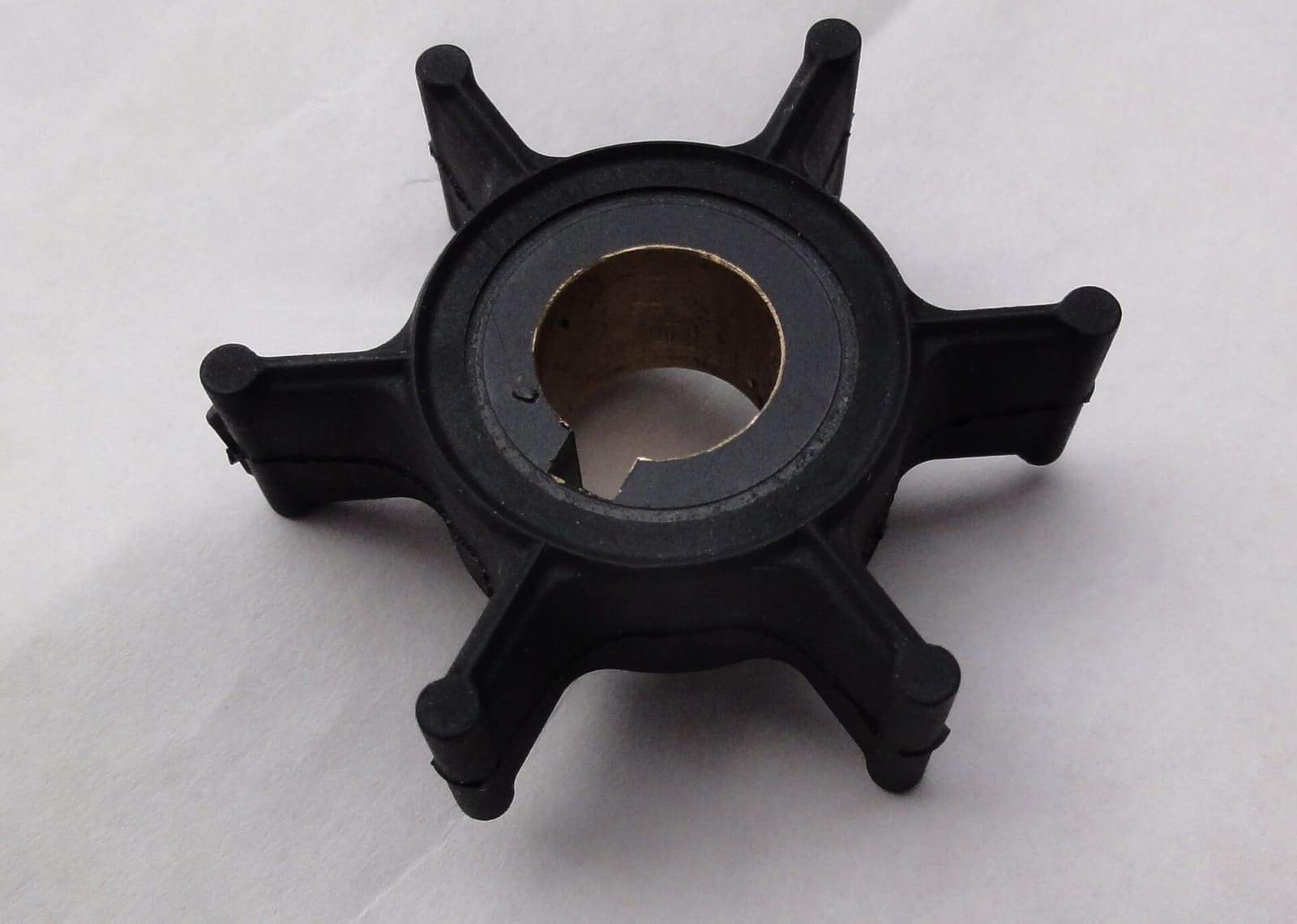
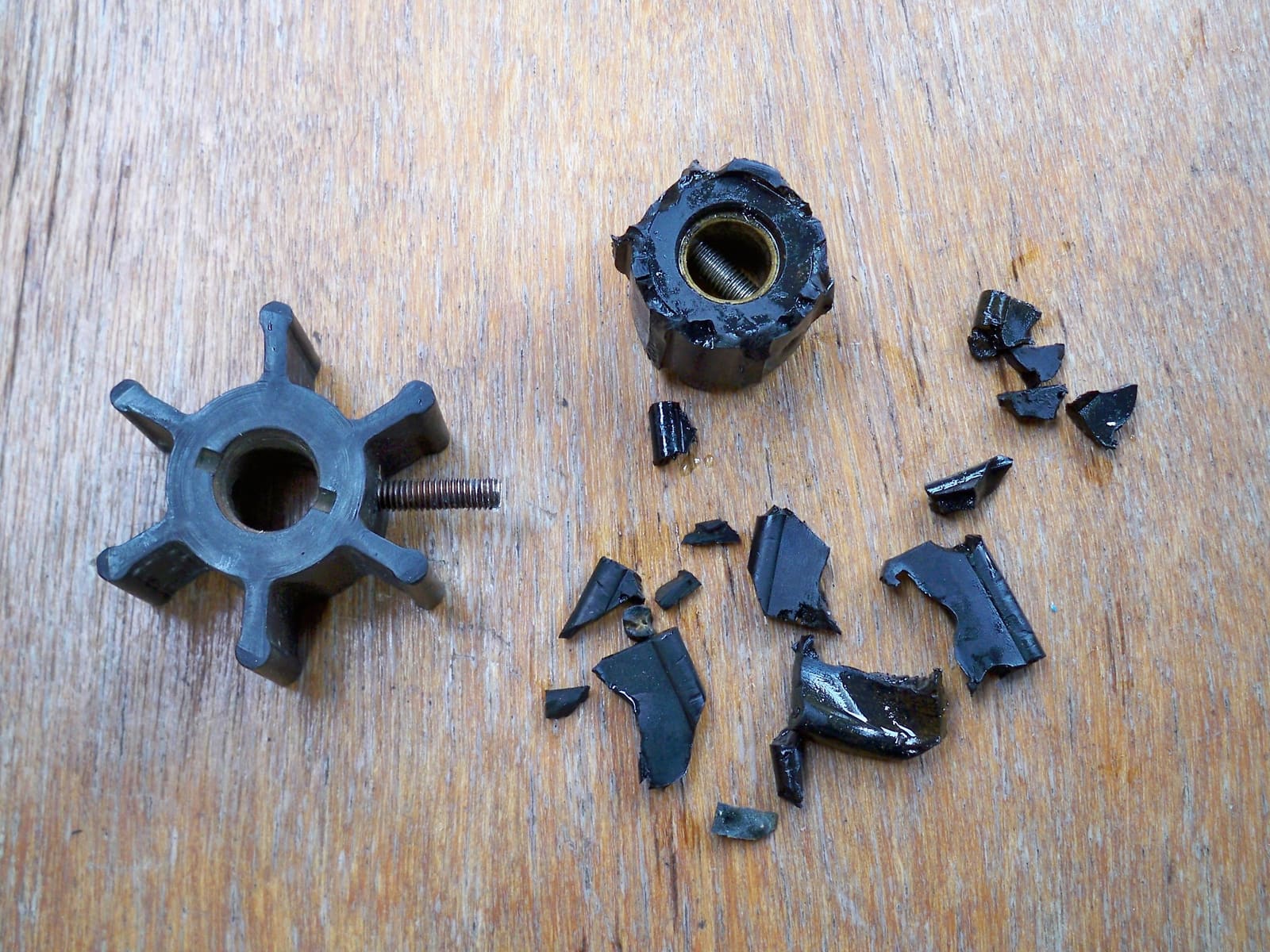
- Impeller: a slow, steady temperature rise over several trips often points to a tired impeller, and a sudden overheat after running in shallow, sandy or weedy water can mean it has just failed. Replacing it on the water is a job only for owners who have done it before at the dock (see the impeller guides).
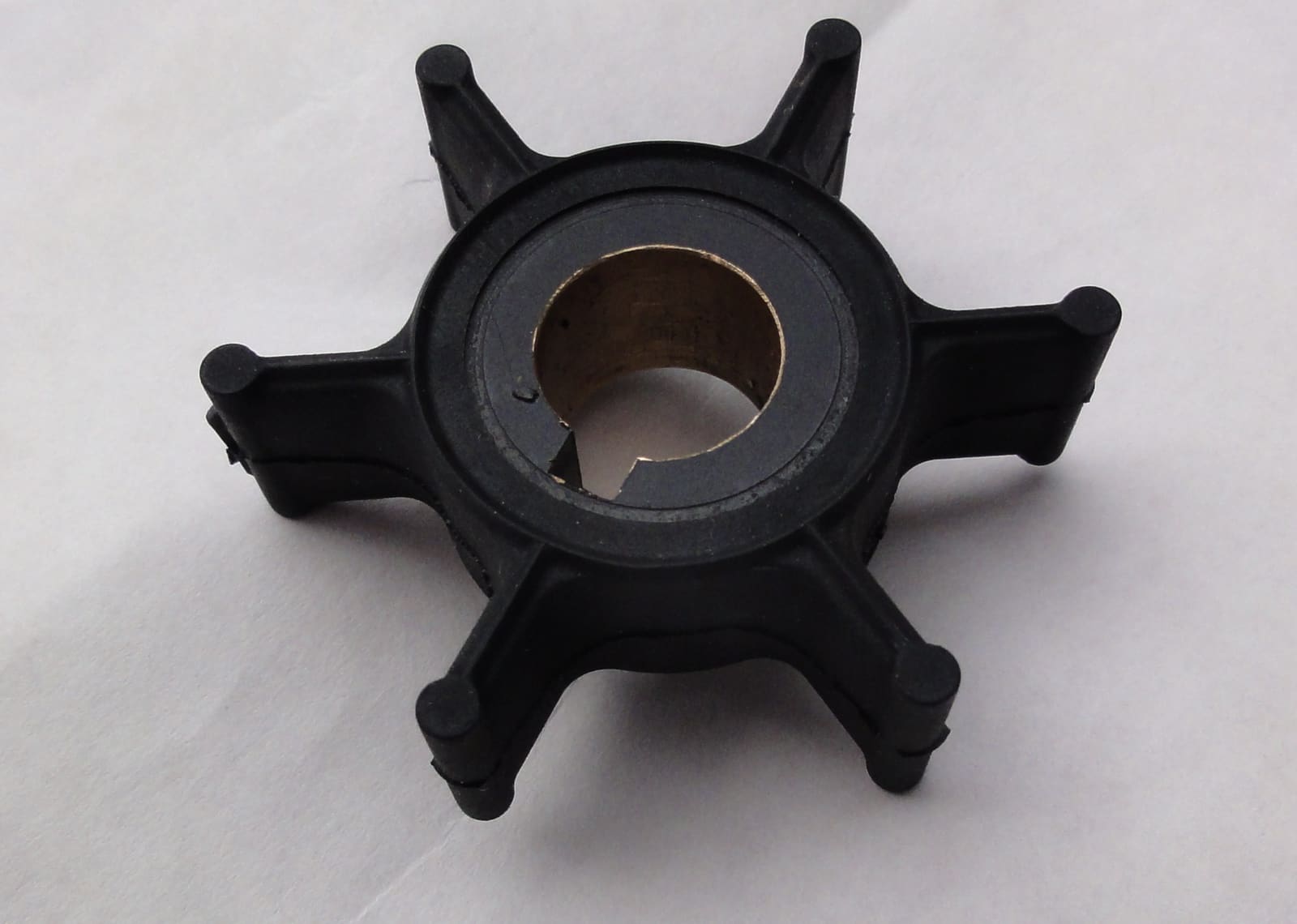
The rubber impeller is the heart of the raw-water pump. When it wears out or loses vanes, cooling water stops. Photo: LittleGun / Wikimedia Commons · CC BY-SA 3.0 If you found and fixed something (cleared an intake, cleaned the strainer, replaced a belt), restart and look for cooling water within the first few seconds. On many boats, shifting briefly into reverse at idle helps blow debris off an intake. If water doesn't appear quickly, shut down again: running the pump dry, even briefly, damages the impeller.
If flow and temperature return to normal, head in at a slow, steady speed and keep watching the gauge. BoatUS notes that partly clogged exhaust passages often show up as overheating only at higher speed or under load, so don't jump straight back to cruising speed.
If you can't find the cause, or the temperature climbs again, stay shut down. Anchor if you're drifting toward shallows, rocks or traffic, and call TowBoatUS or Sea Tow. Use VHF channel 16 or 911 if anyone is in danger, the boat is taking on water, or you see smoke or fire.
Before the next trip, find out why it happened: a worn impeller, a clogged strainer or intake, a broken belt, scale in the exhaust parts or a failed thermostat. Then:
- Follow your engine maker's schedule for the raw-water pump impeller. BoatUS insurance claims show overheating as a real cause of exhaust fires and recommend changing the impeller every other year, after a grounding, or after running in very dirty water (typical; confirm in your manual).
- Have the exhaust hoses and the exhaust parts checked if the engine overheated badly.
- Keep the raw-water strainer clean. The Coast Guard points out that an impeller's life depends on it: a strainer clogged with weeds, plastic or growth starves the pump and wears the impeller out early.
- On closed-cooled engines, ask your mechanic about the heat exchanger (and the oil cooler, if fitted). The Coast Guard notes they need periodic service so they don't foul or leak.
- Practice this routine with your crew. The Coast Guard encourages engine casualty drills, not just fire and man-overboard drills, so everyone knows what to do without thinking.
Common mistakes
- Shifting to neutral and leaving an overheating engine running, assuming it will cool itself. If the pump has failed, nothing is cooling it.
- Assuming it's a bad sensor without checking for cooling water first.
- Checking only the engine compartment and missing heat or smoke in the lazarette or under the cockpit.
- Getting distracted by steam and missing a fire somewhere else.
- Restarting right away while the engine is still hot.
- Opening the coolant cap on a hot closed-cooled engine.
- Running back to the dock at full speed once the alarm stops.
- Never testing the horn, so the first sign of trouble is smoke.
When to call a pro
- No water flow and you can't find a blocked intake or strainer: likely a failed impeller or pump
- Overheating that keeps coming back after you clear the intakes
- Any sign of heat damage: a scorched, soft or melted exhaust hose, burned wiring, or a smoke smell after the event
- Steam or coolant loss from a closed-cooled engine
- Smoke, flames or a burning smell: shut down and call for help first (VHF 16 or 911), then have the boat inspected before it runs again
- You had to shut down on the water: get a tow from TowBoatUS or Sea Tow instead of limping home hot
Tips
- Write the routine on a card at the helm: slow down, look for water, no water = shut down, check the exhaust spaces.
- Carry a spare impeller, a belt and rescue tape, and practice changing the impeller at the dock once so you know if you could do it on the water.
- An IR thermometer is cheap and turns "feel for heat" into a number you can compare from trip to trip.
- If your boat has spaces aft of the engine with no fire detection, consider adding a heat or smoke detector there.
Official references
We read these to write this guide. Your engine's own manual always wins.
- US Coast Guard – Marine Safety Alert 07-26, Know Your Boat, Responding to an Engine High Temperature Alarm (June 2, 2026)
- IIMS – Responding to an Engine High Temperature Alarm (summary of US Coast Guard Safety Alert 07-26, June 2026)
- BoatUS – What If Your Temperature Gauge Spikes?
- BoatUS – Analyzing Onboard Fire Claims
- Yamaha Outboards – Maintenance Matters, Additional Tasks (telltale and RPM reduction mode)
- BoatUS Magazine – Spring Engine Startup (insect nests in telltales and intakes, 2014)
- BoatUS – Inspecting Exhaust Manifolds and Risers (overheating under load)
Safety: BoatMend is for information only and does not replace a certified marine technician. You are responsible for your safety and your boat. Read the full disclaimer.
Last updated 2026-10-24
Related guides
Engine Overheating - Troubleshooting Guide
Work through the most likely causes of a hot engine or overheat alarm, from a blocked water intake to a worn impeller or stuck thermostat. Acting fast and in the right order can save your engine and often gets you home without a tow.
Engine Warning Horn and Dash Lights: What They Usually Mean and What to Do
Learn what a warning horn, beeps or a dash light usually mean on a boat engine, from overheating and low oil pressure to water in the fuel and reduced-power (limp) mode. Find out what to do right away and when to stop the engine. Patterns differ by brand, so match what you hear and see to your owner's manual.
How to Replace the Water Pump Impeller
Replace the rubber impeller that pumps cooling water through your engine, the part most often behind overheating. On many outboards it is a two-hour driveway job that saves a shop bill of several hundred dollars and prevents far costlier heat damage.
How to Clean the Raw-Water Strainer and Replace the Impeller on a Marine Diesel
Clean the sea strainer and swap the rubber impeller in the raw-water pump of a Yanmar, Volvo Penta, Westerbeke, Beta or similar inboard diesel. A worn impeller is one of the most common reasons a diesel overheats, and this job takes about an hour with basic tools.
How to Check, Mount and Replace Boat Fire Extinguishers
A monthly five-minute check of every fire extinguisher aboard, plus how the 2022 Coast Guard rule changes affect you, where to mount them, and when to recharge or replace. A boat fire spreads in seconds, and an extinguisher with a dead gauge, missing pin or expired date will not help you or pass a boarding.
How to Inspect and Exercise Seacocks, Through-Hulls and Hose Clamps
Check every hole in your hull below the waterline, work each seacock open and closed, and inspect the hoses and clamps attached to them. A single failed fitting or hose is one of the most common reasons boats sink at the dock.
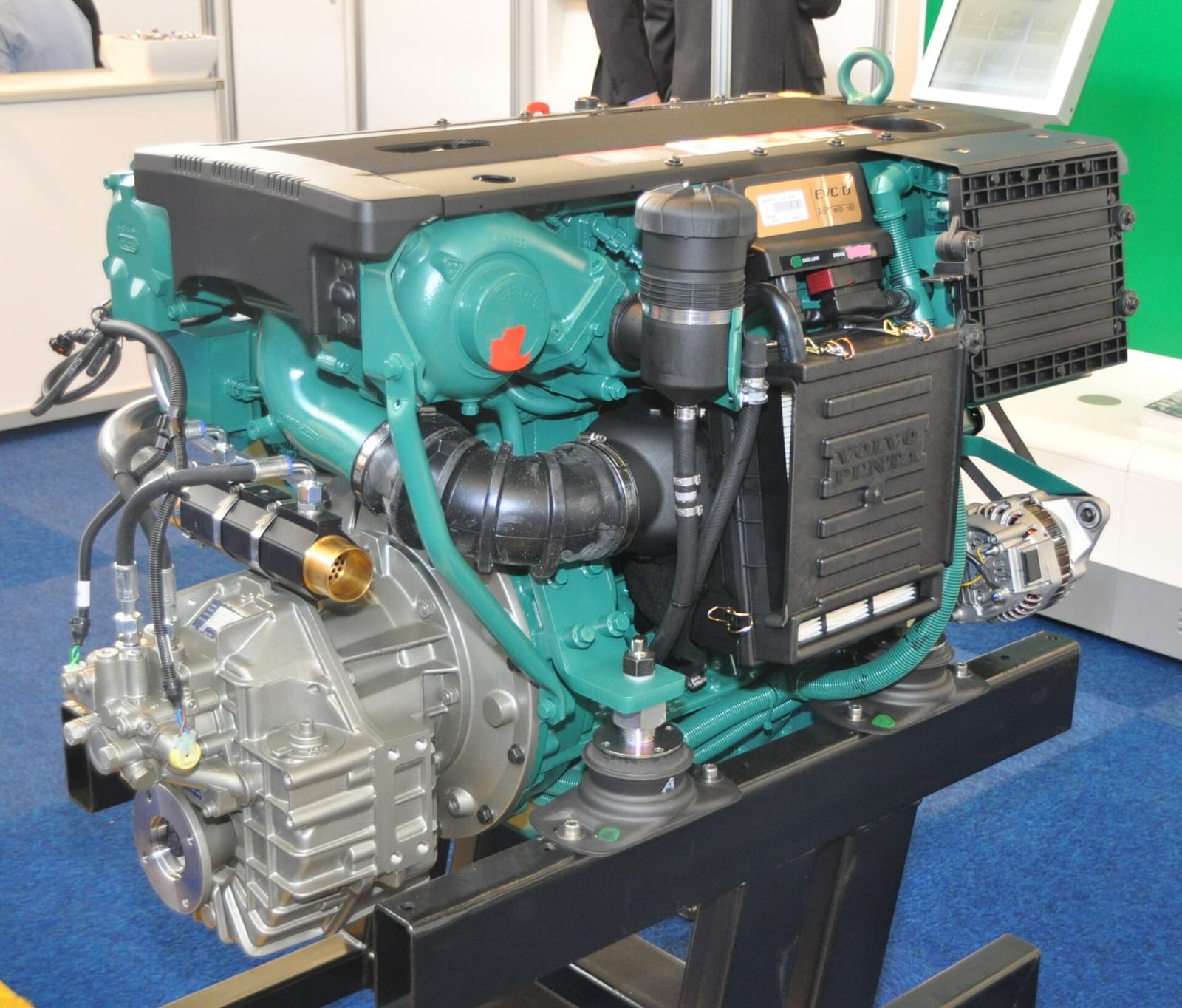
How to Check and Change Coolant in a Closed Cooling System
Check, test and change the coolant in a freshwater-cooled (closed cooling) inboard, sterndrive or diesel, and learn the heat exchanger basics that keep it working. Old coolant quietly eats hoses, pumps and engine passages, and many boats go a decade without a change.
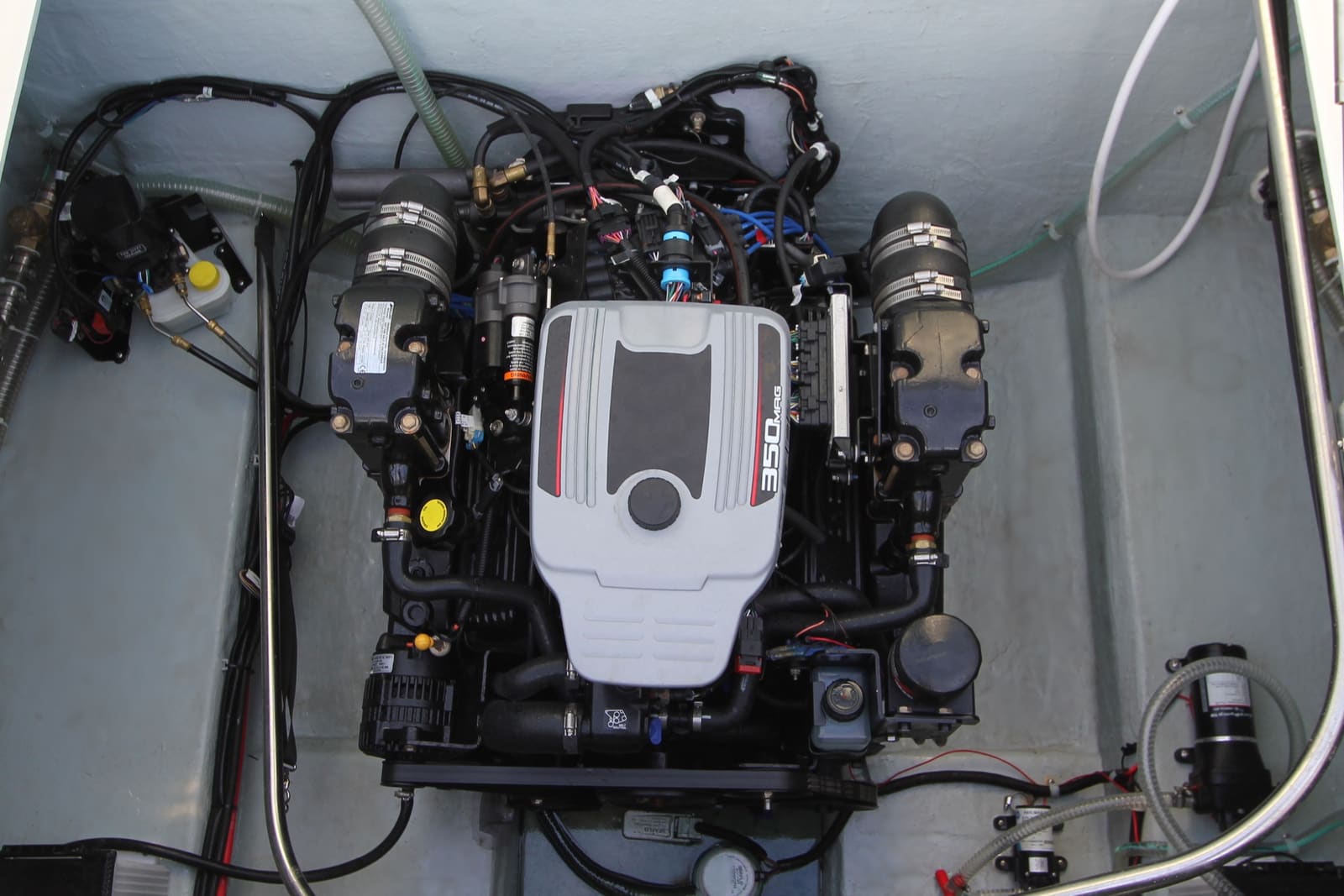
Closed-Cooled Gas Engines: Why the Exhaust Elbows Still Need Checking
Closed (freshwater) cooling protects the block, but on gas sterndrives and inboards the exhaust elbows or risers, and on some systems the manifolds, are still cooled by raw water. Learn which parts still see salt or lake water, the warning signs, what the engine makers and BoatUS say about intervals, and how to inspect and look after them.
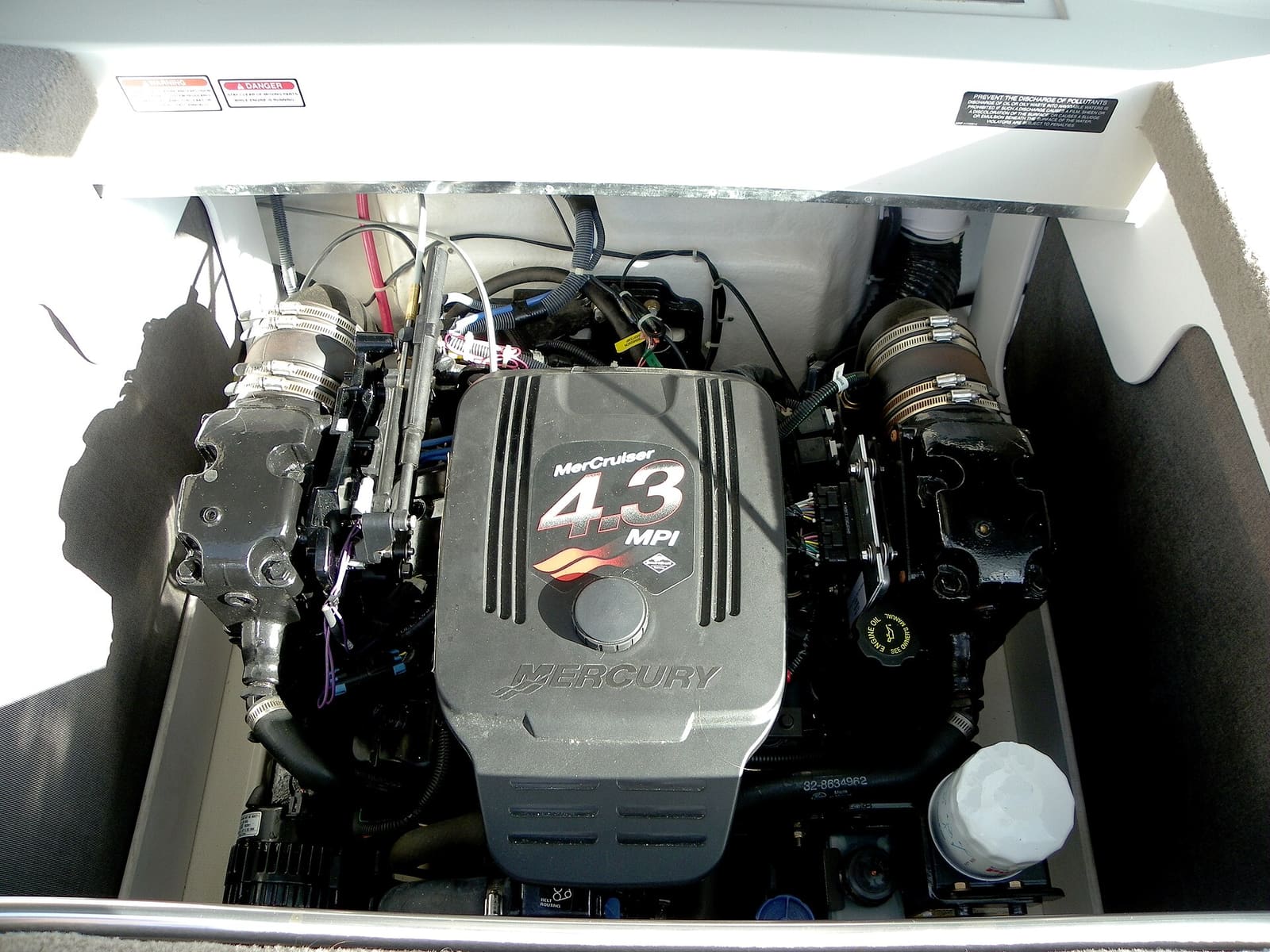
How to Inspect Exhaust Manifolds and Risers on a Sterndrive or Inboard
Cast-iron exhaust manifolds and risers rust from the inside, and when they fail they can let water into the cylinders and ruin the engine. Learn the warning signs, how often to inspect them in salt and fresh water, how to check a riser yourself, and when replacement is a job for a pro.
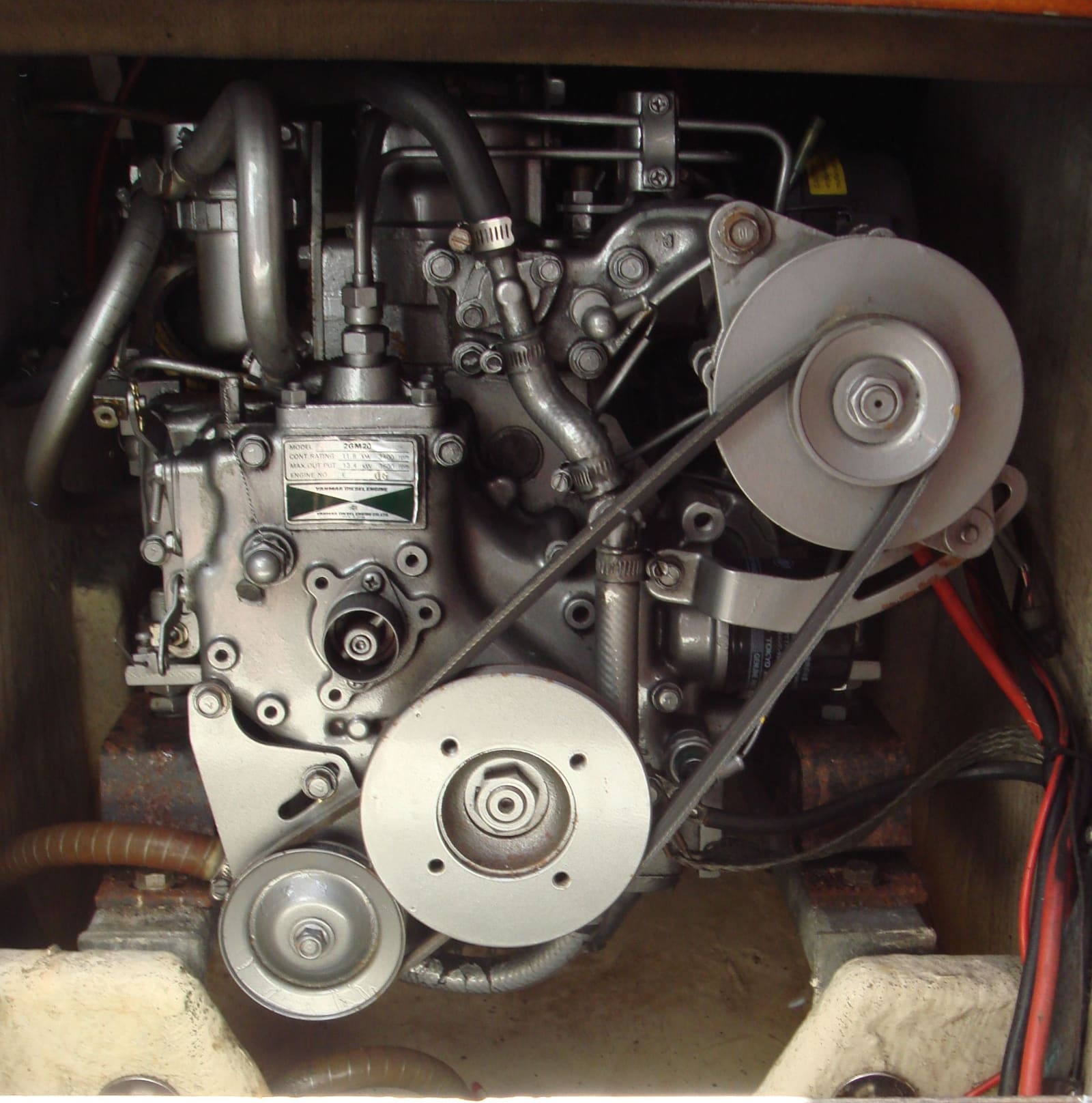
How to Inspect Engine Belts and the Tensioner on Sterndrives, Inboards and Diesels
On many inboard, sterndrive and diesel engines, one belt runs the water pump, the alternator and often the power steering. If it breaks or jumps off, the engine overheats and the steering goes heavy at the same moment. Learn how to inspect the belt, tensioner and pulleys, check tension, and carry the right spare.