No Spark - Safe Ignition Checks for Outboards, Sterndrives, Inboards and PWCs
Engine cranks but never fires, and you suspect the ignition? Work from the cheap, common causes (kill switch lanyard, key switch, plug wires and caps, plugs, battery) to a proper spark test, and learn what the stator, CDI and coils do and when it is time for a dealer.
Time
1 h
Shop would charge
$150-600
Applies to
Outboard, Sterndrive (I/O), Gas inboard, Jet ski / PWC
Safety first: Ignition systems make very high voltage. Never hold a plug wire or boot in your hand to "see if it sparks," and never lay a wire near a plug hole. Do not crank with the spark plugs out: Boating Magazine warns that fuel can spray out of the holes and be lit by the spark. On sterndrives and inboards, run the blower for at least 4 minutes and sniff the engine compartment before any test; if you smell fuel, stop and fix the leak or call a pro. If you are stranded on the water, call TowBoatUS or Sea Tow, and in an emergency use VHF channel 16 or dial 911.
Owners often ask
- No spark from the coil on any cylinder. What should I check before buying parts?
- How do I safely check for spark on my boat engine?
This guide walks you through it. Still stuck? Ask the AI Mechanic about your engine.
Tools
- Spark tester (inline or adjustable-gap type, with an insulated body and ground clip)
- Spark plug socket and ratchet
- Digital multimeter
- Flashlight
- Dielectric grease and electrical contact cleaner
- Flush muffs or a test tank (if the engine might start)
Parts & supplies
- Spare kill switch lanyard (or fob battery for wireless systems)
- Spark plugs specified in your owner's manual
- Fuses of the correct rating
Before you start
Make sure the problem really is spark. The engine should crank at normal speed but not fire. If it does not crank, or cranks slowly, start with the engine-won't-start guide (battery, switches, starter). Also confirm fuel is reaching the engine; a fresh-fuel problem often looks like an ignition problem.
What the ignition system does, in plain words:
- Older outboards (CDI): magnets on the flywheel pass a coil called the stator, which makes the power. A trigger (or pulser) coil tells the CDI box (also called a switch box or power pack) when to fire, and the CDI sends a pulse to each ignition coil, which steps it up to fire the plug.
- Modern fuel-injected engines: the engine computer (ECM) times the spark using sensors and fires coils that often sit right on top of each plug. Many depend on good battery voltage.
- Older sterndrives and inboards: often a distributor with a cap and rotor, a single coil and an ignition module.
- On almost all engines, the kill switch and the key "off" position stop the engine by grounding (shorting out) the ignition. A faulty stop circuit can therefore kill the spark on every cylinder at once.
Engines with a spark problem on all cylinders usually have a shared cause (stop circuit, power, stator, trigger, CDI or computer). A problem on one cylinder usually points to that cylinder's plug, wire, cap or coil.
Steps
The emergency cut-off switch lanyard is the most common no-start cause. The Coast Guard's ECOS FAQ explains that pulling the link from the switch shuts the engine off, and the boat can be restarted once the link is reinstalled. Push the clip fully onto the switch. Try your spare lanyard: a worn or bent clip may not hold the switch in the run position.
On wireless cut-off systems, check the fob battery and that the fob is paired and switched on. On PWCs, make sure the lanyard or digital key is properly seated on its post.
Turn the key to ON and wiggle it gently, and wiggle the harness behind the switch. A worn key switch or corroded connector can keep the stop circuit grounded. On remote-control outboards, look at the plug where the boat harness meets the engine harness; Yamaha points out that loose or corroded connections can cause intermittent problems or a full-time "no run" condition.
A technician may test by disconnecting the stop circuit to see if spark returns. That removes your emergency stop, so never run the boat that way.
A battery that turns the engine slowly can cause weak or no spark, especially on fuel-injected engines that need battery power to run the computer and coils, and on CDI engines where the stator only makes enough power at normal cranking speed. Measure the battery at rest and while a helper cranks. Charge or replace a weak battery before blaming the ignition.
With the engine off and the kill clip removed, look at every plug wire and boot:
- Is each boot pushed fully onto its plug? You should feel it click or seat.
- Any cracks, burn marks or chafed spots on the wires?
- Green or white corrosion inside the boots or on the plug tips?
- Water or salt crust under the cowling or in the engine compartment?
Clean corroded ends with contact cleaner, add a little dielectric grease inside the boot, and reseat firmly. Replace cracked wires or boots.
No plug wires at all? Many newer four-strokes use coil-on-plug ignition: Suzuki, for example, builds the ignition coil into the plug cap on many DF models. Check each cap-coil the same way (seated, no cracks, no corrosion at its plug-in connector), and note that you can't clip a tester onto a wire that isn't there; use a tester made for coil-on-plug engines or let the shop test it.
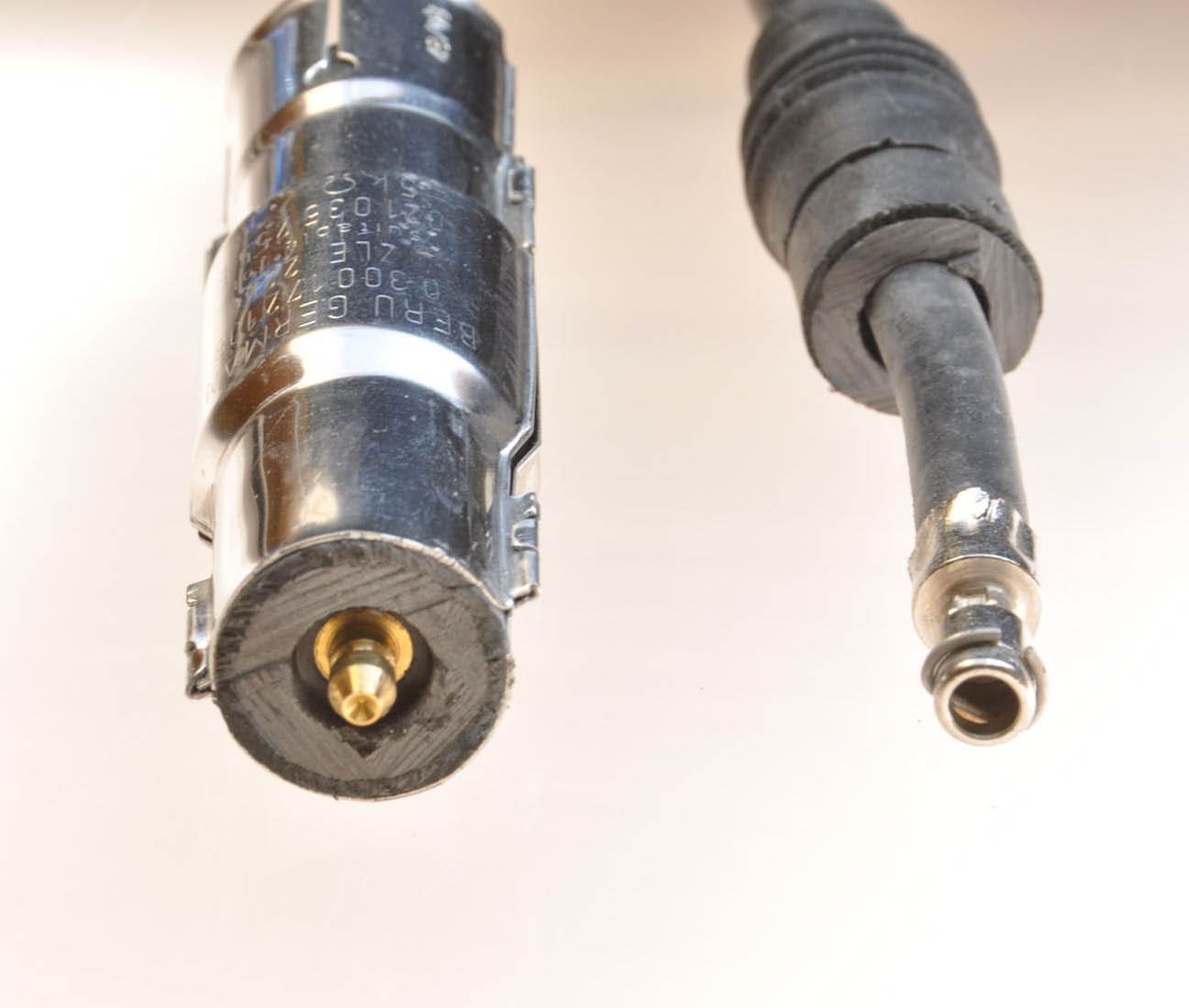
A plug cap cut open next to a plug wire end. Corrosion or a loose fit at this small joint is a common cause of weak or missing spark. Photo: Audiauda / Wikimedia Commons · CC0 1.0 Remove and look at the plugs (kill clip off). A wet, fuel-soaked plug suggests no spark or flooding; a plug fouled with oil or carbon may not fire even with good spark. BoatUS's first ignition step at the ramp is simply to try new plugs. Use the exact plug type and gap from your owner's manual (see the spark plugs guide).
Many fuel-injected engines feed the ignition and computer through fuses and relays in the engine harness. Check them against your manual. Look at the engine ground cable and any ground straps for corrosion or looseness. Replace a blown fuse only with the same rating; if it blows again, stop and call a pro.
Yamaha's electrical maintenance page points out that corrosion can rot the copper strands inside a wire while the insulation looks fine, and that a battery terminal can be corroded yet look clean. Take suspect connections apart, clean both faces to bright metal, and refit them with proper nuts (not wing nuts). With the battery disconnected, an ohmmeter across each end of a wire should read close to zero; a clearly higher reading means a bad wire or connection.
Use a real spark tester with an insulated body and a ground clip. Follow its instructions and these rules:
- Plugs stay in the engine. Connect the tester between the plug wire and a ground (or between the wire and the plug, for inline testers).
- Put a tester on every plug wire if you have one per cylinder, so the engine cannot start. Boating Magazine recommends one tester per cylinder.
- Clip the tester to clean bare metal on the engine for a good ground.
- Stand clear of the flywheel, belts and propeller, keep hands off the tester and wires, and have a helper crank.
- Outboards in open air only for open-gap testers. Boating Magazine says its homemade tester is for outboards in well-ventilated areas, not enclosed sterndrive or inboard compartments, where fuel vapor may collect.
- If the engine might start (inline testers let it run), it needs cooling water: an outboard in the water, a test tank or on external flush muffs (the built-in flush port is for engine-off flushing on most models), and a PWC only with water supplied as its manual describes.
Boating Magazine also notes that its simple tester suits older point or CDI ignitions; modern computer-controlled EFI and DFI engines may need the special procedure in the service manual, and the electrical noise from an open spark can upset onboard computers.
- Strong, steady spark on all cylinders: the ignition is probably fine. Go back to fuel, air, timing or compression.
- No spark on any cylinder: look again at the stop circuit (steps 1 and 2), battery and power feeds (steps 3 and 6), then the shared parts: stator, trigger, CDI or computer.
- Weak, thin or orange spark on all: low power to the system (battery, cranking speed, stator) or a failing CDI.
- No spark on one cylinder: that cylinder's wire, cap, coil or, on some engines, its circuit in the CDI or computer.
On engines with one identical coil per cylinder, you can swap the coil from the dead cylinder with one from a good cylinder and test again. If the missing spark moves with the coil, the coil is bad. If it stays on the same cylinder, the problem is upstream (wiring, CDI or computer). Mark every wire before you move anything, and check your manual that the coils really are interchangeable.
On older carbureted sterndrive and inboard engines, remove the distributor cap and look for moisture, cracks, burned contacts or a worn rotor. BoatUS includes drying out the distributor cap among the steps after an engine gets wet. Clean and dry it, or replace the cap and rotor. Check the coil wire and the coil's power feed with a multimeter. Ventilate the compartment first and keep the blower running.
Stators, trigger coils, CDI boxes and computers are tested with special meters (peak-voltage adapters) and model-specific values from the service manual. A simple resistance check with a basic multimeter can pass a part that fails while cranking, and the reverse. Electrical parts are often non-returnable once installed, so guessing gets expensive. This is the point where most owners should hand it to a dealer.
Modern outboards, sterndrives and PWCs store fault codes that point straight at a failed sensor, coil driver or circuit. A dealer's diagnostic tool reads them in minutes. If your engine shows warnings on its display, write them down before you call.
Common mistakes
- Spending an hour on the ignition with the lanyard clip off or not fully seated.
- Holding a plug wire near the block by hand to look for spark. It can give a painful, dangerous shock, and it is not a reliable test.
- Cranking with the plugs removed and the wires dangling near open plug holes.
- Doing an open-spark test inside a sterndrive or inboard engine compartment without ventilating it.
- Buying a stator or CDI box based on a guess or a resistance reading alone.
- Forgetting the battery: slow cranking can mean weak spark on many engines.
- Bypassing the kill switch to get going and then running the boat without an emergency stop.
When to call a pro
- Any fuel smell or leak during testing: stop and fix it first
- No spark on any cylinder after checking the lanyard, key switch, battery, fuses and wires
- Suspected stator, trigger, CDI, ignition module or computer fault
- Fuel-injected and direct-injected engines that need a diagnostic tool or special test procedure
- Melted wires, burnt connectors or a fuse that keeps blowing
- Stranded on the water: TowBoatUS or Sea Tow, and in an emergency VHF channel 16 or 911
Tips
- Keep a spare lanyard and a set of plugs in the boat; together they fix a large share of "no spark" days.
- A cheap inline spark tester lives happily in a toolbox and makes this test quick and safe.
- After washing the engine or a rough wet ride, dry the area around the coils and plug boots before assuming a part has failed.
- Photograph the wiring before unplugging anything, so it goes back exactly the same way.
Official references
We read these to write this guide. Your engine's own manual always wins.
- Boating Magazine – Build Your Own Outboard Spark Tester
- BoatUS – What to Do if Your Outboard Won't Start
- U.S. Coast Guard – Engine Cut-Off Switch FAQ
- Yamaha Outboards – Maintenance Matters, Electrical System
- BoatUS – A Few Simple Steps to "Pickling" Your Engine (distributor cap after water exposure)
- Suzuki Marine – FAQs (direct ignition, coil in the plug cap)
Safety: BoatMend is for information only and does not replace a certified marine technician. You are responsible for your safety and your boat. Read the full disclaimer.
Last updated 2026-10-24
Related guides
Engine Won't Start or Won't Crank - Troubleshooting Guide
Find out why your boat engine will not turn over or will not fire, starting with the simple things owners miss most, like the kill switch lanyard and battery switch. Many no-starts are fixed at the ramp in minutes without a tow.
How to Inspect and Replace Spark Plugs
Pull, read and replace the spark plugs on a gas outboard, sterndrive, inboard or PWC. Fresh, correctly gapped plugs help the engine start easily and run smoothly, and the old plugs tell you a lot about the engine's health.
Engine Cut-Off Switch (Kill Switch) and Lanyard: The Law, Testing and Daily Use
How the engine cut-off switch (ECOS) and its lanyard or wireless fob work, when federal law requires you to wear it (boats under 26 feet, 3 hp or more, on plane), how to test it before every trip, and why a spare clip aboard matters.
Jet Ski Won't Start or Won't Beep: A Step-by-Step Check
Most personal watercraft that refuse to start have a simple cause: the key or lanyard, a weak battery, a blown fuse, a security lock or a flooded engine. Work through these checks from the cheapest to the most involved and learn what each result means for Sea-Doo, Yamaha and Kawasaki models.
Marine Battery Care: Test, Charge and Store for Winter
Check your boat battery's health, charge it the right way for its type (flooded, AGM or lithium), and store it so it is ready in spring. Most "boat won't start" calls start with a neglected battery.
How to Find and Fix Corroded Electrical Connections on a Boat
Track down the green crust and loose terminals behind flickering lights, dead gauges and slow cranking with a simple voltage-drop test, then remake the connection the marine way: tinned wire, a proper crimp, adhesive-lined heat shrink and a protective coating.
Is My Engine Charging the Battery? Test the Charging System With a Multimeter
A step-by-step way to find out whether your outboard's stator and rectifier/regulator or your inboard's alternator is really charging the battery, what the voltage readings usually mean, and when the problem is just a dirty connection. Exact test specs come from your engine's service manual.
Engine Starts Then Dies - Troubleshooting Guide
Track down why your boat engine fires up and then stalls, whether at idle, when you shift into gear, or after a few minutes of running. Most causes are in the fuel supply and can be checked with no special tools.