How to Prepare Your Boat for a Hurricane or Tropical Storm
Make a written storm plan before the season, then haul out or secure the boat with doubled lines and chafe gear, strip off everything that catches wind, and check it safely after the storm. Never ride out a hurricane aboard.

Time
8 h
Shop would charge
$300-1500
Applies to
All engines
Safety first: Never stay aboard to ride out a hurricane. BoatUS insurance claim files include skippers who were rolled over, forced to swim through debris, or drowned trying to save a boat. Your boat can be replaced; you can't. Finish all prep before tropical-storm-force winds arrive, follow evacuation orders, and stay off docks once water is rising: flooded shore-power pedestals can electrocute people in the water.
Fuel smell, water coming in, CO alarm or smoke? Stop, get everyone in life jackets and call USCG on VHF 16 or 911. For a tow: Sea Tow or TowBoatUS.
Owners often ask
- A hurricane is heading our way. Should I haul my boat out or leave it in the slip?
- How should I tie up my boat at the dock for a hurricane storm surge?
This guide walks you through it. Still stuck? Ask the AI Mechanic about your engine.
Tools
- Phone or camera to photograph the boat and your prep work (for insurance)
- Knife, sail ties and spare line
- Duct tape (a low-residue type)
- Wrenches and screwdrivers for removing canvas, electronics and antennas
- Wheel chocks, and ground anchors or augers for a trailer boat
Parts & supplies
- Extra nylon dock lines, at least as thick as your normal lines, long enough to allow for storm surge
- Chafe gear for every line (commercial chafe guards or polyester sleeves)
- Large fenders and a heavy fender board (optional)
- Wooden plugs for engine exhaust outlets
- Heavy straps for a trailer or lift
Before you start
Plan before the season, not when the storm is named. Atlantic hurricane season officially runs June 1 to November 30, and ShoreMaster notes the peak usually falls from mid-August to mid-October. The most important decisions (where the boat goes, who does the work, how it gets hauled) take weeks to arrange and are impossible to make in the last 48 hours.
Know the forecast terms. The National Weather Service issues a hurricane watch when hurricane conditions are possible, about 48 hours before tropical-storm-force winds are expected. A hurricane warning means they are expected, issued about 36 hours ahead, and all prep should already be done. BoatUS advises acting when a hurricane is a real possibility, before a watch is posted: bridges close, marinas get too busy to haul, and roads jam.
Haul out or stay in? BoatUS claim data and an MIT study after Hurricane Gloria both found boats stored ashore are far less likely to be wrecked than boats left in the water. The exception is a low-lying yard that floods: surge can float boats off their stands. The best spot is ashore on high ground, ideally strapped to anchors in the ground. If you must stay in the water, a protected hurricane hole or a wide slip with tall pilings is far better than a tight slip or an exposed marina.
Steps
Read your slip or storage contract: some marinas require boats to leave, require a written plan, or hold owners liable if a boat isn't secured properly. Ask what the marina itself will do. Write down where the boat will go, who will move it, which lines and gear you need, and a backup person if you are away. Share contact info with neighboring boat owners. Store the plan in your BoatMend boat profile.
Many yards run a "hurricane club" or haul list: you sign up and often pay a deposit before the season, and they haul you first when a storm threatens. Waiting until a watch is posted usually means no slot. If your boat is trailerable, make sure the trailer is roadworthy (tires, bearings, lights) so it can actually go inland.
Call your insurer before the season. Ask whether your boat is in the covered area, what the named-storm deductible is, whether the policy requires haul-out or a specific plan, and whether it helps pay for hauling or professional prep. BoatUS Marine Insurance, for example, says on its claims page that all its policies pay half the cost (up to $1,000, per event) of a professional pre-storm haul-out, move or professionally executed hurricane plan when a NOAA-named storm threatens your area; you file it as a "Hurricane Haul out" claim. BoatUS has also written that it lowers the named-storm deductible for owners who can show they prepped. Coverage can't be bought or changed once a storm is threatening.
Take photos and video of the boat, its equipment and its condition before the storm, and again after your prep work is done. Keep the registration, insurance policy and ship's papers with you, not aboard.
Remove the bimini, dodger, enclosures, covers, cushions, outriggers, antennas, dinghy, kayaks, grills, solar panels and anything loose. On sailboats, take off all sails, especially roller-furling headsails (they almost always unfurl and flog). BoatUS strongly recommends unstepping the mast if practical. Lash down anything that can't come off. Take electronics and valuables home: they get soaked or stolen after storms.
Use extra-long nylon lines, doubled, led to pilings or distant cleats so the boat can rise with the surge without slamming into anything. BoatUS's advice:
- Chafe gear on every line where it touches a chock, piling or the dock edge. Nylon stretches under load, rubs, and can melt inside. Garden hose alone can trap heat; polyester sleeves or a polyester line from the cleat through the chock joined to nylon outboard combine chafe resistance with stretch.
- No more than two lines per cleat, and only on cleats backed with solid plates. Lines pulling sideways can rip a cleat out.
- Plan for surge height. Measure your pilings: a floating dock can be lifted off pilings that are too short. On a fixed dock, short lines snap; lines tied long to far-away pilings let the boat rise without too much slack.
- Tie off line tails with half hitches so they can't shake loose underwater.
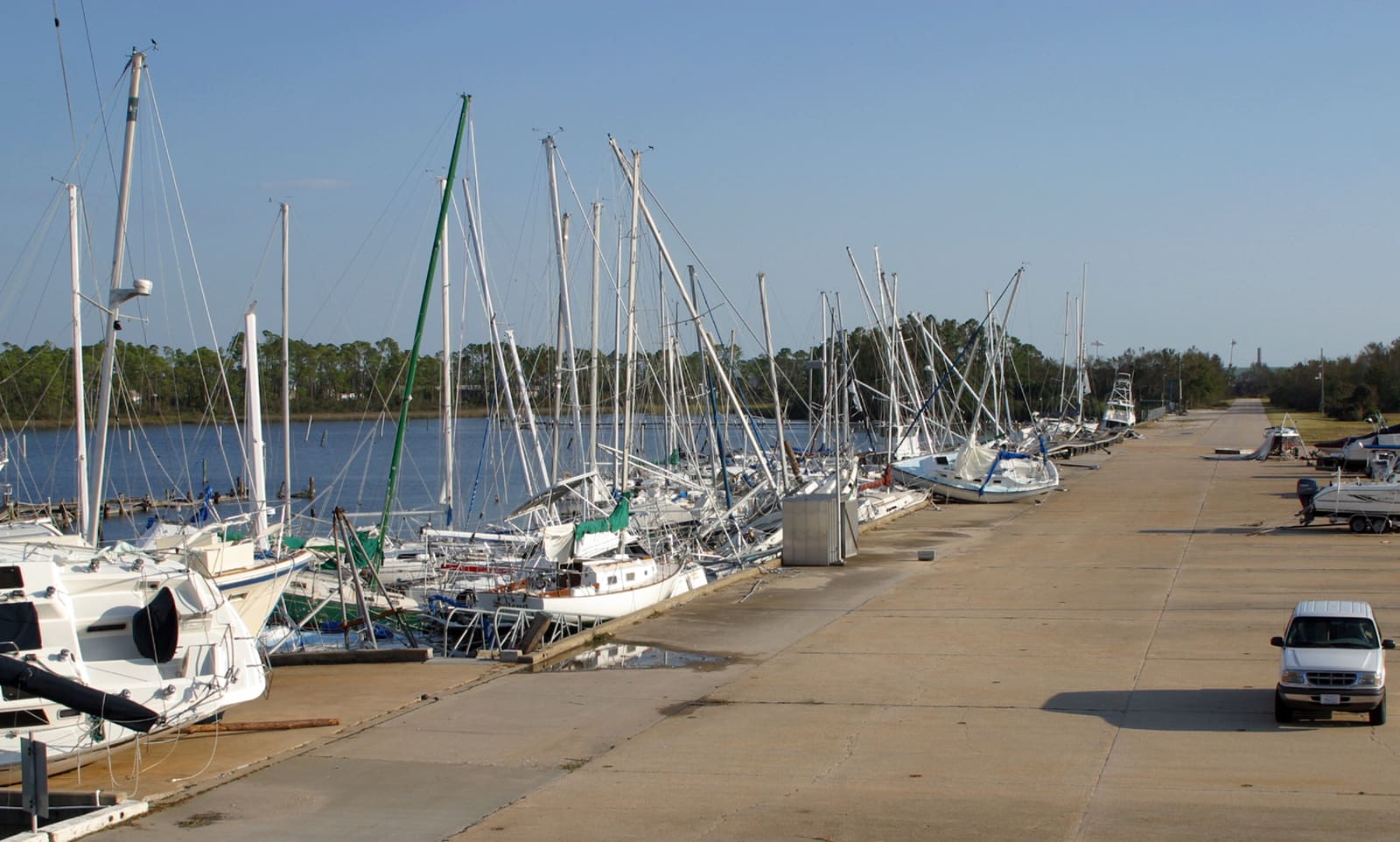
Photo: U.S. Navy (Harry White) / Wikimedia Commons · Public domain Rainfall of 6 to 12 inches in a day is normal in a hurricane, and a cockpit full of rain can sink a boat that survives the wind. Clear cockpit drains and scuppers. Tape hatches, ports, lockers and gauges; remove cowl vents and seal the openings. BoatUS suggests closing all seacocks except the cockpit drains and plugging the engine exhaust outlets so water can't back up into the engine if the boat sits lower. Write "REMOVE EXHAUST PLUGS" on the helm so nobody starts the engine with them in.
Make sure batteries are fully charged and the automatic bilge pumps work, but don't count on them: BoatUS notes owners usually overestimate how long a pump and battery can keep up with storm rain. Disconnect shore power before you leave the dock and stow the cord.
Move the boat inland, away from storm surge and trees, if you can. BoatUS suggests putting the boat (not the car) in the garage if it fits, since a boat is lighter and more easily blown around. Outside:
- Strip all gear and covers, then lash the boat to the trailer.
- Let some air out of the trailer tires and chock the wheels.
- Tie the trailer down to trees or to ground anchors or augers.
- Light outboard boats: BoatUS suggests leaving the drain plug in and adding some water to add weight, with wood blocks between the trailer frame and springs to carry the load. Inboard and sterndrive boats: pull the drain plug so a flooded hull doesn't damage the engine.
BoatUS's Catastrophe Team says a lift is one of the worst places to be in a hurricane: boats get blown off cradles or crushed by rainwater. Store the boat ashore if at all possible. If it must stay on the lift, remove the drain plug so rain drains out and strap the boat firmly to the lift structure.
Once your prep is done, go inland. Do not return during the storm. After it passes, wait until authorities allow travel, and only go out on docks when they are safe. Leave kids and pets at home.
- Hazards first: leaking fuel, downed or live wires (make sure dock power is off), missing dock boards, sewage, and displaced snakes. If you smell fuel or see a sheen, stay off the boat and call the marina, the fire department or 911.
- If the boat is afloat: check for chafed lines, broken hatches or ports, and water in the bilge. Watch the bilge level over the next days for hidden underwater damage. Check that fuel systems are intact and the bilge pump works.
- If it sank, is aground or was carried ashore: call your insurance company first and let them arrange salvage. BoatUS warns that salvage contracts are tricky, and an inexperienced salvor can cause more damage.
- Protect it from further damage: pump out, cover openings, rinse salt and mud out, and dry the interior. An engine that went underwater must be "pickled" by a pro right away. Your policy usually covers reasonable costs to prevent further damage; keep every receipt.
Photograph all damage before you clean up, report it to your insurer right away, and log what happened in BoatMend. Remove the exhaust plugs and inspect everything before starting the engine.
Common mistakes
- Waiting for the warning. By then haul slots, bridges and marinas are full or closed.
- Planning to stay aboard "to tend the lines." No line adjustment is worth your life in 100 mph wind and surge.
- Leaving the roller-furling headsail on. It unfurls and shreds, and can drag the boat down or dismast it.
- Short, tight dock lines that snap or pull cleats out as the surge lifts the boat.
- No chafe gear, or only plastic hose, so lines saw through or melt at the chock.
- Being promised a haul-out and not following up. BoatUS describes an owner whose boat was skipped in the chaos and destroyed because he hadn't added extra lines.
- Counting on the bilge pump to handle a day of tropical rain.
When to call a pro
- Your yard or a marine professional should haul, block and strap the boat, unstep a mast, or move a large boat to a hurricane hole
- You can't reach the boat in time: ask your marina or a captain to execute your written plan (some insurers help pay for this)
- After the storm, the boat sank, is aground, on its side or carried ashore: call your insurer and let them arrange salvage
- The engine or electrical system was submerged
- Fuel is leaking, or there is a fuel smell: stay off the boat and call the fire department or 911
- Anyone is in danger on the water: call USCG on VHF 16 or 911
Tips
- Keep a storm bag ready: extra lines, chafe gear, duct tape, sail ties, a knife, tools, a flashlight, a handheld VHF and life jackets.
- Practice your plan once in early summer and time it. Most owners need far longer than they think.
- Talk to the neighbors on your dock. A neighbor's boat breaking loose is a common cause of damage.
- Free planning tools: BoatUS hurricane worksheet and guides (BoatUS.com/Hurricanes) and NOAA's National Hurricane Center (hurricanes.gov).
Official references
We read these to write this guide. Your engine's own manual always wins.
- BoatUS – Hurricanes (hurricane center, guides, worksheet and videos)
- BoatUS – How To Develop A Hurricane Prep Plan
- BoatUS – How To Find And Fix Potential Breaking Points On Your Boat
- BoatUS – Hurricane Prep Saves During Hurricane Florence
- BoatUS – How Secure Is Your Marina Likely To Be In A Hurricane
- National Weather Service – Tropical cyclone watches and warnings
- National Weather Service – What to Do Before the Tropical Storm or Hurricane
- BoatUS – Boat insurance claims information (named storm haul-out reimbursement)
- ShoreMaster – How to Tie a Boat to a Lift for a Hurricane
Safety: BoatMend is for information only and does not replace a certified marine technician. You are responsible for your safety and your boat. Read the full disclaimer.
Last updated 2026-10-24
Related guides
How to Test and Clean Your Bilge Pump and Float Switch
Make sure your bilge pump actually moves water overboard, both on the manual switch and automatically through the float switch. A working bilge pump is one of the most important safety systems on any boat that stays in the water.
Marine Battery Care: Test, Charge and Store for Winter
Check your boat battery's health, charge it the right way for its type (flooded, AGM or lithium), and store it so it is ready in spring. Most "boat won't start" calls start with a neglected battery.
How to Inspect and Exercise Seacocks, Through-Hulls and Hose Clamps
Check every hole in your hull below the waterline, work each seacock open and closed, and inspect the hoses and clamps attached to them. A single failed fitting or hose is one of the most common reasons boats sink at the dock.
Launch Day and Haul-Out Checklist for Trailer Boats
A step-by-step checklist for getting your boat off the trailer and back on again safely and quickly, from the drain plug and tie-downs to the blower and ramp etiquette. Following it in order prevents the classic mistakes that sink boats and back up the ramp.
Shore Power Safety: Cords, Inlets, Burned Plugs and Electric Shock Drowning
An owner's inspection routine for your shore power cord, plugs, boat inlet, galvanic isolator and ground-fault protection, plus the right way to plug in and the facts about Electric Shock Drowning. This guide is for looking and testing only; any electrical repair belongs to an ABYC-certified marine electrician.
How to Clean and Protect Boat Canvas, Bimini Tops and Vinyl Seats
Wash your bimini, covers and enclosure the right way, beat mildew without wrecking the stitching, keep vinyl seats soft and stain-free, look after zippers and snaps, and store everything so it comes out clean next spring.