Shore Power Safety: Cords, Inlets, Burned Plugs and Electric Shock Drowning
An owner's inspection routine for your shore power cord, plugs, boat inlet, galvanic isolator and ground-fault protection, plus the right way to plug in and the facts about Electric Shock Drowning. This guide is for looking and testing only; any electrical repair belongs to an ABYC-certified marine electrician.
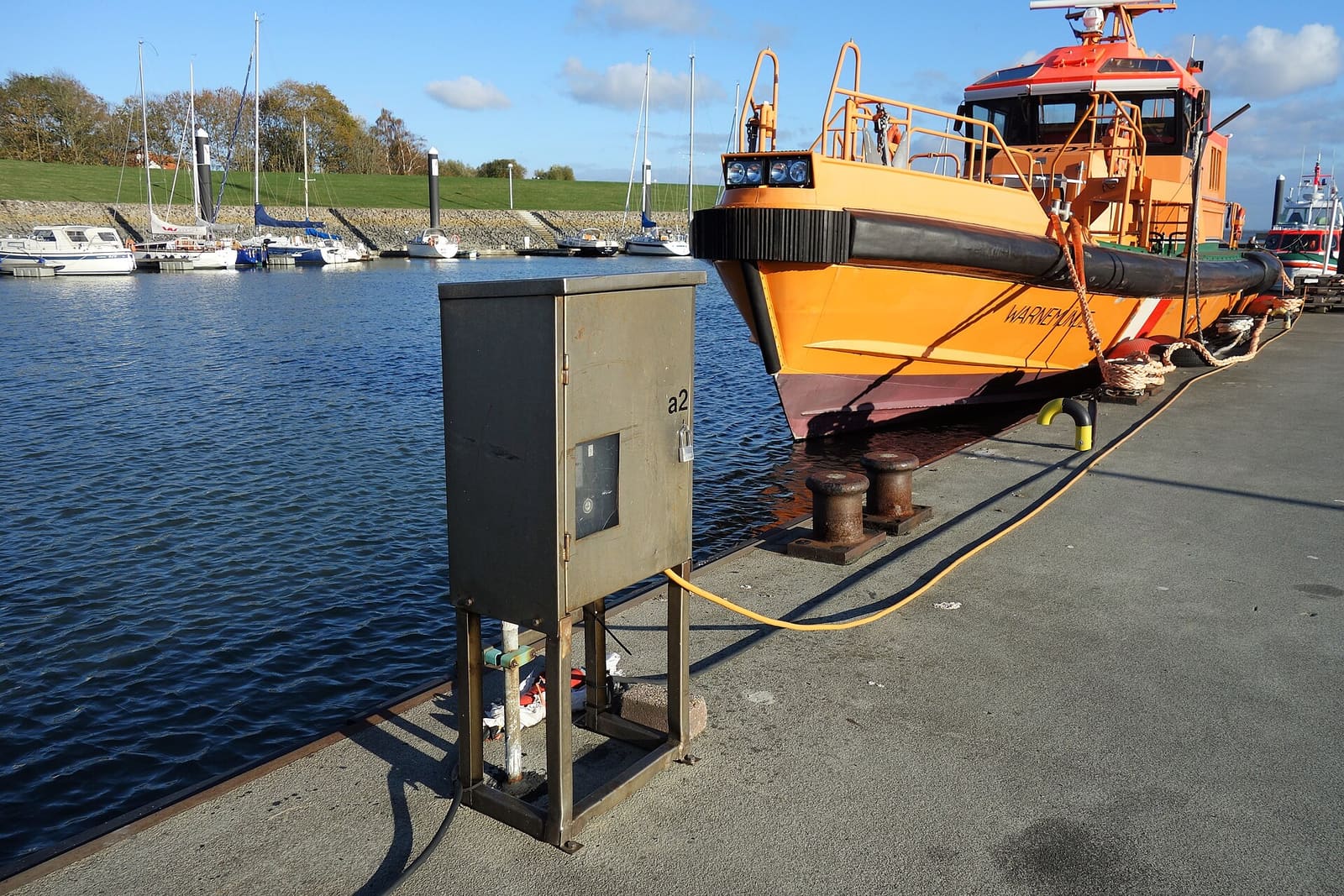
Time
30 min
Shop would charge
$150-500
Applies to
All engines
Safety first: Shore power is household-voltage AC (120/240 volts) and can kill you on the boat or in the water. This guide covers looking and testing only. Do not open the AC panel, the inlet, the galvanic isolator or the dock pedestal, and do not rewire or replace plugs yourself: hire an ABYC-certified marine electrician. Never swim near docks, marinas or boats that use AC power. If someone in the water near a dock says they feel tingling or suddenly cannot swim, do not jump in: shut off the power at the pedestal or main breaker, throw them a life ring or reach with a boat hook, and call 911 (or the USCG on VHF 16). If a cord, plug or inlet is hot, smoking or melted, turn off the pedestal breaker before touching anything and call the marina and a pro.
Fuel smell, water coming in, CO alarm or smoke? Stop, get everyone in life jackets and call USCG on VHF 16 or 911. For a tow: Sea Tow or TowBoatUS.
Tools
- Flashlight
- Clean, dry rag
- Optional AC clamp meter that can read low leakage current (milliamps)
Parts & supplies
- Replacement marine shore power cord of the correct amp rating, only if yours is damaged
- Weather cap for the boat inlet if missing
Before you start
Why this matters: BoatUS reports that most boat fires start in the electrical system, and the shore power inlet is a major source in the AC system. Corroded or loose connections heat up, and arcing when plugs are pulled under load burns the contacts. Small faults on a boat can also put AC current into the water, which is what causes Electric Shock Drowning (ESD).
How ESD happens: an electrical fault on a boat or dock leaks current into the water. A swimmer in that current can be paralyzed and drown, often without any burn marks, so many cases are recorded as ordinary drownings. The Electric Shock Drowning Prevention Association says it is far more likely in fresh water, the fault can be intermittent (for example only when a water heater or charger switches on), and there is no way to see whether water is energized. Their advice: no swimming around boats, docks or marinas that use AC power.
Know your parts:
- Shore power cord: 30-amp or 50-amp, with a locking plug at each end.
- Boat inlet: the socket on the boat where the cord connects.
- Main breaker and AC panel, often with a reverse-polarity light.
- ELCI (equipment leakage circuit interrupter): a whole-boat ground-fault breaker. ABYC has required one on new boats with AC systems for several years; older boats may not have one. GFCI outlets protect only individual outlets.
- Galvanic isolator (or isolation transformer on larger boats): protects your underwater metals from stray DC current coming through the shore power green ground wire.
Steps
Turning power on and off at the right moment prevents arcing that burns plugs:
- To connect: turn off the boat's main shore power breaker and the pedestal breaker. Plug the cord into the boat first, then into the pedestal. Turn on the pedestal breaker, then the boat's main breaker.
- To disconnect: turn off the boat's main breaker and the pedestal breaker first. Unplug at the pedestal first, then at the boat. Put the weather cap back on the inlet.
Never plug or unplug a cord with power on, and never leave a live cord end lying on the dock or in the water.
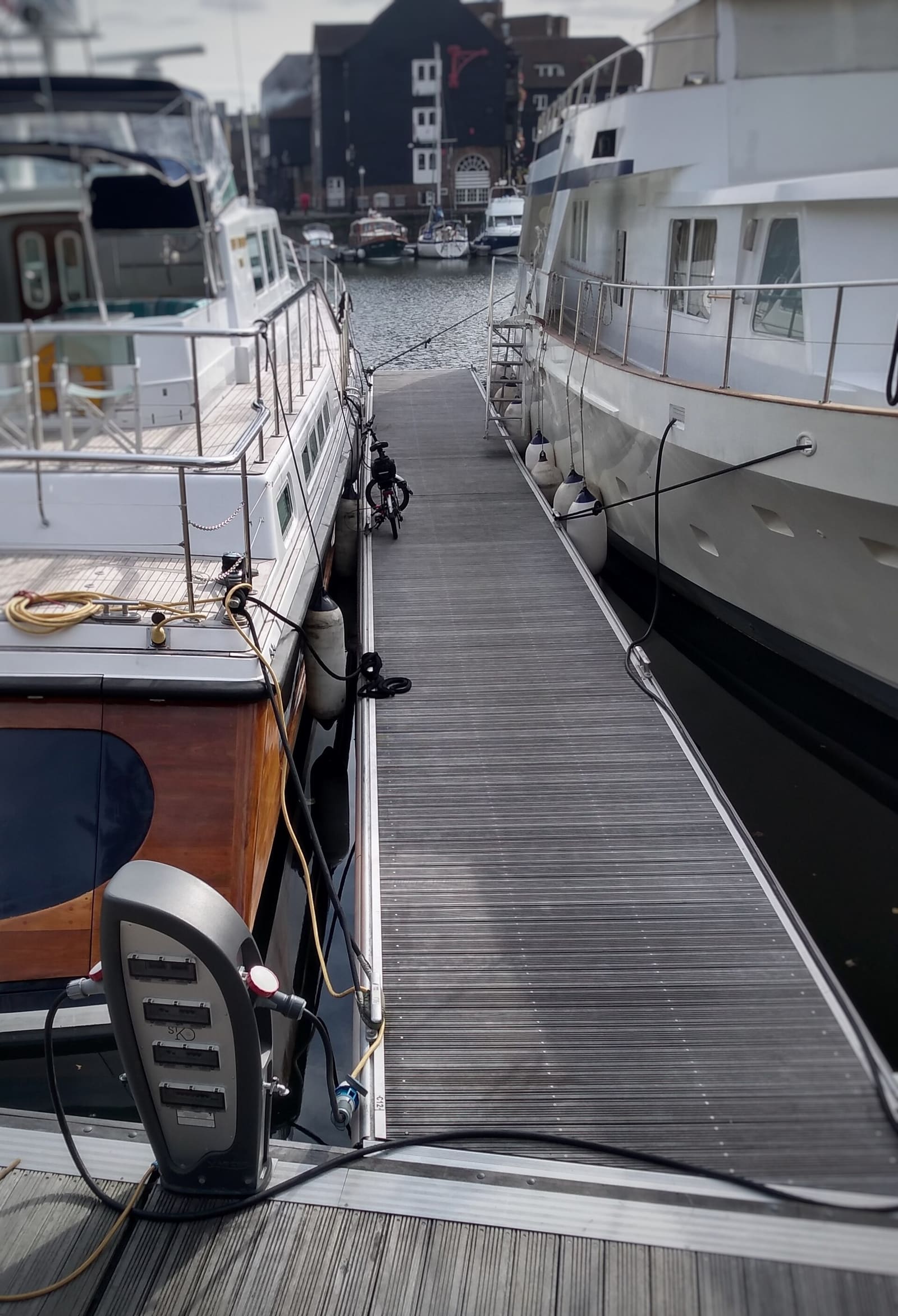
Photo: Back_ache / Wikimedia Commons · CC BY-SA 4.0 With the cord unplugged at both ends, run it through your hands (with a dry rag) from end to end. Look for cuts, cracks, crushed or flattened spots, kinks, exposed inner wires, tape or splices, and soft or stiff areas that suggest heat. Any of these means replace the cord. Do not tape or repair a shore power cord.
Look closely at the pins, blades and the face of each end. Warning signs:
- Brown, black or blue discoloration
- Melted or blistered plastic
- Pitted, burned or green corroded contacts
- A loose or cracked locking ring or housing
BoatUS says burn marks on either end of the cord, or on the boat's receptacle, mean the cable, the boat's inlet, or the dock receptacle must be replaced. If one end of the cord is burned, assume what it was plugged into is damaged too, and have the inlet and pedestal checked.
Look at the inlet on the boat with the cord removed and power off. Check for the same burn and corrosion signs, cracks in the housing, a loose mounting, and a missing or broken weather cap. Look inside the boat behind the inlet only if it is easy to see without removing anything; discolored or melted wiring there is a call-a-pro-now item.
On a boat more than about 10 years old, the inlet deserves a pro's look even if the front looks fine. BoatUS's analysis of its fire claims found that most AC electrical fires start somewhere between the dock pedestal and the boat's inlet, and pinpointed the back of the inlet, where the boat's wiring attaches to the terminals, as a high-risk spot on older boats. Those terminals see water, vibration and corrosion, often next to things that burn easily. Its advice: if the inlet is original, have an electrician replace it, or at least pull it out and inspect the connections.
After the boat has been on shore power with a normal load (air conditioning, water heater or charger) for an hour or so, lightly touch the plug ends and the inlet with the back of your hand. Slightly warm can be normal; hot is not. If anything is hot, turn off the boat's main breaker and the pedestal breaker, let it cool, and have a marine electrician find the cause.
The cord should not hang by its plug or pull on the inlet. Leave a little slack for tide and movement, form a drip loop so water runs off before reaching the plug, and keep the cord out of the water and away from where it can be crushed or tripped over. Tighten the locking rings fully so the connection is snug and sealed.
- Use only marine shore power cords and listed marine adapters of the correct amp rating.
- Never use a household extension cord, a "cheater" adapter that skips the ground pin, or a homemade cord.
- Do not daisy-chain adapters. If the pedestal does not match your boat, ask the marina for a proper solution.
BoatUS also describes newer cord and inlet designs that seal better and reduce arcing; they are worth considering when you replace a cord, but the inlet change itself is a job for a pro.
If your panel has a reverse-polarity light or meter, check it right after you switch on. A reverse-polarity warning means turn everything off and unplug: the problem may be the boat, the cord or the pedestal. Tell the marina and do not use shore power until it is found.
If your boat has an ELCI main breaker, press its test button as the maker recommends (many say monthly). It should trip. Reset it. Test GFCI outlets aboard the same way. If an ELCI or GFCI trips by itself or trips repeatedly, do not keep resetting it: that is a fault that may be putting current where it should not be. Unplug and call an ABYC-certified electrician. If your older boat has no ELCI, ask an electrician about adding one.
Find your galvanic isolator (often near the inlet or main panel) and its remote monitor or status light if fitted. BoatUS recommends checking the unit and its connections for corrosion or damage at least once a year, and checking the monitor whenever you plug in and after nearby lightning. A fault light or a burned or corroded unit is for a pro. If your boat has a sterndrive or outboard and you use shore power but have no isolator, ask about one: Mercury recommends a galvanic isolator for boats on shore power to protect the drive from stray-current corrosion coming from the dock or nearby boats, and notes that this kind of corrosion damage is not covered by its warranty. Never disconnect the green ground wire to fix corrosion; that ground is what makes a fault trip the breaker instead of electrifying the boat and the water.
This test is non-invasive: the meter clamps around the outside of the cord. With the boat plugged in and every AC load aboard turned off, clamp the AC clamp meter around the whole shore power cord (all wires together). Because current going out and coming back should cancel, the reading should be essentially zero. Any steady reading means current is leaking somewhere, possibly into the water. Unplug and call an ABYC-certified electrician. Do not open the cord or clamp individual wires.
- No swimming within the marina or near docks and boats that use AC power. The ESDPA position is that it should be strictly prohibited.
- If you feel tingling in the water, shout a warning and swim away from the dock or boat, the way you came if you can, and do not grab metal ladders or docks.
- To help someone: reach, throw, don't go. Shut off power first if you can, use a boat hook, oar, line or life ring, and call 911. Rescuers who jump in often become victims. Start CPR if needed once the person is out.
Have an ABYC-certified marine electrician inspect the AC system, inlet and galvanic isolator periodically, after any burned plug or inlet, and before adding AC equipment. If you have a private dock, have the dock wiring inspected too. Ask your marina whether its docks have ground-fault protection. Record inspection dates and cord replacements in BoatMend.
Common mistakes
- Plugging or unplugging with the breakers on, which arcs and burns the contacts.
- Replacing a burned cord but plugging it back into the same burned inlet or pedestal, which then ruins the new cord.
- Using a household extension cord or a cheater adapter to reach a pedestal.
- Cutting or disconnecting the green ground wire to stop zinc loss, which removes a life-saving safety path.
- Letting kids swim off the swim platform at the marina "because it's always been fine." ESD faults can come and go.
- Resetting an ELCI or GFCI over and over instead of finding out why it trips.
- Doing DIY AC wiring. BoatUS notes that some leakage faults are created by owners' own repairs or upgrades.
When to call a pro
- Any burned, melted or discolored plug, inlet or pedestal outlet
- A cord end, inlet or wiring that gets hot under load
- Reverse-polarity warnings, an ELCI or GFCI that trips by itself, or any reading on the clamp meter test
- A galvanic isolator fault light, or corroded or damaged isolator
- Anyone reports tingling in the water near your boat or dock
- Adding or changing an inlet, ELCI, galvanic isolator, inverter, charger or any AC circuit (ABYC-certified marine electrician)
Tips
- Keep a spare marine cord aboard of the correct rating so you are never tempted to use a damaged one.
- Turn off big AC loads (air conditioning, water heater) before unplugging, even after turning off breakers, so you form the habit.
- If you have a generator, turn the shore power breaker off before you start the generator at the dock. Generator maker Northern Lights warns that a worn shore/generator selector switch can connect the two power sources, with expensive (and dangerous) results.
- Put a "No swimming: electrical hazard" sign at a private dock; the ESDPA encourages posted warnings.
- When you buy a used boat, ask the surveyor to check the shore power inlet and look for an ELCI and galvanic isolator.
Official references
We read these to write this guide. Your engine's own manual always wins.
- BoatUS – Avoid Electric Shock Drowning
- BoatUS – Install A Galvanic Isolator
- BoatUS – Plugging For Safety
- BoatUS – Spring Commissioning Checklist
- Electric Shock Drowning Prevention Association – ESD and FAQ
- Electric Shock Drowning Prevention Association – Preventing ESD
- Mercury Marine – Owners Resources FAQs (galvanic isolator, stray current corrosion)
- BoatUS – Analyzing Onboard Fire Claims
- BoatUS – 5 Spring Claims to Avoid (shore power inlet)
- Northern Lights – Top 10 Generator Maintenance Tips and Tricks
Safety: BoatMend is for information only and does not replace a certified marine technician. You are responsible for your safety and your boat. Read the full disclaimer.
Last updated 2026-10-24
Related guides
Marine Battery Care: Test, Charge and Store for Winter
Check your boat battery's health, charge it the right way for its type (flooded, AGM or lithium), and store it so it is ready in spring. Most "boat won't start" calls start with a neglected battery.
How to Inspect and Replace Sacrificial Anodes (Zincs)
Check the anodes on your outboard, sterndrive or inboard running gear, replace them when they are half gone, and choose the right metal for the water you boat in. Fresh anodes are cheap insurance against expensive corrosion damage to your lower unit, drive and prop.
Marine Generator Routine Maintenance and CO Safety
Keep an Onan, Kohler/Rehlko, Northern Lights, Westerbeke or similar marine generator reliable with regular checks of oil, raw-water cooling, fuel, exhaust and the start battery, plus a monthly run under load. Generator exhaust is a leading source of carbon monoxide on boats, so safety checks come first.
Launch Day and Haul-Out Checklist for Trailer Boats
A step-by-step checklist for getting your boat off the trailer and back on again safely and quickly, from the drain plug and tie-downs to the blower and ramp etiquette. Following it in order prevents the classic mistakes that sink boats and back up the ramp.