Emergency Steering: What to Do When Your Boat's Steering Fails
A plan for the day the wheel goes slack or locks up - stop safely, find the problem, then steer home with an emergency tiller, twin engines, a drogue or a bridled bucket - plus how to build the gear and practice it before you need it, on outboard, sterndrive and inboard boats.
Time
1 h
Applies to
All engines
Safety first: If the steering fails underway, slow down right away: a boat stuck in a turn at speed can throw people overboard or hit something. Put life jackets on everyone. If you're drifting toward rocks, a lee shore, a channel with ship traffic or breaking surf, anchor if you can and call the Coast Guard on VHF 16 (PAN-PAN, or MAYDAY if there's danger to life), or call your tow service. Never lean over the transom near a turning propeller to fix steering; shut the engine off first.
Fuel smell, water coming in, CO alarm or smoke? Stop, get everyone in life jackets and call USCG on VHF 16 or 911. For a tow: Sea Tow or TowBoatUS.
Owners often ask
- My steering cable locked up offshore. How can I steer the boat home without it?
- Can I steer a twin-engine boat with just the shifters if the steering fails?
This guide walks you through it. Still stuck? Ask the AI Mechanic about your engine.
Tools
- Life jackets for everyone aboard
- VHF radio and a charged phone
- Anchor with enough rode for local depths
- Basic tools to disconnect steering at the engine or rudder (wrenches, pliers, cotter pins)
- Flashlight
Parts & supplies
- Emergency tiller made for your rudder post (inboard and sailboats), if the builder offers one
- Commercial drogue sized for your boat, or a sturdy bucket with a rope bridle twice the boat's beam
- Two long lines for a drogue bridle, and a fender or two for recovery
- Spare steering parts such as cotter pins, clips and a bolt for the steering link
Before you start
Steering can fail in a few ways: a cable seizes or snaps, a hydraulic line leaks, a bolt or cotter pin falls out of the steering link at the engine, a rudder is bent by a log, or a rudder is lost altogether. Practical Sailor notes that loss of steering is one of the most common reasons boats need rescue offshore, and that hitting debris is even more likely inshore.
The goal is to get to a safe place, not back to your slip. A towboat or an anchorage is a fine outcome. This guide shows the options from simplest to most involved. Pick the ones that fit your boat now, build the gear, and practice in calm water. Boating Magazine's advice, based on hard experience, is that every boat needs a backup steering plan worked out ahead of time.
Steps
Pull back to idle and shift to neutral. Note where you are, which way the wind and current are pushing you, and how much room you have. Have someone keep watch for traffic. If it's safe, turn on your navigation lights or deck lights so others can see you.
Dropping the anchor buys time to work without drifting. If you can't hold and danger is close, call the Coast Guard or your tow service before you start tinkering. "PAN-PAN" on VHF 16 is the urgency call for a boat in trouble without immediate danger to life.
Practical Sailor retells a race-boat loss that shows why: after the rudder broke, the crew spent more than two hours trying one unpracticed jury-rig after another, turned down offers of help and waited to call MAYDAY, and the boat was driven onto a surf-swept ledge where a crew member drowned. If your first fix isn't working and the shore is getting closer, make the call and accept the help while you keep working; you can always cancel.
With the engine off:
- Outboard: look at the steering link arm and the bolt, nut and cotter pin that join the cable or hydraulic ram to the engine. A missing pin is a common, easy fix if you carry spares.
- Cable steering: does the wheel turn freely while the engine doesn't move (broken cable), or is everything locked (seized cable or tilt tube)?
- Hydraulic steering: look for fluid on the floor at the helm or around the cylinder at the engine. A soft, spinning wheel usually means air or a fluid leak.
- Inboard/sailboat: check the quadrant, cables or linkage at the rudder post, and look over the stern at the rudder.
See the hydraulic steering and steering cable guides for what each finding means.
A makeshift steering method only works if the engine or rudder can swing. Boating Magazine stresses carrying tools to free the drive, engine or rudder even if you can't fix the steering itself. On an outboard or sterndrive that may mean unbolting the cable or ram from the steering arm. Also center the engine or rudder: Boating Magazine notes that a drive stuck hard over makes only slow, wide circles.
On a twin-engine boat, you can steer with the shifters. Boating Magazine explains it simply: to turn to starboard (right), put the port (left) engine in gear and leave the starboard one in neutral. For a tighter turn, put the starboard engine in reverse, but only at slow speed. Keep the drives or rudders centered. Rudders and drives still help when they work, so don't fight them. Different boats behave differently, which is why you practice (step 11).
A boat turns toward the side where you drag something through the water. Boating Magazine describes steering home with a paddle and then a landing net held alongside, braced by a crew member's leg while sitting on the gunwale (wearing a life jacket). It's tiring and imprecise, but it works at slow speeds. On a single engine you can also use the wind and current: a little thrust combined with the drift can carry you where you want to go.
For longer distances, tow a drag device off the stern on a bridle:
- Bucket (small boats): Boating Magazine suggests a heavy plastic bucket with the bottom cut out, the wire handle replaced with stout line (or holes drilled a few inches below the rim with a bowline through them), tied to the middle of a line about twice the boat's beam. Tie each end of that bridle to a strong stern cleat or tow eye. Shorten the bridle on the side you want to turn toward.
- Commercial drogue (larger boats): Practical Sailor strongly advises against a bucket on bigger boats: it tows unsteadily, the handle can rip out, and the drag is only enough for boats up to about 25 feet. A cone-shaped drogue sized by the maker for your boat is steadier. Use a length of chain to keep it under water, and a fender to help recover it.
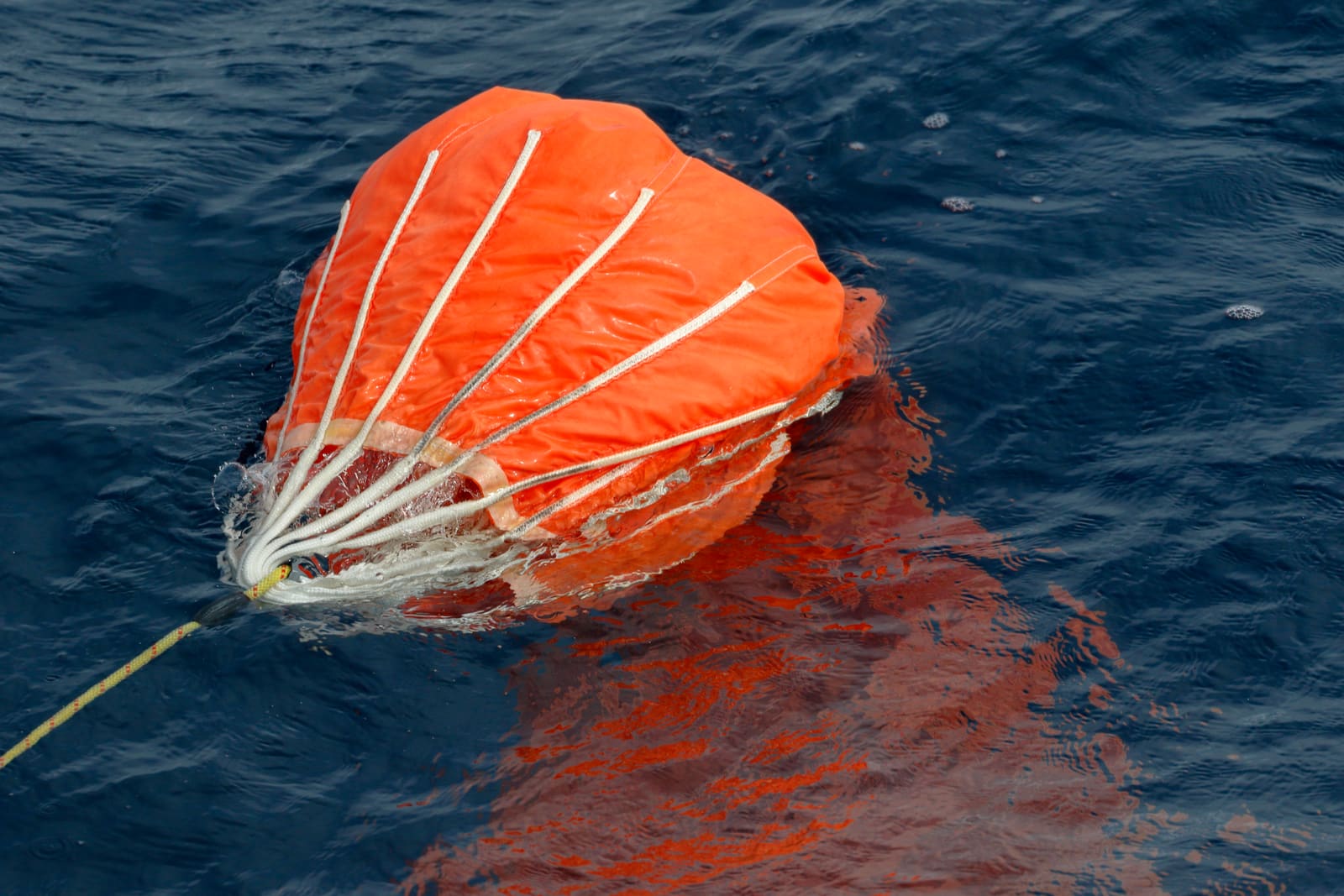
Photo: Ed Dunens / Wikimedia Commons · CC BY 2.0 Start with the bridle lines long (Practical Sailor suggests about one and a half boat lengths) and a gentle downwind course. Pull in one side to turn that way, ease it to straighten out. Go slow: speed makes the loads huge and tangles the lines. Keep lines away from the propeller, and shift to neutral when you haul the drogue in. Expect downwind and reaching courses to be easiest; heading into the wind is hard.
Many inboard boats and sailboats have an emergency tiller that fits over the top of the rudder post, under a deck plate or in the lazarette. Boating Magazine notes that on inboards someone may have to steer from the engine room or lazarette. Before you need it, check that:
- the tiller is aboard and you know where it is
- the deck plate opens (bring the key or tool)
- it fits the rudder post and the steering cables can be disconnected so it can turn
- it's long enough to give useful leverage in waves
- it's strong enough: Practical Sailor warns that some emergency tillers seem to be added mainly to tick a certification box, and in their experience many wouldn't survive days of steering in rough weather; if you go offshore, look hard at the tiller and how it locks onto the rudder post
On a sailboat with wheel steering, a parted steering cable often shows up as the boat suddenly rounding up into the wind with the wheel spinning uselessly. BoatUS contributing editor Mark Corke had exactly that happen on a calm day; the emergency tiller had them sailing again within minutes. Most pedestal systems use a short chain over a sprocket joined to wire cables that run around sheaves to the rudder quadrant, and every one of those contact points wears.
An outboard has no rudder post. Some owners lash a pole or gaff to the engine as a tiller; Boating Magazine describes a cowling destroyed by a taped-on gaff that barely held. A small kicker motor with its own tiller can be the best backup on a fishing boat. Trim tabs can nudge the boat in calm water. Whatever you try, keep hands and feet away from the propeller and only make adjustments with the engine off.
Once a season, on a calm day with plenty of room:
- Twin engines: steer a figure eight using only the shifters.
- Single engine: try your bucket or drogue for a few hundred yards.
- Inboard/sailboat: fit the emergency tiller at the dock, then try it underway. You'll find out what's missing (a key, a pin, a line) while it's easy to fix.
Most steering failures give warning. Grease outboard steering tubes and check the link bolt and cotter pin, check hydraulic fluid and look for leaks, and replace a stiff cable before it seizes. Look over the rudder and bearings at every haul-out (see rudder bearings). After hitting anything, check the steering before you get back on plane.
Two quick habits from BoatUS:
- Hydraulic outboard steering: before each trip, turn the wheel lock to lock and look for drips at the helm fittings and the engine cylinder, and for a wheel that feels spongy (air). Many owners bleed the system at the start of each season.
- Sailboat wheel steering: once a year, open up the pedestal and the quadrant area and look for broken wire strands, frayed spots at the sheaves and loose fasteners. A cable that wears slowly out of sight is what usually parts.
If you ever replace hydraulic parts, don't buy a used cylinder unless you're sure it's the right one for your exact engine; BoatUS warns that mismatched cylinders can bind or come loose.
Common mistakes
- Staying at speed with a jammed wheel and the boat turning.
- Forgetting the steering is still connected, so a jury rig can't move the engine or rudder.
- Using a thin bucket handle that pulls out on the first surge.
- Bridle lines wrapped in the prop because the engine was left in gear while rigging.
- An emergency tiller nobody has ever fitted, with a seized deck plate or missing key.
- Waiting until you're on the rocks to call for a tow.
When to call a pro
- Drifting toward hazards, in heavy weather or at night: call USCG on VHF 16 or your tow service (Sea Tow, TowBoatUS) right away
- Any hydraulic leak, a broken or seized steering cable, or a bent rudder or drive after a strike
- A missing or sheared steering bolt you can't replace with a proper part
- Before relying on any repair made at sea: have the system inspected and fixed properly
Tips
- Keep a few spare cotter pins and the right size nut and bolt for your steering link in the toolkit.
- Tie a short loop of line to your bucket now and keep it with the anchor gear.
- Write "Steering failure: SLOW, NEUTRAL, ANCHOR, CALL" on your pre-departure card.
- If you buy a drogue for steering, practice recovering it too: it's heavy work.
Official references
We read these to write this guide. Your engine's own manual always wins.
- Boating Magazine – What to Do If Your Boat's Steering Fails
- Boating Magazine – Using Wind and Current to Steer Your Boat
- Practical Sailor – Emergency Steering? You Can Jury-Rig a Drogue For That
- BoatUS – Sailboat Steering Inspection (Mark Corke, 2020)
- BoatUS – Outboard Steering Options (2020)
- USCG Navigation Center – Radio Information for Boaters (MAYDAY and PAN-PAN)
- Practical Sailor – Emergency Repairs at Sea: Jury-Rigging Rudders, Rigs and Keels
Safety: BoatMend is for information only and does not replace a certified marine technician. You are responsible for your safety and your boat. Read the full disclaimer.
Last updated 2026-10-25
Related guides
Emergency Drills for Your Crew: Engine Failure, Fire, Steering Loss and Man Overboard
Practice what everyone aboard does when the engine quits, a fire starts, the steering fails or someone falls in. A few short drills each season turn panic into a plan, and teach your crew to anchor, call for help on VHF 16 or DSC, and get a tow.
Hydraulic Steering: Check Fluid, Bleed Air and Fix Stiff or Loose Steering
Check the fluid in your hydraulic steering helm, bleed out the air that makes steering spongy, and track down the usual causes of stiff, loose or noisy steering. Includes notes for boats with mechanical cable steering.
Stiff or Seized Mechanical Steering - Lubricate, Inspect and Replace the Steering Cable
Fix hard, notchy or loose cable steering on an outboard boat. Find out whether the engine, the tilt tube, the cable or the helm is the problem, clean and grease what can be serviced, and measure and install a new cable correctly when the old one is done.
Rudder, Rudder Bearings and Steering Gear Inspection (Sailboats and Inboards)
Check your rudder for play, water inside the blade and stock corrosion, inspect the rudder tube and its seal, and go over cables, sheaves, quadrant and stops so the steering does not fail when you need it. Includes how to find, fit and practice with the emergency tiller.
How to Synchronize Twin Engines (RPM and Trim)
Twin engines running at slightly different RPM cause a pulsing drone, extra vibration, uneven wear and wasted fuel. Learn how to sync them by tach, sync gauge or ear, use the one-button sync on digital controls, check that your tachs tell the truth, match trim, and know when uneven engines or cable adjustment are a dealer job.
Anchor Basics: Choosing the Anchor, Rode and Scope, Setting It and Checking Your Gear
Match your anchor to the bottom you usually anchor in, put together a chain-and-nylon rode, let out enough scope for the depth and weather, set and check the anchor, use an anchor alarm, and inspect the rode, splices and shackles every season so the weakest link isn't hiding in your ground tackle.
How to Mount and Maintain a Kicker Motor Bracket
Set up a small auxiliary outboard (a kicker) the right way: choose a manual or spring-assisted bracket, through-bolt it to a sound transom with a backing plate, add a safety cable, sort out steering and fuel, and keep the bracket working season after season.