Anchor Basics: Choosing the Anchor, Rode and Scope, Setting It and Checking Your Gear
Match your anchor to the bottom you usually anchor in, put together a chain-and-nylon rode, let out enough scope for the depth and weather, set and check the anchor, use an anchor alarm, and inspect the rode, splices and shackles every season so the weakest link isn't hiding in your ground tackle.
Time
1 h
Applies to
All engines
Safety first: Never anchor a small boat by the stern: the BoatUS Foundation warns the engine and most of the weight are there, and waves can swamp it. Put on a life jacket before going forward to drop or raise the anchor, keep feet and hands clear of a running rode and the windlass, and always tie the bitter end to the boat before you let go. If your anchor drags toward rocks, shore or other boats and you can't reset it, start the engine and get clear; if you can't, call your tow service or the Coast Guard on VHF 16.
Owners often ask
- How much anchor line should I let out, and do I count the height of the bow?
- My anchor keeps dragging in mud. Do I need a different anchor or more chain?
This guide walks you through it. Still stuck? Ask the AI Mechanic about your engine.
Tools
- Depth finder or a lead line
- Tape measure (to mark the rode)
- Pliers and a marlinspike or screwdriver (for shackle pins and seizing wire)
- Wire brush
- Chartplotter or phone app with an anchor alarm
Parts & supplies
- Anchor sized from the anchor maker's chart for your boat
- Length of galvanized chain (about half to one boat length for a rope-chain rode)
- Three-strand or braided nylon anchor line
- Galvanized anchor shackles rated for your chain
- Stainless steel seizing wire (for mousing shackle pins)
- Nylon snubber line (for all-chain rodes)
- Rode length markers
Before you start
Your anchor system ("ground tackle") is the anchor, the rode (chain, line or both), the shackles and splices that join them, and the cleat, roller or windlass on the boat. Practical Sailor's reminder is that it's only as strong as its weakest piece.
Know the depth and bottom where you'll anchor (your chart or plotter usually shows sand, mud, rock or grass), the tide range if you're on the coast, and the forecast wind. Have your anchor maker's sizing chart handy.
Steps
The BoatUS Foundation suggests choosing the style for the bottom you anchor in most, then the size for your boat:
- Fluke (Danforth-style): light for its holding power; best in hard sand or mud where the flukes can dig in. Common on small boats.
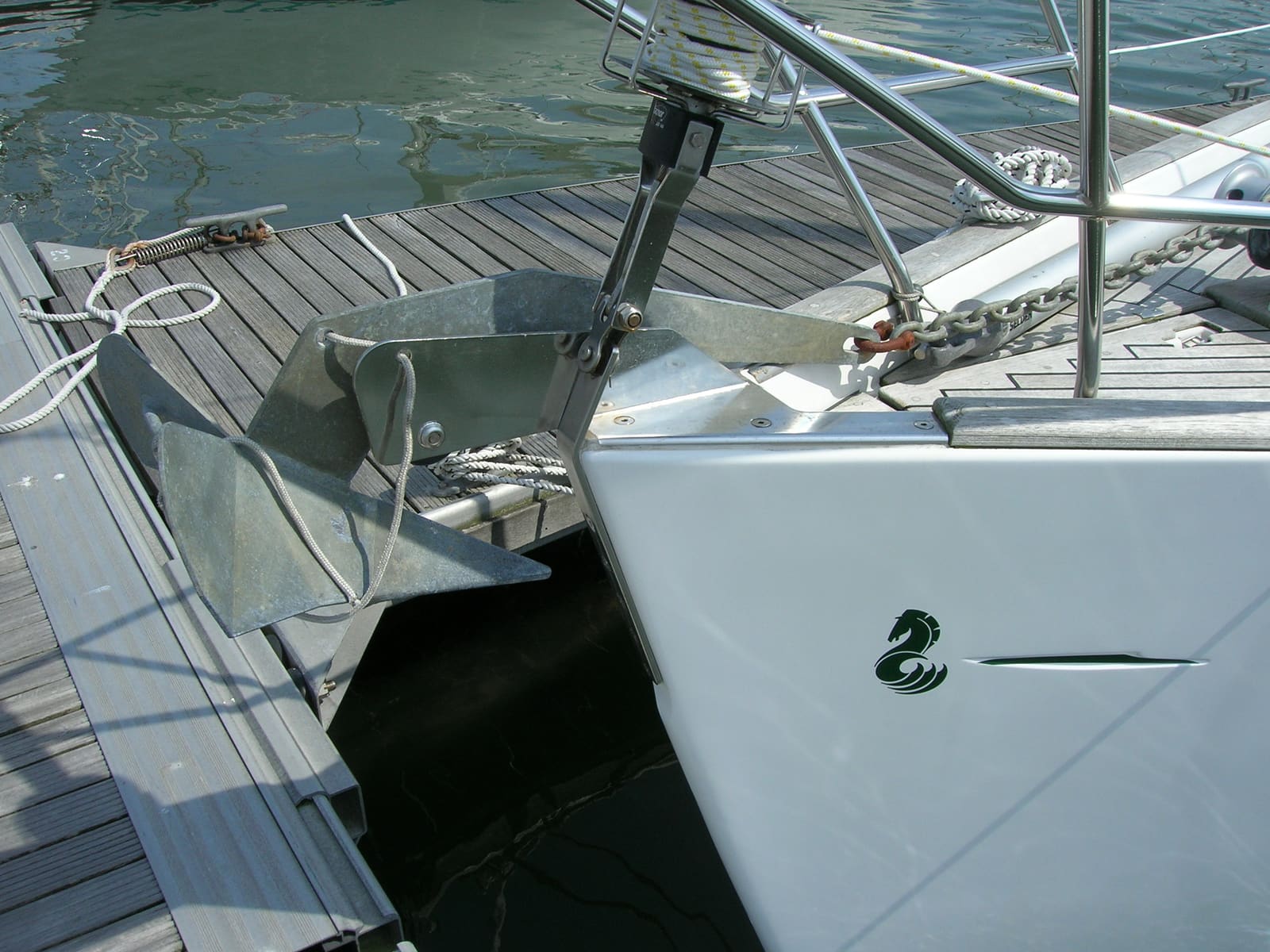
- Plow (fixed or hinged shank): holds over a wide range of bottoms and resets fairly well when the wind or tide swings the boat. A favorite of cruisers.
- Claw: similar to a plow at lower weight; good in sand, rock, weeds and grass, poor in soft mud.
- Traditional (stock and arms): good in heavy grass, weed and rocky bottoms, poor in mud or loose sand.
- Grapnel: little holding power; for rocky or wreck areas and very small boats.
- Mushroom: for soft bottoms and small boats as a lunch hook (big ones are used for permanent moorings).
Boating Magazine adds that many popular styles, including newer designs, work in most common bottoms, but heavier anchors do better in grass. If you anchor in varied places, many owners carry two different anchors.
Box (folding cage) anchors are popular with lake owners. On soft mud, clay or sand they dig in and can re-set when the wind swings, and owners report they hold on less scope than a fluke anchor. They snag on stumps and rock, tangle in weeds, and have to be pulled from directly above. Follow the anchor maker's scope advice anyway, and still drop it from the bow, never the stern.
Look up your boat's length and weight on the anchor maker's chart. Heavy boats and boats with lots of windage (tall cabins, flybridges, canvas, most sailboats) need bigger gear. The BoatUS Foundation notes these charts assume fair holding ground, at least 5:1 to 10:1 scope and some shelter, so going one size up gives a margin. Boating Magazine agrees one size up is nice, especially with a windlass doing the lifting.
Most small and mid-size boats use a combination: chain at the anchor, nylon line after it.
- Chain: it adds weight that keeps the pull on the anchor low and horizontal, which helps it set and stay set, and it resists chafe on rock, shell and coral. West Marine's rule of thumb is half to one boat length of chain; the BoatUS Foundation suggests about a foot of chain per foot of boat length. Boating Magazine says 6 to 8 feet is OK for light day use but suggests at least half a boat length for overnight. On rocky bottoms, West Marine notes some boaters use as little as 4 feet so the chain doesn't snag.
- Line: nylon, because it stretches and absorbs gusts and waves instead of jerking the anchor loose. West Marine says not to use polyester or other low-stretch line for anchoring.
- All-chain rodes suit larger boats with windlasses. Use a nylon snubber to take the load and absorb shock, and tie a length of nylon at the bitter end so the chain can be cut free in an emergency.
- Size the line and chain from the maker's or retailer's chart for your boat's length and weight. West Marine suggests shackles one size larger than the chain. If you have a windlass, the chain must match its gypsy (see the windlass guide).
Scope is the length of rode you let out divided by the height from the bottom to your bow (water depth plus the height of the bow above the water). To figure the rode you need, West Marine's method: take the deepest water you expect to anchor in, add your bow height, and multiply by 7, and carry enough for 10:1 in a storm. On the coast, use the depth at high tide.
Published guidance from these sources:
Situation Typical scope (rode : depth + bow height) Source General recommendation 7:1 BoatUS Foundation, West Marine Small boat, light anchor, good weather 5:1 BoatUS Foundation All-chain rode, calm to moderate weather about 4:1 West Marine Typical plan, mixed rode about 8:1 Boating Magazine Rough weather, poor holding, strong current, or boat left unattended overnight 10:1 West Marine, Boating Magazine Example: 10 feet of water and a 4-foot bow is 14 feet; at 7:1 that's 98 feet of rode. More scope is almost always better if you have the swinging room. West Marine calls a steep angle of pull the most common mechanical cause of dragging.
Look at where other boats are lying and estimate the circle your boat will swing through on that much rode. Boating Magazine notes that the first boat in an anchorage has priority, that big boats swing more slowly and in bigger arcs, and that high-windage boats swing faster in strong wind. Make sure the depth is still enough at low tide everywhere in your swing circle.
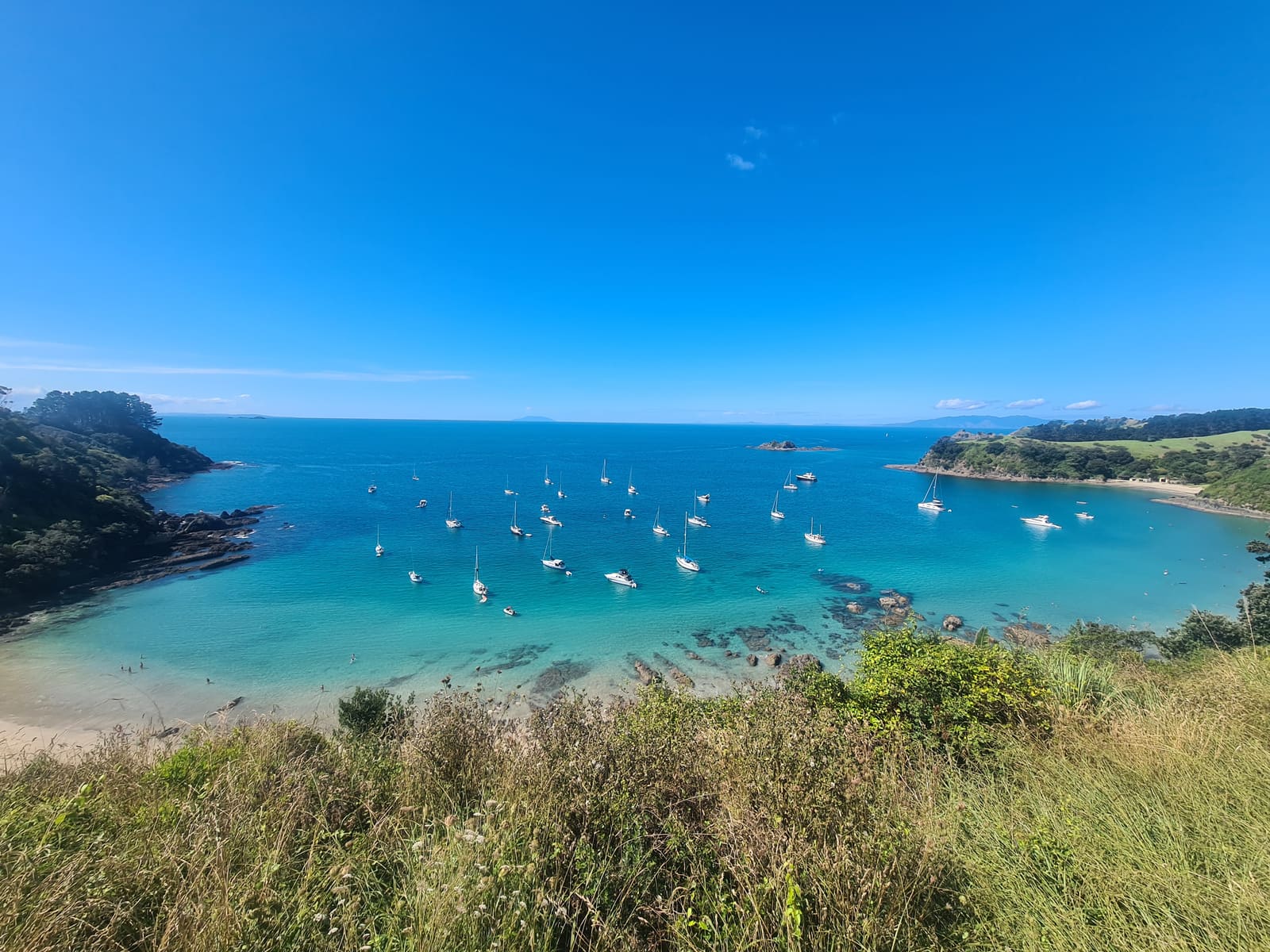
Boats at anchor need room to swing as the wind and tide change. Photo: RadishSlice / Wikimedia Commons · CC BY-SA 4.0 - Life jackets on for whoever goes forward, and agree on hand signals with the helm.
- Tie the bitter end to the boat if it isn't already permanently attached.
- Head slowly into the wind or current past the spot where you want the boat to end up, then stop.
- Lower the anchor to the bottom (don't throw it, or the rode can tangle).
- Let the boat drift or back slowly while you pay out rode. The BoatUS Foundation suggests giving a tug after about a third is out to help it bite, then continuing.
When the full scope is out, snub the rode on the bow cleat and let the boat's momentum straighten it. Wait for the line to stretch and see if it holds. Then back down gently in reverse, building power slowly. Boating Magazine cautions that too much reverse too early can make the anchor skate across the bottom instead of digging in. A set anchor holds the boat with the rode steady; a dragging one telegraphs bumps up the line. If it drags, pull it up and try again, perhaps with more scope or in a different spot.
Lead the rode through a chock so it doesn't rub or sweep fittings as the boat swings. If you have a windlass, don't leave the load on it: Boating Magazine notes a windlass is not a cleat. Use a chain stopper, a snubber or the bow cleat.
Right after setting, pick two landmarks that line up (a range) or take bearings, as the BoatUS Foundation suggests, and check them again over the next while. Set the anchor alarm on your chartplotter or phone app with a radius a bit bigger than your swing circle. Check again whenever the wind or tide changes. At night, show an all-around white anchor light; by day, the BoatUS Foundation notes you must display a ball shape sized for your boat (check the Navigation Rules for your boat's length). The Inland Rules (Rule 30) have two exceptions: a boat under 7 meters (about 23 feet) anchored away from channels, fairways, anchorages and places where boats normally travel, and a boat under 20 meters (about 65 feet) anchored inside a Coast Guard designated special anchorage area, don't need the light or ball. Showing the light anyway costs nothing and makes you easier to see.
Motor slowly toward the anchor while someone takes in the rode, so the boat does the pulling, not your back or the windlass. When the rode is straight up and down, the anchor usually breaks free. If it's stuck, try pulling from a different direction. Discover Boating warns never to tie the rode to a stern cleat and pull with the engine to break a stuck anchor free: it can drag the stern down until waves come over the transom and swamp the boat. Wash mud off the anchor and chain before stowing, and secure the anchor so it can't swing or drop underway.
Practical Sailor recommends laying the whole rode out at least once a year:
- Anchor: bent shank or flukes, cracks, and worn or rusty galvanizing. A bent anchor gets replaced, not straightened.
- Rope: chafe, cut strands, stiff or glazed hard spots (heat damage), discoloration and sun rot. Look for whatever caused chafe (sharp chocks, rollers, burrs) and fix it.
- Splices: a rope-to-chain splice should be tight. An eye splice should have at least six full tucks and its thimble seized in so it can't pop out.
- Chain: turn it end-for-end every year so the galvanizing wears evenly. Replace or re-galvanize it once rust appears (Practical Sailor says re-galvanizing more than twice isn't worth it). Check it closely after any hard pull or a snag on rocks. Chain that starts jumping off the windlass gypsy may have damaged links.
- Shackles must be the right size and rated at least as strong as the chain.
- Mouse every shackle pin with stainless steel seizing wire, not a plastic cable tie, so it can't unscrew.
- The load should pull on the bow of the shackle, not the pin.
- Never use a hardware-store quick link or C-link in the rode: Practical Sailor says they aren't made for this.
- Practical Sailor discourages swivels; if you use one, the jaw should attach to the chain, not the anchor, so it isn't bent by side loads.
Mark the rode every 25 or 50 feet with colored markers so you know how much scope is out. Check that the bitter end is tied to a strong point in the anchor locker, and on all-chain rodes that the nylon tie at the end can be cut quickly.
Common mistakes
- Not tying the bitter end to the boat and watching the whole rode follow the anchor overboard.
- Letting out 2:1 or 3:1 scope "because we're only stopping for lunch," then dragging when the breeze picks up.
- Measuring scope from the water depth only, forgetting the bow height or the coming high tide.
- Throwing the anchor so the rode lands on top of it and fouls.
- Gunning it in reverse before the anchor has had a chance to bite.
- Anchoring a small boat from the stern, or tying a stuck anchor to a stern cleat and powering forward to break it out.
- Shackle pins never moused, or tied with a plastic cable tie that sun destroys.
- Leaving the anchor load on the windlass instead of a cleat, stopper or snubber.
When to call a pro
- Your anchor drags toward danger and you can't reset or motor clear: call your tow service, or the Coast Guard on VHF 16 if anyone is in danger
- Anchor stuck on the bottom and you can't free it: a diver or your tow service can help; cut it free if the boat is in danger
- Installing a bow roller, windlass or new cleat: it must be through-bolted with backing plates into solid structure
- Choosing ground tackle for a very large boat (over 60 to 70 feet), where West Marine says windage is hard to calculate: ask a naval architect or marine surveyor
- Badly rusted chain, cracked fittings, or a bent bow roller or stem fitting
Tips
- Practice anchoring in a calm, empty spot so the crew learns the routine before a crowded harbor.
- Keep a "lunch hook" setup (smaller anchor, short chain, nylon) for quick stops, and the main anchor for overnight.
- Tie a short trip line with a small float to the anchor's crown in rocky or debris-filled areas, so you can pull it out backward if it snags.
- Write your anchor size, chain length and total rode length on a card at the helm, so you always know how deep you can anchor at 7:1.
- Keep a sharp knife where the bow person can reach it. Mercury's anchoring basics point out you may need to cut the rode fast if weather turns or another boat is bearing down on you.
- Crowded sandbar: Mercury describes setting the main anchor off the bow, then a second, smaller anchor off the stern only to stop the boat swinging into neighbors. The bow anchor still does the holding; the stern line just keeps you lined up. Mercury itself warns never to use a stern anchor in rough conditions, so pull it as soon as waves or big wakes show up (see Safety first).
- Trailer to other lakes? Rinse the anchor, chain and line after every trip so mud and weeds don't carry invasive species (see Clean, Drain, Dry).
Official references
We read these to write this guide. Your engine's own manual always wins.
- BoatUS Foundation – Anchoring & Mooring (online boating course study guide)
- West Marine – How to Select an Anchor Rode
- Boating Magazine – Boat Anchoring Tips and Techniques
- Practical Sailor – Ground Tackle Inspection Tips
- Discover Boating – How to Anchor a Boat
- eCFR – 33 CFR 83.30, Vessels anchored, aground and moored barges (Rule 30)
- Mercury Marine – Boating Basics, Anchoring Your Boat
Safety: BoatMend is for information only and does not replace a certified marine technician. You are responsible for your safety and your boat. Read the full disclaimer.
Last updated 2026-10-24
Related guides
How to Maintain an Anchor Windlass and Inspect and Mark Your Anchor Rode
Keep your electric windlass working with a seasonal clean-and-grease, sort out a dead or slow windlass from the breaker and solenoid to the motor, and inspect, mark and splice your chain and rope rode. Your anchor is a safety system; this guide keeps every link of it ready.
How to Size, Rig and Inspect Dock Lines and Fenders
Pick the right dock line diameter and fender size for your boat, set up bow, stern and spring lines in a slip, add chafe gear, inspect for wear and UV damage, and double everything up before a storm.
Fish Finder and Depth Sounder Transducers: Mounting, Fixing Bad Readings and Cleaning
Where and how to mount a transom-mount transducer so it reads cleanly at speed, how to track down lost bottom readings and noisy screens, how to clean and paint a transducer without ruining it, and why thru-hull transducers are a haul-out job for a pro.
How to Prepare Your Boat for a Hurricane or Tropical Storm
Make a written storm plan before the season, then haul out or secure the boat with doubled lines and chafe gear, strip off everything that catches wind, and check it safely after the storm. Never ride out a hurricane aboard.
How to Find and Fix Leaking Deck Hardware (Rebedding Cleats, Stanchions and Tracks)
Track down the cleat, stanchion base or track that is dripping into the cabin, then remove it, seal the deck core and bed it again with the right sealant so the leak stops for years instead of weeks. Catching it early protects the deck core from rot.
How to Test and Fix Your Boat's Navigation Lights
Learn which navigation lights your boat must show and when, then test them and fix the usual culprits such as corroded sockets, loose pole-light plugs and blown bulbs. Working lights are legally required at night and in poor visibility and are how other boats see which way you are heading.
Set Up Your VHF Radio: MMSI, DSC, GPS Hookup and Radio Checks
Get a free or low-cost MMSI number, program it into your DSC radio, connect your GPS so a distress alert sends your exact position, check the antenna, and learn the Channel 16 rules and the right way to do a radio check.