How to Inspect and Replace Your Bow Eye and Transom Eyes
Check the bow eye and transom tie-down eyes for rust, loose nuts and missing backing plates, and replace and reseal them properly, because a failed bow eye can let the boat slide off the trailer.
Time
2 h
Shop would charge
$150-500
Applies to
All engines
Safety first: The bow eye carries the whole pull of the winch, and on the road it is what keeps the boat from sliding back. If it pulls out, the strap or hook can whip back and the boat can roll off the trailer. Never stand in line with the strap or under the bow while winching, and don't tow with a loose, cracked or rusted bow eye. The bow eye sits near or below the waterline on many boats: if you find water coming in around it, keep the boat out of the water until it's fixed. If a boat starts to slide off at the ramp, get clear; never try to hold it with your body.
Owners often ask
- My bow eye wiggles a little when I pull on it. Is it safe to keep trailering?
- Do I need a backing plate behind my bow eye or transom eyes?
This guide walks you through it. Still stuck? Ask the AI Mechanic about your engine.
Tools
- Flashlight or headlamp and an inspection mirror
- Wrenches or a socket set (often a long extension and a deep socket for nuts in the bow)
- Drill and bits, including a bit larger than the bolt (for sealing the core)
- Plastic scraper and a small pick
- Caulking gun
- Nitrile gloves and safety glasses
- A helper to hold the outside while you work inside
Parts & supplies
- Stainless steel bow eye or transom eye (316 stainless for salt water) matched to your hull and trailer use
- Backing plate (aluminum, stainless or epoxy-sealed marine plywood) if one is missing
- Stainless flat washers and locknuts
- Marine sealant suitable for below-waterline or high-load fittings
- Epoxy and filler for sealing exposed core
Before you start
What these eyes do:
- Bow eye: the U-bolt or single eye low on the bow stem. The winch strap hooks here to pull the boat onto the trailer, and a separate safety chain or tie-down should also attach here for the road.
- Transom eyes: the eyes low on each side of the transom. Trailer tie-down straps hook here so the stern can't bounce. On many boats they are also used for ski or tube tow harnesses.
Why they fail: salt and water corrode the nuts and the bolt inside the hull where you rarely look; nuts loosen from years of pulls and bumps; and some eyes were installed with only washers, no backing plate. BoatUS notes that a fastener with only a nut and washer underneath gives a small area to resist pull-through, and that bolting through a cored laminate without a solid insert can crush the core. Over time the eye starts to move, the gelcoat cracks around it, water gets in, and one day a hard pull at the ramp brings it out.
The winch isn't a tie-down: West Marine points out that the winch is for launching and retrieving, not for holding the boat on the highway; use a separate tie-down from the bow eye to the trailer. Discover Boating also recommends rope, chain or a turnbuckle in addition to the winch at the bow, plus straps at the stern.
Steps
With the boat on the trailer, slack the winch strap. Look at the eye itself: rust, pitting, wear grooves from the hook, bends or cracks. Look at the gelcoat around the base: spider cracks, a gap, rust streaks or sealant squeezing out all suggest movement or a leak.
Grab the eye and push, pull and twist firmly. It should not move at all. Any wiggle, click or rotation means loose nuts, crushed core or a failing backing plate.
The bow eye nuts are usually inside the bow: in the anchor locker, a forward storage compartment, under a cabin berth or behind an access panel. Transom eye nuts are inside the transom, often in the bilge or behind the battery or livewell area. A flashlight, mirror and phone camera help in tight spots.
Look for rust on the nuts and washers, a missing or rotted backing plate, wet or dark laminate, soft spots, or old sealant that has failed. A U-bolt should have a plate or block across both legs. If the nuts are just bearing on bare fiberglass with small washers, plan to add a backing plate.
If nuts are just loose and everything else is sound, tighten them evenly until snug. Don't overtighten: on a cored transom or bow, cranking down crushes the core, which only makes the eye loose again. If a nut keeps turning without getting tight, stop; the core or plate is damaged.
- Keep: solid, no rust, no movement, no leaks.
- Rebed: the eye is in good shape but has moved or leaked; remove, clean, seal the hole and reinstall.
- Replace: pitted, worn, bent or cracked eye, rusted-through nuts, or a cheap plated eye. Use a stainless eye sized for your boat and trailer use.
Support the boat properly on the trailer (bunks or rollers taking the weight, and keep the boat from moving forward or back). Have a helper hold the outside while you remove the nuts inside. Tap the eye out from inside with a soft mallet if it's stuck in old sealant. Clean the holes and the hull surface with a plastic scraper.
Now look closely at the bolt legs. BoatUS's technical editor points to crevice corrosion, which hides exactly where the stainless passes through the hull and under the nut; a leg can look shiny outside and be pitted or cracked there. If in doubt, buy a new, stronger eye. It has to fit the flattened pad molded into the stem unless you carefully enlarge it, so measure the leg spacing before you order.
Probe the holes with a pick. If the laminate is solid fiberglass, clean and dry it. If you find core material (balsa, foam or wood) that's wet or soft, it needs drying and repair. BoatUS's backing-plate article says core in the area of a bolted fitting should be removed and replaced with something that won't crush, such as solid resin and fiberglass or a solid insert. For a small, sound hole, a common way to do this is to drill the hole oversize, fill it with thickened epoxy, let it cure, then redrill the bolt hole through the epoxy plug. Large wet areas are a pro job.
Use a plate that spreads the load across a much wider area than washers can: aluminum, stainless or epoxy-sealed marine plywood with tapered edges are common choices (BoatUS advises against soft polymer boards that slowly deform under bolt pressure). Bed it so it bears evenly on the rough inside surface rather than on a few high spots.
If the stem is thin where the eye mounts, BoatUS describes beefing it up from inside with several layers of woven fiberglass cloth and epoxy, flattening the area around the bolt holes while it's still soft so the plate sits flat, then redrilling. That is an advanced job; if you're not comfortable with fiberglass work, have a shop do it.
Aluminum boats: many small aluminum boats have a riveted bow eye bracket rather than a through-bolted U-bolt, and owners on iBoats report old cast eyes snapping at the ramp. If you switch to a stainless eye, keep stainless from touching the aluminum directly (non-metal gasket and backing, sealant on every fastener) so the hull doesn't corrode around it, and seal or replace any rivets you disturb (see aluminum rivet leaks).
Apply marine sealant to the eye's base and the bolt shanks so it fills the hole and forms a gasket outside. Push the eye through, fit the backing plate, washers and locknuts inside, and tighten evenly until sealant just squeezes out. Don't fully crush the sealant layer; follow the sealant maker's advice on final tightening after it cures.
Repeat the check on each transom eye. These often sit in a wet bilge area and corrode out of sight. They also take the shock loads of trailering and sometimes tow-sports harnesses, so give them the same backing plate and sealant care.
Inspect the winch strap and hook too. BoatUS advises replacing straps with frayed stitching, cuts, folds or heavy fading, and matching the strap rating to the winch and boat. Hook up, winch the boat snug against the bow stop, attach a separate safety chain or tie-down to the bow eye, and fit the stern straps to the transom eyes. Check for leaks the first time the boat goes in.
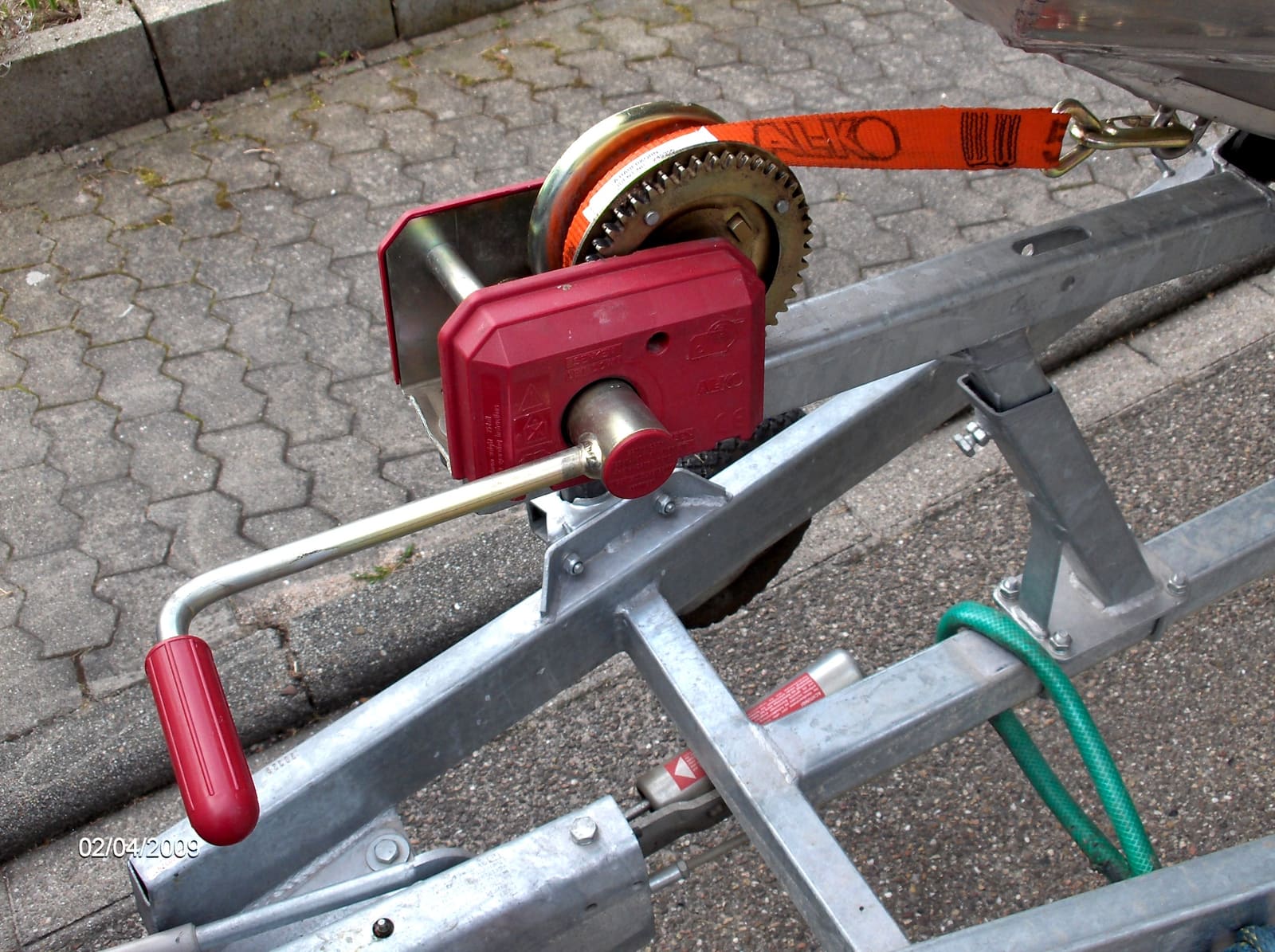
The winch strap and hook pull on the bow eye every launch and retrieve. Use a separate safety chain or tie-down for the road. Photo: Wualex / Wikimedia Commons · Public domain
Common mistakes
- Never looking at the nuts inside. The outside looks fine while the nut and washer rust away in the anchor locker.
- Towing on the winch strap alone. If the strap or eye fails, nothing stops the boat moving back.
- Cranking nuts down hard on a cored hull, crushing the core so the eye loosens again.
- No backing plate, just small washers on thin fiberglass.
- Using plated or zinc-alloy hardware in salt water, or mixing metals.
- Sealing with household silicone. It won't hold below the waterline and keeps later sealants from sticking.
- Hooking a ski rope or tube to a single eye that wasn't designed or backed for those loads.
When to call a pro
- Wet, soft or rotten core around the eye, or rot in the transom
- Cracks in the stem or transom laminate, not just the gelcoat
- You can't reach the inside nuts without cutting an access hole
- The eye leaks below the waterline and you can't stop it
- After the eye has pulled out or the boat has come off the trailer: have the hull inspected
Tips
- Add the bow eye and transom eyes to your pre-trip check every time you hitch up.
- Put a dab of marine grease or anti-seize on stainless threads to prevent galling when you tighten them.
- Take a photo of the inside nuts each spring so you can spot new rust or movement.
- Keep a spare safety chain or bow tie-down in the tow vehicle in case yours goes missing.
Official references
We read these to write this guide. Your engine's own manual always wins.
Safety: BoatMend is for information only and does not replace a certified marine technician. You are responsible for your safety and your boat. Read the full disclaimer.
Last updated 2026-10-25
Related guides
How to Inspect and Use the Trailer Winch, Strap, Tie-Downs and Safety Chains
Check the winch, strap or cable, bow safety chain, transom tie-downs and the safety chains to your vehicle, and learn how each one is meant to be used. These parts keep the boat on the trailer and the trailer behind your truck.
Get Your Boat Ready for the Road: Pre-Trailering Checklist
Most trailering trouble starts in the driveway: an engine left without support, a loose strap, a cover that balloons at 60 mph, gear that blows out or tongue weight that makes the rig sway. Work through this checklist before every trip and do a quick walkaround at each stop.
How to Adjust and Replace Trailer Bunks and Rollers So Your Boat Sits Right
Set up your boat trailer so the hull is supported in the right places: bunks and rollers clear of the strakes, the transom fully supported, the bow snug against the winch stop and the weight balanced on the tongue. Also covers replacing rotten bunk boards and worn carpet or rollers.
How to Mount Rod Holders, Fish Finders, Cleats and Antennas Without Causing Leaks
Add accessories to your boat the right way, with through-bolts, backing plates, sealed core and proper wire pass-throughs, so every new hole stays dry and strong. Also learn where you should never drill.
How to Find and Fix Leaking Deck Hardware (Rebedding Cleats, Stanchions and Tracks)
Track down the cleat, stanchion base or track that is dripping into the cabin, then remove it, seal the deck core and bed it again with the right sealant so the leak stops for years instead of weeks. Catching it early protects the deck core from rot.
How to Launch and Retrieve Your Boat Alone
A repeatable routine for putting a trailer boat in and taking it out by yourself: what to do in the staging area, how to rig one long line so you can control the boat from the dock, when power loading is off-limits, and the safety habits that keep you, your boat and the next boater out of trouble.