Boat Loan Add-Ons: GAP, Service Contracts and Credit Insurance, and How to Cancel Them
Understand the extras offered at the finance desk when you buy a boat (GAP coverage, extended service contracts and credit insurance), when one might make sense, what they really cost once financed, and how to decline, cancel or get a refund. General information, not financial or legal advice.
Time
1 h
Applies to
All engines
Before you start: This is general information, not financial or legal advice. The CFPB's consumer pages quoted here are written about auto loans; boat loans often work the same way, but your contract and your state's rules decide. Read every page of the loan and add-on contracts before signing, and ask a trusted financial advisor or attorney about anything you don't understand.
Owners often ask
- Do I need GAP insurance on a boat loan?
- Can I cancel the extended warranty the dealer added to my boat loan?
This guide walks you through it. Still stuck? Ask the AI Mechanic about your engine.
Tools
- The buyer's order and the full loan contract (ask for copies before signing)
- Your insurance quote for the boat
- Calculator or loan calculator
Before you start
When you finance a boat at a dealer or boat show, the paperwork often includes optional extras. The common ones:
- GAP coverage: pays the difference between what you still owe on the loan and what your boat insurance pays if the boat is stolen or totaled.
- Extended service contract (often called an "extended warranty"): pays for some repairs after the factory warranty ends.
- Credit insurance: makes loan payments, or pays off part of the loan, if you die, become disabled or lose your job.
They're sold at the moment you're most excited and least likely to read fine print, and their cost is usually added to the loan. Discover Boating notes that boat loans can run from 4 to 20 years and that extras like extended warranties can be rolled into the loan. A few hundred dollars financed for 15 or 20 years costs a lot more than the sticker price.
The three facts to remember from the CFPB:
- These products are generally optional. If someone says one is required, ask them to show you where the contract says so.
- You can cancel optional add-ons, and you may get a refund, including when you sell, refinance or pay off the loan early.
- If a lender ties approval to buying one, you can complain to the CFPB, your state attorney general, your state insurance commissioner or the FTC.
Steps
BoatUS recommends arranging financing and insurance before making an offer. A pre-approval from your own bank, credit union or a marine lender lets you compare the dealer's offer, and an insurance quote tells you what the boat will be insured for. Both make it easier to say no at the finance desk.
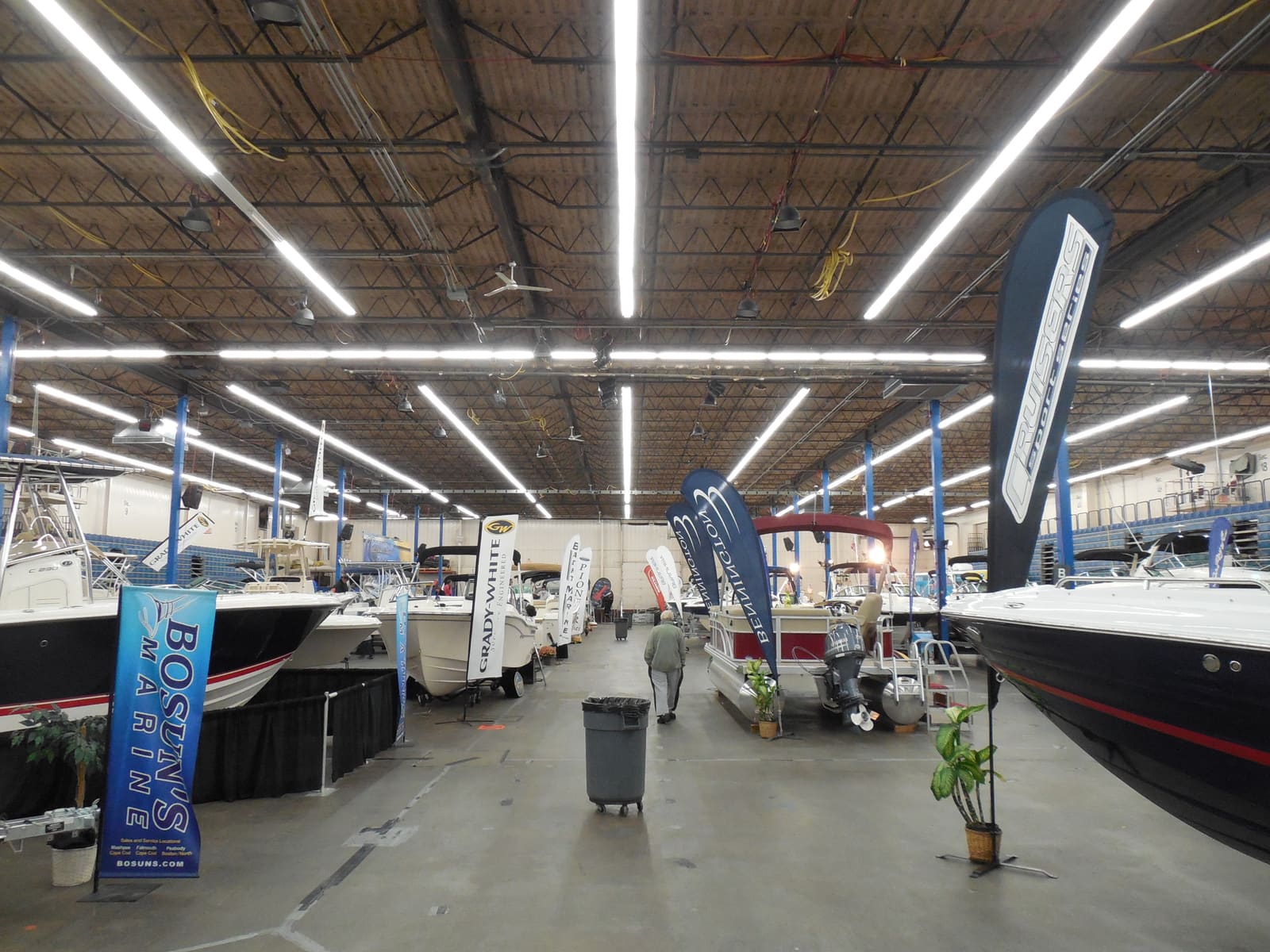
Boat shows make it easy to buy on the spot, so arrive with financing already lined up. Photo: John Phelan / Wikimedia Commons · CC BY 4.0 Before signing, ask for the full itemized list: boat, motor, trailer, options, fees, taxes, and each add-on with its own price. Ask directly, "Does this loan include charges for any optional products?" Take the papers home overnight if you can.
The CFPB says you generally can't be required to buy an extended warranty, GAP or credit insurance to get a loan. If you're told one is required:
- Ask to see the contract language.
- If it isn't written in the contract, decline it.
- If the lender really requires it, shop elsewhere. The CFPB also notes that a product the lender requires has to be counted in the finance charge and shown in the APR, which makes the loan's true cost easier to compare.
GAP matters only when you could owe more than the boat is worth. That's most likely when:
- You put little or nothing down (Discover Boating describes 10 to 20% down as typical, with some no-money-down deals).
- The loan term is long.
- You rolled taxes, fees or add-ons into the loan.
- Your insurance pays actual cash value (depreciated value), not an agreed value. BoatUS explains that agreed-value policies cost more but pay more, while actual-cash-value policies pay what the boat was worth at the time of the loss.
If you're putting a solid amount down and your policy is agreed value, GAP may add little. If you do want it, the CFPB notes that some insurers and lenders sell GAP too, so compare prices and coverage before buying it from the dealer. Ask whether it's available for boats, whether it covers your insurance deductible, and what it excludes; then read the exclusions in the contract itself.
Our extended service plans guide covers this in depth. From BoatUS:
- Most are really insurance contracts from third parties, not the manufacturer, and dealers may not step in if there's a problem.
- They often won't pay for consequential damage, engine removal or haul-out, and they usually have deductibles.
- On a new boat, a third-party contract may not start until the factory warranty ends, so a three-year contract on a one-year warranty may give you only two years.
- Dealers can mark them up a lot, and the price is negotiable.
- Many are transferable for a fee, and you may be able to cancel, often with a prorated refund minus a fee.
A factory-backed plan from the engine maker usually works more smoothly at the dealer. Either way, you don't have to buy it on the day you buy the boat; ask how long you have to sign up.
The CFPB describes four kinds: credit life (pays the loan if you die), credit disability (pays if illness or injury keeps you from working), involuntary unemployment (pays if you're laid off) and credit property (covers the boat if it's stolen or destroyed, which your boat policy may already do). It notes these products often have eligibility limits, the price can be negotiated, and adding them to the loan means you pay interest on them too. Compare with term life or disability coverage you may already have.
You may also be offered debt cancellation or debt suspension agreements, which look a lot like credit insurance. The CFPB explains the difference:
- Debt cancellation promises to wipe out the loan if you die, or cancel monthly payments if you're disabled, laid off or face another listed hardship.
- Debt suspension only postpones payments during a hardship; you still have to make them up later.
- Unlike credit insurance, these products aren't regulated by state insurance officials, they often have eligibility limits, and financing them adds interest.
The CFPB adds that ordinary life insurance may be cheaper and covers more than one loan. Ask the finance manager, "Is this insurance, or a debt cancellation agreement?" and get the answer on the contract.
For each one, multiply its price by the effect of financing it: put it into a loan calculator with your rate and term, and look at the total interest. Ask yourself: "Would I write a check for this today?" If not, decline.
- Ask for a lower price on any add-on you want; BoatUS notes service contract prices are negotiable.
- For anything you don't want, make sure it's removed from the contract and the payment is recalculated before you sign.
- Initial only the lines you agreed to.
File the GAP agreement, service contract and any credit insurance certificate with your loan papers. The CFPB notes that if you lose your paperwork you can ask the lender, provider or dealer, but it's far easier to keep your own copy. Write down the cancellation instructions and who to contact.
The CFPB says you can cancel optional add-ons during the loan, which can lower your costs. Typical steps:
- Read the cancellation section of the add-on contract.
- Send a written cancellation request to the provider or administrator (and the dealer, if it sold it), keeping proof of delivery.
- Ask how the refund will be calculated and whether it goes to you or toward the loan balance.
- Check your next loan statement to confirm.
BoatUS warns that some service contract companies calculate refunds with the "rule of 78s," a formula that returns less money than a simple prorated refund. Check the contract.
Many add-ons are paid up front for the whole loan. If the loan ends early, the CFPB says you may be entitled to a refund. Contact each provider when you sell the boat, refinance or make the final payment. A transferable service contract may instead go to the buyer, sometimes with a fee.
If you were told an add-on was required, signed for something you declined, or can't get a refund owed to you, file a complaint with the CFPB, your state attorney general, your state insurance commissioner (for products sold as insurance, such as credit insurance or GAP written as an insurance policy) or the FTC. Debt cancellation and suspension agreements aren't regulated by state insurance officials, so send those complaints to the CFPB or your attorney general.
Common mistakes
- Signing the stack of papers at the boat show without reading the itemized list.
- Believing "the bank requires it" without seeing it in writing.
- Buying GAP on a boat with a big down payment and an agreed-value policy.
- Buying a third-party service contract that overlaps the factory warranty.
- Forgetting to ask for refunds when selling the boat or paying off the loan.
- Financing add-ons for 15 or 20 years and paying interest on them the whole time.
When to call a pro
- You don't understand a contract term, or the dealer won't give you copies before signing.
- You think you were charged for products you declined: talk to a consumer attorney and file a complaint.
- You're financing a large boat: ask a fee-only financial advisor to review the whole deal.
- A claim under GAP or a service contract is denied and you think it's wrong: ask the provider for the reason in writing and contact your state insurance department.
Tips
- Say "I'll decide about extras after I read the contracts at home." A good deal will still be there tomorrow.
- Ask your boat insurer about agreed-value coverage and whether it offers gap-style coverage before you get to the finance desk.
- Put cancellation contacts and refund dates in your BoatMend boat file next to the loan papers.
- When you sell, mention a transferable service contract in the listing; it can help the price.
Official references
We read these to write this guide. Your engine's own manual always wins.
- CFPB – What is guaranteed asset protection (GAP) insurance?
- CFPB – Am I required to purchase an extended warranty or GAP insurance from a lender or dealer to get an auto loan?
- CFPB – What is credit insurance for an auto loan?
- CFPB – What are debt cancellation or debt suspension products offered with my auto loan?
- BoatUS – Extended Service Contracts (2019)
- BoatUS Magazine – Boat Insurance and Financing (2025)
- Discover Boating – Boat Loan Basics (loan terms, down payments, rolling extras into the loan)
Safety: BoatMend is for information only and does not replace a certified marine technician. You are responsible for your safety and your boat. Read the full disclaimer.
Last updated 2026-10-26
Related guides

Financing a Boat: Loan Terms, Survey and Insurance Requirements, Liens and the True Cost of Ownership
Understand a boat loan before you sign: typical terms and down payments, what lenders check, why they want a survey and insurance, how the lien is recorded (Coast Guard preferred mortgage for documented boats, state title for the rest), how the payoff works when you sell, and how to add up the real yearly cost beyond the monthly payment. Practical guidance, not financial advice.
Extended Warranties and Service Plans for Boat Engines: Factory Plans vs Third-Party Contracts
Decide whether an extended service plan is worth it: how factory plans such as Mercury Product Protection and Yamaha Y.E.S. differ from third-party contracts, what they usually cover and exclude, why maintenance records decide claims, how deductibles, transfers and cancellations work, and the questions to ask before you sign. Practical guidance, not legal or financial advice.

Boat Insurance Policy Basics: Agreed Value vs Actual Cash Value, Navigation Limits, Storm Deductibles and Exclusions
Learn to read a boat insurance policy before you need it: agreed value versus actual cash value, navigation limits and lay-up periods, named storm deductibles, towing, salvage and wreck removal, liability limits, and the exclusions that cause most claim surprises. General information, not legal or insurance advice.
The Real Cost of Owning a Boat: Building a Yearly Budget and Cutting Costs with DIY
Add up what a boat really costs each year (storage, insurance, fuel, maintenance, winterizing, registration, depreciation and the surprise repair), check it against the common rules of thumb, and find the places where do-it-yourself work and smarter choices save real money. Practical planning help, not financial advice.

Used Boat Purchase Agreement and Closing: Deposit, Contingencies, Bill of Sale and Who Pays What
A plain-English walk-through of buying a used boat on paper: getting ready before you offer, what the purchase and sale agreement should say, how the deposit is held and when it comes back, survey, sea trial, financing and insurance contingencies, paying off the seller's loan, the bill of sale, closing and transferring the paperwork, and the costs each side usually covers. Practical help, not legal advice; rules vary by state.
How to Prepare Your Boat for an Insurance or Condition Survey
Get ready for a marine survey your insurer or lender asked for: what a SAMS or NAMS surveyor looks at, the common findings you can fix beforehand (hose clamps, seacocks, bilge, fire extinguishers, wiring), the paperwork to have ready, and how to handle the recommendations afterward.

How to Get Your Boat Ready to Sell (Records, Title and Prep)
Prepare your boat for sale the way buyers and surveyors expect: gather the title, registration and HIN paperwork, organize your maintenance records and receipts, fix the small stuff, detail the boat, get it ready for a sea trial and buyer's survey, and close the deal with the right documents.
Boat Taxes by State: Sales and Use Tax, Yearly Property or Excise Tax, Visiting Limits and Moving
Understand the taxes a boat can trigger in the US (sales or use tax when you buy, a yearly property or excise tax where you keep it, and deadlines when you visit or move to another state) so you can budget for them and avoid penalties. General information, not legal or tax advice.