Taking Your Boat to Another State: Registration Reciprocity, Visitor Time Limits and Nonresident Permits
Your home-state registration lets you boat in other states, but only for a while, and some states add their own visitor permits, use-tax permits and invasive species stickers. Learn how federal reciprocity works, real examples from Texas, Florida, Washington and Oregon, and a checklist for a vacation trip or a season away. General information, not legal advice.
Time
45 min
Applies to
All engines
Before you start: This is general information to help you ask the right questions, not legal or tax advice. Each state sets its own visitor rules and changes them; the examples below were checked on official pages in November 2026. Confirm with the destination state's boating agency (and its revenue office for long stays) before you go. Our boat taxes guide covers buying and moving; our inspection station guide covers the invasive species checks. This guide covers what's in between: visiting.
Owners often ask
- How long can I keep my out-of-state registered boat in Florida or Texas before I have to register it there?
- I am trailering to Oregon for a week. Do I need a special permit for my boat?
- My boat is in Massachusetts for the summer but registered in another state. How long can it stay?
This guide walks you through it. Still stuck? Ask the AI Mechanic about your engine.
Tools
- Current registration card (or USCG Certificate of Documentation) in your name
- Boater education card, if your home state or the destination requires one
- Phone or computer to check the destination state's boating agency site
Parts & supplies
- Any visitor permit, tax permit or invasive species sticker the destination requires
Before you start
Three kinds of visit, three sets of questions:
- A trip (a weekend or a week's vacation): usually your home registration is enough, but you may need an invasive species sticker, a boater education card the state accepts, and a fishing license.
- A season (a winter in Florida, a summer on a lake up north): watch the destination's visitor time limit and any use-tax rules.
- A move (the boat will be used there most of the year): that's a new "state of principal operation," and you'll need to register there (see our boat taxes guide).
Steps
Federal law, repeated in 33 CFR 173.17, says two things:
- A boat numbered in one state is treated as complying with the numbering system of a state where it's temporarily operated.
- When a boat moves to a new state of principal operation, that state must recognize the old number for 60 days.
The rules define the state of principal operation as the state whose waters the boat is (or will be) used in most during a calendar year (33 CFR 173.3). So a two-week trip is "temporary." A boat that spends most of the year in another state has moved, even if you still live at home.
Federal law doesn't say how long "temporary" is. States fill that gap with their own limits, and those limits vary.
Every visitor rule starts with a valid home registration. Check the expiration date before you leave and renew early; an expired registration means you're not "visiting," you're unregistered. Texas, for example, allows visits only if the boat is registered or titled in your name in another state. If you're borrowing a friend's boat for a trip, ask the destination state how that's handled.
Documented boats: some states still expect a state registration or decal on documented boats, and some visitor rules (Washington's, for example) accept current Coast Guard documentation instead. Check before you go.
Real examples (as of November 2026):
- Texas: you may operate a boat registered in your name in another state for up to 90 consecutive days with current out-of-state registration (Texas Parks and Wildlife). Staying longer means transferring registration and title to Texas.
- Florida: if your boat has a current out-of-state (or Coast Guard) number, you must record that number with the Florida Department of Highway Safety and Motor Vehicles before operating, using or storing the boat on Florida waters beyond the 90-day reciprocity period (Florida Statutes 328.58). If you keep the home registration valid, Florida doesn't issue a new number. Note the word "storing": a boat sitting in a Florida marina counts.
- Washington: personal boats with another state's registration or current Coast Guard documentation can stay up to 60 days without a permit. Longer than that, the owner applies for a nonresident vessel permit on or before the 60th day (the 61st day for some larger vessels), after approval from the state Department of Revenue. Washington says the permit can be renewed only once, for another 60 days.
- Ohio and Massachusetts (60 days): Ohio's DNR says a nonresident whose boat is legally registered in its state of primary use may use Ohio waters for up to 60 days without an Ohio registration, must carry the home registration aboard, and must follow Ohio's boating laws. If your home state doesn't require registration for your type of boat (some don't for kayaks or canoes), Ohio says to carry proof of residency. Massachusetts allows visiting boats registered elsewhere up to 60 consecutive days without a Massachusetts registration and title.
Count days from when the boat first arrives, and keep proof of that date (a marina receipt, a launch receipt, a fuel receipt).
Some states treat a boat used within their borders as subject to use tax unless you buy a temporary permit. Texas is the clearest example: Texas Parks and Wildlife says use tax is due on arrival, and in place of paying it you can get a temporary use tax permit. As of November 2026 it costs $150 per boat and $150 per outboard motor, lasts 90 days, and can't be renewed; only two can be issued for the same boat or motor in a calendar year, with at least 30 days between them. The Texas Comptroller gives the example of a visitor bringing a boat with two outboards to a fishing tournament: three permits, $450. Ask the Comptroller whether tax you already paid in your home state is credited.
Washington's revenue rule (WAC 458-20-238) works differently: use tax doesn't apply for the first 60 days of temporary use by a nonresident individual, the nonresident vessel permit lets that use continue without use tax, and the total may not exceed six months in any 12-month period. Boats owned by companies, LLCs or trusts have stricter rules there. For any long stay, ask the destination's revenue department.
Many western states charge visiting boats an aquatic invasive species (AIS) fee:
- Oregon: out-of-state motorized boats (and out-of-state sailboats over 12 feet, per the Marine Board's fee page) need an Out-of-State Aquatic Invasive Species Prevention Permit, $30, valid one year, as of November 2026 (vendor and portal fees can add a little). They must also stop at Oregon's mandatory inspection stations. Paddlecraft need a separate Waterway Access Permit.
- Idaho, Utah and Colorado have their own stickers, stamps or courses; our inspection station guide lists them.
Buy online before the trip, put the decal where the state says, and keep the receipt with your registration.
Visiting boats are exactly what inspection stations look for. Arrive with the plug out, the boat clean and dry, and ballast tanks and livewells drained. A boat coming from a lake with zebra or quagga mussels may need decontamination before launch, which can take time. Our inspection station and clean, drain and dry guides cover what to expect.
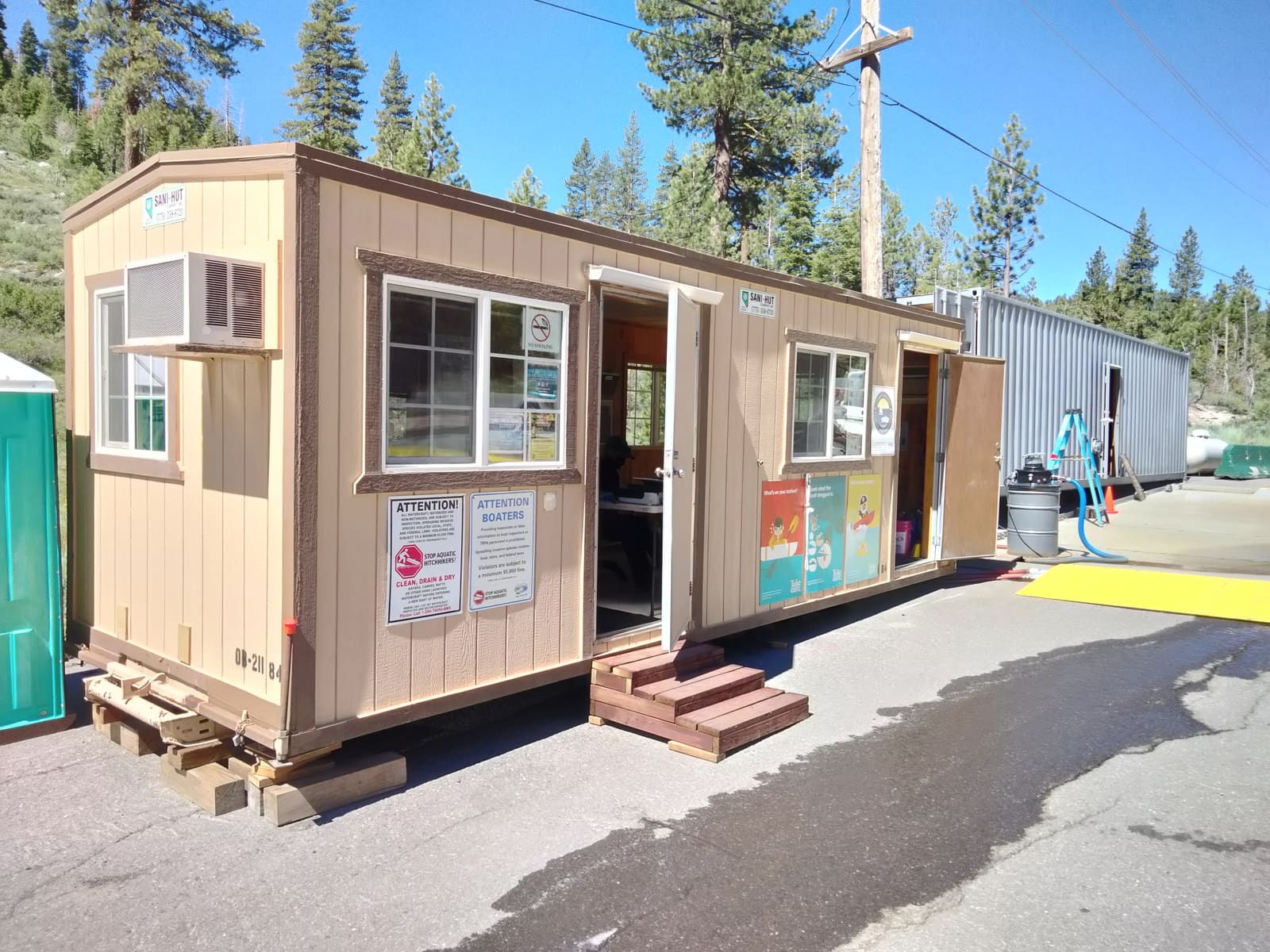
A temporary watercraft inspection station near Lake Tahoe. Out-of-state boats are exactly what these stations are set up to check, so arrive clean, drained and dry. Photo: USFWS Pacific Southwest Region / Wikimedia Commons · Public domain Most states accept a NASBLA-approved boater education card from another state, but age rules, horsepower thresholds and PWC rules differ. A few states require a course for every operator. Check the destination's rule for every person who'll drive the boat, including teenagers and guests. Our boater education card guide explains how reciprocity works.
A fishing license is separate from boat registration: each state sells its own, and nonresident licenses are usually sold online. Many lakes also have their own rules: horsepower or two-stroke limits, no-wake zones, launch fees or park passes. Our lake engine restrictions guide has examples.
Make sure your policy covers the waters you're heading to (navigation limits can be written by region) and that your towing membership works there. A season on the coast after years on a lake can also change what your insurer wants to know. See our insurance policy basics guide.
- Track the days. Visitor limits and tax rules often start counting the day the boat arrives.
- Before the limit, decide: leave, buy the next permit, or register there.
- If the destination becomes the state where the boat is used most of the year, it's a move: register within the deadline, ask about use tax, and tell your old county the boat has left (our boat taxes guide walks through it).
- Moving yourself, not just the boat? Ask about a new-resident rate. The Texas Comptroller, for example, says a new Texas resident who brings a boat or motor into the state can pay a $15 new resident tax instead of the 6.25% use tax, paid when titling and registering with TPWD or a participating county office (as of November 2026).
Keep together, on the boat or in the tow vehicle: the registration card, proof of the date you arrived, visitor or tax permits, AIS receipts and inspection seals, boater education cards, fishing licenses and insurance cards. Save photos in your BoatMend boat profile.
Common mistakes
- Assuming "60 days" (the federal number) is every state's visitor limit. It's the minimum recognition when a boat moves; states set their own visitor periods.
- Forgetting that storing the boat in a marina counts as being in the state (Florida's rule says so plainly).
- Taking a boat with two outboards to Texas and buying one temporary permit instead of three.
- Trailering west without the destination's AIS sticker, then being turned away at the ramp.
- Letting the home registration lapse while away for the season.
- Lending the boat to a friend for an out-of-state trip without checking how the state treats a boat not registered in the operator's name.
When to call a pro
- You'll keep the boat in another state for months, or rotate between two states every year: ask both states' revenue offices, and consider a tax professional
- The boat is owned by an LLC or trust, or it's documented: ask the destination how visitor rules apply (Washington, for example, has separate rules for entity-owned boats)
- You got a notice saying you owe use tax or registration in another state: ask the agency how to respond, and consider a tax professional or attorney
- You plan to charter or rent the boat while you're there: that's commercial use with its own licensing (see our passengers-for-hire guide)
Tips
- Search "[state] out-of-state boat" on the state boating agency's own site; ignore third-party summaries.
- Set phone reminders for day 30, day 60 and day 80 of a long stay.
- Buy AIS permits and fishing licenses online the week before; ramps in remote areas often have no signal.
- Keep a copy of the visitor rules page as it read on the day you checked.
Official references
We read these to write this guide. Your engine's own manual always wins.
- eCFR – 33 CFR 173.17, Reciprocity
- eCFR – 33 CFR 173.3, Definitions (state of principal operation)
- Texas Parks and Wildlife – Boat Registration and Titles FAQ (out-of-state boats, temporary use tax permit)
- Texas Comptroller – Boat and Boat Motor Sales and Use Tax (temporary use permit)
- The 2026 Florida Statutes – 328.58, Reciprocity of nonresident or alien vessels
- Washington State Department of Licensing – Visiting Washington waters (nonresident vessel permit)
- Washington Administrative Code – WAC 458-20-238, Sales of watercraft to nonresidents and use of watercraft by nonresidents
- Oregon State Marine Board – Agency Fees (out-of-state aquatic invasive species permit)
- Ohio DNR – Frequently Asked Boat Registration Questions (visiting boats, 60 days)
- Mass.gov – Boat Registration FAQs (visiting boats, 60 consecutive days)
- Oregon State Marine Board – Waterway Access Permit FAQs (who needs which permit)
Safety: BoatMend is for information only and does not replace a certified marine technician. You are responsible for your safety and your boat. Read the full disclaimer.
Last updated 2026-11-06
Related guides
Boat Taxes by State: Sales and Use Tax, Yearly Property or Excise Tax, Visiting Limits and Moving
Understand the taxes a boat can trigger in the US (sales or use tax when you buy, a yearly property or excise tax where you keep it, and deadlines when you visit or move to another state) so you can budget for them and avoid penalties. General information, not legal or tax advice.
How to Get Through Aquatic Invasive Species Boat Inspection Stations
Many states, especially in the West, make you stop at an inspection station before you launch or when you cross the state line, to keep zebra and quagga mussels out. Learn what inspectors check, when they decontaminate, what decals, courses and seals you may need, and how to arrive clean, drained and dry so you're through fast.
Boat Registration Numbers and Validation Decals: Federal Display Rules, State Placement and Renewals
Display your state registration number and validation decal the way federal rules (33 CFR 173 and 174) and your state require: size, block style, contrast, spacing, placement on the forward half, decal position, what documented boats show instead (name and hailing port), what to carry aboard, and how to never miss a renewal. States add their own details, so check your state boating agency.
Boater Education Cards: Who Needs One, How to Get It and When It Works in Other States
Most states require some boat operators to complete an approved boating safety course and carry proof. Learn how to find your state's rule (age, horsepower, boat type), pick a NASBLA-approved course, get the card, use it when you visit other states, and what rental and other exemptions usually look like. Practical guidance, not legal advice.

Clean, Drain, Dry: Stopping Zebra and Quagga Mussels and Other Invasive Species
What Clean, Drain, Dry means in practice for your boat, trailer and motor, what to drain before you leave the ramp, what happens at a watercraft inspection or decontamination station, and examples of state rules you may run into when you trailer between lakes.
Buying a Boat in Another State: Survey, Paperwork, Taxes, Registration and Getting It Home
A step-by-step plan for buying a boat that is hundreds of miles away: checking it remotely with a local surveyor, matching the HIN and VIN to the title, avoiding long-distance scams, paying the right sales or use tax, registering in your home state, the trailer's own paperwork, temporary permits, and legal towing or professional transport for wide boats. Rules vary by state, so confirm each step with the agencies involved.
Get Your Boat Ready for the Road: Pre-Trailering Checklist
Most trailering trouble starts in the driveway: an engine left without support, a loose strap, a cover that balloons at 60 mph, gear that blows out or tongue weight that makes the rig sway. Work through this checklist before every trip and do a quick walkaround at each stop.
Lake Engine Restrictions: Two-Stroke Bans, Horsepower Limits, Electric-Only and No-Wake Lakes
Some lakes ban older two-stroke outboards, cap horsepower, allow only electric motors, or make the whole lake no-wake. Learn the common types of rules (with dated real examples like Lake Tahoe and Ohio's lake list), how to tell what kind of engine you have, and how to check before you tow the boat three hours to a ramp you can't use.
Boat Insurance Policy Basics: Agreed Value vs Actual Cash Value, Navigation Limits, Storm Deductibles and Exclusions
Learn to read a boat insurance policy before you need it: agreed value versus actual cash value, navigation limits and lay-up periods, named storm deductibles, towing, salvage and wreck removal, liability limits, and the exclusions that cause most claim surprises. General information, not legal or insurance advice.
Boating on High-Altitude Lakes: Power Loss, Prop Changes, Cold Water and Mountain Weather
Engines lose roughly 3% of their power for every 1,000 feet of elevation, so a boat that flew at sea level can struggle on a mountain lake. Learn what's normal, when a lower-pitch prop or a dealer adjustment helps, and how to handle the strong sun, cold water and fast-changing weather up high.