Roller Furler Care: Inspection, Drum and Swivel Service, and Halyard Wrap
Keep your headsail roller furler turning easily with a yearly unroll-and-inspect, fresh-water rinses of the drum and swivel, a correct halyard angle and a clean furling line lead. A neglected furler can jam with the sail half out, and a halyard wrap can damage the forestay.

Time
3 h
Shop would charge
$250-900
Applies to
All engines · Sailboat
Safety first: Work on the furler only at the dock or on a mooring in light wind: a partly unrolled sail can flog hard enough to injure people and tear itself apart. Never climb the mast or go aloft in a bosun's chair without proper gear and an experienced helper; hire a rigger for work at the top of the mast. If the furler jams under way and you can't furl or lower the sail in rising wind, reduce speed, keep the crew clear of flogging sheets and call TowBoatUS, Sea Tow or the Coast Guard on VHF 16 if the boat is in danger.
Owners often ask
- My roller furler is hard to turn and I need a winch to roll up the jib. What is wrong?
- How do I stop the halyard from wrapping around the furler foil?
This guide walks you through it. Still stuck? Ask the AI Mechanic about your engine.
Tools
- Garden hose with a gentle spray nozzle and a bucket
- Mild soap or boat wash
- Soft brush and clean rags
- Binoculars (to check the top swivel from deck)
- Screwdrivers and wrenches that fit your furler's drum and line guide
- Small mirror and flashlight
- Masking tape and a marker (to mark positions before you take anything apart)
- A helper for unrolling, lowering and folding the sail
Parts & supplies
- Lubricant or grease your furler maker specifies, only if the manual calls for one
- Replacement furling line of the size and length in your manual
- Spare drum or swivel parts (bearings, line guide, screws) for your model, if worn
- Sail ties and a sail bag for winter storage
Before you start
How it works: a roller furler is an aluminum foil (a long tube with a sail groove) that turns around the forestay. A drum at the bottom holds the furling line, and a halyard swivel (top swivel) rides up the foil with the head of the sail. Pull the furling line and the foil turns, rolling the sail up. Both the drum and the swivel turn on bearings that salt and grit slowly choke.
Know your brand: Harken, Profurl (now part of Wichard), Seldén Furlex, Schaefer, Facnor and others all work the same way but differ in the details. Some makers say their bearings need nothing but a fresh-water rinse and no lubricant at all; others call for a specific grease at certain points. Find the manual for your exact model (Harken and Seldén have manuals and drawings on their support pages; Seldén's support site lists Furlex manuals by type and production years, so note the model stamped on your drum; Profurl's technical support page also keeps documents and spare-part lists for older ranges such as Classic, Basic and Elite) and follow it over anything here. If you can't identify the model, the brand's support line or a rigger can usually tell from photos of the drum.
Best timing: do the full inspection once a year, ideally when you bend on or take off the sail for the season. Give it a quick check every time you sail.
Which jobs are owner jobs: rinsing, inspecting from deck, the furling line and its lead blocks, and removing or bending on the sail. Taking the foil off the forestay, replacing bearings in a sealed drum, cutting the foil to length or anything at the masthead is usually rigger work.
Steps
On a calm day, unroll and roll the sail a few times. With the sheets eased, you should be able to furl a boat under about 40 feet hand over hand. Practical Sailor's rule is simple: if you need a winch to furl on a light-air day, something is wrong. Note whether it is stiff all the way, only near the end, or only under halyard tension. That clue tells you where to look.
Sight up the foil from the drum. It should be straight, with no twist or "barber pole" look. A twisted foil usually means someone forced the furling line while the top swivel was stuck. Look for loose or missing screws where foil sections join: on many furlers the connectors can back out over time. Any twist, a dented foil section or joints sticking out are a call to a rigger.
Check the UV cover (the colored strip along the leech and foot) for rotten stitching and tears, the luff tape for chafe where it enters the foil, and the head and tack rings for wear. A furling sail lives outside all season, so the sun cover goes first. Small repairs are cheap at a sail loft; a torn cover left alone leads to a ruined sail. Harken notes the other option some sailors use: a long sock-style cover hoisted over the furled sail, which needs a spare halyard. Ask your sailmaker which suits your boat.
With the sail fully hoisted, look up with binoculars. The halyard must not run parallel to the foil. It should leave the top swivel at an angle back toward the mast, so it pulls slightly aft. Good Old Boat suggests an angle of roughly 5 to 10 degrees; your manual has the exact figure for your model. The top swivel should sit near the top of the foil, just short of the end stop. If there is a long gap between the swivel and the top of the foil, or the halyard lies along the stay, you are set up for a halyard wrap (see "Halyard wrap" below).
Spray fresh water into the drum's bearing area and the line guide while a helper slowly furls and unfurls the sail, so the water works through the bearings. Many makers recommend this rinse often in salt water, with a little mild soap now and then, then rinse until no suds remain. Most top swivels have openings you can rinse at deck level by lowering the sail first (Step 9) and pulling the swivel down with the halyard.
Some drums and swivels use bearings that should stay dry; oil or general-purpose grease attracts grit and makes them worse. Others need a specific grease at set intervals. Use only what your manual lists, in the amount it lists, and wipe off the excess. If you have no manual and can't identify the model, rinse only and ask a rigger.
Look for cracked or worn plastic parts, a line guide that is grooved or loose, missing screws, and corrosion where stainless meets aluminum (white powder or bubbling paint). Check that the drum and the bottom of the forestay are toggled so they can move both fore and aft and side to side. Good Old Boat warns that a furler that can't move both ways stresses the end fittings and can cost you the mast. Look closely at the forestay wire just above its bottom fitting for broken strands; a broken strand means replace the stay (rigger job). Age matters too: Harken advises that when a new furler goes on, a headstay that has lived in salt water for more than about three years (about five in fresh water) should be replaced at the same time, since the foil hides the wire afterward.
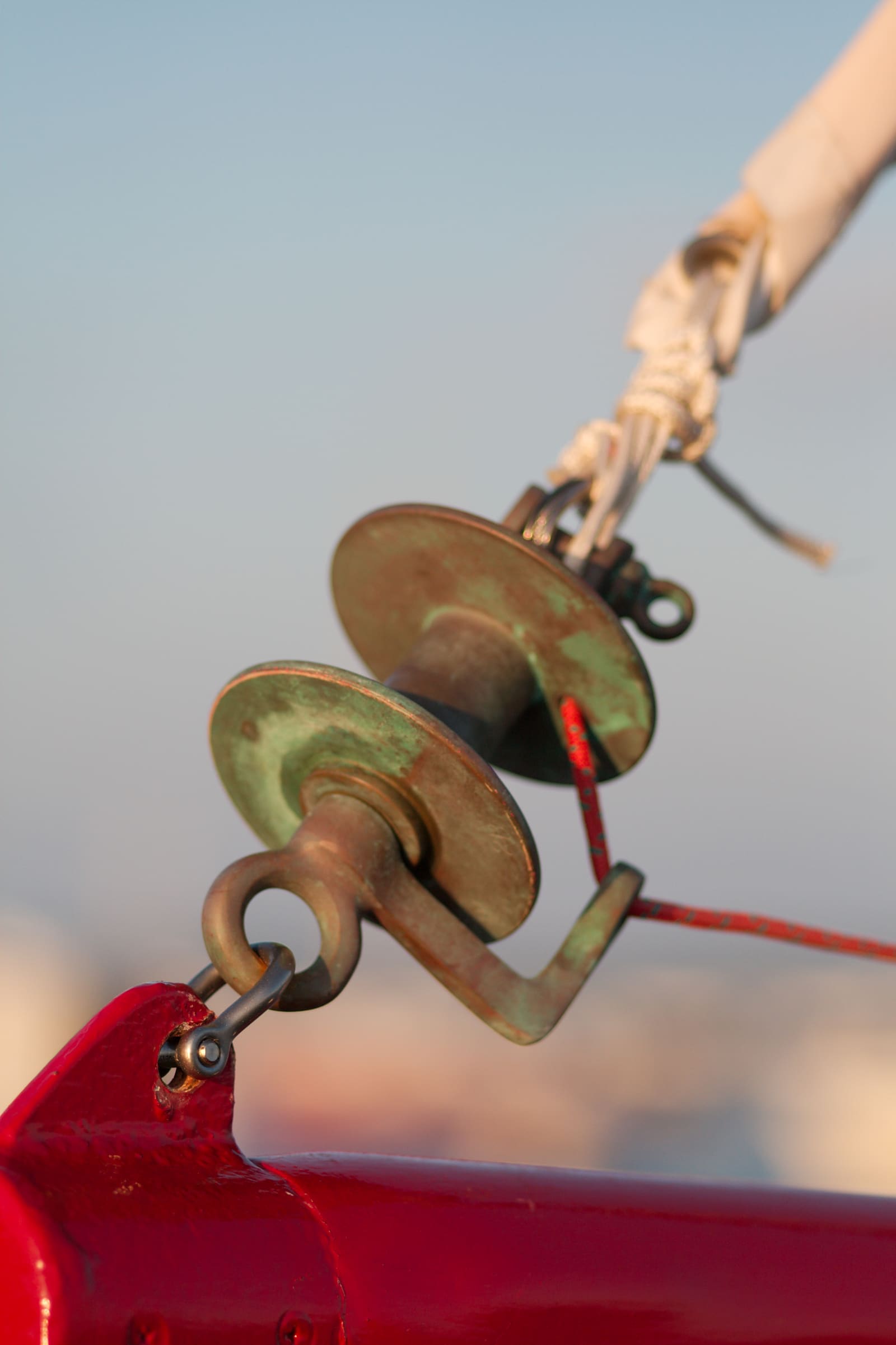
Photo: Pierre (PARIS) / Wikimedia Commons · CC BY-SA 2.0 Check the furling line along its whole length for chafe, a stiff salt-crusted section and a worn sheath. Replace it if it is fuzzy or has a flat spot. Check the lead:
- The line should come onto the drum at about 90 degrees to the foil, so it winds on evenly instead of piling up at one end (Good Old Boat's advice). A fairlead block placed too far forward is a common cause of jams.
- Every turn on the way to the cockpit adds friction. Keep the run as straight as possible and rinse the fairlead blocks; Practical Sailor notes most use plastic bearings that need a regular wash.
- With the sail fully furled, there should still be a few wraps of line left on the drum. If not, the line is too short or was loaded wrong.
- If the line keeps overriding (crossing over itself) on the drum, a little drag on the line as the sail unrolls helps it wind back on neatly. Harken's lead block kit includes a ratchet block for exactly this reason: it keeps tension on the furling line so it doesn't override, and gives you more grip when furling in a breeze.
On a calm day, unroll the sail fully, ease the halyard and lower the sail while a helper feeds the luff tape out of the foil and keeps it from blowing over the side. Don't let the sheets or the luff tape snag. Fold or roll the sail on the dock or a clean lawn and take it home or to a sail loft.
Rinse the sail with fresh water, let it dry completely and store it in a bag somewhere dry and away from rodents (see our sail care guide). Rinse the drum and swivel one more time. Many owners take the sail off for winter because a furled sail can unroll in a storm. If you leave the sail on, wrap the sheets around the furled sail several times and lock the furling line securely; Good Old Boat suggests leaving enough line on the drum to do this. If the mast comes down for winter, your rigger or yard should support the foil along its length: a bent foil is expensive.
In spring, feed the luff into the foil, hoist to the same mark as before, tension the halyard as your manual says and check the halyard angle again (Step 4). Furl and unfurl a few times at the dock. It should turn smoothly with an even wrap of line on the drum. Log the date, what you rinsed or replaced and the furling line age in BoatMend.
Halyard wrap: what it is and how to avoid it
A halyard wrap happens when a slack halyard winds around the foil above the top swivel as you furl. The sail then won't furl, won't unfurl and won't come down. If someone keeps cranking on the furling line, Practical Sailor warns, the forestay itself can be damaged, which can bring down the mast.
The usual causes are a halyard that runs too close to parallel with the stay, a long gap between the top swivel and the top of the foil, too little halyard tension, and a stiff top swivel. The usual fixes:
- A halyard restrainer (a small fairlead on the mast below the sheave) to create the angle. Practical Sailor notes these are stainless and must be isolated from the aluminum mast with the supplied pads and insulating compound. This is often a rigger job.
- A pendant (a short wire or strong line) at the head or tack of the sail so the swivel sits near the top of the foil.
- Keeping the halyard tensioned and cleated whenever the furler turns.
Harken also sells a halyard deflector that keeps other halyards from wrapping around the foil, worth a look if a spinnaker or spare halyard lives near the stay.
If it happens: stop pulling. In calm conditions, try easing the halyard a little and turning the furled sail by hand the opposite way. If it won't clear, it may need a trip aloft by someone qualified. Don't force it with a winch.
Electric furlers
Electric units (Harken, Seldén Furlex Electric and others) replace the drum and line with a motor and gearbox. The motor and gears are sealed and need no owner service, but the halyard and tack swivels still want the same detergent and fresh-water rinse. Three habits matter:
- Ease the sheet before you furl. Seldén's units have a current limiter that cuts power if you try to furl against a loaded sheet; the fix is to release the sheet, not to hold the button.
- Learn the manual backup at the dock. Both makers include a way to furl by hand (a crank or line driver; Harken also allows a cordless drill in the drive socket). Harken's safety note: switch off the furler's power first so the motor can't start while you're cranking.
- Power runs through a breaker near the bow, often shared with windlass wiring. If it stops working, check that breaker and the control switches before suspecting the motor, and treat any heavy-cable work as you would windlass wiring.
Common mistakes
- Putting the furling line on a winch and cranking when it gets hard. Many furler makers advise against it; find the cause instead.
- Spraying household oil or general grease into the drum. On many furlers it gums up the bearings.
- Furling with the halyard loose or uncleated. That is the classic setup for a wrap.
- Leaving the sail on all winter with only the furling line holding it. High winds can unroll a sail on an unattended boat and shred it.
- A furling line fairlead too far forward, so the line piles up at one end of the drum and jams.
- Not checking the halyard angle after a new sail, a new halyard or a mast re-step.
When to call a pro
- A twisted, bent or dented foil, or foil joints that have backed out
- Broken strands in the forestay or damaged end fittings
- A top swivel or drum that stays stiff after rinsing, or bearings you'd have to unseal
- A halyard wrap you can't clear from deck, or anything that needs someone aloft
- Installing a halyard restrainer, cutting a foil, or removing the foil from the stay
- A furler that has been rotated under heavy load and now feels gritty or clicks
Tips
- Mark the halyard at the right hoist height with a whipping or marker so you hoist to the same spot every time.
- Keep a little tension on the furling line while unrolling and on the sheets while furling, so the line winds on tight and even.
- In strong wind, bear away so the main shadows the headsail; it furls much more easily.
- After reefing the headsail, move the genoa lead car forward so the sheet keeps pulling toward the middle of the luff (Harken's tip); the reefed sail sets flatter and the boat heels less.
- Keep a spare furling line aboard if you cruise; they wear out faster than people think.
- Take a phone photo of the drum and line lead when everything works well, so you can compare later.
Official references
We read these to write this guide. Your engine's own manual always wins.
- Practical Sailor – Improving Roller Furling Efficiency
- Good Old Boat – Respecting the Furler
- Harken – Manuals (manuals and drawings for Harken furlers)
- Harken – MKIV Furling System Q&A
- Harken – MKIV Ocean Furling System Q&A
- Harken – Electric Furling Q&A
- Profurl – Technical Support (manuals and spare-part lists, including older ranges)
- Seldén Mast – Furlex systems
- Seldén Mast – Assembly and operation manuals (Furlex by type and year)
Safety: BoatMend is for information only and does not replace a certified marine technician. You are responsible for your safety and your boat. Read the full disclaimer.
Last updated 2026-10-24
Related guides

How to Inspect Your Sailboat's Standing Rigging
A step-by-step owner's inspection of the wires, fittings, turnbuckles, pins, chainplates and mast that hold your rig up, plus how to decide when it is time for a rigger and new rigging. Includes what insurers commonly expect for older rigs.

Sail Care and Winter Storage: Rinse, Dry, Inspect, Fold and Store
Keep your sails out of the sun, rinse and dry them before they go away, catch small tears and rotten stitching early, and fold and store them so they come back in spring without mildew or hard creases. Good habits can add years to an expensive set of sails.
Running Rigging Care: Inspecting Halyards, Sheets and Dyneema Lines
Check your halyards, sheets and control lines for chafe, sun damage, glazing and cover slip, wash them the right way, end-for-end them to spread the wear, and know when a line has to go. A halyard that parts drops a sail; a sheet that parts in a gust can be worse.

Stepping and Unstepping a Sailboat Mast: Trailer Sailers and Yard Cranes
How to raise and lower a sailboat mast safely, whether you step a trailer sailer's mast at the ramp or help the yard crane do it, including power-line checks, mast wiring, basic tuning afterward, and when to leave the job to the yard.
How to Service Sailboat Winches (Clean, Oil the Pawls, Grease the Gears)
Take your sheet and halyard winches apart, clean out old grease and salt, oil the pawls, lightly grease the gears and bearings, and put them back together. A serviced winch turns easily and, more importantly, its pawls catch every time so the drum can't spin backward under load.

How to Prepare Your Boat for a Hurricane or Tropical Storm
Make a written storm plan before the season, then haul out or secure the boat with doubled lines and chafe gear, strip off everything that catches wind, and check it safely after the storm. Never ride out a hurricane aboard.