Small Portable Outboard Care (2.5 to 20 hp Kickers and Dinghy Motors)
Keep your dinghy motor or kicker starting on the first few pulls. Use fresh fuel, flush it, run the carburetor dry before you put it away, carry and lay it down on the correct side so oil doesn't flood the cylinders, and check the shear pin or prop, gear oil and engine oil on schedule.
Time
1 h
Shop would charge
$150-350
Applies to
Outboard
Safety first: Never run an outboard without water at the intake, and only run it outdoors (exhaust contains carbon monoxide). Remove the propeller before running on flush muffs or in a test tank, in case it gets knocked into gear. If you smell gas in your car, garage or boat, or see fuel dripping from the engine or tank, stop, ventilate, keep sparks and flames away, and fix the leak before you go anywhere.
Owners often ask
- Which side can I lay my small four-stroke outboard on in the car?
- Should I run my dinghy motor's carburetor dry before storing it?
This guide walks you through it. Still stuck? Ask the AI Mechanic about your engine.
Tools
- Owner's manual for your exact model (download from the maker's site if lost)
- Large bucket or test tank deep enough to cover the water intake, or external flush muffs (a built-in flush port is for flushing with the engine off unless your manual says otherwise)
- Garden hose
- Pliers, a socket set and a flat screwdriver
- Spark plug socket
- Old towels or a blanket for transport
- Drain pan and rags
Parts & supplies
- Fresh gasoline (ethanol-free if you can get it) and the fuel stabilizer your engine maker approves
- 2-stroke oil for premix (2-stroke engines only), mixed at the ratio in your manual
- Engine oil and filter if fitted (4-stroke engines), as specified in your manual
- Gear oil and new drain-screw washers
- Spare shear pin and cotter pin, or a spare prop hub kit, for your model
- Spare spark plug
Before you start
Small motors, same needs. A 3.5 hp dinghy motor or a 9.9 hp kicker needs the same basics as a big outboard (fresh fuel, cooling water, gear oil, engine oil on a four-stroke) plus a few extra habits because you carry it around.
Get your manual and learn these four things about your motor:
- Two-stroke or four-stroke? Two-strokes run on premixed fuel and oil. Four-strokes have an oil sump (with a dipstick) and must be laid down only on the correct side.
- Built-in tank or remote tank? It changes how you shut off fuel and run the carb dry.
- Which side can it lie on? Mercury puts a sticker on the lower cowl of its portables showing the correct side for transport. Other makers mark it on the motor or in the manual, often with resting pads on the correct side.
- Shear pin or rubber hub? Many of the smallest outboards use a soft metal shear pin that breaks to protect the gears if the prop hits something. Others use a rubber-cushioned prop hub. Your manual tells you which, and the correct replacement part.
Typical service rhythm: flush after each trip in salt or dirty water, check the four-stroke oil before each outing, and do the gear oil, engine oil, plug and anode check once a season or at the hours in your manual. Cruising World notes that most makers call for gear oil changes around every 100 hours, which on a kicker can take years to reach, so many owners do it yearly. Typical; confirm in your manual.
Steps
Mercury's advice for clamp-on motors: back the clamp screws all the way out, hang the motor centered on the transom, then tighten the two screws a little at a time, alternating, until they're very tight, and finish with the handles roughly horizontal. A padlock through both handles deters theft and stops the screws from vibrating loose. Many owners also tie a short safety line from the motor to the boat so a loose motor can't sink. Mercury adds that on most boats the anti-ventilation plate should sit an inch or two below the bottom of the hull; if not, ask a dealer whether the shaft length is right.
Southern Boating notes that motors of about 25 hp and under are the ones that most often end up on the bottom, usually because clamp screws vibrated loose or someone tripped carrying one down the dock. Recheck the clamp screws during the day. If it does go overboard: don't try to start it. Rinse it with plenty of fresh water (after salt water, keep it submerged in fresh water if you can't get it to a shop right away) and get it to a technician the same day. The water in engine oil guide has more detail.
Old gas is the number-one reason small outboards won't start. Cruising World warns that ethanol-blended fuel sitting much longer than about 90 days can cause real trouble, even with stabilizer. Buy small amounts, add the stabilizer your engine maker approves at the label dose, and use ethanol-free fuel if you can find it. On a two-stroke, mix oil at exactly the ratio in your manual, in a separate can, never by guessing in the tank.
- Four-stroke oil: with the motor upright, check the dipstick. Low oil or oil that looks milky or smells of gas needs attention before you run it.
- Fuel vent: open the tank vent (built-in tanks and most portable tanks have one) or the motor will starve and die after a few minutes.
- Kill switch: clip the lanyard to yourself; most small motors won't start without it.
- Fuel line: check the hose and primer bulb for cracks and leaks.
After starting, look for a steady stream of water from the small telltale outlet on the motor's leg or cowl. No stream, or a weak, spitting one, means stop the motor and check for a blocked intake or telltale, or a worn water pump impeller. Small motors overheat quickly. Yamaha points out that mud daubers and other insects love to nest in the telltale outlet of a motor that has been sitting, so poke the outlet clear with a bit of wire or a small zip tie before you suspect the pump. It also notes some motors only show a stream once the rpm comes up a little; if yours doesn't, watch for the overheat warning.
Salt, silt and sand build up in the cooling passages. Yamaha says regular freshwater flushing goes a long way toward extending an outboard's life, especially in salt water. On small motors the simplest way is to clamp the motor to a sturdy stand or a sawhorse with the lower unit in a large bucket or trash can of fresh water deep enough to cover the intake, then idle it for a few minutes with the prop removed. External flush muffs over the intake also work for running the engine. If your motor has a built-in flush port, use it only to flush with the engine off, unless your owner's manual explicitly says the engine may run on the port. Yamaha's rules apply whenever the engine is running:
- Turn the water on (or fill the bucket) before starting, and only shut the water off after the engine stops.
- Idle only. Don't rev on muffs; there isn't enough water flow at high rpm.
- Keep the water intake screens clean.
Fuel left sitting in a small carburetor turns to varnish and blocks its tiny jets. Before transport and before any break of more than a few weeks, empty it. Mercury's procedure for its portables:
- With the lower unit in water, start the motor.
- On a built-in tank model, close the fuel valve; on a remote tank model, disconnect the fuel line.
- Let it run until it stops by itself.
- Close the tank vent (built-in tank), or put the protective cap on the fuel connector (remote tank). Many carburetors also have a small drain screw on the float bowl. Opening it over a rag gets out the last bit of fuel. Check your manual for its location and close it again afterward.
Mercury warns that laying a portable outboard on the wrong side lets oil drain out of the crankcase and into the cylinders, which can damage the engine. Before you carry it:
- Hold it upright for a minute after flushing so water drains out of the leg.
- Transport it upright on a stand or bracket when you can. If it must lie down, follow the sticker or the manual: correct side up, resting on its pads.
- Some motors are designed to lie on their side safely; Yamaha says its F2.5, F4 and F6 have an oil retention system and resting pads that allow on-side storage. That's model-specific, so don't assume yours can.
- Wrap it in old towels or a blanket and wedge it so it can't slide around, as Mercury suggests.

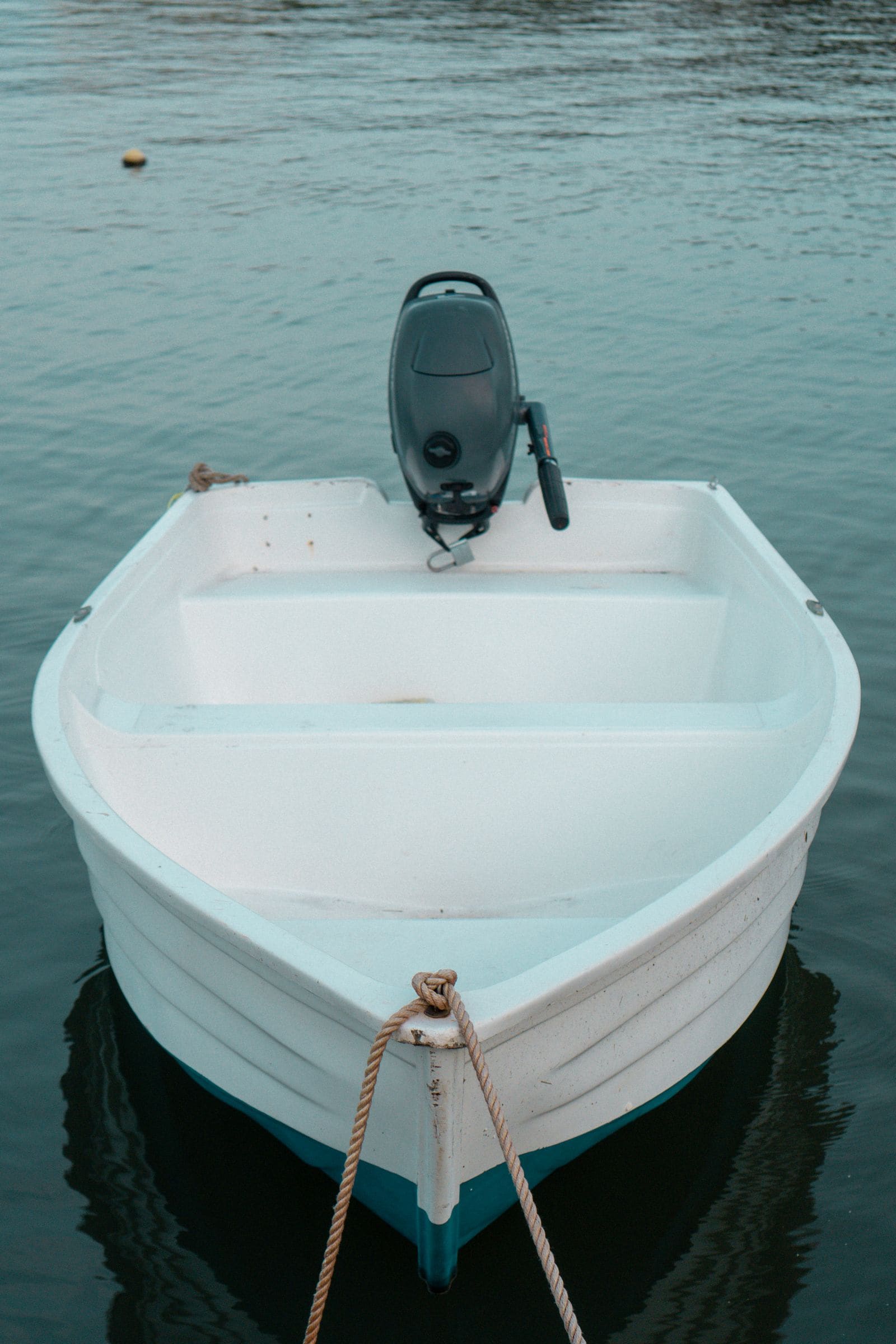
A dinghy outboard stored upright on a stern rail bracket. Upright is the safest way to keep oil where it belongs. Photo: Çağın KARGI / Pexels At least once a season, and any time the motor revs but the boat doesn't move:
- Remove the kill switch clip first so it can't start.
- Take off the prop (usually a cotter pin and a nut, or just a cotter pin on the smallest motors).
- Check the shear pin: a sheared or bent pin must be replaced with the correct part from your maker. Never substitute a bolt or nail; a hard pin passes the shock straight to the gears.
- Look behind the prop for fishing line wrapped around the shaft. It can cut the seal and let water into the gearcase.
- Check the prop blades for dings and cracks, put a light coat of marine grease on the shaft, and reinstall with a new cotter pin.
Cruising World's method: with the motor upright, remove the upper (vent) screw on the gearcase. Oil should be at the hole or just below. Look at a drop of it. Milky or creamy gear oil means water is getting past a seal and needs a mechanic soon. To change it, drain from the bottom screw, then refill from the bottom with the maker's gear oil until it comes out the top hole. Fit new washers on both screws. Details are in the lower unit oil change guide.
Small four-strokes hold very little oil, so it gets dirty fast. Change it at the interval in your manual, and before storage if it's due, with the motor upright and warm. Many small motors have no filter and some drain by tipping the motor; follow your manual exactly and use the oil grade it specifies. Two-strokes skip this step.
- Anodes: Cruising World recommends replacing them once they're about half worn away.
- Grease points: swivel and tilt pivots, clamp screws and the throttle linkage, using the grease your manual names.
- Spark plug: check the color and gap (use the spec in your manual), and replace it if it's worn or fouled.
- Pull cord: replace it if frayed.
- Corrosion: after salt water, wipe the motor down with fresh water and a corrosion protectant on the outside surfaces your manual allows.
- Flush, then run the carb dry (Step 6) or follow your manual's storage procedure, which may include fogging the cylinder.
- Change the four-stroke oil if due and check the gear oil.
- Drain or use up old fuel in the built-in tank, and store fuel cans away from living spaces.
- Store the motor upright on a stand, in a dry place, with the leg lowest so water can't sit in the powerhead. If it must lie down, use only the side the maker allows.
- If it has to winter outdoors on the boat, Yamaha suggests either trimming it fully down or slipping a tightly sealed plastic bag over the gearcase once it's completely dry, so moisture can't collect in the lower unit and freeze. Check the gear oil for water before the season, too.
- Look under the cowl and at the air intake in spring for bird or insect nests before the first start; Yamaha lists this as part of its routine.
- Log the date and what you did in BoatMend.
Common mistakes
- Laying a four-stroke on the wrong side (or on its back) in the car trunk, then fighting oil smoke, a hydrolocked cylinder or a fouled plug.
- Leaving fuel in the carburetor over winter. The jets gum up and the motor won't start in spring.
- Running it in a bucket that's too small, where the water gets hot and the intake sucks air. Use a big container and short runs.
- Revving it on flush muffs, or starting it before the water is on.
- Starting the engine on the built-in flush port. On most motors the port is for flushing with the engine off; run it only on muffs or in a tank unless your manual allows the port.
- Forgetting to open the tank vent, then blaming the carburetor when it dies after five minutes.
- Replacing a shear pin with a bolt or nail.
- Mixing premix by eye, or putting premix into a four-stroke.
- Carrying the motor by the tiller or cowl instead of the carry handle.
When to call a pro
- No cooling water stream after clearing the telltale and intake
- Milky gear oil, or engine oil that's milky or rising on the dipstick
- The motor won't idle or only runs with the choke on after fresh fuel (the carburetor likely needs cleaning)
- It shears pins repeatedly without hitting anything, or makes grinding or clunking noises in gear
- It was dropped overboard or submerged (it needs immediate service before it sits)
- Fuel leaks from the carburetor, tank or fuel lines that you can't trace to a loose cap or fitting
Tips
- Keep a small kit with the motor: spare shear pin and cotter pin, spark plug and plug wrench, pliers and a spare pull cord.
- Mark the center of your transom once, as Mercury suggests, so you can center the motor quickly every time.
- Use a dedicated, labeled fuel can for premix so it never ends up in the car.
- Running a small motor a few minutes every couple of weeks keeps fuel moving through the carb, but only if the fuel is fresh.
- A stand or a padded bracket in the garage makes upright storage easy and keeps the motor off the floor.
Official references
We read these to write this guide. Your engine's own manual always wins.
- Mercury Marine – Quick Tip, Preparing Your Portable Mercury Outboard for Transport
- Mercury Marine – Quick Tip, Installing and Removing a Portable Outboard
- Yamaha Outboards – 6 to 2.5 HP Portable Outboard Motors
- Yamaha Outboards – The Importance of Freshwater Flushing
- Cruising World – Outboard Engine Maintenance
- Southern Boating – When Your Outboard Goes Under, Dunked Outboard Rescue
- Yamaha Outboards – Maintenance Matters, Additional Tasks (telltale, air intakes)
- Yamaha Outboards – Maintenance Matters, Extended Storage
Safety: BoatMend is for information only and does not replace a certified marine technician. You are responsible for your safety and your boat. Read the full disclaimer.
Last updated 2026-10-24
Related guides
How to Flush Your Engine With Fresh Water
Rinse salt, silt and sand out of your outboard or sterndrive cooling system using the built-in flush port, flush muffs or a flush bag. Flushing after every saltwater trip is one of the easiest ways to prevent corrosion and overheating.
Ethanol (E10) Fuel Care: Stabilizer, Phase Separation, Fuel Lines and Tank Vents
Keep E10 gasoline from damaging your boat engine. Learn how to use stabilizer, test for water and phase separation, and inspect the fuel lines, primer bulb, anti-siphon valve and tank vent. Most fuel-related breakdowns start with one of these.
How to Change Lower Unit (Gearcase) and Sterndrive Oil
Drain and refill the gear oil in your outboard lower unit or sterndrive, and learn to spot water intrusion before it destroys the gears. It is a 30-minute job that protects a gearcase costing thousands to replace.
How to Change the Oil and Filter on a 4-Stroke Outboard
Drain the old oil, swap the filter and refill with the right marine oil on your 4-stroke outboard. It is the most common service job, takes about an hour, and costs a fraction of the dealer price.
How to Clean the Carburetor on a Small or Older Outboard
Old fuel turns to varnish and plugs the tiny jets in a carburetor, so the engine only runs on choke, surges or will not idle. Learn when the carburetor really is the problem, how to drain and clean it, and when a rebuild kit or a replacement makes more sense.
How to Mount or Re-Tighten an Outboard on the Transom
A loose outboard can steer badly, crack the transom or fall off the boat. Learn how to center the motor, check engine height, tighten clamp screws, seal and bolt through the transom with backing plates, add a safety cable on small motors and spot transom flex before it becomes a costly repair.

Propeller Care: Inspect, Remove, Replace and Choose the Right Pitch
Check your prop for damage, pull it to clear fishing line and grease the shaft, reinstall it correctly, and learn how pitch affects your engine's wide-open-throttle RPM. The right prop in good shape protects your engine and often makes the boat run better and use less fuel.

Saltwater Outboard Care: The After-Every-Trip and Monthly Routine
A simple routine that keeps salt from eating your outboard, built from Honda, Yamaha, Mercury and Suzuki advice. It covers flushing after every trip, washing, where to spray anticorrosion (and where never to), monthly greasing, anodes, and tilting up or storing out of the water.
Milky Engine Oil or Water in the Oil - What It Means and What to Do
Milky, creamy or rising engine oil usually means water is getting into the engine. Learn why you should stop running it right away, how to tell harmless condensation from a real leak, and which parts are the usual suspects: head gaskets, exhaust risers and manifolds, intake manifold gaskets, oil coolers and freeze cracks.