Propeller Care: Inspect, Remove, Replace and Choose the Right Pitch
Check your prop for damage, pull it to clear fishing line and grease the shaft, reinstall it correctly, and learn how pitch affects your engine's wide-open-throttle RPM. The right prop in good shape protects your engine and often makes the boat run better and use less fuel.
Time
45 min
Shop would charge
$50-150
Applies to
Outboard, Sterndrive (I/O)
Safety first: A prop can start turning if the engine cranks or is bumped into gear. Before touching it, shift to neutral, remove the key, and pull the kill-switch lanyard; on larger engines also disconnect the battery. Prop blade edges are sharp, so wear gloves. Never work on a prop with the boat in the water and someone at the helm.
Owners often ask
- I found fishing line wrapped around my prop shaft. Did it damage the seal?
- What prop pitch should I run, and what RPM should I hit at wide open throttle?
This guide walks you through it. Still stuck? Ask the AI Mechanic about your engine.
Tools
- Prop wrench or deep socket that fits your prop nut (size varies by engine)
- Breaker bar or ratchet
- Block of wood (a short piece of 2x4)
- Torque wrench
- Pliers and flat screwdriver (for tab washers and cotter pins)
- Pick or small screwdriver (for fishing line)
- Fine file (for small burrs)
- Phone camera (to photograph the washer order)
- Gloves
Parts & supplies
- Marine grease (the type your engine maker specifies)
- New tab washer or cotter pin (do not reuse a bent tab washer)
- Spare propeller and hub kit (recommended)
Before you start
Prop sizes: the hub is usually stamped with two numbers, like 14 x 19. The first is diameter in inches and the second is pitch in inches (how far the prop would move forward in one turn if it were screwing through something solid). Brands mark props differently: Yamaha, for example, stamps a pitch number plus a letter for the prop series, and that letter tells your dealer which engine size range the prop fits.
Why pitch matters: pitch works like a gear.
- More pitch = higher top speed potential, but slower acceleration and lower RPM at wide-open throttle (WOT).
- Less pitch = quicker hole shot, but higher WOT RPM and possibly lower top speed.
Every engine has a recommended WOT RPM range in its owner's manual. Mercury says running outside that range, too high or too low, can damage the engine and drive and may affect the warranty. A common rule of thumb (Mercury): each inch of pitch changes WOT RPM by roughly 150 to 200 RPM. Confirm with your dealer or prop maker.
How often: look at the prop before every trip. Pull it at least once a year (Mercury suggests yearly) to check for fishing line, grease the shaft, and make sure it is not seized on. If you fish a lot or run in weedy water, Mercury suggests pulling it a few times a season, because line wraps are the most common cause of gearcase seal damage. Also inspect it after running in shallow water: a soft-bottom strike can bend blades slightly with no obvious mark.
Steps
Neutral, key out, lanyard off. Trim the engine so the prop is at a comfortable working height. On a trailer, chock the wheels.
Spin it slowly by hand (in neutral) and look at each blade:
- Nicks, dings and small burrs on the edges
- Bent or curled tips, or a blade that looks out of line with the others
- Cracks, missing chunks, or heavy cupping damage
- Signs the rubber hub is slipping (engine revs but boat does not speed up)
Small burrs can be dressed with a fine file. A bent, cracked or chunked blade means repair or replacement; an unbalanced prop causes vibration that can damage seals and bearings.
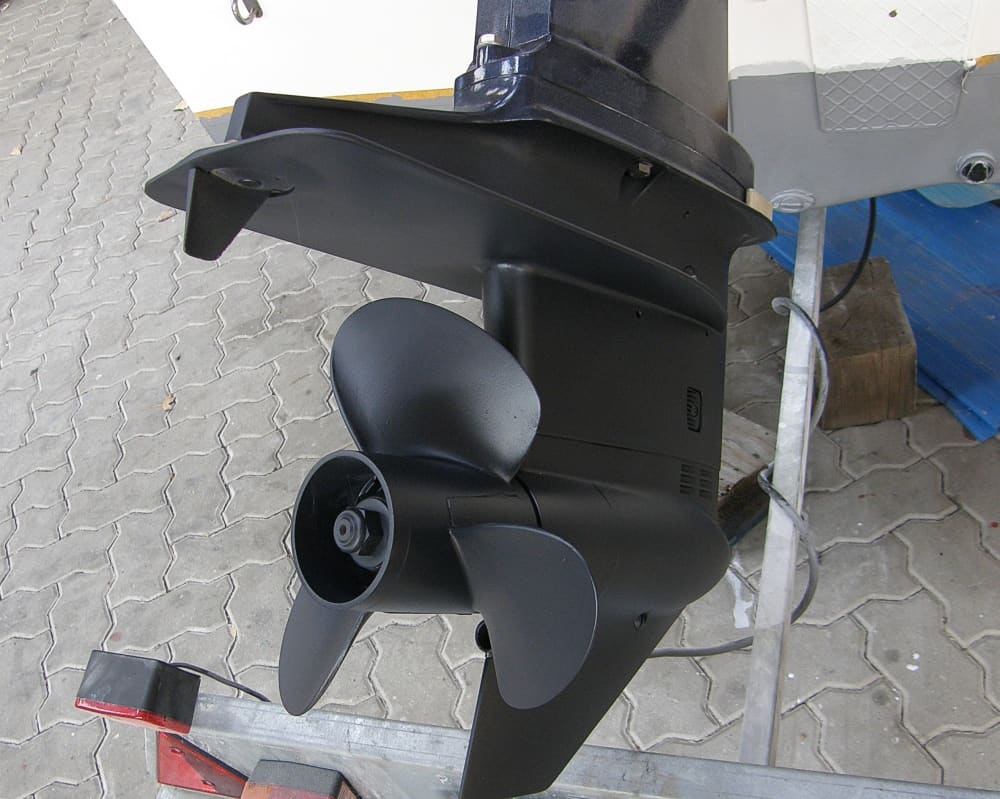
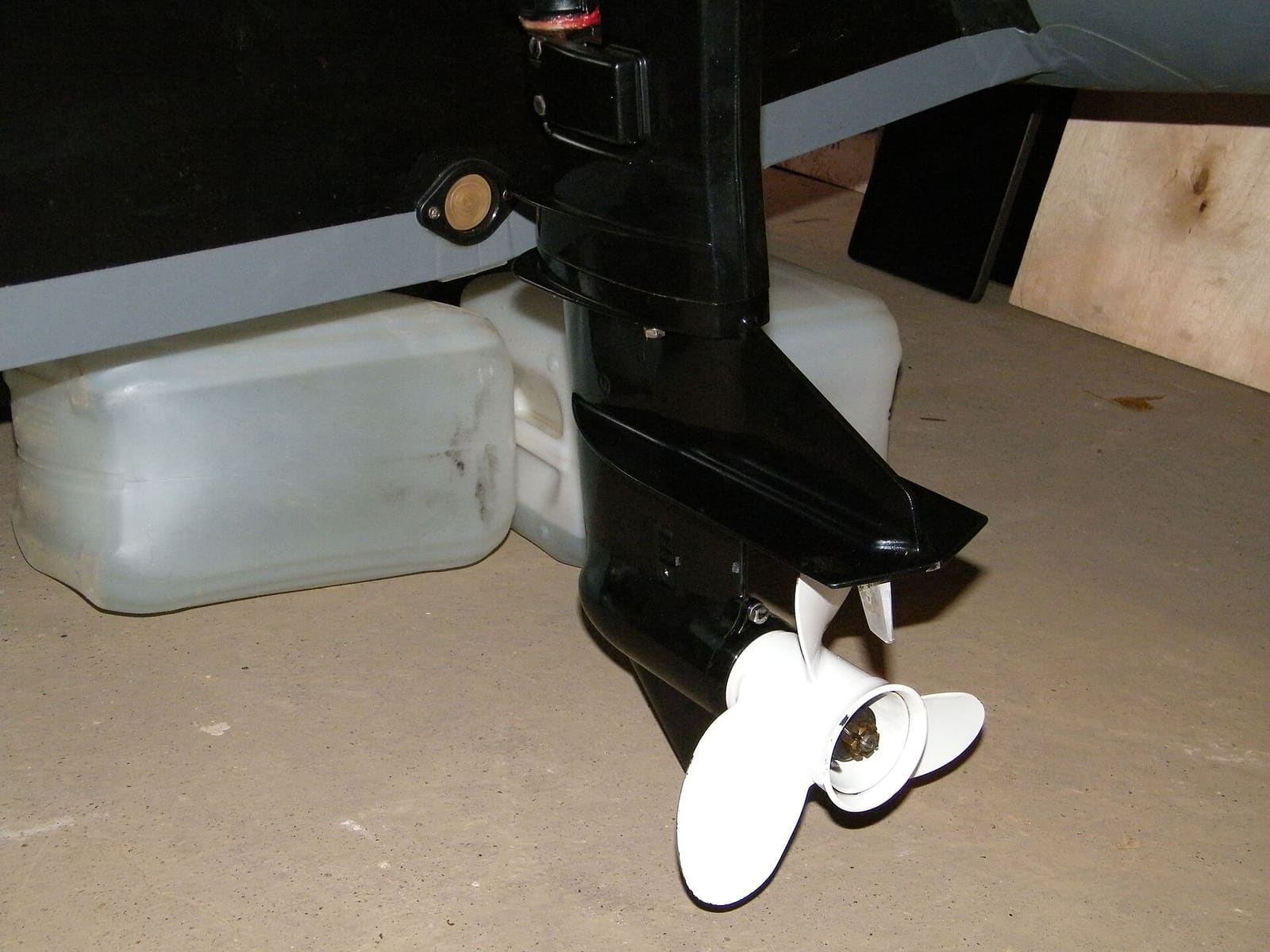
Check each blade with the engine tilted up and in neutral, like this prop on a trailered boat. Photo: Ra Boe / Wikimedia Commons · CC BY-SA 3.0 Most props are held by a nut with either a cotter pin or a tab washer whose tabs are bent up against the nut. Straighten the cotter pin and pull it out, or pry the tabs flat with a screwdriver.
Wedge the wood block between a blade and the anti-ventilation plate (the flat plate above the prop) so the prop cannot turn. Turn the nut counterclockwise on a standard right-hand prop. Counter-rotating (left-hand) props, used on the second engine of some twin setups, follow the same idea; check your manual.
Slide off the nut, washers, spacer, prop and the thrust washer behind it (some hubs do not have one). Photograph the stack or lay the parts out on a towel in order. They must go back exactly the same way, including which way each washer faces.
Look closely at the shaft right in front of the seal. Fishing line wraps here, gets pushed into the seal, and lets water into the gearcase. It is often coated in grease and hard to see. Pick it out carefully with a pick. If you found line, check your gear lube for water (see the lower unit oil guide).
Wipe the shaft and splines clean. Look for a bent shaft (wobble when you spin it after reinstalling the prop is a clue), worn splines, or damaged threads. A hard strike can bend the shaft even if the prop looks fine.
Coat the splines and shaft with the marine grease your engine maker recommends. Grease prevents the prop from seizing on the shaft, which makes the next removal easy. A light, even coat is enough; heavy globs just collect dirt.
Thrust washer (if fitted), prop, then the rear washers and spacers exactly as they came off, then the nut. On some hubs a cupped spring washer has a direction; follow your photo or the hub kit instructions.
Block the prop with the wood again (on the other side) and tighten the nut to the torque in your owner's manual or hub kit instructions. Then lock it: bend the tab washer tabs up against the flats of the nut, or install a new cotter pin and bend its legs. Use a new tab washer if the old one is fatigued.
Remove the block and spin the prop by hand. It should turn freely all the way around without binding.
Mercury recommends checking that the prop is still tight after about 20 hours of running, and never running with a loose prop. Put a reminder in your BoatMend log.
On the water, with a normal load, trim the boat out for best speed and note the WOT RPM on the tach (or engine display). Compare it with the range in your manual:
- Above the range: consider more pitch.
- Below the range: consider less pitch.
- Near the top of the range under a normal load: typically ideal.
Remember that hot weather, high altitude, a dirty bottom and a heavy load all lower RPM. Test under your usual conditions. Mercury's online Prop Selector and most dealers (often with test props) can narrow the choice.
Common mistakes
- Pulling the prop without noting the washer and spacer order, then putting a thrust washer or spring washer back the wrong way.
- Reusing a fatigued tab washer, or skipping the cotter pin, so the nut can back off.
- Buying a higher-pitch prop for top speed and ending up below the WOT RPM range. Lugging the engine like that strains it.
- Testing a new prop with an empty boat on a cool day, then being disappointed when the boat is loaded in summer.
- Never pulling the prop, so fishing line slowly cuts the seal and lets water into the gearcase.
- Blaming the engine for poor performance when a slipping hub or a slightly bent blade is the real cause.
- Hitting something hard, swapping the prop and not having the shaft and gearcase checked.
When to call a pro
- The prop has cracks, missing chunks or bent blades (send it to a prop shop; repairing stainless is often worth it)
- The prop is seized on the shaft and will not come off
- The shaft looks bent, the splines are worn, or the threads are damaged
- You found fishing line and the gear lube looks milky (seal may be leaking)
- The engine revs up but the boat does not speed up (spun hub)
- You hit something hard: have the dealer check the shaft and gearcase
Tips
- Carry a spare prop, hub kit, nut, washers, wood block and wrench aboard. Practice a prop change on the trailer so you can do it calmly on the water.
- An inexpensive aluminum spare is fine for getting home on a lake; offshore boats should carry a spare sized close to the main prop.
- Store a removed prop inside over winter to discourage theft.
- Log the prop size, model and WOT RPM in BoatMend. It makes future prop shopping much easier. Boating Magazine's list of what a dealer needs to suggest a prop: engine model and horsepower, boat weight and hull type, your current prop (blades, diameter, pitch), your WOT RPM with a typical load and best trim, and whether you care more about hole shot or top speed.
- Switching from aluminum to stainless steel? Stainless is stiffer and tougher, but Mercury notes stainless parts on an aluminum drive or gearcase speed up its galvanic corrosion. Watch the anodes closely after the switch and replace them on time.
Official references
We read these to write this guide. Your engine's own manual always wins.
- Mercury Marine – Prop Bite, Prop Diameter & Pitch
- Mercury Marine – Selecting the Best Prop is Crucial but Easy
- Mercury Marine – Prop Bite, Propeller Installation
- Mercury Marine – How to Swap Your Prop
- Mercury Marine – Maintenance Made Easy, Propeller Maintenance
- Mercury Marine – Quick Tip, Inspecting Your Prop and Prop Shaft
- Mercury Marine – Owner FAQs (prop sticking, prop tightness, corrosion)
- Yamaha Outboards – Owner FAQs (propeller markings)
- Boating Magazine – Understanding Propeller Pitch
Safety: BoatMend is for information only and does not replace a certified marine technician. You are responsible for your safety and your boat. Read the full disclaimer.
Last updated 2026-10-23
Related guides
Loss of Power, Hesitation or Misfire - Troubleshooting Guide
Figure out why your engine bogs down, stumbles, will not reach full rpm or runs rough. Work from simple checks like trim, prop and fuel filter to ignition and engine protection modes before paying for diagnostics.
How to Inspect and Replace Sacrificial Anodes (Zincs)
Check the anodes on your outboard, sterndrive or inboard running gear, replace them when they are half gone, and choose the right metal for the water you boat in. Fresh anodes are cheap insurance against expensive corrosion damage to your lower unit, drive and prop.
How to Change Lower Unit (Gearcase) and Sterndrive Oil
Drain and refill the gear oil in your outboard lower unit or sterndrive, and learn to spot water intrusion before it destroys the gears. It is a 30-minute job that protects a gearcase costing thousands to replace.
How to Winterize an Outboard Engine
Protect your outboard from freeze damage, stale fuel and internal corrosion over the off-season. Most owners can do it in an afternoon with basic tools, compared with a shop bill that often runs several hundred dollars.