Freshwater Pump Troubleshooting: Cycling, Won't Shut Off or No Water
When the pressure water pump keeps cycling at night, runs nonstop or sputters air, the cause is usually simple: an empty tank, a dripping fixture, a clogged strainer, air in the lines or a tired accumulator. Work from the cheapest checks to the pressure switch and pump, and learn the basics of replacing a pump.
Time
1 h 30 min
Shop would charge
$150-500
Applies to
All engines · Cabin cruiser, Yacht, Sailboat, Pontoon
Safety first: Switch the pump off at its breaker or switch before you open any fitting, strainer or pump. A pump that runs nonstop can drain the battery and pump the whole tank into the bilge, so turn it off until you find the problem. If a breaker trips again right after you reset it, or wiring at the pump is hot, melted or smells burnt, stop and have it checked.
Owners often ask
- My freshwater pump keeps turning on by itself every few minutes. What causes that?
- My water pump runs but nothing comes out of the faucet. What should I check?
This guide walks you through it. Still stuck? Ask the AI Mechanic about your engine.
Tools
- Flashlight
- Screwdrivers and nut drivers
- Towels and a small bucket or bowl
- Multimeter (for checking voltage at the pump)
- Tire pressure gauge (for an accumulator tank with an air valve)
- Hose pinch-off pliers or a spare valve (optional, for the leak test)
Parts & supplies
- Pump inlet strainer screen or O-ring (if damaged)
- Faucet aerators or shower head washers (if clogged)
- Hose clamps and reinforced potable-water hose (if a fitting leaks)
- Pressure switch or service kit for your pump model (only if the tests point there)
Before you start
How the system works. Most boats use a pressure-controlled diaphragm pump. Xylem explains that a pressure switch senses the drop when you open a faucet and starts the pump, then stops it once the pressure builds back up to a preset limit after you close the faucet. Many systems also have an accumulator tank (a small tank with an air cushion that smooths the pressure), a strainer before the pump, a water heater and several outlets: galley, head sink, shower, transom shower, sometimes a freshwater-flush toilet or deck wash.
Name the symptom. Each one points somewhere different:
- Cycles on and off with every faucet closed (often at night): a small leak somewhere, or a leak inside the pump.
- Runs and won't shut off: empty tank, air in the pump, a big leak, low voltage or a bad pressure switch.
- Runs but little or no water: empty tank, clogged strainer, closed tank valve, air leak on the suction side, worn pump.
- Pulses or "chatters" while a faucet is open: often a restriction (clogged aerator or strainer) or a waterlogged accumulator.
- Totally silent: power problem (switch, breaker, fuse, wiring) or a dead pressure switch or motor.
Spring tip: If the problem started right after the boat came out of storage, look for freeze damage first: a cracked pump head, split strainer bowl or popped fitting. The winterizing guide covers how to prevent that next time.
Work through the steps in order. Most fixes are found in the first half.
Steps
Make sure the pump switch and breaker are on (or reset them once), then listen at the pump when you open a faucet. Silence means skip ahead to step 10 (power). If the pump runs, keep going in order. Have a towel handy every time you open anything; fittings hold water.
An empty tank is the most common reason a pump won't shut off: the pump runs, sucks air and never builds enough pressure to trip the switch. Tank gauges on boats are often wrong, so look through the fill or inspection port if you can. Also check that the tank's outlet valve (if it has one) is open, and that you're drawing from the right tank on boats with a selector valve. Turn the pump off until you refill; diaphragm pumps shouldn't run dry for long.
The water tank needs to breathe in air as water is pumped out. If its vent is blocked, the pump struggles and flow fades. Practical Sailor notes that many water tank vents end at an unscreened through-hull or inside the cabin, where insects love to nest. Find the vent fitting, clear it, and consider an inline screen. While you're there, make sure the vent hose has a high loop so seawater can't get into your drinking water. Xylem suggests following the vent line with a flashlight from the top of the tank all the way to the outside fitting, especially where it bends through bulkheads: a kink can choke it just like a clog. Ease the tension on the hose or fit an elbow at a hard bend. (BoatUS adds that a vent that isn't higher than the deck fill will overflow when you fill the tank, and a deck fill cap needs a good O-ring to keep seawater out.)
A leak is the most common reason a pump cycles by itself. With the pump on and every faucet closed, check:
- Galley and head faucets, the shower head and the transom shower for drips
- The water heater, its fittings and its pressure-relief valve
- A freshwater-flush toilet or a deck washdown outlet, if fed from this system
- Every hose fitting and clamp you can reach, including under sinks and behind panels
If your bilge pump runs more than usual, taste a drop of the bilge water: fresh water in the bilge is a strong clue.
If you can't see a leak, split the system in half. Close any shutoff valve on the outlet side of the pump, or pinch the outlet hose just past the pump with hose pinch-off pliers. If the cycling stops, the leak is somewhere downstream in the plumbing or fixtures. If the pump still cycles with its outlet closed off, the problem is inside the pump (a leaking check valve or diaphragm lets pressure bleed back to the inlet) or in the pressure switch. Release the clamp when you're done.
Most installations have a strainer just before the pump; Xylem sells strainers as part of its freshwater systems. Close the tank valve if there is one, switch the pump off, then open the strainer bowl and rinse the screen. Tank sediment and old sealant bits are common. A clogged strainer makes the pump run with weak or pulsing flow. Check the bowl's O-ring as you reassemble: a poorly seated O-ring here lets the pump suck air.
After the tank runs dry, after winterizing, or after any plumbing work, air gets trapped and the pump spits and runs. Open the faucet farthest from the pump (both hot and cold) and let it run until the flow is smooth, then work back toward the pump. If air keeps coming, a loose fitting or cracked hose between the tank and the pump is pulling air in. Xylem's rule of thumb: if air spurts out of the faucet every time you open it, there's a loose connection on that side. A cracked inlet strainer bowl or a loose inlet hose can let air in without dripping any water, so a dry fitting isn't proof it's sealed. Tighten clamps on that side and replace hose that's soft or kinked. BoatUS notes that reinforced potable-water hose is the better choice because it's less likely to collapse on the suction side of a pump.
If one outlet pulses or barely flows while the others are fine, unscrew its aerator or shower head and rinse out the grit. Debris from the tank often collects here after a refill or a strainer cleaning. If the whole system started pulsing after you added a drinking-water filter on the pump's main outlet, the filter's restriction may be the cause, especially as its cartridge clogs. Change the cartridge (Xylem says a water purification filter may need a new cartridge every six months or sooner, depending on use and how much sediment is in the tank; follow the filter maker), and check your pump manual: pump makers commonly want a drinking-water filter on its own faucet line rather than in front of every outlet.
If the pump starts every time you draw a cup of water, or chatters while a faucet runs, the accumulator may have lost its air charge or its internal bladder may have failed. With the pump switched off and a faucet open so the system has no pressure, check the air valve with a tire gauge. Set the air charge to the value in your accumulator or pump manual (it's usually tied to the pump's switch settings). If there's no air, water comes out of the air valve, or the seam is wet, the bladder has failed and the accumulator needs replacing. Not every system has one; some newer variable-speed pumps are designed to work without it.
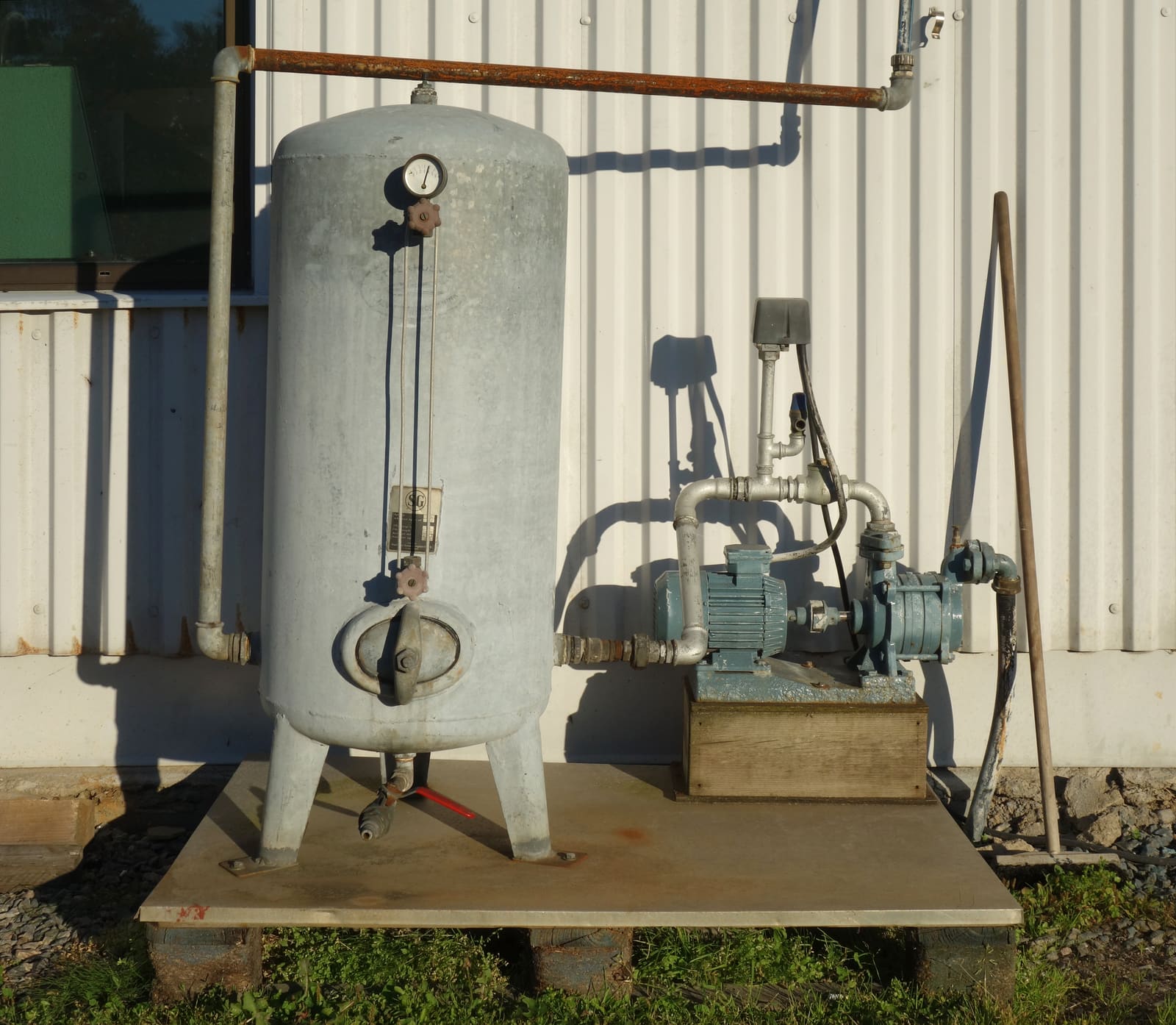
The same idea on land: a pump, a pressure switch and a pressure tank that stores water under an air cushion. A boat accumulator is a much smaller version of that tank. Photo: W.carter / Wikimedia Commons · CC BY-SA 4.0 A pump that's silent, slow or never quite reaches shut-off pressure may be getting low voltage. With a multimeter, measure the voltage at the pump's terminals while it runs, and compare it with the battery voltage. A big difference means a corroded connection, a loose terminal or undersized wire. Check the fuse or breaker, clean and tighten connections, and make sure the battery is charged. See the 12-volt wiring and corrosion guides for how to test and repair connections.
If the tank is full, there are no leaks, the strainer is clean, the accumulator is right and voltage is good, the pressure switch is the next suspect. A switch that's stuck closed lets the pump run forever; one that's stuck open never starts it. Look for corroded terminals on the switch first; cleaning them sometimes fixes it. Some switches can be adjusted, but the pump maker sets them on purpose, so follow the manual or replace the switch with the kit made for your pump. BoatUS's technical editor, writing about common diaphragm pumps, points out that a pump that won't run at all even with good voltage at its wires most often needs a new pressure switch, while one that runs very fast with no water is usually just out of water. Switch kits often include the check valve and switch diaphragm too; replace those while you're in there, keep the gaskets and seating surfaces clean, and drive the small screws back into the plastic pump head gently so you don't strip the threads. Sometimes the only problem is grit in the switch diaphragm or its check valve, and cleaning it fixes the pump for free. Adding a quick-disconnect in the pump's wires makes the next removal easier.
Worn diaphragms and valves, or debris stuck in the valves, cause a pump that runs but won't prime, cycles even with its outlet closed off (from step 5), loses pressure quickly or drips water from the pump body. Many pumps have service kits for valves and diaphragms. BoatUS notes that valves leaking from debris or age-stiffened rubber are a common cause of the night-time chatter, often before the pump stops working altogether. Before buying a kit, open the valve housing (pump off, pressure released) and look: a bit of grit caught between a rubber valve and its seat is sometimes the whole problem. If the pump is old, noisy and leaking, replacing it is often the quicker fix.
Match the new pump to the old one's voltage, flow rating and port size, and check that it suits the number of outlets you use at once (Xylem sizes pumps by system size and how many outlets run at the same time). Xylem also points out that a pump mounted at the stern has to push water the whole length of the boat to a forward head; if pressure is weak only at the farthest outlet, ask the pump maker whether a higher-pressure model fits your system. Then:
- Switch off the breaker, close the tank valve and open a faucet to release pressure.
- Photograph and label the wires and hoses before you disconnect anything; catch the water with a towel.
- Mount the new pump as its manual says (position, rubber feet, strainer on the inlet side).
- Make proper crimped, sealed wire connections and use the fuse or breaker size the manual calls for.
- Open the tank valve, switch on, bleed the air from each faucet (step 7) and check every fitting for drips.
Common mistakes
- Replacing the pump when the real problem was a dripping faucet, an empty tank or a clogged strainer.
- Leaving the pump switched on when the boat is unattended; a small leak becomes a drained tank, a wet bilge and a flat battery.
- Using clear, non-reinforced hose on the suction side, where it can collapse.
- Topping up an accumulator without first taking the water pressure off the system.
- Adjusting the pressure switch screw "to make it stop cycling," which only hides a leak.
- Forgetting to winterize the pump, strainer and accumulator, then finding a cracked pump head in spring.
- Using automotive antifreeze in the drinking-water system. BoatUS and Xylem both say use only non-toxic propylene glycol.
When to call a pro
- A breaker or fuse trips again and again, or wiring at the pump is hot, discolored or melted
- You can't find a leak but fresh water keeps showing up in the bilge
- The water heater or its relief valve is leaking (it may be on shore power and has hot water inside)
- You need to rewire the pump circuit or add a new breaker
- Your water smells or tastes bad after sanitizing, or the tank itself is leaking
Tips
- Turn the pump off whenever you leave the boat, then open a faucet briefly to relieve the pressure. It takes strain off fittings and the pump.
- Keep a spare strainer screen, aerator and pressure switch (or service kit) aboard if you cruise far from parts.
- A cheap inline pressure gauge near the pump makes switch and accumulator problems much easier to diagnose.
- If the pump cycles every few minutes at night, it's almost always a small leak; start with the faucets and the water heater.
Official references
We read these to write this guide. Your engine's own manual always wins.
- Xylem (Jabsco) – Freshwater Delivery Systems for Boats
- Xylem (Jabsco) – Expert Winter Maintenance Tips for Pumps and Marine Toilets
- BoatUS – Choosing the Correct Boat Hose
- BoatUS – How to Winterize Boat Plumbing
- Practical Sailor – Filters for Water Tank Vents
- Xylem (Jabsco) – Tackling Poor Water Pressure on Your Boat
- BoatUS – Servicing Your Boat's Potable Water Pump
- BoatUS – Boat Plumbing (tanks, vents, pumps and accumulators)
Safety: BoatMend is for information only and does not replace a certified marine technician. You are responsible for your safety and your boat. Read the full disclaimer.
Last updated 2026-10-24
Related guides

How to Winterize (and Recommission) Your Boat's Freshwater System
Protect the tank, pump, water heater, faucets and showers from freeze damage with non-toxic antifreeze, then flush and sanitize everything in the spring so the water is clean again. A cracked pump or split fitting is a common, avoidable winter repair bill.

Marine Water Heater Care: No Hot Water, Relief Valve, Anode and Winter Draining
Most boat water heaters warm up two ways: a 120-volt electric element at the dock and a coil that borrows hot coolant from the engine underway. Learn the safe owner checks when the hot water quits, what a dripping relief valve means, and how to drain and bypass the tank for winter.
12-Volt Boat Wiring Basics: Circuits, Color Codes, Fuses and Wire Size
Learn how your boat's 12-volt system is laid out, what the ABYC wire colors mean, how fuses and breakers protect the wiring, why voltage drop and tinned wire matter, and how to read a wiring diagram, so you can troubleshoot smarter and know which jobs belong to a marine electrician.

Fuse Keeps Blowing? How to Troubleshoot a Boat Fuse Block or Breaker Panel
Work through a blown fuse or tripping breaker the safe way: confirm it, tell a short from an overload, isolate the device or wire at fault, replace a worn breaker or panel switch with the same rating, and label every circuit, without ever fitting a bigger fuse.
How to Find and Fix Corroded Electrical Connections on a Boat
Track down the green crust and loose terminals behind flickering lights, dead gauges and slow cranking with a simple voltage-drop test, then remake the connection the marine way: tinned wire, a proper crimp, adhesive-lined heat shrink and a protective coating.
Marine Battery Care: Test, Charge and Store for Winter
Check your boat battery's health, charge it the right way for its type (flooded, AGM or lithium), and store it so it is ready in spring. Most "boat won't start" calls start with a neglected battery.
How to Test and Clean Your Bilge Pump and Float Switch
Make sure your bilge pump actually moves water overboard, both on the manual switch and automatically through the float switch. A working bilge pump is one of the most important safety systems on any boat that stays in the water.
How to Clean and Maintain Shower Sump and Macerator Pumps (and Stay Legal)
The shower sump pump fights hair and soap scum every day, and the macerator empties the holding tank, but only where that is legal. Learn how to clean the sump and filter, test the float switch, avoid burning out pumps by running them dry, follow the 3-mile and no-discharge rules, and winterize both.