Missing or Faded Capacity Plate: How to Read It and Get a Proper Replacement
The capacity plate tells you how many people, how much weight and how much horsepower your boat can safely handle. Learn what each line means, which boats must have one under 33 CFR 183, how to order a replacement from the builder, what to do if the builder is gone, and why homemade numbers are a bad idea.
Time
30 min
Applies to
All engines
Safety first: Until you have a readable plate, load the boat conservatively: fewer people, gear stowed low, and never more horsepower than the boat was built for. Overloading and overpowering small boats lead to swamping, capsizing and loss of control. Never invent numbers or copy a plate from a different model. A wrong plate is more dangerous than no plate because everyone trusts it.
Owners often ask
- The capacity plate on my old aluminum boat is unreadable. How do I find out the max horsepower and how many people it can carry?
- Can I have a sign shop make a new capacity plate for my boat?
This guide walks you through it. Still stuck? Ask the AI Mechanic about your engine.
Tools
- Phone camera
- Flashlight
- Tape measure (to note length and beam)
- Screwdriver or drill/driver (to mount the new plate)
- Mild soap, water and a soft cloth
Parts & supplies
- Replacement capacity plate from the boat builder (or one made from a naval architect's or marine engineer's figures)
- Stainless steel screws and marine sealant, or the adhesive the plate maker supplies
Before you start
What the plate shows. The Coast Guard rules for builders (33 CFR 183.23 and 183.25) require a yellow-panel label headed "U.S. Coast Guard Maximum Capacities." Depending on the boat, it lists:
- Maximum persons, as a whole number of people and in pounds (for example, "5 Persons or 750 Pounds")
- Maximum weight in pounds. On outboard boats this is "persons, motor, gear"; on inboard and sterndrive boats it's "persons, gear" because the engine weight is already accounted for.
- Maximum horsepower on outboard boats. Some plates show two figures: one for a motor with remote steering and a lower one without (tiller steering).
- "This Boat Not Rated for Propulsion by Motor" on boats meant only for oars or paddles
All three limits apply at the same time. Five adults plus a cooler, fuel and tackle can exceed the weight figure even when you're within the persons number.
Why the pounds figure matters more than the head count. On small boats, the federal formulas (33 CFR 183.39 and 183.41) turn the persons capacity in pounds into a number of people by dividing by 141 pounds (after adding a small allowance). Most adults today weigh more than that, so a group of grown-ups can hit the pounds limit before the persons number. Add up real weights and go by the lower limit.
The certification label. Most boats also have a manufacturer's certification label stating that the boat complies with Coast Guard safety standards, with the builder's name and address (33 CFR 181.15). Some builders combine it with the capacity plate. Federal rules (33 CFR 181.13) say nobody may remove a required label or alter its information unless the Coast Guard authorizes it.
Who must have a capacity plate. Under 33 CFR 183.21, the capacity display is required on monohull boats under 20 feet, except sailboats, canoes, kayaks and inflatable boats. That covers most small runabouts, bass boats, jon boats, skiffs and small center consoles. Boats 20 feet and longer, pontoons and other multi-hulls aren't covered by this federal rule, though many builders post a plate or list capacity in the owner's manual anyway. BoatUS has pointed out that this gap leaves loading of bigger boats to the skipper's judgment, and described a 34-foot cruiser that capsized with 27 people aboard (8 on the flybridge).
Older boats, pontoons and the NMMA tag. Discover Boating notes the federal plate rule took effect on August 1, 1973, so a boat built before then may never have had a compliant plate. Separately, builders in the NMMA certification program put a capacity tag (aluminum plate or Mylar sticker) on their boats under 26 feet and on pontoons of every length, so many pontoons and 20- to 26-foot boats do have a plate even though federal law doesn't require one. Those larger boats' plates say just "Maximum Capacities," without "U.S. Coast Guard." NMMA sells these tags only to certified builders, which is one more reason to go back to the builder rather than an engraving shop.
A new label design is coming. In 2026 the Coast Guard accepted the revised ABYC S-7 capacity standard as an equivalent to the federal label rule, and builders may use the new design from July 15, 2026; NMMA says its certified builders must switch by August 1, 2028 (model year 2029). The big change for outboard boats is a new line: maximum outboard motor running weight. ABYC explains that motors of the same horsepower now vary widely in weight, so a plate can be within the horsepower limit and still be too heavy for the transom. If your boat has the new label, check both numbers when you repower; if it has the old one, ask the builder or dealer what motor weight the transom was designed for.
Why it matters when it's missing. Check your state's boating laws: many states treat overloading or exceeding a boat's rated horsepower as an offense, and a marine surveyor, insurer or buyer will ask about a missing plate. On a small boat, the plate is also the only easy way to know the horsepower limit when you repower.
Steps
Federal rules require the plate where the operator can clearly see it when getting underway. Look on the console, near the helm or tiller seat, inside the transom, under the gunwale, and on the inside of the hull next to the operator's position. On older aluminum boats it's often a small riveted metal plate; on fiberglass boats, a sticker or plastic plate. Dirt, paint or a bolted-on accessory can hide it.
Wash it gently with mild soap, water and a soft cloth. Photograph it in low, angled light (a flashlight held to the side helps raised or stamped lettering stand out). Don't use solvents or abrasive pads; they can erase what's left. If you can read every number clearly, write them down and keep the photo in your BoatMend boat profile. If any number is uncertain, treat the plate as missing and get a replacement.
Tracing over faded figures with a paint pen invites mistakes (a 3 becomes an 8, a 25 becomes a 35), and it alters a safety label. Get the correct figures from the builder instead.
Boats built since the early 1970s carry a 12-character Hull Identification Number (HIN), normally on the starboard side of the transom near the top (33 CFR 181.29), with a duplicate hidden somewhere inside. The first three characters are the builder's Manufacturer Identification Code (MIC), which identifies the company. The HIN also contains the hull serial number and the model year. Note the full HIN, plus the model name, length and beam.
Contact the builder's customer service or a dealer for that brand. Give them the HIN, model, year and photos of the boat and any remains of the old plate. Builders keep records of how each model was rated and can usually supply an exact replacement label. Expect a small charge and some paperwork; some builders ask for proof of ownership.
The Coast Guard's Boater's Guide to the Federal Requirements for Recreational Boats suggests:
- Look online for a sister boat (same builder, model and year) whose owner can send a clear photo of its plate. Confirm it's truly the same hull and layout, not just a similar boat.
- Hire a naval architect or marine engineer to work out the ratings.
- As a rough rule of thumb only: maximum persons = boat length (ft) × beam (ft) ÷ 15, based on 150-pound people. The guide warns that this doesn't account for the boat's displacement or volume, so it's a loading estimate, not a substitute for a plate.
Your state boating agency or a marine surveyor can also tell you how they handle boats without plates in your state.
The ratings on a real plate come from formulas and float tests in 33 CFR 183 (for example, the outboard horsepower limit depends on the boat's length, transom width, steering type and transom height). Guessing, "rounding up," or copying a plate from a bigger model can put the boat past its stability or handling limits. Engraving shops can make a plate look official; they can't make the numbers right. Only mount figures that came from the builder, a confirmed sister boat, or a qualified naval architect or marine engineer.
Put it where the old plate was, or where it's plainly visible from the operator's position. Follow the plate maker's instructions:
- Adhesive labels go on a clean, dry, wax-free surface.
- Screw-on plates use stainless screws. Don't drill into flotation chambers, fuel or wiring areas, and seal every screw hole in fiberglass so water can't reach the core (see our deck hardware rebedding guide).
Compare the horsepower on your outboard's cowling or serial tag with the plate's maximum (use the "with remote steering" figure only if the boat actually has remote wheel steering). If the motor is larger than the rating, talk to your insurer and a dealer before using the boat. Overpowering stresses the transom and makes small boats hard to control.
- Ask the seller why it's missing and whether they have the figures from the builder.
- Look for signs of a bigger engine than original: new holes in the transom, a heavy motor on a light hull, stress cracks around the motor mount.
- Check the HIN against the title and registration (see our used boat paperwork guide). A missing plate plus a missing or altered HIN is a red flag.
- Budget for a replacement plate before your first trip, and mention it in any survey.
Count people and weigh the load: people, fuel, coolers, anchors, batteries and gear all count toward the weight figure on outboard boats. Keep people seated and the load low and spread evenly side to side and front to back. In rough water, carry well under the maximum. See our weight distribution and loading guide.

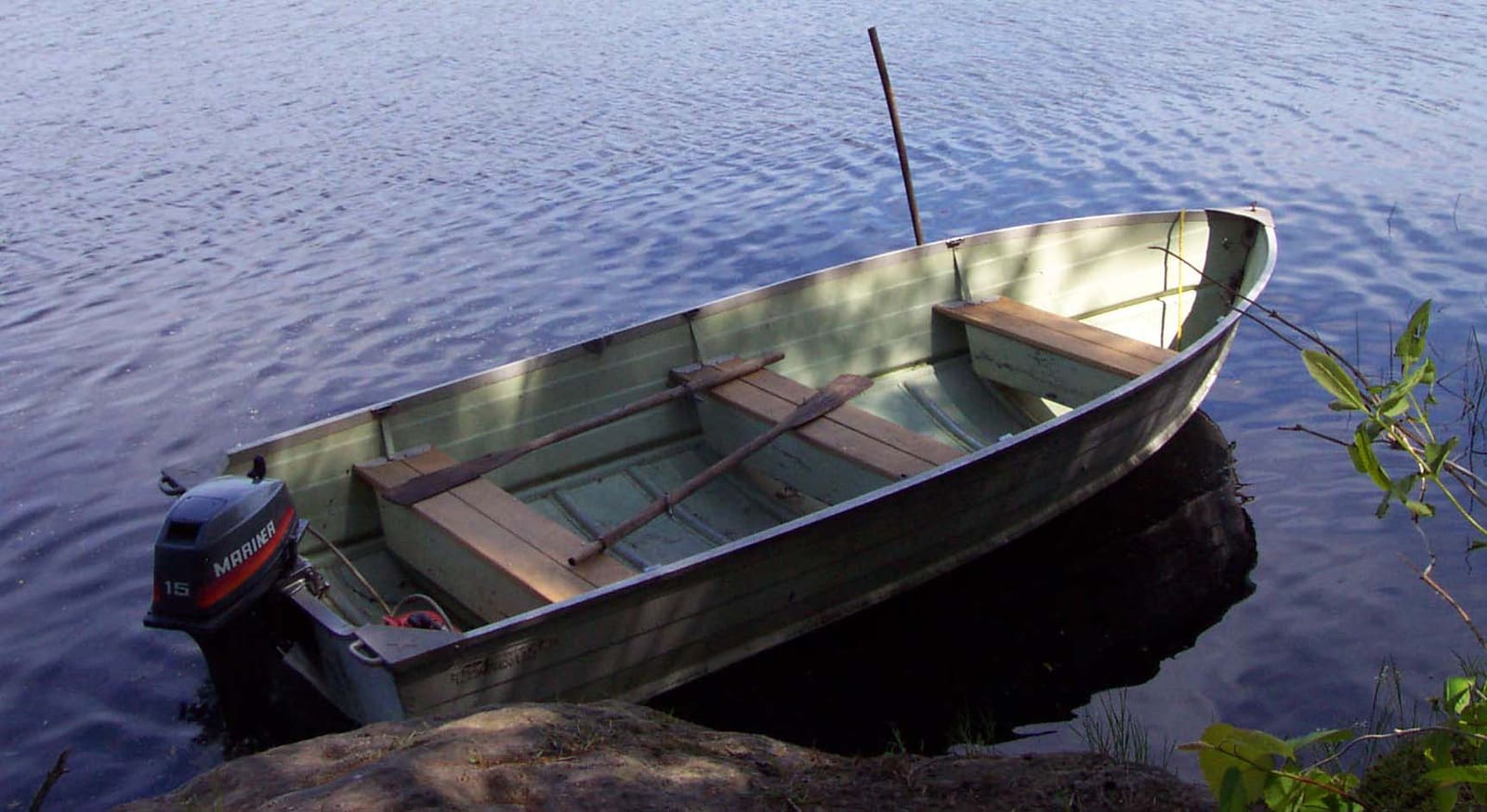
Small boats are most stable with people seated low and spread out, well within the plate's limits. Photo: Virginia State Parks / Wikimedia Commons · CC BY 2.0 Save a clear photo of the new plate, the builder's letter or invoice, and the HIN in your BoatMend boat profile. It helps with insurance, inspections and when you sell the boat.
Common mistakes
- Treating the persons number as the only limit and ignoring the weight figure.
- Using the higher "remote steering" horsepower on a tiller-steered boat.
- Copying numbers from a "similar" boat online that turns out to be a different length or layout.
- Having a trophy or engraving shop make a plate from guessed numbers.
- Painting over or riveting accessories across the plate so nobody can read it.
- Assuming a boat over 20 feet or a pontoon "has no limit" because it has no federal plate. Check the owner's manual and use common sense.
When to call a pro
- The builder is gone and you can't find a confirmed sister boat (hire a naval architect or marine engineer)
- You plan to repower and aren't sure what the hull can safely take
- The boat has been modified (new floor, added flotation removed, a cut-down transom, a bracket or jack plate added); the original ratings may no longer apply
- You're buying or insuring the boat and need a surveyor's opinion on capacity
Tips
- Take a photo of your capacity plate today, while it's readable.
- Post the persons number on a small card near the boarding area so guests know the limit before they step aboard.
- On boats without a plate, keep the owner's manual capacity page aboard.
- No plate and no figure from the builder? BoatUS offers a cautious rule of thumb: carry no more people than there are fixed seats in the main cockpit, not counting bow or flybridge seats, and lighten the load if the boat feels sluggish, rolls a lot or takes water through the scuppers. Don't try to fix poor balance with trim tabs; move the weight.
Official references
We read these to write this guide. Your engine's own manual always wins.
- eCFR – 33 CFR 183.21, Applicability (display of capacity information)
- eCFR – 33 CFR 183.23, Capacity marking required
- eCFR – 33 CFR 183.25, Display of markings
- eCFR – 33 CFR 183.39, Persons capacity, inboard and sterndrive boats
- eCFR – 33 CFR 183.41, Persons capacity, outboard boats
- BoatUS – Boat Capacity Tips (2015)
- eCFR – 33 CFR 183.53, Horsepower capacity
- eCFR – 33 CFR 181.13 and 181.15, Removal and contents of certification labels
- eCFR – 33 CFR 181.29, Hull identification number display
- U.S. Coast Guard – A Boater's Guide to the Federal Requirements for Recreational Boats (2023), Safe Loading
- BoatUS – Capacity, Stability, and Safety: How Many Is Too Many?
- Discover Boating – All about Capacity Plates
- ABYC – Boat Capacity Labels: A New Approach (S-7 2026)
- NMMA – Capacity Tags & Yacht Plates (certification labels)
Safety: BoatMend is for information only and does not replace a certified marine technician. You are responsible for your safety and your boat. Read the full disclaimer.
Last updated 2026-10-25
Related guides

How to Load Your Boat Safely: Capacity Plate, Balance and Stability
Too much weight, or the right weight in the wrong place, is behind most small-boat capsizes and swampings. Learn to read the capacity plate (persons, weight and horsepower), add up your real load, balance it side to side and fore and aft, and adjust for rough water, water aboard and towing riders.
How to Inspect a Used Boat Before You Buy
A step-by-step checklist for looking over a used boat, from paperwork and the hull ID number to the transom, engine, compression test, sea trial and trailer. Know what to check yourself, what the red flags mean, and when to pay a marine surveyor.
How to Mount or Re-Tighten an Outboard on the Transom
A loose outboard can steer badly, crack the transom or fall off the boat. Learn how to center the motor, check engine height, tighten clamp screws, seal and bolt through the transom with backing plates, add a safety cable on small motors and spot transom flex before it becomes a costly repair.
Planning a Repower: Horsepower Limits, Transom, Rigging, Prop and Costs
Putting a new engine on a boat you love can cost far less than a new boat, but only if the plan is right. Learn how to read the capacity plate for maximum horsepower and weight, check the transom, sort out controls, gauges and rigging, budget for the prop and the extras, and decide between a dealer installation and doing it yourself.
Boat Registration Numbers and Validation Decals: Federal Display Rules, State Placement and Renewals
Display your state registration number and validation decal the way federal rules (33 CFR 173 and 174) and your state require: size, block style, contrast, spacing, placement on the forward half, decal position, what documented boats show instead (name and hailing port), what to carry aboard, and how to never miss a renewal. States add their own details, so check your state boating agency.
How to Prepare Your Boat for an Insurance or Condition Survey
Get ready for a marine survey your insurer or lender asked for: what a SAMS or NAMS surveyor looks at, the common findings you can fix beforehand (hose clamps, seacocks, bilge, fire extinguishers, wiring), the paperwork to have ready, and how to handle the recommendations afterward.
How to Find and Fix Leaking Deck Hardware (Rebedding Cleats, Stanchions and Tracks)
Track down the cleat, stanchion base or track that is dripping into the cabin, then remove it, seal the deck core and bed it again with the right sealant so the leak stops for years instead of weeks. Catching it early protects the deck core from rot.

USCG Required Safety Equipment Check by Boat Length
Walk through your boat and confirm you carry every piece of safety gear the US Coast Guard requires for your boat's length and type, and that none of it is expired or worn out. Missing or expired gear is one of the most common tickets on the water, and it is the gear you need when things go wrong.
How to Prepare for a Free Vessel Safety Check
Volunteers from the Coast Guard Auxiliary and America's Boating Club will inspect your boat's safety gear for free, with no ticket if something is missing. Learn how to request a Vessel Safety Check, what the examiner looks at, how to get your boat ready and what to do with the fix list.
Used Boat Paperwork: Titles, Liens, HIN Checks, Bill of Sale and Registration
A practical checklist for the paperwork side of buying a used boat: state title or Coast Guard documentation, checking for liens and theft, verifying the hull ID number, writing a proper bill of sale, the trailer's own title, registering in your name, and transferring warranties and checking recalls. Rules vary by state, so confirm each step with your state agency.