Boarding Ladder Upgrade: A Ladder You Can Reach and Use From the Water
Make sure anyone who ends up in the water - including you, alone - can pull down a ladder and climb back aboard. Compare ladder types, check how deep it reaches, mount it away from the propeller with proper backing, and test it from the water before you need it.
Time
2 h
Shop would charge
$150-500
Applies to
All engines
Safety first: Always shut the engine off (not just neutral) before anyone uses the ladder, and keep the ladder as far from the propeller as you can. Test any new ladder from the water only in calm, warm conditions, wearing a life jacket, with someone aboard. If a person in the water can't get back aboard and is tiring, call the Coast Guard on VHF 16 or 911.
Owners often ask
- How far into the water should a boarding ladder reach so I can climb back in by myself?
- I boat alone. How do I get back aboard if I fall in and the ladder is folded up?
This guide walks you through it. Still stuck? Ask the AI Mechanic about your engine.
Tools
- Tape measure
- Grease pencil or masking tape
- Drill with sharp bits and a center punch
- Wrenches or sockets for the mounting bolts
- Caulking gun
- Life jacket and a helper for the in-water test
Parts & supplies
- Boarding ladder or emergency ladder suited to your boat
- Marine-grade stainless bolts, nuts and washers
- Backing plates or large fender washers
- Epoxy to seal any exposed core in drilled holes
- Marine sealant for bedding the hardware
- Light line or a pull strap reachable from the water
Before you start
Why it matters: Coast Guard statistics show most boating deaths happen on boats under 20 feet, and the BoatUS Foundation notes that in a number of cases the victims drowned because they couldn't get back into their own boat. A ladder that folds up out of reach, or that has to be hung over the side from inside, is useless to the person who fell in alone.
What the standard says. BoatUS summarizes the American Boat and Yacht Council (ABYC) standard this way: boats should have a way to reboard without help that a person in the water can reach and deploy; rungs about 12 inches apart; and the top of the lowest step at least 22 inches below the waterline with the boat floating normally. ABYC raised that from 12 inches in 2014 after testing with Coast Guard support showed that a ladder just 10 inches longer cut the chance of legs going toward the propeller by about 75%. Many older boats don't meet this. Deeper is easier, especially for older or less agile people.
Steps
On a calm, warm day at anchor or the dock, engine off, put on a life jacket and get in the water. Without anyone helping: can you reach the ladder? Can you unlatch or pull it down? Can you get a foot on the bottom rung without lifting your knee to your chest? Is there something solid to hold at the top? Most people are surprised how hard this is.
With the ladder deployed, measure from the waterline down to the top of the lowest step. Compare it to the 22-inch minimum. If your boat sits lower with a full load, measure in that condition too. A ladder that stops at the waterline is the most common problem.
BoatUS describes four main types:
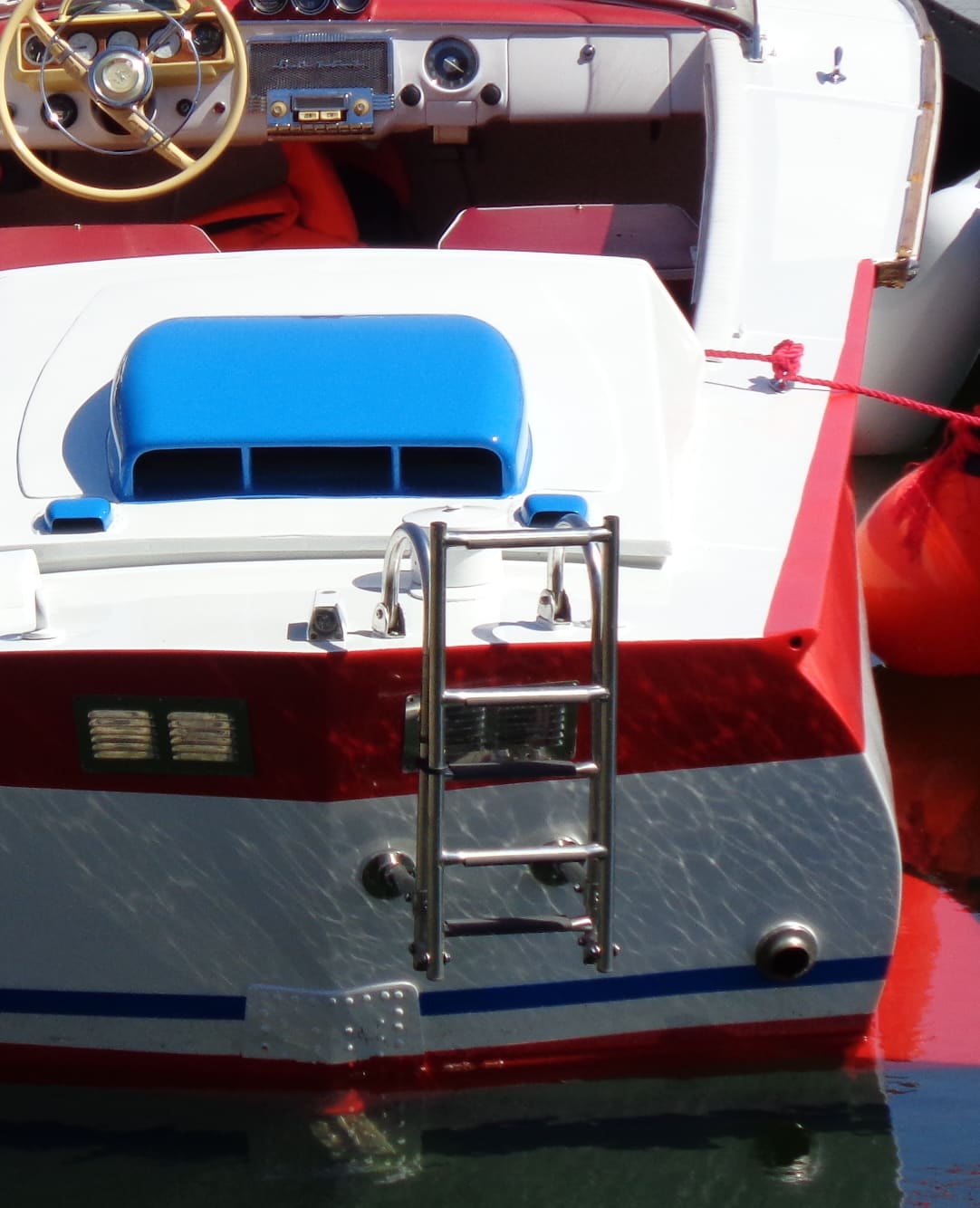
- Swim-platform ladders: fold or telescope off a platform; usually need no more than three steps to reach the depth because the platform sits close to the water.
- Transom ladders: hinged units on sailboats, often part of the stern rail.
- Removable ladders: clip into brackets bolted to the gunwale or deck. Handy, but if stowed underway they can't help someone who falls in.
- Portable gunwale-hook ladders: cheap but often flimsy, swing under the boat, and must be hung from inside the boat.
If your main ladder can't be deployed from the water, add an emergency ladder: a rope ladder with rigid steps stored in a bag on the boat, with a pull strap that hangs just above the water.
In 2008, the Foundation had volunteers make more than 200 reboarding attempts with portable ladders on a jon boat, a RIB and a 17-foot center console. Their lessons:
- A ladder that worked great on one boat often failed completely on another. Match it to your boat and test it.
- Short, simple one- or two-step ladders that didn't swing far under the hull scored best.
- Many testers liked a homemade loop of thick polyester line, sized to fit them, as much as any store-bought product.
- On a tippy jon boat, boarding at the stern or bow near something to grab worked best.
- On a stern ladder, mount it as far from the centerline (and the propeller and exhaust) as practical.
- On an outboard or sterndrive boat, turn the engine hard toward the side you've picked and mark how far it swings; the ladder goes outboard of that mark.
- Make sure there's a solid handhold within reach of someone standing on the ladder.
- On sailboats, the side by the lifeline gate is often easiest.
- On outboard boats, BoatUS notes the port side of the transom is a common choice, because the steering, control and fuel lines usually run inside the starboard side and swimmers would have to climb over them.
- A small transom swim-platform kit (platform plus telescoping ladder) is a popular retrofit on outboard and sterndrive boats. Before ordering, measure how much flat transom you have above the waterline: BoatUS's writer learned that some transoms are too short for the strut below and the handrail above, and the maker then suggests a different model.
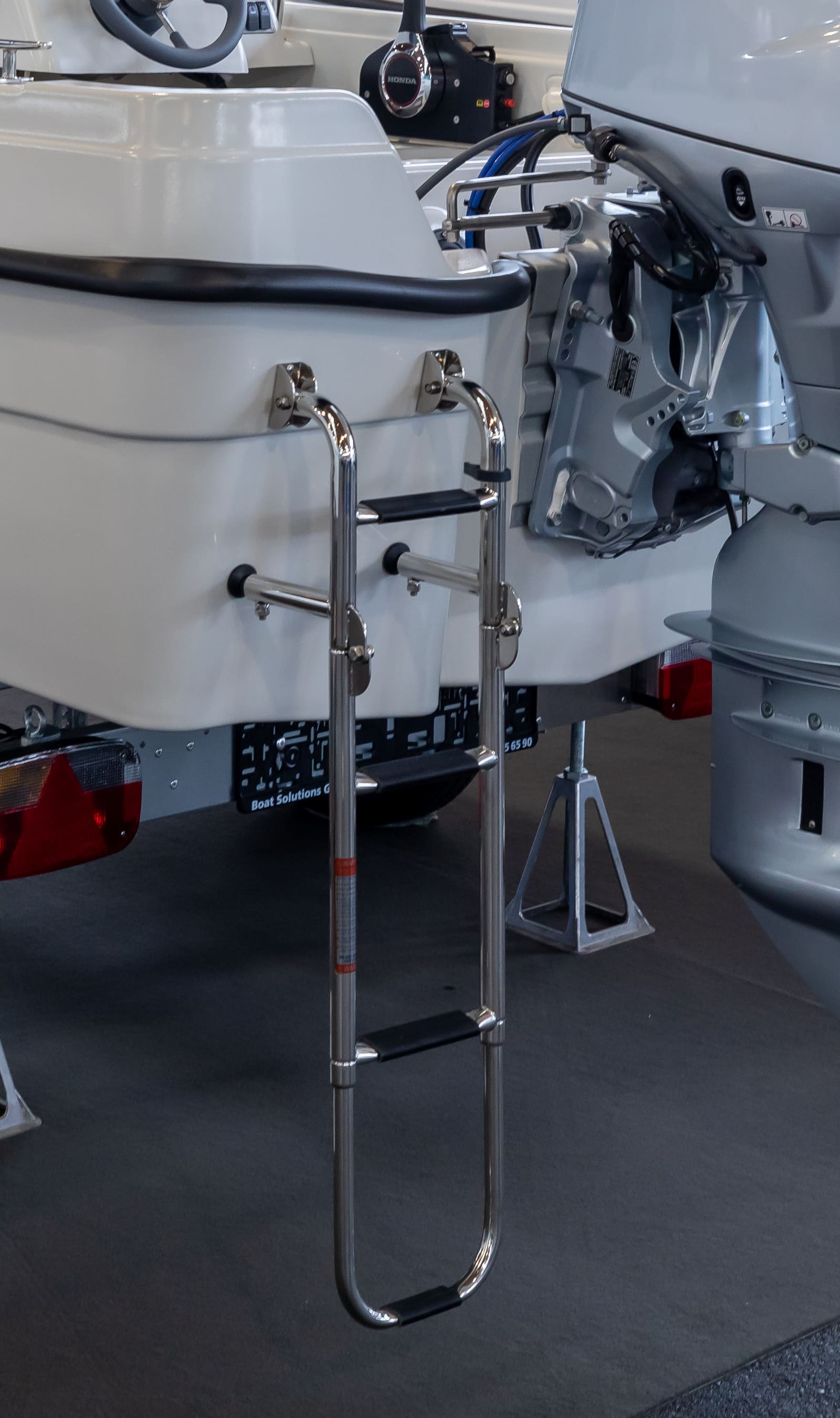
Photo: Matti Blume / Wikimedia Commons · CC BY-SA 4.0 A folding ladder needs a pull line or strap that hangs low enough to grab from the water, and a latch that holds it up while underway but releases with a tug. Check that it can't be released by a wave, but can be by a tired swimmer. Weighting the bottom rung of a rope ladder helps it drop all the way.
Hold the ladder or mount in place and mark the holes with a grease pencil. Look inside: can you reach every bolt to put a nut on it? Are there wires, hoses or fuel lines behind the spot? Is there room for a backing plate? If you can't reach the back side, pick another spot.
Center-punch each mark, drill a small pilot hole, then the full size, slowly and with a sharp bit so the gelcoat doesn't chip. Running the bit in reverse through the gelcoat helps. If the transom or deck is cored (plywood or foam between fiberglass), seal the exposed core in each hole with epoxy so water can't get in and rot it. See through-bolting accessories.
Use marine-grade stainless bolts, nuts and washers, with a backing plate or large washers inside to spread the load: a ladder carries the full weight of an adult pulling and bouncing. Bed every bolt and the mount base in marine sealant. Tighten evenly; check your ladder's instructions for any torque figure. Never use screws alone into fiberglass for a ladder.
Repeat step 1 with the new ladder, and have every regular crew member try it, including the lightest and least agile person. Time how long it takes. If anyone can't do it, adjust: a longer ladder, an extra step, a better handhold, or a different spot.
Look for:
- Cracked welds or bent tubes, and loose or cracked steps
- Hinge pins and latches moving freely, not seized with salt
- Mounting bolts tight, with no cracks in the gelcoat around them (a sign of flexing)
- Rope ladders: chafed line, faded webbing, brittle plastic steps
- Pull strap still in place and reachable
Rinse with fresh water after saltwater use and lightly lubricate hinges as the maker recommends.
Common mistakes
- A ladder that only the person aboard can deploy. If you boat alone, this is the one that counts.
- Too short: the bottom rung at or near the waterline, so you have to lift your knee to your chin.
- Mounted next to the propeller, or used with the engine idling in neutral.
- Screws instead of through-bolts and backing plates, pulled out the first time someone heavy climbs.
- Never testing it from the water until the day it matters.
- Forgetting that most people climb with their legs, not their arms. BoatUS points out that a ladder that stops short, or a handhold set too low, leaves people trying to haul themselves up by arm strength alone. Add steps or a higher grab handle until it works for the weakest swimmer aboard.
- Swimming at the stern with an engine or generator running on your boat or the one next to you. Carbon monoxide collects near the water's surface around the transom and swim platform.
When to call a pro
- The transom or deck is cored and soft, wet or cracked around the planned spot
- You can't reach the back side to install backing plates
- Adding or modifying a swim platform (structural job)
- Anyone is in the water and can't get back aboard: call USCG on VHF 16 or 911, and throw them a flotation device and line
Tips
- Keep a loop of thick line or a cheap webbing step aboard as a backup reboarding aid.
- Classic or antique boat? The Antique & Classic Boat Society points out that a period-correct ladder may look right at a show but be hard to climb. Their writer found a small removable transom-mount ladder worked best of the removable types, ranked rope ladders with plastic steps as the hardest to board with, and noted that gunwale-hook ladders demand real upper-body strength. A removable ladder kept aboard lets you keep the boat original and still get people back in.
- Make it a group drill: on a warm day, have everyone aboard (or your boat club) try climbing in from the water with your ladder. You'll learn who can't manage it before it matters, and it doubles as man-overboard practice.
- Always wear the engine cut-off lanyard or wireless fob when running alone, so the boat stops if you go in (see kill-switch lanyard).
- A ladder on your home dock or slip, if the marina allows it, gives anyone who falls in at the dock a way out.
- Teach guests how to put the ladder down from the water before the first swim.
Official references
We read these to write this guide. Your engine's own manual always wins.
Safety: BoatMend is for information only and does not replace a certified marine technician. You are responsible for your safety and your boat. Read the full disclaimer.
Last updated 2026-10-25
Related guides
Man-Overboard Recovery Gear: Throwables, Lifesling, Ladders and MOB Alarms
Set up and check the gear that gets a person in the water back aboard - a throwable within reach, a floating rescue line or Lifesling-style sling, a boarding ladder someone in the water can pull down, and MOB alarms or AIS beacons - and practice the drill so it works when it counts.
How to Mount Rod Holders, Fish Finders, Cleats and Antennas Without Causing Leaks
Add accessories to your boat the right way, with through-bolts, backing plates, sealed core and proper wire pass-throughs, so every new hole stays dry and strong. Also learn where you should never drill.
Marine Sealants Explained: 5200, 4200, 4000UV, Polysulfide, Silicone and Butyl Tape
Pick the right sealant before you bed a cleat, a through-hull, a window or a transducer. The wrong goo either leaks in a year or glues a part on so hard you damage the boat getting it off.
How to Find and Fix Leaking Deck Hardware (Rebedding Cleats, Stanchions and Tracks)
Track down the cleat, stanchion base or track that is dripping into the cabin, then remove it, seal the deck core and bed it again with the right sealant so the leak stops for years instead of weeks. Catching it early protects the deck core from rot.
USCG Required Safety Equipment Check by Boat Length
Walk through your boat and confirm you carry every piece of safety gear the US Coast Guard requires for your boat's length and type, and that none of it is expired or worn out. Missing or expired gear is one of the most common tickets on the water, and it is the gear you need when things go wrong.
Engine Cut-Off Switch (Kill Switch) and Lanyard: The Law, Testing and Daily Use
How the engine cut-off switch (ECOS) and its lanyard or wireless fob work, when federal law requires you to wear it (boats under 26 feet, 3 hp or more, on plane), how to test it before every trip, and why a spare clip aboard matters.
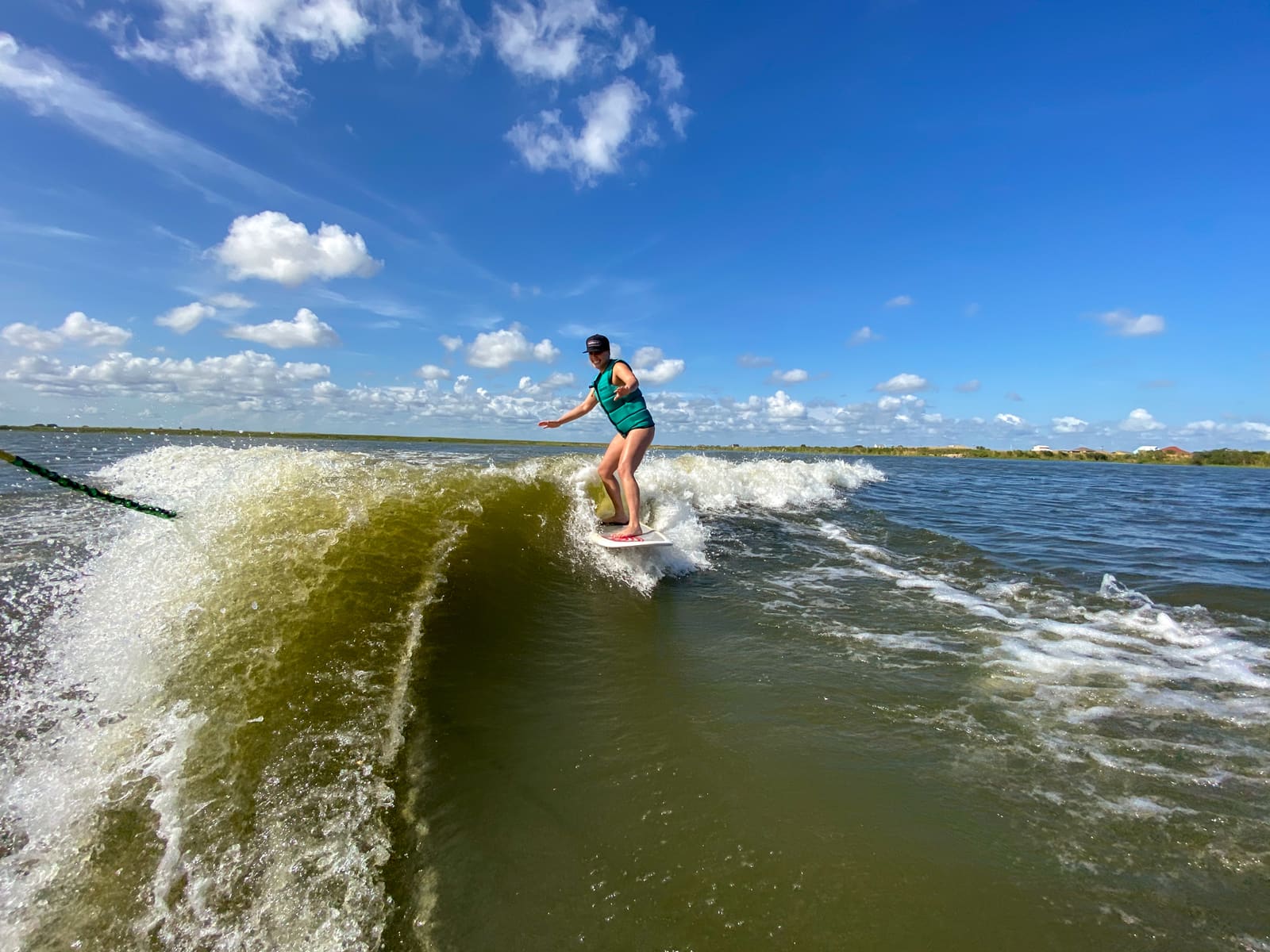
Wakesurf Safety: The Right Boat, Carbon Monoxide, Spotters and Distance
A pre-ride checklist for wakesurfing - surf only behind inboard or V-drive boats built for it, keep riders away from exhaust and the engine off when they board, use a spotter and a short surf rope, stay well away from shore, docks and other boats, and never overload the ballast.