Helping Another Boater: Your Duty to Assist, Safe Approaches, and When Not to Tow
What the law expects when you come across a boater in trouble, how to approach a disabled or sinking boat safely, how to take people aboard, the basics of a short tow, and when to stand by and call the Coast Guard, Sea Tow or TowBoatUS instead. People first, boats second.
Time
30 min
Applies to
All engines
Safety first: Save people, not boats. If anyone is in the water, the boat is sinking or on fire, or someone is hurt, call the Coast Guard on VHF 16 (or press the DSC distress button) or 911 first, then help as far as you safely can. Never put your own boat or crew at serious risk, and never tie up to a boat that's going down.
Fuel smell, water coming in, CO alarm or smoke? Stop, get everyone in life jackets and call USCG on VHF 16 or 911. For a tow: Sea Tow or TowBoatUS.
Owners often ask
- A boat broke down near me and asked for a tow. Am I legally required to tow them?
- Can someone who pulled my boat off a sandbar send me a salvage bill?
This guide walks you through it. Still stuck? Ask the AI Mechanic about your engine.
Tools
- VHF radio (ideally with DSC and GPS)
- Throwable flotation (ring buoy or cushion) on a line
- Extra life jackets
- Fenders
- Long, strong line (an anchor line of 100 to 150 feet works) and two dock lines for a bridle
- Sharp knife within reach
Parts & supplies
- Spare fuel can, jump pack or charged battery (to hand over rather than tow)
Before you start
Sooner or later you'll see a boater waving, drifting, or sitting low in the water. Most problems are minor: out of fuel, dead battery, forgot the drain plug. Some are life-threatening. This guide helps you decide what to do quickly and safely.
What the law says. Federal law (46 U.S.C. 2304) requires the person in charge of a vessel to help anyone found at sea "in danger of being lost," as far as they can without serious danger to their own boat or the people aboard. If you're involved in an accident, a separate section (46 U.S.C. 2303) requires you to help the people affected and exchange names and boat details. That same section protects a Good Samaritan from liability for damages when they help in good faith, without objection from the people helped, and act as a reasonable, prudent person would.
What the law doesn't say. As a charter captain quoted by Mercury puts it, nothing says you have to tow anyone. Helping can be a radio call, a life jacket, a ride to shore, or a can of fuel.
Steps
Slow down well before you reach them. Look and ask (by voice or VHF):
- Is anyone in the water, hurt, or sick?
- Is the boat taking on water, on fire, or smoking?
- How many people are aboard, and are they wearing life jackets?
- What's the problem, and have they already called for help?
A TowBoatUS captain's advice: make a slow circle around the boat, size it up, then back off and make a plan. "If there is no emergency, don't make one."
If anyone's life could be at risk, call the Coast Guard on VHF 16 with your GPS position, or press your DSC distress button. On inland waters the Coast Guard doesn't cover, call 911 or the local marine patrol. Mercury points out a VHF call is also heard by other boaters nearby who may be better equipped to help.
For a non-emergency breakdown, help them call their tow service, or call Sea Tow or TowBoatUS for them. On lakes without a local tow company, BoatUS dispatch or local law enforcement usually know who to call.
If someone is in the water:
- Throw flotation right away: a ring buoy or cushion on a line.
- Approach slowly, ideally into the wind or current so you can stay in control.
- Shift to neutral, and stop the engine before the person is near the propeller. Never back toward someone in the water.
- Bring them aboard over the side or stern away from the prop. Cold, tired people can't climb much; see MOB recovery gear and treat for cold if needed (cold-weather boating).
If their boat is going down, take the people, not the boat. Mercury's guidance:
- Don't tie a sinking boat to yours; it can pull your boat over.
- Put fenders between the boats, hold the rail, and pass people across one at a time, wearing life jackets.
- Keep upwind of a burning boat and don't come alongside if flames or fuel are near.
- Watch your capacity plate. A small boat can only safely carry so many extra people. If you can't take everyone, keep everyone afloat and together and stay close until help arrives.
Then take them to shore if it's safe and close; if you're far out, Mercury says the best option may be to stay with them until help arrives.
Many breakdowns don't need a tow at all. You can:
- Hand over a can of fuel or a jump pack.
- Lend a life jacket or a handheld VHF.
- Run to the dock for fuel or a charged battery and bring it back (a TowBoatUS suggestion).
- Help them anchor so they're safe while they wait for a commercial tow.
Mercury and TowBoatUS captains list good reasons to say no:
- You're not experienced at towing, it's getting dark, or you're tired after a day in the sun.
- Wind or seas are building, especially a following sea or wind against current.
- The other boat is much bigger or heavier than yours, or your cleats aren't strong, well-backed hardware.
- It's a hard grounding, or the boat may be damaged and could sink once pulled into deep water.
- People aboard are drunk or argumentative.
- Your insurance may not cover you; Mercury notes towing could violate your own policy's terms.
If any of these apply, stand by, keep them safe, and let the Coast Guard or a commercial tow handle it. Standing by is still helping.
Discover Boating goes further: it advises recreational boaters not to tow at all, because their boats aren't rigged or equipped for it, and sums up the Good Samaritan job as "helping the people, not the boat." Two alternatives it suggests: run to the marina for a can of fuel if they're simply out of gas, or, if you can do it without overloading your boat, carry the crew to shore and leave their boat anchored for a professional. If you do tow a short distance, head for the nearest safe harbor or dock, not necessarily the ramp they launched from; you won't be getting on plane.
If you do decide to tow (calm water, short distance, a boat about your size or smaller):
- Everyone on both boats wears a life jacket. Agree on a plan and an "abort" signal.
- Use the disabled boat's own anchor line if it's long and strong; a TowBoatUS captain suggests 100 to 150 feet between boats in open water, about half that in tight quarters.
- Make a bridle from two dock lines between your stern cleats so the load is shared. Attach the towline to their bow eye or a strong bow cleat.
- Keep hands, feet and people clear of the line. Nylon stretches a lot, and if anything breaks it snaps back like a whip.
- Keep a sharp knife within reach in case you need to cut the line in a hurry.
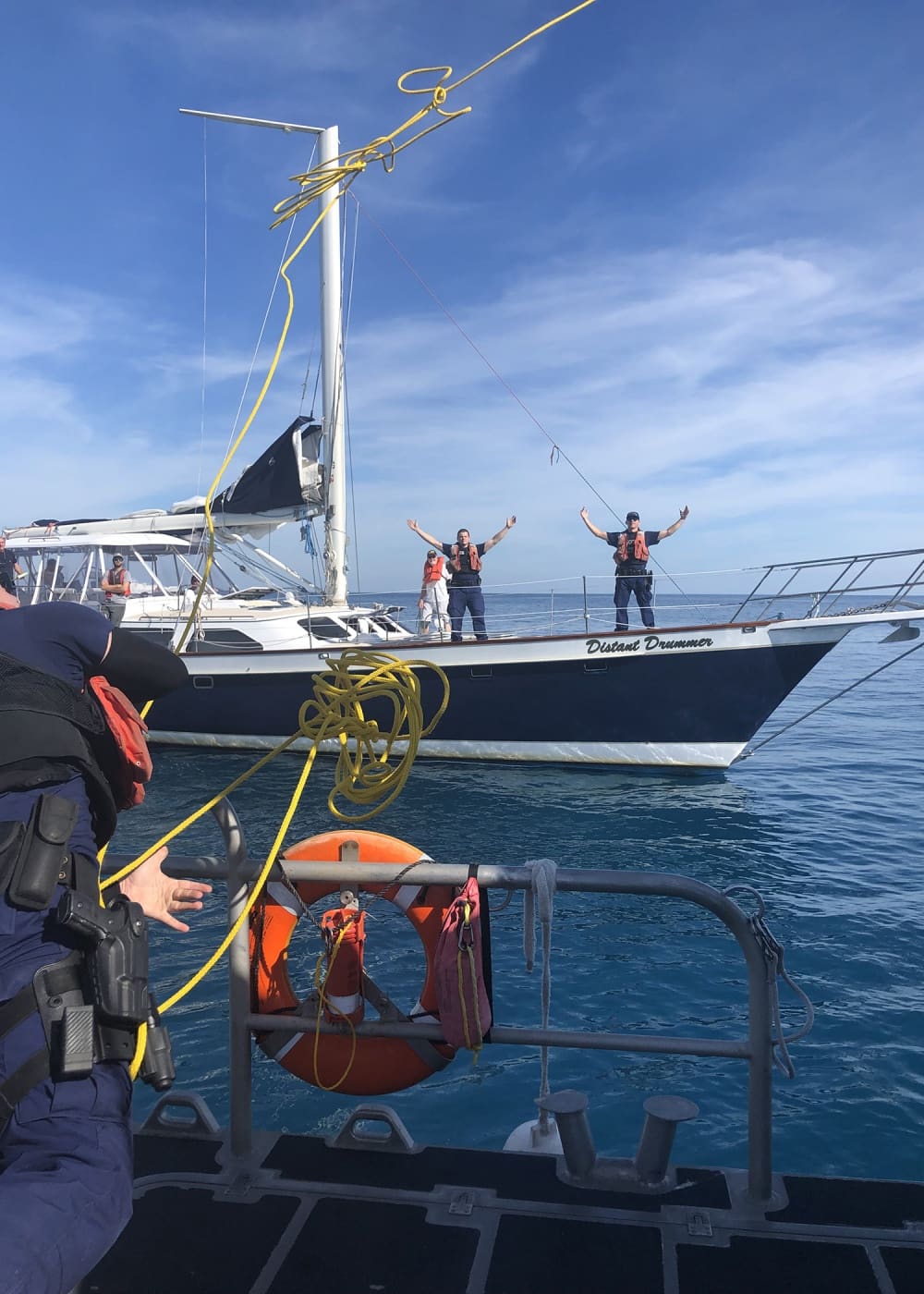
Pass the line from a safe distance, then let the other crew make it fast at their bow. Photo: U.S. Coast Guard (Andrew Krok) / Wikimedia Commons · Public domain - Take up the slack very gently: bump in and out of gear.
- Go slowly. Expect a long trip; TowBoatUS captains plan for around 6 mph, and a 45-minute run can take hours. Check that you have enough fuel and daylight for both boats.
- Make wide, gradual turns; even with a bridle, only about 20 degrees at a time. The towed boat cuts inside your turn.
- Never back down with the towline behind you, where it can foul your prop.
- Remember the towed boat keeps coming if you stop, so slow down gradually. Have someone on the towed boat steer to keep it tracking straight behind you.
TowBoatUS captains say the most stressful part is right at the dock. Shorten the line before you get close, or tie your own boat up first, then bring the towed boat in by hand with lines. Approach into the wind or current if you can.
If your boat is the one in trouble, know that a stranger who saves your boat from real danger may be entitled to a salvage award under maritime law; the Sailing Magazine article describes a good Samaritan who lassoed a drifting racing catamaran and then filed a salvage claim. A maritime lawyer quoted there advises agreeing on terms, in writing, before accepting help from anyone: the price or hourly rate and what's being done. You can also decline assistance.
BoatUS draws the line between a simple tow (no immediate danger, no special equipment) and salvage (the boat is in immediate peril, or pumps, airbags or cranes are needed). Tow memberships usually don't cover salvage; your boat insurance usually does. See boat insurance claims.
If you are the helper, you're helping, not hunting for a payday. Keep it simple and friendly.
Note the time, position, what happened, who you called, and the boat's name and registration. If there was an accident, the operators involved may have to file a boating accident report with the state. Under federal rules (33 CFR 173.55), the operator must report when someone dies, is injured and needs medical treatment beyond first aid, disappears from the boat, or when damage totals $2,000 or more or a boat is a total loss. The deadline is 48 hours for a death within 24 hours, an injury needing treatment, or a disappearance, and 10 days otherwise. If the operator can't file, the owner must. States can set their own thresholds and forms, so check with your state boating agency. Exchange names and boat information as 46 U.S.C. 2303 requires.
As a helper who wasn't involved, you usually don't file the report yourself, but your notes and photos can help the people who do.
Common mistakes
- Racing up to a boat in trouble and creating a wake or a second accident.
- Tying alongside a sinking boat.
- Backing toward a person in the water with the propeller turning.
- Towing with a short line straight off one cleat, then turning sharply.
- Standing in line with a loaded towline.
- Starting a long tow in late afternoon with half a tank of fuel.
- Overloading your own boat with rescued people and gear.
- Assuming the Coast Guard will tow a boat that isn't in danger. They usually hand non-emergencies to commercial towers.
When to call a pro
- Anyone in the water, injured, a fire, or a sinking: Coast Guard on VHF 16 or 911, right away.
- Hard groundings, boats on rocks or reefs, boats that are flooding, or large or heavy boats: commercial towing and salvage (Sea Tow, TowBoatUS or a local operator).
- Bad weather, nightfall, or any doubt about your skills: stand by and let the professionals tow.
Tips
- Keep a long, floating line and two dock lines aboard just for emergencies.
- Save Sea Tow's and TowBoatUS's dispatch numbers in your phone.
- Practice approaching a mooring ball slowly from downwind; it's the same skill as approaching a disabled boat.
- Carry a couple of extra life jackets; the people you rescue may not have theirs on.
- Before a trip, read emergency drills with your crew so they know how to help someone else too.
Official references
We read these to write this guide. Your engine's own manual always wins.
- Cornell LII – 46 U.S. Code § 2304, Duty to provide assistance at sea
- Cornell LII – 46 U.S. Code § 2303, Duties related to marine casualty assistance and information (Good Samaritan protection)
- eCFR – 33 CFR 173.55, Report of casualty or accident
- Mercury Marine – How to Be a Boating Good Samaritan (Dockline)
- Trade Only Today – Rendering Aid, How to Safely Tow Other Boats (advice from TowBoatUS captains)
- BoatUS Foundation – Dealing with an Accident (study guide)
- BoatUS – Boat Towing FAQ (towing vs. salvage)
- Sailing Magazine – Know Your Salvage Rights
- Discover Boating – How to Tow Another Boat in the Water
Safety: BoatMend is for information only and does not replace a certified marine technician. You are responsible for your safety and your boat. Read the full disclaimer.
Last updated 2026-10-25
Related guides
Emergency Drills for Your Crew: Engine Failure, Fire, Steering Loss and Man Overboard
Practice what everyone aboard does when the engine quits, a fire starts, the steering fails or someone falls in. A few short drills each season turn panic into a plan, and teach your crew to anchor, call for help on VHF 16 or DSC, and get a tow.
Set Up Your VHF Radio: MMSI, DSC, GPS Hookup and Radio Checks
Get a free or low-cost MMSI number, program it into your DSC radio, connect your GPS so a distress alert sends your exact position, check the antenna, and learn the Channel 16 rules and the right way to do a radio check.
Man-Overboard Recovery Gear: Throwables, Lifesling, Ladders and MOB Alarms
Set up and check the gear that gets a person in the water back aboard - a throwable within reach, a floating rescue line or Lifesling-style sling, a boarding ladder someone in the water can pull down, and MOB alarms or AIS beacons - and practice the drill so it works when it counts.
What to Do When Your Boat Is Taking On Water: Emergency Steps and Prevention
A step-by-step emergency plan for water coming into the boat - life jackets on, call for help early on VHF 16, find and slow the leak, pump, and head for shallow water if needed - plus the maintenance checklist that prevents most sinkings.
How to Size, Rig and Inspect Dock Lines and Fenders
Pick the right dock line diameter and fender size for your boat, set up bow, stern and spring lines in a slip, add chafe gear, inspect for wear and UV damage, and double everything up before a storm.
Boat First-Aid Kit and Medical Prep: What to Carry, Day Trips to Offshore
Build and maintain a boat first-aid kit that fits how far from help you go, with the extras boaters actually need for seasickness, fish hooks, cuts, burns, sun, heat and cold, plus a crew briefing, expiration-date checks and training. General preparation only, not medical advice.
How to File a Boat Insurance Claim: Safety, Mitigation, Documentation and Settlement
What to do from the moment something goes wrong until the check arrives: make everyone safe, stop further damage, report right away, document with photos and your maintenance log, handle towing versus salvage, work with the adjuster or surveyor, and understand agreed value, actual cash value and the common exclusions. Policies differ, so your own policy wording always wins.
Cold-Weather Boating: Cold Water Safety, Gear and Engine Care in Late Fall and Winter
Boating after the crowds leave can be beautiful, but cold water changes the risks. Learn why cold shock is the first danger, why the popular 1-10-1 rule needs caution, what to wear, how to plan, and how to care for the engine, battery and anything that holds water between trips.
Engine Cut-Off Switch (Kill Switch) and Lanyard: The Law, Testing and Daily Use
How the engine cut-off switch (ECOS) and its lanyard or wireless fob work, when federal law requires you to wear it (boats under 26 feet, 3 hp or more, on plane), how to test it before every trip, and why a spare clip aboard matters.
How to Load Your Boat Safely: Capacity Plate, Balance and Stability
Too much weight, or the right weight in the wrong place, is behind most small-boat capsizes and swampings. Learn to read the capacity plate (persons, weight and horsepower), add up your real load, balance it side to side and fore and aft, and adjust for rough water, water aboard and towing riders.