How to Change the Oil and Filter on a Four-Stroke Jet Ski (PWC)
Pump the old oil out through the dipstick tube, swap the filter, refill and check the level the way your model requires. A yearly oil change (or at the hours your manual lists) is the single most important service for a four-stroke Sea-Doo, Yamaha WaveRunner or Kawasaki Jet Ski.
Time
1 h
Shop would charge
$150-300
Applies to
Jet ski / PWC · Jet ski / PWC
Safety first: Only run the engine outdoors, never in a garage: exhaust carbon monoxide can kill. Never run a PWC engine out of the water without cooling water from a flush hose, and follow your manual's time limit (Sea-Doo says no more than 2 minutes at a time). Hot oil and exhaust parts burn. Keep hands, hair and loose clothing away from the drive shaft area while the engine runs.
Owners often ask
- How do I change the oil on my Sea-Doo if there's no drain plug?
- Why does my jet ski's dipstick read differently every time I check the oil?
This guide walks you through it. Still stuck? Ask the AI Mechanic about your engine.
Tools
- Fluid extractor pump (hand, manual-vacuum or 12 V) with a thin hose
- Socket wrench and the driver that fits your filter cover bolts (Sea-Doo uses an external Torx)
- Drain pan, rags, oil-absorbent pads and a small funnel
- Garden hose and flush adapter (to run the engine with cooling water)
- Gloves and safety glasses
- Tape or marker to mark the extractor hose depth
Parts & supplies
- Marine four-stroke PWC oil of the type and grade in your owner's manual
- New oil filter and O-ring(s) for your engine (or the maker's oil change kit)
Before you start
This guide is for four-stroke PWCs (all current Sea-Doo, Yamaha and Kawasaki models). Older two-stroke skis have no engine oil to change; they burn oil from a separate tank.
How often: typical intervals are once a year or every 50 to 100 hours, whichever comes first. Yamaha lists every 50 hours or once a year on its WaveRunner maintenance page; Sea-Doo recommends a yearly change and suggests doing it at the end of the season so the engine sits all winter with clean oil. Supercharged and high-output engines often have shorter intervals. Confirm in your owner's manual.
Break-in service: new skis have a break-in period with RPM limits, and most makers schedule an early first service (often around the first 10 hours or first month; check your manual). It usually includes an oil and filter change. Doing it on time, with receipts, matters for warranty.
Extraction, not a drain plug. Most PWCs have no easy oil drain plug: you pump the oil out through the dipstick tube with an extractor. Some models need the tube pushed to a specific depth, which is in your manual (Sea-Doo lists it per engine).
Dry-sump engines. Many PWC engines keep part of their oil in a separate oil tank or reservoir rather than all in the bottom of the engine, so one pass with the extractor leaves a good share of old oil behind. That is why some makers add a crank-and-extract routine (step 5) or other extra steps. Follow your own manual's procedure instead of a video for a different engine.
Oil and filter: use a marine four-stroke oil that meets your manual's spec, not car oil. Yamaha explains that PWC engines run at high RPM for long periods but cooler than car engines, and marine oils add corrosion protection for that. The maker's oil change kit has the right amount of oil, filter and O-rings.
Steps
Park the PWC on its trailer on level ground, chock the trailer wheels, and use the jack to level it if needed. Remove the seat (and engine cover if fitted). Leave it open a few minutes so any fuel vapors can clear, then look around the engine for oil, coolant or fuel leaks before you start.
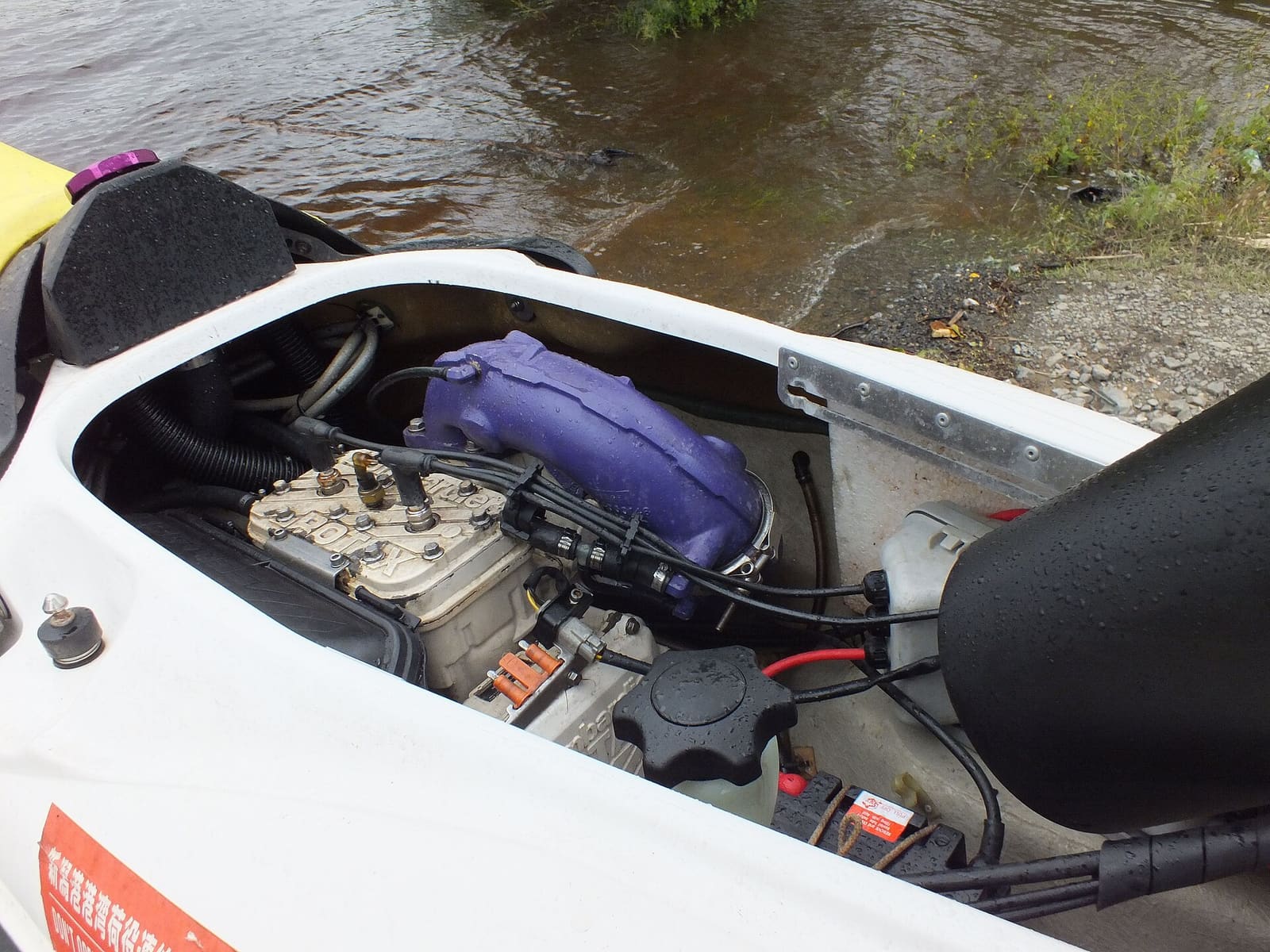
Photo: Andshel / Wikimedia Commons · CC BY-SA 3.0 The engine sits right under the seat. This older two-stroke shown has no oil dipstick; four-stroke engines add a dipstick tube and an oil filter cover on top or to the side.
Warm oil flows out more easily and carries more dirt with it. Connect the garden hose to the flush fitting and warm the engine following your manual's flushing steps. Most makers want the engine started before turning on the water and the water turned off before stopping the engine, so water can't back up into the engine. Stay within the run-time limit, and let it cool between runs if the manual says so.
Some engines hold oil in other parts of the engine that won't reach the dipstick tube unless you do a short rev and shut-off. Sea-Doo, for example, has owners give a brief rev and stop the engine at that RPM before extracting, so oil returns to the tank. Only do this if your manual says to, and only with the flush water connected.
Remove the dipstick and the oil fill cap. Mark the extractor hose at the depth your manual specifies with tape, push it down the dipstick tube to the mark, and pump the oil into the extractor or a pan. Keep pumping until only air comes up.
Sea-Doo's procedure adds crank-and-extract cycles: reinstall the cap and dipstick, reattach the tether cord, hold the throttle lever fully pressed and crank the engine for a few seconds as Sea-Doo describes (the engine turns over to move oil but doesn't start), then extract again, two or three times, to get the rest of the old oil out. Follow your own manual; not every brand does this.
Put a rag under the filter cover. Remove the cover bolts with the correct driver and set them somewhere they can't fall into the hull. Pull the old filter and O-ring(s). Wipe the housing and cover clean and check for debris. Sea-Doo notes some engines use one O-ring and others two; the new ones come in the kit.
Coat the new O-ring(s) and the filter's sealing ring lightly with fresh oil. Install the filter and the cover, and tighten the bolts to the torque in your manual (they are small bolts into a soft housing; don't overtighten). In salt water, Sea-Doo suggests a thin coat of grease on the cover's mating surface to fight corrosion.
Pour in the oil through the fill opening with a funnel. Start with a little less than the amount in your manual, since some old oil always stays in the engine. Reinstall the fill cap and dipstick.
This is where most owners go wrong: PWC oil level checks are not like a car. Each brand has its own routine, so follow your manual. In general:
- Yamaha says to check with the engine at full operating temperature, and that anywhere between the marks on the dipstick is OK.
- Sea-Doo has owners warm the engine, rev briefly and shut off at that RPM, wait at least 30 seconds, then read the dipstick.
- The level often drops a little after the first run because the new filter fills with oil. Top up in small amounts until it reads correctly. Do not overfill.
With the flush water on, run the engine briefly and look at the filter cover and fill cap for leaks. Shut down, turn off the water, and look again.
Reinstall the engine cover and seat. If your PWC has a maintenance reminder on the display, reset it as your manual describes. Record the date, engine hours, oil and filter used in BoatMend.
Pour the old oil into a sealed container and take it, with the drained filter in a bag, to an auto parts store or a local recycling center that accepts used oil.
Common mistakes
- Reading the dipstick like a car (cold, or right after shutting off without the brand's routine) and then overfilling.
- Running the engine dry without the flush hose, or running it too long on the hose.
- Turning the flush water on before starting (or leaving it on after stopping), which can push water into the engine.
- Car oil instead of a marine four-stroke oil that meets the manual's spec.
- Reusing old O-rings or pinching an O-ring under the filter cover, which causes a leak.
- Dropping a filter cover bolt into the hull. Use a magnet or put a rag under the work area.
- Skipping the break-in service on a new ski and losing warranty proof.
When to call a pro
- The oil looks milky, has metal flakes or smells of fuel (possible water intrusion or fuel dilution)
- The oil level rises between changes or keeps dropping between rides
- You can't find the correct extraction depth or level-check routine for your model
- The ski is supercharged and due for supercharger service, or it is still under warranty and you want dealer records
- Any fuel smell in the hull: stop, don't start the engine, ventilate, and call your dealer
Tips
- Buy the maker's oil change kit: it matches the oil amount, filter and O-rings to your engine.
- Change oil before winter storage, not in the spring, so acids from used oil don't sit in the engine all winter.
- A 12 V or manual-vacuum extractor makes the job much faster than a small hand pump.
- Check the oil level and color before every outing as part of your pre-ride check.
- Go by the hour meter. Yamaha suggests installing an inexpensive hour meter if your ski doesn't have one, so you know when the 50-hour service comes up.
- While the seat is off, look at the air filter and air box too. Yamaha's maintenance checklist calls for checking them for signs of water getting in; water there is also a reason to look closely at the oil for a milky color.
Official references
We read these to write this guide. Your engine's own manual always wins.
Safety: BoatMend is for information only and does not replace a certified marine technician. You are responsible for your safety and your boat. Read the full disclaimer.
Last updated 2026-10-24
Related guides
How to Winterize a Jet Ski or PWC (Sea-Doo, Yamaha WaveRunner, Kawasaki)
Get your personal watercraft ready for the off-season by flushing and draining the cooling and exhaust system, stabilizing fuel, changing oil, fogging, and storing the battery. Doing it yourself takes an afternoon and helps avoid freeze damage, corrosion and spring no-starts.
Jet Ski and Jet Boat Pump Care: Clearing the Intake Grate and Checking the Impeller and Wear Ring
Clear weeds, rope and rocks from the intake grate of a Sea-Doo, Yamaha WaveRunner, Kawasaki Jet Ski or jet boat, and learn to spot a damaged impeller or worn wear ring. A clogged or worn pump is the usual reason a jet craft revs high but goes slow.
Jet Ski Won't Start or Won't Beep: A Step-by-Step Check
Most personal watercraft that refuse to start have a simple cause: the key or lanyard, a weak battery, a blown fuse, a security lock or a flooded engine. Work through these checks from the cheapest to the most involved and learn what each result means for Sea-Doo, Yamaha and Kawasaki models.
How to Flush Your Engine With Fresh Water
Rinse salt, silt and sand out of your outboard or sterndrive cooling system using the built-in flush port, flush muffs or a flush bag. Flushing after every saltwater trip is one of the easiest ways to prevent corrosion and overheating.
How to Change the Oil and Filter on a 4-Stroke Outboard
Drain the old oil, swap the filter and refill with the right marine oil on your 4-stroke outboard. It is the most common service job, takes about an hour, and costs a fraction of the dealer price.
Four-Stroke Outboard Oil Level Rising or Smelling Like Gas: What It Means and What to Do
If the oil on your four-stroke outboard's dipstick keeps going up or smells like gasoline, fuel is probably getting into the crankcase. Learn how to check the level the right way, why lots of idling, trolling, short runs and cold water cause it, what you can do yourself, and when a fuel-system fault needs a dealer.