Electrical Safety at Your Private Dock or Boat Lift: GFCI, Shock Drowning and Annual Checks
Lights, outlets, lift motors and de-icers at a home dock put household current right next to the water, and a hidden fault can kill a swimmer without any warning. Learn the owner checks you can do safely, the protection your dock should have, the no-swimming rule, and which jobs must go to a licensed electrician.
Time
45 min
Shop would charge
$200-1500
Applies to
All engines
Safety first: Dock wiring is 120/240-volt AC next to water and can kill without any warning. Never swim near a dock, lift or boat that has AC power, and never let children or pets swim there. If someone in the water says they feel tingling, or suddenly can't swim, do not jump in: turn off the dock power at its disconnect or main breaker, throw a life ring or reach with a pole, and call 911. This guide is for looking, testing buttons and planning only. Do not open junction boxes, lift motor housings or the panel, and never stand in water while touching switches or cords. All dock wiring work belongs to a licensed electrician familiar with marine codes.
Fuel smell, water coming in, CO alarm or smoke? Stop, get everyone in life jackets and call USCG on VHF 16 or 911. For a tow: Sea Tow or TowBoatUS.
Owners often ask
- Is it safe to swim off my own dock if it has lights and a boat lift?
- Does my home dock need GFCI protection?
This guide walks you through it. Still stuck? Ask the AI Mechanic about your engine.
Tools
- Flashlight
- Plug-in GFCI/receptacle tester (the kind with a test button), optional
- Phone camera to photograph the panel, outlets and wiring
Parts & supplies
- "No swimming - electrical hazard" signs for the dock
- Weatherproof in-use outlet covers, only if fitted by your electrician
- UL marine-listed shore power cord or portable GFCI, if you plug a boat in at the dock
Before you start
What Electric Shock Drowning (ESD) is: when AC current leaks into the water from a faulty dock or a boat plugged in at the dock, a swimmer in that current can be paralyzed and drown. The Electric Shock Drowning Prevention Association (ESDPA) says most ESD deaths happen at public and private marinas and docks, the typical victim is a child swimming near the dock, and there is no visible way to tell whether water is energized. Faults are often intermittent: the water can be fine one minute and deadly the next, for example when a lift motor, light or charger switches on. Victims usually show no burn marks, so many cases are recorded as ordinary drownings.
Fresh water is the bigger risk. BoatUS explains that ESD is far more likely in fresh water, where the body conducts electricity better than the water around it. Lakes, rivers and brackish creeks are where most home docks are.
What the code says now: BoatUS reports that the National Electrical Code added ground-fault protection requirements for marinas in 2011 and, in the 2017 edition, extended them to docks at private residences, along with warning signs on docks that use electricity. The rules are not retroactive, so many older home docks have never been upgraded. Local codes and adoption dates vary; your electrician and building department know what applies to you.
What usually has power at a home dock: dock and walkway lights, outlets, boat lift motors and switches, de-icers or bubblers, a shore power pedestal or outlet for the boat, pumps, fans and sometimes a boathouse panel.
Steps
Walk the dock and list every powered item: lights, outlets, the lift motor and its switch, any de-icer, pump or aerator, the boat's shore power connection, and boathouse equipment. Photograph each one and note where its wire comes from. This list is what you hand to the electrician.
Locate the breaker(s) in your house or boathouse panel that feed the dock and label them clearly. Ask your electrician about a disconnect switch at the shore end of the dock that anyone, including a neighbor or first responder, can find and use quickly. Make sure everyone in the household knows where it is.
Safe Electricity, working with ABYC, recommends GFCI breakers on the circuits that feed a dock. Look for GFCI breakers (with a "TEST" button) in the panel, or GFCI outlets on the dock. If you can't find any protection on the dock circuits, stop using dock power for anything near swimmers and call a licensed electrician. Note that a GFCI outlet protects only itself and the outlets wired after it; a whole-dock solution is a decision for your electrician.
ESFI recommends testing GFCIs once a month. Press TEST: the power should cut off (a lamp or the tester light goes out). Press RESET to restore it. If a GFCI does not trip when tested, or trips by itself or repeatedly, do not keep resetting it. Leave that circuit off and have an electrician find the fault. A GFCI that trips is doing its job; the problem is whatever it detected.
A GFCI that passes its test is still not permission to swim. The ESDPA points out that GFCIs are fairly fragile electronic devices living in a harsh waterfront environment, and they can fail without switching the power off.
With the dock breaker off, look for:
- Cracked or missing outlet covers, or covers that don't close over a plugged-in cord
- Outlets mounted low where waves, ice or spray reach them
- Rust, green corrosion or burn marks on outlets, switches and light fixtures
- Wires stapled to the dock without protection, chafed where the dock moves, or hanging toward the water
- Extension cords used as permanent wiring, cords with the ground pin removed, or household-grade cords
Any of these is a reason to call an electrician. ESFI warns never to use frayed or damaged cords or ones with altered prongs, and to use only UL, CSA or ETL listed marine cords and plugs near water. Ontario's Electrical Safety Authority adds that marine cords must have a ground pin.
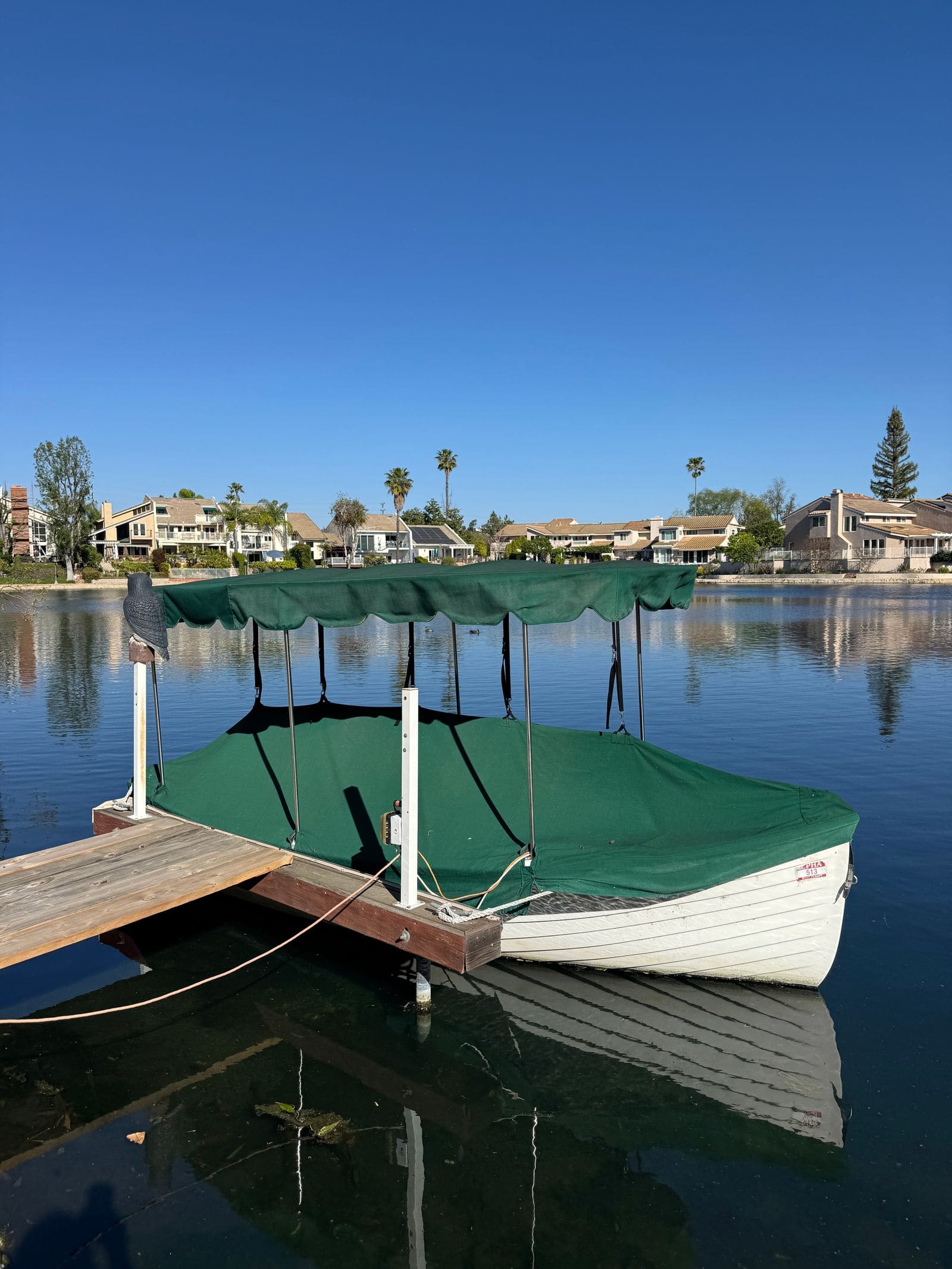
Photo: Petra Nesti / Pexels Boat lift motors and switches live in spray, rain and lightning. With power off, look at the motor housing, switch box and cable for cracks, rust streaks, missing grommets, cables lying in the water, or a switch box that holds water. The lift's metal frame should be bonded to the electrical ground, which your electrician can verify. Lift motor repair or replacement is pro work. See boat lift care for the mechanical side.
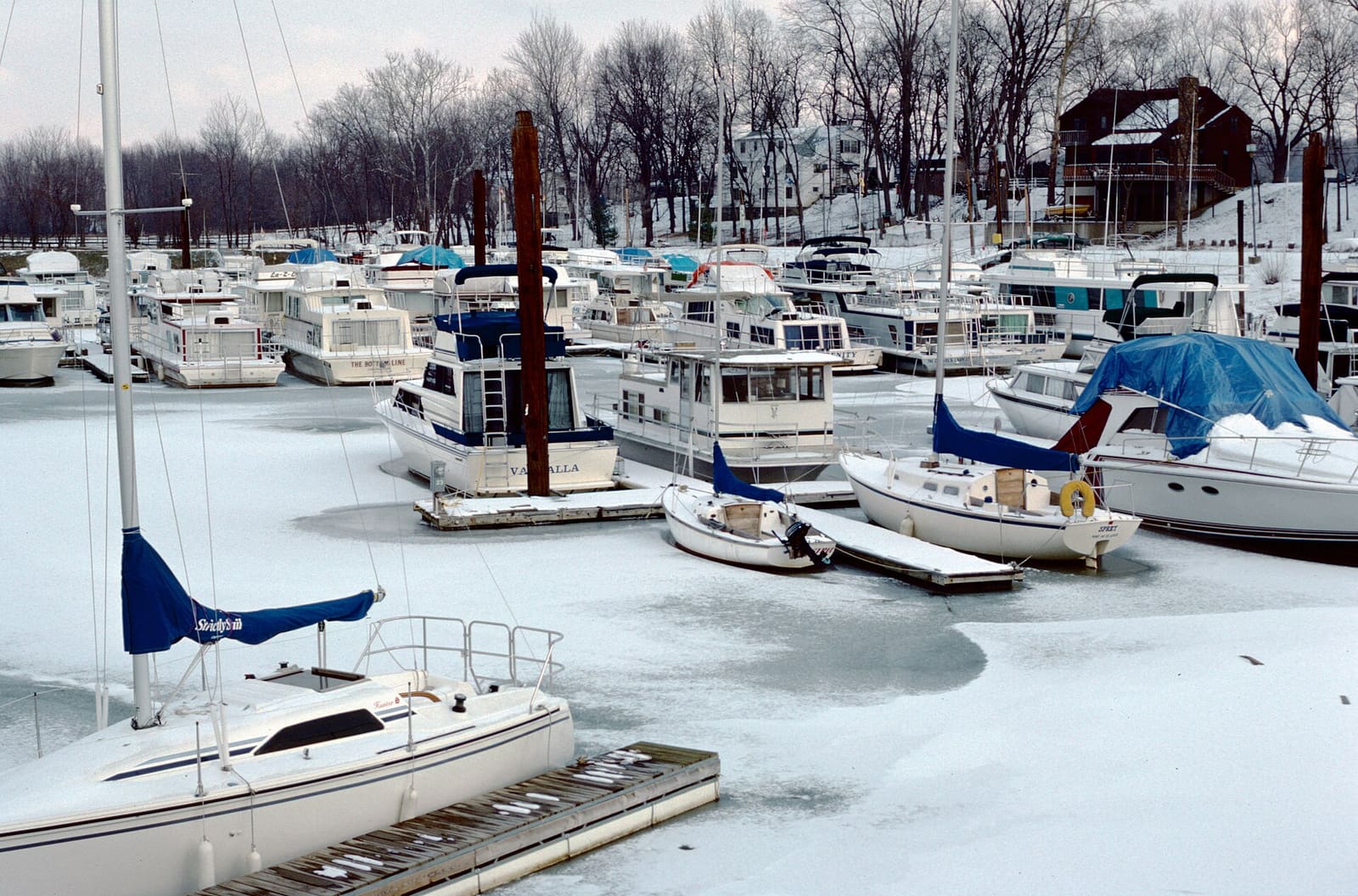
De-icers sit in the water for months. Use only units with their own built-in ground-fault protection or on a GFCI circuit, keep cords off the ice and out of the way of moving docks, and post warnings on the shore and on the ice where people walk or skate. See winter in-water de-icer.
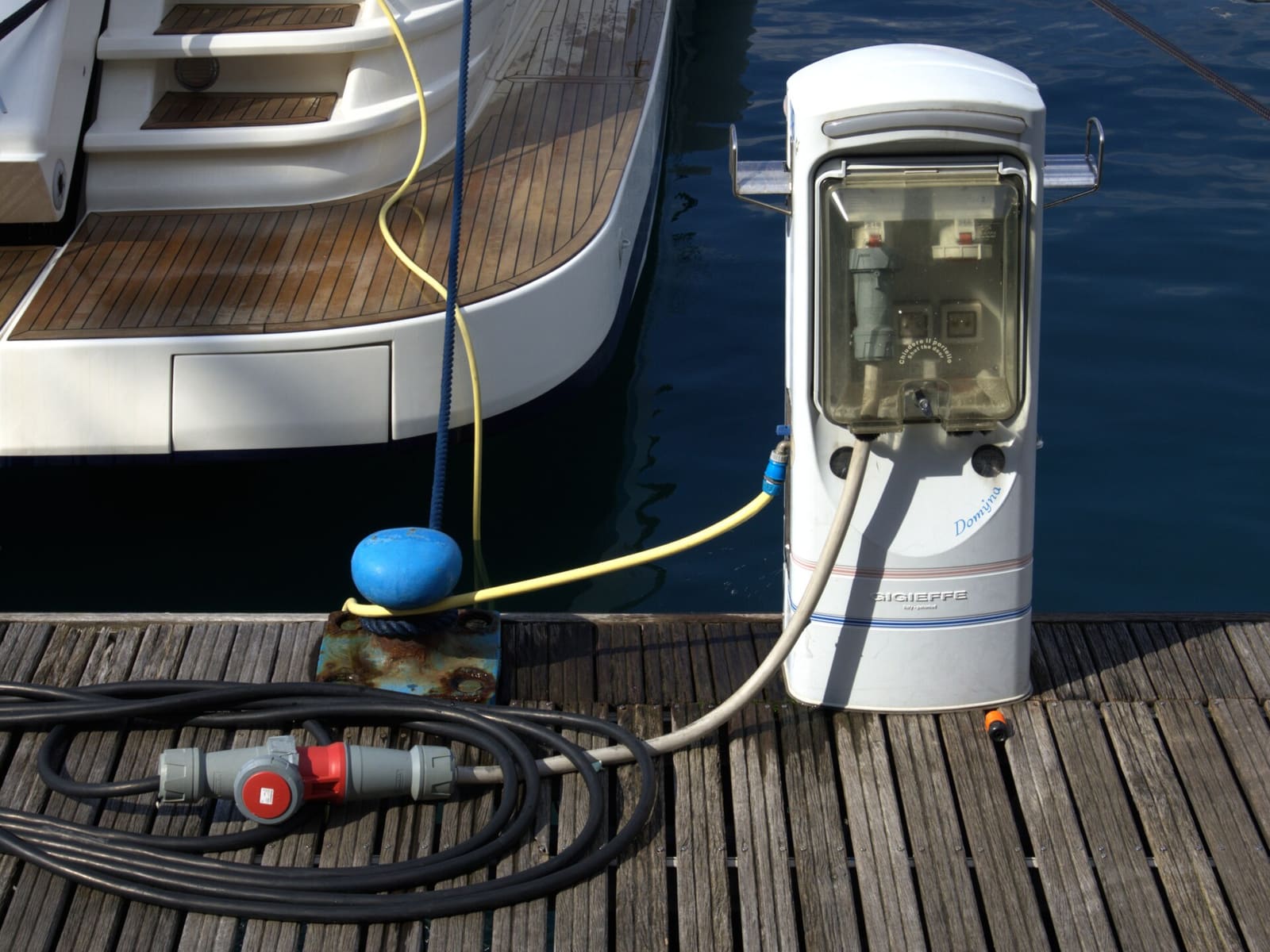
If you plug your boat in at the dock, inspect its cord and inlet (see shore power safety), use only marine-rated cords and adapters, and make sure the boat has an ELCI or isolation transformer if it has AC systems, as the ESDPA and Safe Electricity recommend. Many ESD accidents start with a fault on a boat connected to dock power. In one case a father described in BoatUS, a 12-volt wire had melted into an AC wire on a nearby powerboat with no working safety ground, putting 120 volts into its engines and the fresh water around it.
If the boat keeps tripping the dock GFCI: BoatUS explains that the 15- and 20-amp dock receptacles the code protects with GFCIs trip at about 5 milliamps, which suits a small boat with a battery charger, while modern marina shore power outlets use 30 mA protection, the same level as a boat's ELCI. A larger boat with several AC appliances can leak a few milliamps normally and trip a 5 mA outlet. That is a reason to have an electrician set up proper shore power for the boat, never to swap in a non-GFCI outlet or keep resetting it; leakage above 30 mA points to a real fault. A galvanic isolator also protects your drive and anodes (see galvanic isolator).
The ESDPA strongly discourages swimming around any boat, dock or marina that uses AC power for anything (lights, outlets, lifts, aerators) and recommends posted warning signs. BoatUS suggests staying out of the water within 150 feet of any electrical equipment or wiring. Set a firm rule: swimming happens away from powered docks, or only with all dock and boat power shut off at the breaker and unplugged. Tell guests, renters and neighbors' kids. If someone must go in to retrieve something dropped overboard, BoatUS says to shut off the dock's power first.
Owners often ask what counts. BoatUS explains that the boat's own 12-volt system does not cause ESD, and a boat's generator alone won't either unless it is feeding power to another boat through a cord. In salt water ESD is unlikely because the water conducts better than the body, but nobody knows where brackish water becomes dangerous. When in doubt, stay out.
Voltage and current detectors sold for docks can help warn you of a problem, but the ESDPA does not endorse them as a "green light" for swimming. A detector reading nothing does not mean the water is safe, because faults come and go.
BoatUS and Safe Electricity recommend having a qualified electrician inspect a private dock at least once a year, and Safe Electricity adds that all dock electrical installations should be done by a professional electrician familiar with marine codes and standards. Spring, before anyone swims, is the best time. Ask for a written report covering ground-fault protection, bonding of metal parts (frame, ladders, lift), wiring condition and any leakage readings. If you plug a boat in at the dock, ask for a leakage check on its shore power cord too: BoatUS describes how an AC clamp meter around the cord shows whether current is leaving the boat by another path. Also have it checked after storms, flooding, ice damage, or any time you add equipment.
Safe Electricity points out that neighboring docks can also put current into the water near your dock. Share what you learned, encourage neighbors to get their docks inspected, and report any tingling felt in the water to the dock owner right away so power can be shut off until it is inspected, as ESFI recommends.
Log the inspection date and electrician, GFCI test dates, any faults found and fixed, and photos of the panel labels and dock equipment. Set a yearly reminder for the spring inspection and a monthly one for GFCI tests.
Common mistakes
- Letting kids swim off the dock "because we always have." ESD faults are invisible and intermittent.
- Running a household extension cord down the dock for a lift, light or charger.
- Resetting a GFCI that keeps tripping, or replacing it with a regular outlet or breaker to "stop the nuisance."
- Doing dock wiring yourself or hiring a general handyman without marine code experience.
- Jumping in to help a swimmer in trouble near a powered dock. Rescuers often become victims; turn the power off first and throw something that floats. In the case BoatUS published, the children nearby felt tingling and backed off, and the mother who jumped in went numb and could barely move.
- Assuming a new dock is fine. Have it checked anyway, and again after the first winter.
- Forgetting the boat: a faulty boat plugged into a perfect dock can still energize the water.
When to call a pro
- No GFCI protection on dock circuits, or a GFCI that won't test or keeps tripping
- Any burned, corroded, cracked or water-filled outlet, switch box or lift motor housing
- Anyone feels tingling in the water or a shock touching a ladder, lift or rail: shut off the power, keep everyone out, and call a licensed electrician before turning it back on
- Adding lights, outlets, a lift, de-icer or shore power to the dock
- After storm damage, flooding, ice movement or a lightning strike nearby
- Annual inspection, every year
Tips
- Put the dock disconnect and the breaker labels on your family's emergency list, next to the 911 address for the house.
- Use a bright "No swimming - electrical hazard" sign at the shore end and on the dock itself; renters and guests won't know the rule otherwise.
- Turn dock power off at the breaker when you leave for the season or for more than a few days, unless something (like a de-icer) must stay on.
- When you buy a waterfront house, add a dock electrical inspection to the home inspection.
Official references
We read these to write this guide. Your engine's own manual always wins.
- BoatUS – Avoid Electric Shock Drowning
- Electric Shock Drowning Prevention Association – ESD and FAQ
- Electric Shock Drowning Prevention Association – Preventing ESD
- Electric Shock Drowning Prevention Association – Position Statement on "Green Light Devices"
- BoatUS – Raising Awareness About Electric Shock Drowning
- Safe Electricity – Prevent Deadly Shocks Around Boats and Docks
- Electrical Safety Foundation International – Electrical Safety Tips for Boat Operators
- Boating Industry Canada – Safety Tips for Public and Private Dock Owners (Electrical Safety Authority)
- BoatUS – The Electrical Dilemma On The Dock (5 mA GFCI vs 30 mA shore power protection, ELCI)
- BoatUS – A Preventable Dockside Tragedy (a family's account of an ESD death)
Safety: BoatMend is for information only and does not replace a certified marine technician. You are responsible for your safety and your boat. Read the full disclaimer.
Last updated 2026-10-25
Related guides
Shore Power Safety: Cords, Inlets, Burned Plugs and Electric Shock Drowning
An owner's inspection routine for your shore power cord, plugs, boat inlet, galvanic isolator and ground-fault protection, plus the right way to plug in and the facts about Electric Shock Drowning. This guide is for looking and testing only; any electrical repair belongs to an ABYC-certified marine electrician.
How to Inspect and Maintain a Boat Lift (Cables, Pulleys, Motor, Bunks and Storm Prep)
Inspect the cables, pulleys, motor, wiring and bunks on your boat lift, center the boat correctly, and prepare the lift and boat for storms and winter. Cable failures and overloading from rainwater or snow are the most common ways lifts drop boats.
How to Keep Your Boat in the Water Over Winter (De-Icers, Covers and Checks)
Wintering afloat can be safe if you still winterize every water system, keep the bilge pump and batteries working, use a de-icer correctly on a GFCI-protected circuit, respect the shock and thin-ice risks, and visit the boat regularly.
Galvanic Isolator: Why Shore-Powered Boats Need One and How to Tell If It's Working
A galvanic isolator (or an isolation transformer on bigger boats) keeps stray DC current from the marina's ground wire from eating your anodes, drive and running gear, without cutting the safety ground. Learn what it does, the owner-level checks you can do, what failure looks like, and why the actual meter test is usually a job for a marine electrician.
Lightning and Your Boat: Protection, Storm Safety and After-Strike Inspection
How lightning damages boats, what a professionally installed protection system (ABYC and NFPA 780 guidance) can and cannot do, what to do when a storm catches you on the water, and a step-by-step inspection checklist after a strike, including the haul-out, compass, electronics, through-hulls and the insurance claim.

How to Prepare Your Boat for a Hurricane or Tropical Storm
Make a written storm plan before the season, then haul out or secure the boat with doubled lines and chafe gear, strip off everything that catches wind, and check it safely after the storm. Never ride out a hurricane aboard.