Diesel Cabin Heaters: What a Forced-Air or Bulkhead Heater Install Involves
Understand what goes into installing a diesel cabin heater (fuel pickup, exhaust or chimney, combustion air, ducting, power and CO alarms) so you can plan it with an installer, check the work, and keep the heater safe with monthly runs and regular service.
Time
4 h
Shop would charge
$2500-8000
Applies to
All engines · Sailboat, Cabin cruiser, Yacht
Safety first: A diesel heater burns fuel inside your boat. A poor installation can cause a fire, a fuel leak or carbon monoxide (CO) poisoning, and CO can kill sleeping people without warning. We recommend a trained marine heater installer for the install itself; this guide explains what the job involves so you can plan it, ask the right questions and check the result. Install working marine CO alarms before the first night with the heater. If a CO alarm sounds, or anyone gets a headache, dizziness or nausea, shut the heater off, get everyone into fresh air and call 911 (or the USCG on VHF 16 if you are underway). If you smell diesel or see smoke inside the boat, shut the heater down and do not use it again until a pro has checked it.
Fuel smell, water coming in, CO alarm or smoke? Stop, get everyone in life jackets and call USCG on VHF 16 or 911. For a tow: Sea Tow or TowBoatUS.
Owners often ask
- Can I install a diesel forced-air heater myself, and where should the exhaust go?
- My diesel heater puffs white smoke and won't stay lit. What usually causes that?
This guide walks you through it. Still stuck? Ask the AI Mechanic about your engine.
Tools
- Tape measure, flashlight and notepad for planning the layout
- Infrared thermometer (to check surface temperatures on the test run)
- Screwdrivers and a small wrench set (for inspection covers and clamps)
- Multimeter (for checking supply voltage at the heater)
Parts & supplies
- Heater kit and marine installation accessories approved by the heater maker
- Exhaust through-hull or deck (chimney) fitting specified for your heater
- Marine CO alarms for the main cabin and every sleeping area, plus a smoke alarm
- Fuel filter and fuel-rated hose specified in the installation manual
- Heat shield material and standoffs, if the manual calls for them
Before you start
The three common types:
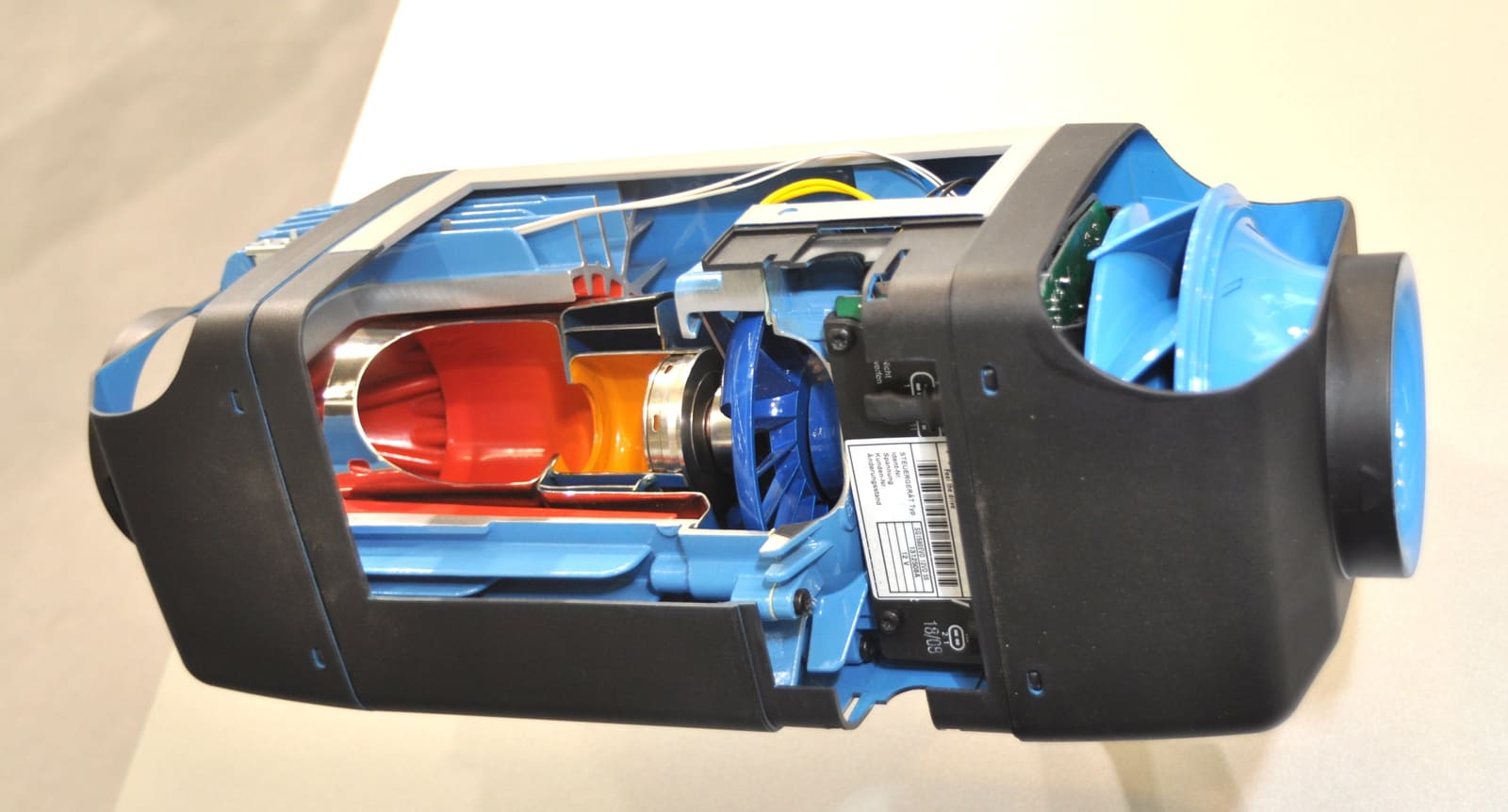
- Forced-air (air) heater: a compact burner, often about the size of a loaf of bread, hidden in a locker. A fan blows warmed cabin or outside air through ducts to outlets in each cabin. Electronics control the start-up, fuel pump and fan. Webasto lists its marine air heaters in the roughly 2 to 5.5 kW range.
- Hydronic (water) heater: a burner heats a coolant loop that feeds fan-coil heaters around the boat and can also heat domestic water or preheat the engine. Common on larger yachts.
- Bulkhead (natural-draft) heater: a small stove-like heater mounted on a bulkhead, with a visible flame and a chimney through the deck. It needs no fan and little or no electricity, but it relies on a good draft and plenty of fresh air.
Why a pro install is worth it. A forced-air heater alone needs six connections: power, fuel, exhaust and three air connections (combustion air in, air to be heated in, hot air out). Each has length, slope, clearance and material rules in the maker's installation manual. Webasto points boat owners to a marine installation partner for retrofits and says repairs need specialist knowledge and tools. Several heaters sold online were designed for trucks and lack marine exhaust fittings and parts.
Gasoline boats. Diesel heaters are generally not ignition-protected. Never put one, its exhaust or its intake in an engine compartment or any space where gasoline vapor can collect. Ask your installer what the heater maker and ABYC standards require for your boat.
Diesel boats are different. You may see a heater mounted in the engine room of a diesel boat: Webasto describes its Air Top Evo marine heater as compact enough to fit in the engine compartment. That is allowed only as the maker's manual describes, with the combustion air and the air to be heated ducted in from the right places (step 4). Don't copy that layout on a gasoline boat.
Steps
- Forced-air suits most cruising boats: it hides away, heats several cabins and dries the air.
- A bulkhead heater suits a sailboat with one main cabin and a good spot for a chimney; it draws almost no battery power. Dickinson notes its natural-draft heaters can be lit and run without the small start-up fan, which matters on a boat with a weak battery bank.
- Hydronic suits larger boats that want even heat in many cabins and hot water.
Check your power budget: forced-air heaters draw much more current while starting and glowing the igniter than while running. Make sure your batteries and charging can handle it on nights at anchor.
For a forced-air unit, look for a dry, accessible locker with room for service, where the duct runs can be short and simple. Many sailboat installs use dead space under a cockpit seat or coaming. Keep it away from fuel and water tanks that could be heated by the exhaust.
For a bulkhead heater, the BoatUS installer chose a spot that radiates heat into the main cabin, is out of the traffic path (so nobody falls against it) and has room for a straight chimney above. Many makers want it facing fore or aft on a sailboat. Check the clearances to combustible materials listed in your manual.
This is the most safety-critical part.
- Forced-air exhaust: a short run of the maker's stainless exhaust pipe to a special exhaust through-hull. In the Good Old Boat install, the pipe sloped downward to the fitting for drainage, was wrapped with heat lagging along its full length, and was clamped and sealed at each joint. The through-hull went in with the clearances and heat-resistant washers the fitting maker specified.
- Bulkhead chimney: a vertical flue pipe to a deck fitting with an air gap around the pipe and a cap on top. The manual gives a minimum flue length and prefers a straight run; elbows reduce draft. Dickinson says the chimney's height and shape matter more than anything else when choosing the heater's spot, because the chimney creates the draft that pulls in fresh air and pushes exhaust out. Its Newport bulkhead heater, as an example, lists a chimney of roughly 4 to 8 feet, a straight run as best, and a barometric damper on longer chimneys; your heater's numbers may differ. Seal any cut core in the deck with thickened epoxy.
- Placement: keep the outlet away from hatches, opening ports, ventilators, docklines, fenders and the dock itself, and (for chimneys) clear of the boom, sheets and anything a crew member might grab. Exhaust gas must not find its way back inside.
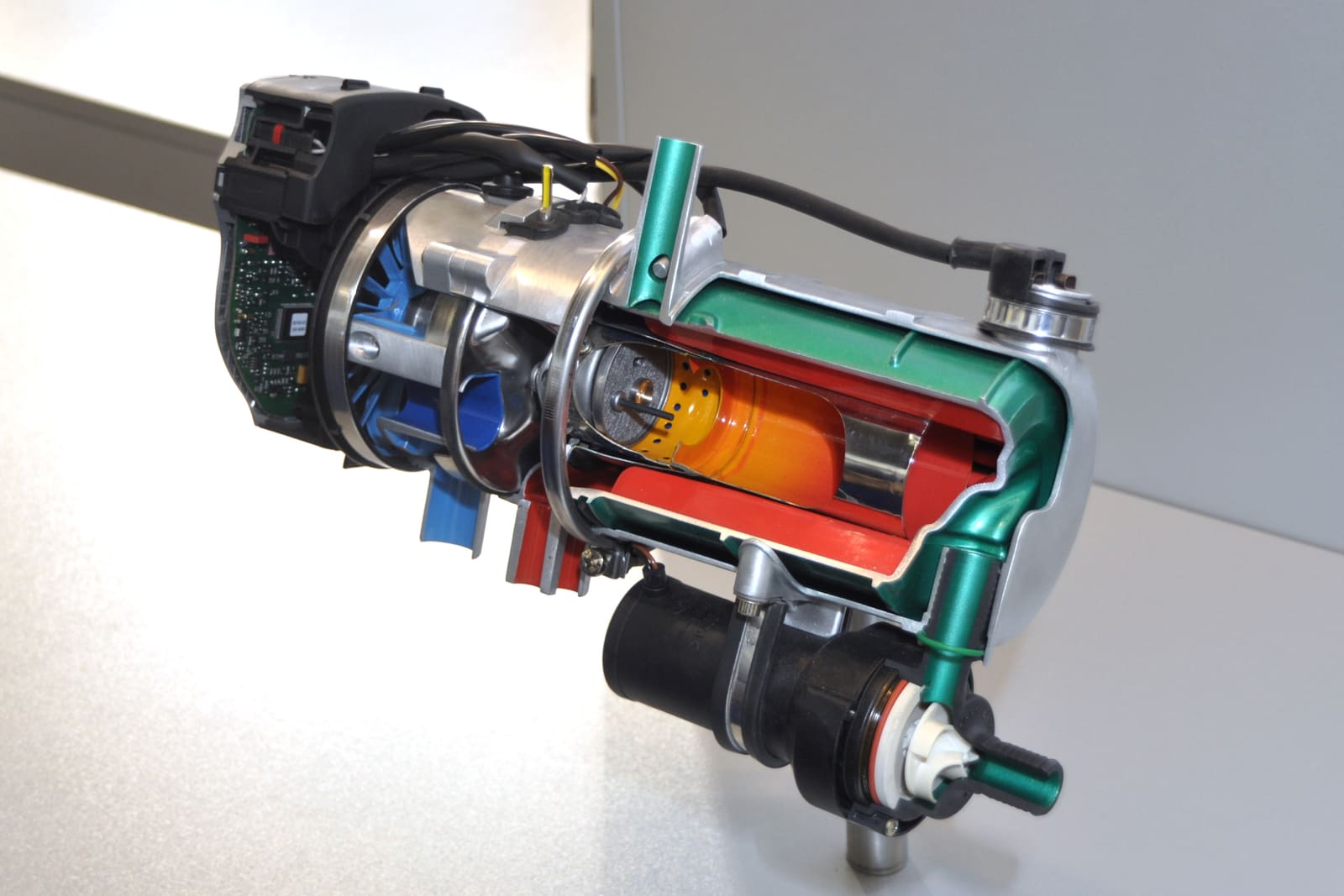
Photo: S.J. de Waard / Wikimedia Commons · CC BY-SA 3.0 - Combustion air for a forced-air heater usually comes through its own short intake pipe. The Good Old Boat owner got clouds of white smoke until he cut that pipe to the length in the manual; these heaters are very sensitive to intake and exhaust length.
- Air to be heated should come from the cabin (recirculation) or from outside, never from the engine compartment. Drawing it from a locker shared with the engine can pull fumes into the cabin and can starve both of air; that owner had a flameout running heater and engine with the lockers shut.
- Ducting: keep runs short with few bends, use the maker's heat-rated ducting and outlets, and close outlets only as the manual allows.
- Bulkhead heaters need a permanently open fresh-air supply into the cabin (the manual gives the minimum size). The BoatUS writer counted his open dorade vents toward it. Without enough fresh air, draft drops and smoke or fumes can spill back.
- Most installs use a separate pickup tube through a spare fitting in the top of the diesel tank, reaching near the bottom. Do not tee into the engine's fuel supply line unless the heater and engine makers both approve it; you can starve the engine or let air into it.
- Forced-air heaters use a small metering pump with strict rules on mounting angle, line size and run length. Bulkhead heaters typically use a low-pressure pump or a gravity day tank, plus an inline filter. Dickinson describes its natural-draft heaters as fed by gravity or an impulse pump, with a float-type metering valve that keeps a steady fuel level, and recommends a fuel filter.
- Use the fuel the heater is set up for. Dickinson's diesel heaters are calibrated for #2 diesel (other metering parts exist for kerosene or #1 diesel), and it says biodiesel cannot be used. Check your heater's manual before trying any other fuel. Approved fuels really do vary by maker and model: Webasto's product page for its Air Top Evo marine heater lists diesel and paraffinic fuels (such as renewable diesel), which is not the same list as Dickinson's.
- Many bulkhead heaters have an overflow line: it returns to the main tank, or (with a day tank) drains to a small container below the heater.
- Use fuel-rated hose and fittings specified in the manual, routed away from heat and chafe and well supported.
Give the heater its own fused or breaker-protected circuit at the panel, sized as the manual says, with wire heavy enough to limit voltage drop (low voltage causes failed starts). Mount any separate control module where it stays dry; the Good Old Boat owner oriented its wire entries downward so water could not collect. Run the controller or thermostat to a convenient spot in the cabin.
Where combustible surfaces are closer than the listed clearances, makers call for insulation or millboard plus a metal shield on standoffs with an air gap behind it. The BoatUS install used a stainless plate on spacers behind the heater and on nearby woodwork. Keep wiring, fuel lines and stowed gear clear of the exhaust and chimney.
Fit marine CO alarms covering the main cabin and every sleeping area, plus a smoke alarm, before you run the heater overnight. Test them, note their expiry dates and keep spare batteries aboard if they use them. See the CO detector guide for placement.
On the first run, with the installer present:
- Watch the exhaust outside: after warm-up it should be nearly clear. Persistent white or black smoke means a fault.
- Use an infrared thermometer on nearby bulkheads, liners and stowed items as the heater reaches full output. Nothing combustible should get too hot to touch comfortably.
- Look and sniff along the exhaust or chimney joints and the fuel line for leaks.
- Make sure the CO alarm stays silent and that air flows from every outlet.
- Ask for the manuals, a list of what was installed and the service schedule.
Webasto recommends switching the heater on once a month for at least 20 minutes, even in seasons when you don't need heat, so it stays ready to work. Some controllers remind you when a maintenance run is due. Run it with the boat attended and ventilated.
- Look at the exhaust through-hull or chimney cap: clear of nests, soot, salt and damage, and the gelcoat around it not discolored.
- Check the exhaust lagging, clamps and duct connections; ducts should not be crushed.
- Look for diesel weeps at the pump, filter and heater.
- Check the intake screens are clear.
- Test the CO and smoke alarms.
Webasto says the heater should not be cleaned with high-pressure water or compressed air.
Webasto recommends inspection and maintenance by an authorized dealer at regular intervals, at least every two years. Many owners have it serviced every year if they use the heater a lot or burn questionable fuel. Clean fuel matters: water or sludge in the tank is a common cause of failed starts. Record service dates in BoatMend.
Common mistakes
- Buying a cheap truck heater kit and improvising a marine exhaust. Exhaust leaks inside the boat are the most dangerous failure.
- Ignoring the manual's exhaust and intake lengths, then fighting smoky, sooty running.
- Pulling the heater's air from the engine compartment or a closed locker.
- Running the exhaust outlet near a hatch, port or the cockpit where people sit.
- Skipping the CO alarms because "diesel heaters are sealed."
- Never running the heater in the off-season, then finding it won't start on the first cold night.
When to call a pro
- For the installation itself, including any new through-hull or deck penetration and tank fitting
- Any smell of exhaust or diesel inside the boat, or a CO alarm that sounds with the heater on
- Smoky exhaust, repeated failed starts, flame-outs or error codes after the easy checks
- Soot around the exhaust outlet or discoloration around the heater, chimney or deck fitting
- Annual or two-yearly burner service, glow plug or igniter replacement, and control faults
Tips
- Plan the exhaust location first; it often decides where everything else goes.
- Keep the installation and owner's manuals aboard, and note the heater's model and serial number in BoatMend.
- Heaters run better on clean fuel; see the fuel polishing guide if your tank has a history of sludge.
- If you sleep aboard with any fuel-burning heater, crack a hatch or vent for fresh air as well.
Official references
We read these to write this guide. Your engine's own manual always wins.
- BoatUS – Installing A Diesel Heater (Frank Lanier)
- Good Old Boat – High-End Heat on a Budget (forced-air diesel heater install)
- Webasto – Marine heating solutions (air and water heaters)
- Webasto – Air Top Evo 40/55 Marine (product page)
- Webasto – Operating instructions, maintenance and service
- Dickinson Marine – Cookstoves and heaters for boats
- Dickinson Marine – Support (diesel stove and heater FAQs)
- Dickinson Marine – Newport Diesel Bulkhead Mount Heater (product page)
- USCG Boating Safety – How to protect others and yourself from carbon monoxide
Safety: BoatMend is for information only and does not replace a certified marine technician. You are responsible for your safety and your boat. Read the full disclaimer.
Last updated 2026-10-25
Related guides
Cabin Heater Safety Aboard: Diesel, Propane and Electric Heaters
Heat your cabin without poisoning the crew or burning the boat. Covers carbon monoxide alarms, exhaust and through-hull checks for diesel and propane heaters, fuel and ventilation, why household and camping heaters don't belong in a closed cabin, and how to use electric space heaters on shore power safely.
Carbon Monoxide on Boats: Where It Comes From, CO Alarms and Warning Signs
Carbon monoxide can build up in cabins, under canvas and around the swim platform, and its first symptoms look like seasickness. Learn the danger zones, where to mount marine CO alarms, how to test and replace them, and exactly what to do if an alarm sounds or someone feels sick.
Smoke and Heat Detectors on a Boat: Where They Make Sense, What to Buy and How to Test
A fire in a closed cabin, engine room or lazarette can grow for minutes before anyone notices. Learn where smoke alarms and heat detectors make sense aboard, why boats are hard on household alarms, how to power and test them, how they fit with CO alarms, and how automatic engine-room extinguishers and engine shutdown tie in.
How to Deal with Diesel Fuel Contamination, Diesel Bug and Fuel Polishing
Learn the signs of water, sludge and microbial growth ("diesel bug") in your diesel tank, how to check a fuel sample, when a biocide helps, and when the tank needs polishing or cleaning. Clean fuel prevents most diesel breakdowns.
How to Replace an Outboard Fuel Line and Primer Bulb
A cracked hose or a stiff primer bulb can leak gasoline, starve your engine or shed rubber into the fuel. Learn how to choose Coast Guard-rated fuel hose, the right connectors for your engine brand and good stainless clamps, install the bulb pointing the right way, leak-test the job and get rid of the old parts safely.

Fuse Keeps Blowing? How to Troubleshoot a Boat Fuse Block or Breaker Panel
Work through a blown fuse or tripping breaker the safe way: confirm it, tell a short from an overload, isolate the device or wire at fault, replace a worn breaker or panel switch with the same rating, and label every circuit, without ever fitting a bigger fuse.
How to Find and Fix Leaking Deck Hardware (Rebedding Cleats, Stanchions and Tracks)
Track down the cleat, stanchion base or track that is dripping into the cabin, then remove it, seal the deck core and bed it again with the right sealant so the leak stops for years instead of weeks. Catching it early protects the deck core from rot.