Checking a Used Boat's History by HIN: Decoding, State Records, Coast Guard Search and History Reports
Use the hull identification number to check a used boat before you buy: find and decode the HIN, confirm the builder and model year, look for recalls, check state title and lien records and the Coast Guard documentation database, decide whether a paid history report is worth it, and learn what none of these checks can tell you.
Time
1 h
Applies to
All engines
Safety first: A history check is a desk exercise, but use it to protect yourself in person too: never send a deposit for a boat whose HIN you haven't seen and checked against the paperwork. If the HIN looks ground off, re-riveted, painted over or doesn't match the title, stop and walk away, and if you suspect the boat is stolen, tell local law enforcement rather than confronting the seller. A clean report never replaces a professional survey and a careful inspection of the fuel system, hull and electrical system.
Owners often ask
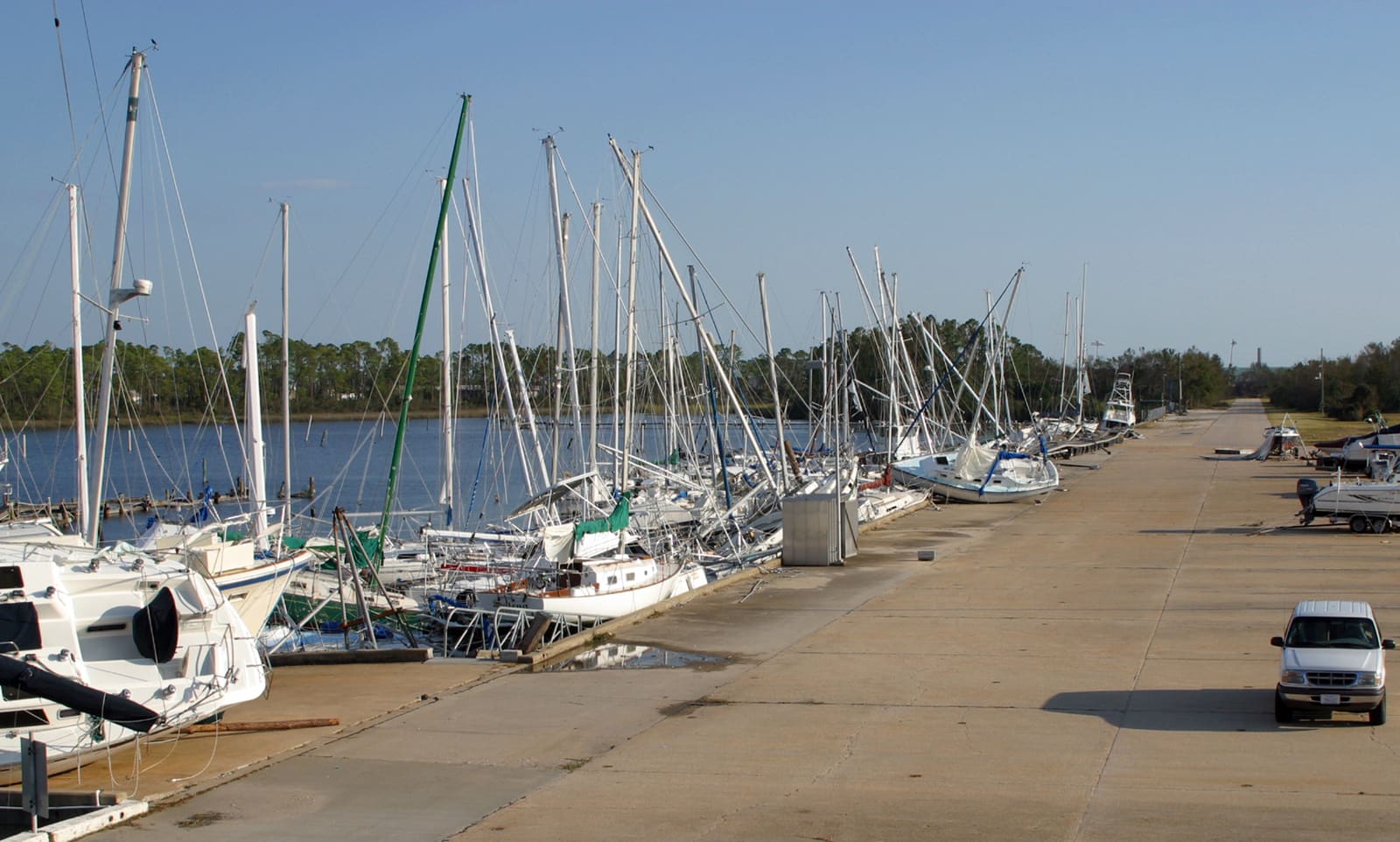
- How can I find out from the HIN whether a used boat was in a hurricane, an accident or an insurance total loss?
- The boat I want to buy has a HIN plate held on with screws. Is that a problem?
This guide walks you through it. Still stuck? Ask the AI Mechanic about your engine.
Tools
- Flashlight and phone camera
- Clean rag (to wipe grime off the HIN plate)
- The seller's title, registration card or Certificate of Documentation
- Internet access and a credit card for any paid report
Before you start
The hull identification number (HIN) is the boat's equivalent of a car's VIN: 12 characters, required on boats built or imported for sale in the U.S. since the early 1970s, and the key to every record about the boat. A history check pulls together several free sources and, if you want, a paid report. Each covers a different slice:
- The HIN itself: who built the boat and when
- Coast Guard records: builder codes, recalls, and documentation for documented boats
- State records: title, registration and liens (access varies a lot by state)
- Commercial history reports: accidents, insurance total losses, storm damage, theft and title history gathered from many sources
Ask the seller for the HIN, the state registration number and, for a documented boat, the official number before you travel. Run the free checks first; they often settle the question.
Steps
Federal rules put the primary HIN on the starboard (right) side of the transom, within two inches of the top of the transom, gunwale or hull-to-deck joint, whichever is lowest. Boats without a usable transom carry it on the starboard hull side within a foot of the stern; pontoons with replaceable hulls carry it on the aft crossbeam near the starboard hull. A duplicate HIN is hidden somewhere inside the boat or under a fitting. Wipe the plate clean and photograph it.
If the number is hard to read, make a pencil tracing (a rubbing on thin paper) as well as a photo. The Coast Guard's HIN guidance for states lists pencil tracings and photographs among the accepted ways to present a HIN for verification, along with an inspection by a state official, a signed owner affidavit, contacting the builder, the Coast Guard's MIC check and the National Insurance Crime Bureau (NICB) database.
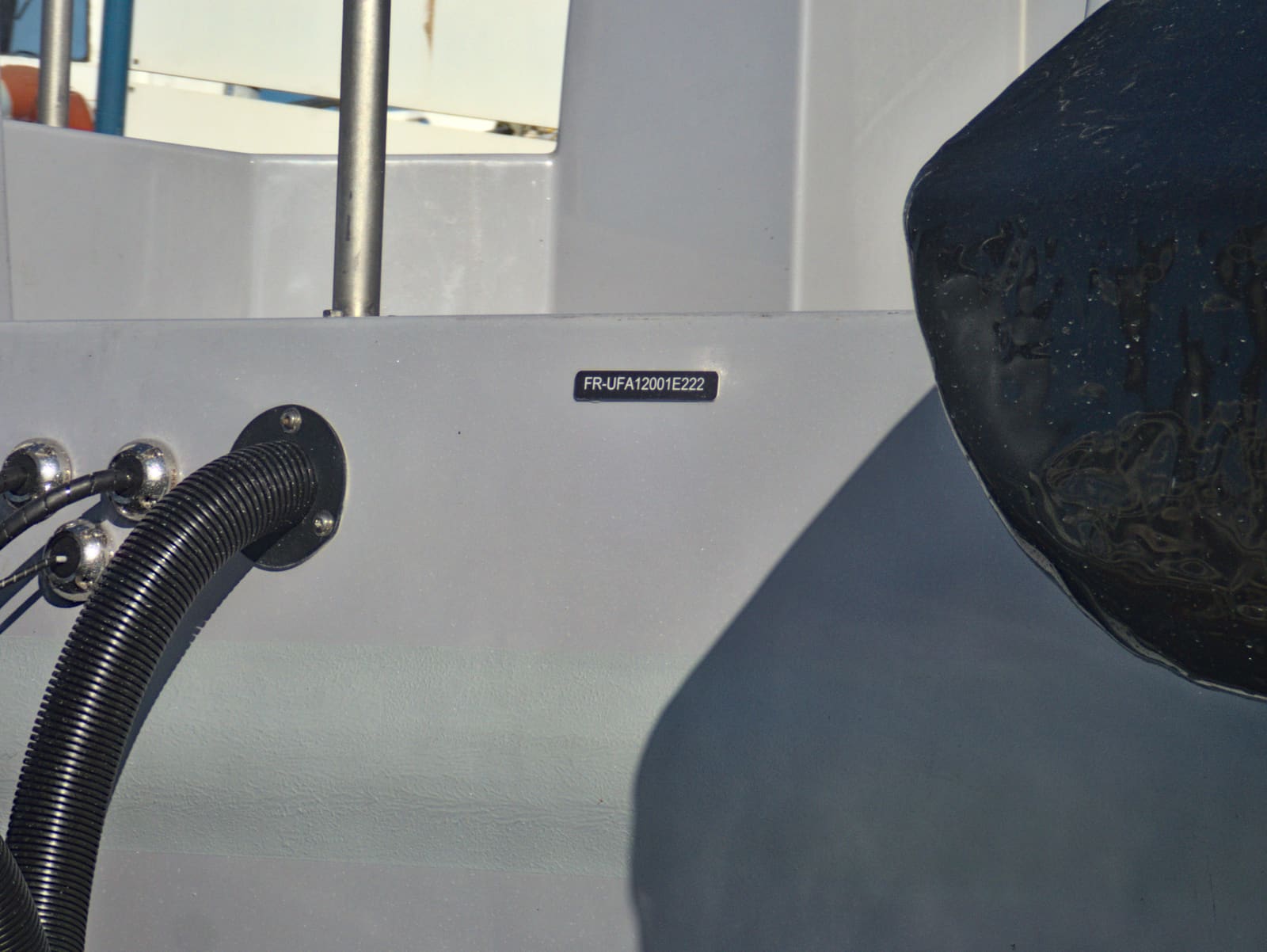
This is a European Craft Identification Number on a French-built boat. After the 'FR-' country code it follows the same 12-character layout as a U.S. HIN: builder code UFA, serial 12001, E2 = May 2022, model year 22. Photo: PtiBzh / Wikimedia Commons · CC0 1.0 Note that outboards and sterndrives carry their own serial numbers, separate from the HIN (see our engine serial number guide).
The number must be permanently carved, molded, stamped or bonded so that changes would be obvious. Warning signs: a plate held by fresh screws or rivets, a patch of new gelcoat or paint around the number, grinding marks, characters that don't line up, or a number that differs from the title. If something looks wrong, our state-assigned HIN guide explains what altered numbers mean, and it's usually time to walk away.
Under the current format:
- Characters 1 to 3: the Manufacturer Identification Code (MIC), assigned by the Coast Guard to the builder or importer
- Characters 4 to 8: the builder's serial number (the letters I, O and Q aren't used)
- Character 9: the month of manufacture or certification, as a letter from A (January) to L (December)
- Character 10: the last digit of the year of manufacture or certification
- Characters 11 and 12: the model year
So a HIN ending in D526 means built (or certified) in April 2025, model year 2026. The model year and build date should make sense together, and both should match the title and the seller's story. Boats from the 1970s and early 1980s may use an older layout, so don't panic if an old HIN reads differently; check with the state agency.
Search the MIC on the Coast Guard's Manufacturer Identification Code page. Confirm that it belongs to the brand on the boat and its paperwork. A MIC that doesn't exist, or belongs to a different builder, is a red flag. J.D. Power also has a free online HIN decoder that shows the basics.
Search the Coast Guard's recall database by the builder's MIC or name. Note any open recall for that model and year, and ask the seller (or the builder) whether the repair was done. Our title-and-paperwork guide covers recalls and warranty transfers at the closing.
Every state handles this differently:
- Some offer an online check. New York's DMV, for example, lets you check a boat's title and lien status online with the HIN, model year and make; it shows when the title was issued and the number of liens and lienholders, but no personal owner information.
- Many states only release records to the owner, or by written request. Ask the titling agency what a buyer can see.
- Expect the state to check the HIN itself when you register. Since January 1, 2017, federal rules (33 CFR 174.16) require states to confirm that a boat built or imported on or after November 1, 1972 has a valid primary HIN before issuing, renewing or transferring its registration, and to assign one if it doesn't. A HIN problem the seller "never had trouble with" can still stop your registration.
- Always look at the actual title: owner names, lienholder, and any brand such as salvage or rebuilt.
If the boat is registered in a different state from where you're buying it, check with that state's agency (our out-of-state buying guide helps).
Bigger boats are often federally documented instead of (or as well as) state titled. The Coast Guard's PSIX vessel search lets you search by vessel name, official number or HIN to see whether the boat is documented and under what name and number. If it is, order an Abstract of Title from the National Vessel Documentation Center (request form CG-7043, submitted through the NVDC's eStorefront). It lists recorded owners and recorded mortgages. Our expired-documentation guide explains how to read it.
Commercial reports gather records that are hard to collect yourself. Boat History Report, which J.D. Power's HIN page links to for full reports, says it searches by HIN, state registration number or Coast Guard documentation number, and lists categories such as accident and damage history, hurricane damage, salvage and total-loss events, theft records, title and registration history, and recalls. Other services exist, with different data sources and prices. A report usually costs less than one hour of a surveyor's time, so it's worth buying for any boat you're serious about, especially one coming from a hurricane-prone coast or an auction.
A clean result means "nothing was reported," not "nothing happened." Reports and records usually can't show:
- Damage repaired privately without an insurance claim
- Engine hours, maintenance or how the boat was stored
- Whether it lived in salt or fresh water
- Liens in a state that doesn't record them on boat titles, or a mechanic's or storage lien
- Storm or flood damage on a boat that was never claimed, or a title that was never branded (many states don't brand boat titles at all; see our salvage-title guide)
Ask directly: Has the boat ever sunk, flooded, been in a storm, an accident or an insurance claim? How many owners? Any liens? Where has it been kept? Compare the answers with what you found. A seller who won't put answers in writing is telling you something.
Before money changes hands, the HIN on the transom, the hidden duplicate (if you can find it), the title or registration, the documentation record, the insurance quote and the bill of sale should all show the same 12 characters. Check the engine serial numbers against the paperwork too. If anything doesn't match, stop until it's explained and corrected by the agency.
History checks tell you what's on record; a marine survey and an engine inspection tell you what's actually there. Use what you learned (a storm history, a past claim, an open recall) to tell the surveyor where to look harder. Our used-boat inspection guide covers what to check before you even call a surveyor.
Common mistakes
- Reading the HIN from the paperwork instead of from the boat.
- Paying for a report on a HIN the seller typed into a message, before seeing the boat.
- Treating a clean report as proof the boat was never damaged.
- Forgetting that a documented boat's mortgage shows up on the NVDC Abstract of Title, not on a state record.
- Ignoring a mismatch between the model year in the HIN and the year in the ad.
- Not checking the trailer's VIN and title, which are separate from the boat's.
When to call a pro
- Marine surveyor: always, before you buy a boat of any real value; tell them what the history check found
- Local law enforcement or your state boating agency: the HIN is altered or missing, or you suspect the boat is stolen
- A maritime attorney: liens, title brands or ownership gaps that the seller can't clear before closing
- The NVDC: questions about a documented boat's record or mortgage
Tips
- Photograph the HIN plate in good light and zoom in; worn characters like 8 and B or 0 and D are easy to misread.
- Keep screenshots of every check with the date, in case a problem shows up later.
- Buying from a broker or dealer? Ask whether they already ran a history report; many include one with the listing.
- After you buy, store the HIN, engine serials and documentation number in BoatMend's records; you'll need them for insurance, registration and theft reports.
Official references
We read these to write this guide. Your engine's own manual always wins.
- eCFR – 33 CFR 181.25, Hull identification number format
- eCFR – 33 CFR 181.29, Hull identification number display
- USCG Boating Safety – HIN guidance for states
- USCG Boating Safety – Manufacturer Identification Code (MIC) search
- USCG Boating Safety – Recalls search
- USCG CGMIX – PSIX Vessel Search
- USCG NVDC – Instructions and Forms (CG-7043 Abstract of Title request)
- New York DMV – Check title or lien status
- J.D. Power – HIN Lookup and Decoder
- Boat History Report – HIN lookup
- eCFR – 33 CFR 174.16, Verification of hull identification numbers (HINs)
Safety: BoatMend is for information only and does not replace a certified marine technician. You are responsible for your safety and your boat. Read the full disclaimer.
Last updated 2026-11-06
Related guides
Boats With No HIN: State-Assigned Hull Numbers for Homebuilt, Pre-1972 and Damaged-HIN Boats
What to do when a boat has no hull identification number, a homemade or kit boat needs one, an older boat predates the 1972 rule, or the number has been damaged or altered: the federal rules, how a state assigns a HIN, the inspection, the proof of ownership and build receipts to bring, how to fix the number to the hull, and the red flags that mean walk away. Practical help, not legal advice; every state runs its own process.
How to Inspect a Used Boat Before You Buy
A step-by-step checklist for looking over a used boat, from paperwork and the hull ID number to the transom, engine, compression test, sea trial and trailer. Know what to check yourself, what the red flags mean, and when to pay a marine surveyor.
Salvage and Branded Title Boats: What They Mean, the Risks, and How to Check Before You Buy
Understand boats that an insurer declared a total loss: what salvage, rebuilt and hull-damaged title brands mean, why flood and storm boats hide expensive problems, how branded titles affect insurance, financing and resale, how to dig into a boat's history, and what a survey should check. Title branding rules differ a lot by state, and some states don't brand boat titles at all.
Used Boat Paperwork: Titles, Liens, HIN Checks, Bill of Sale and Registration
A practical checklist for the paperwork side of buying a used boat: state title or Coast Guard documentation, checking for liens and theft, verifying the hull ID number, writing a proper bill of sale, the trailer's own title, registering in your name, and transferring warranties and checking recalls. Rules vary by state, so confirm each step with your state agency.
Buying a Documented Boat With an Expired or Deleted Coast Guard Certificate
What an expired or deleted Certificate of Documentation means when you buy a used boat, how to check the record and any mortgage with an Abstract of Title, your two paths (keep it documented or move it to a state title), and how to spot private sites that look like the Coast Guard. General information, not legal advice.
Avoiding Boat-Buying Scams: Fake Listings, Fake Escrow, Overpayment Checks and Safe Payment
How to spot and avoid the scams that target boat buyers and sellers: too-good-to-be-true listings, sellers who are always overseas, look-alike escrow and shipping websites, overpayment checks and fake payment notices. Covers verifying the boat, the title, the HIN and the seller, paying safely, and what to do fast if you already sent money. Practical help, not legal advice.
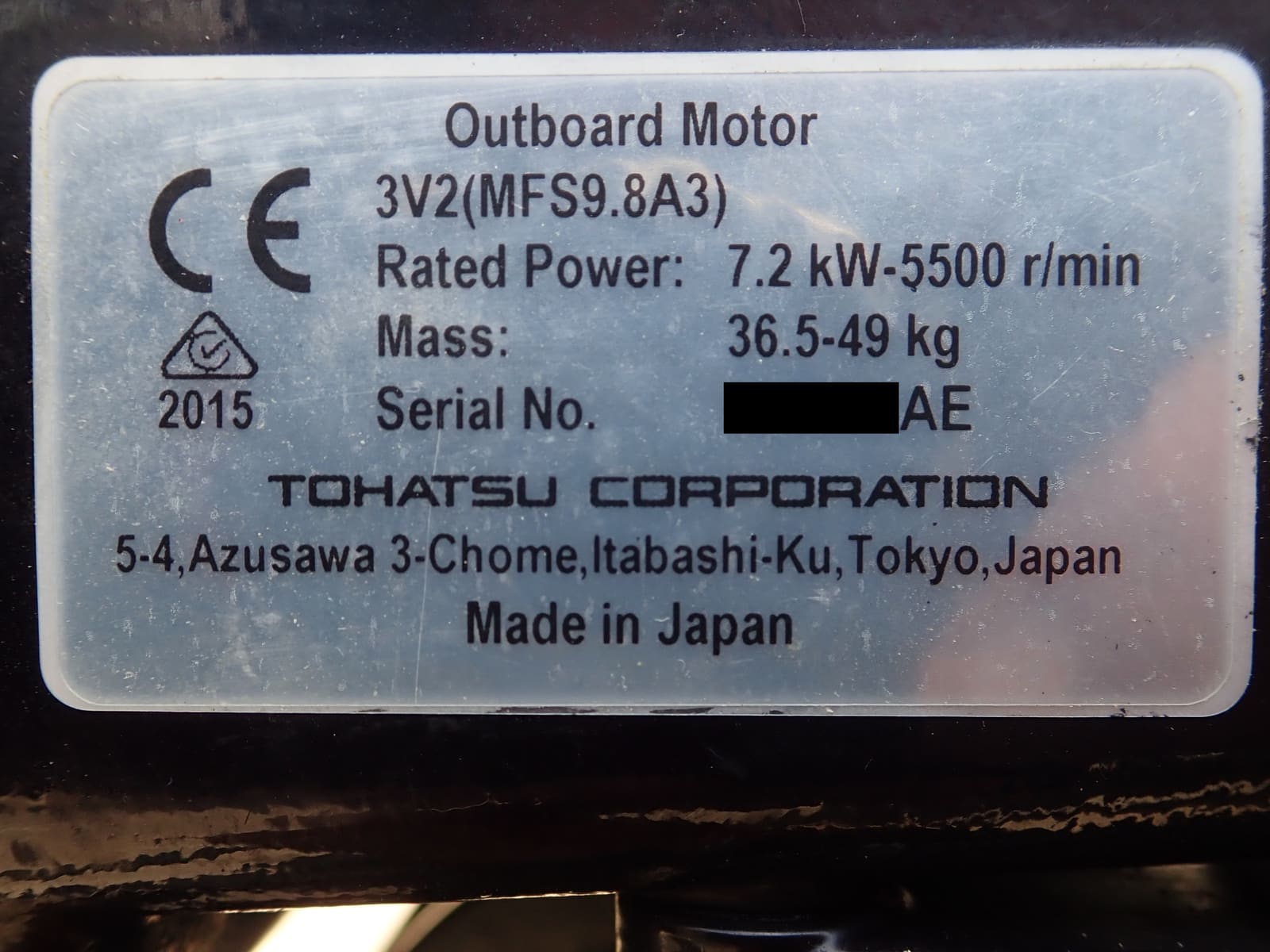
How to Find Your Engine's Serial Number, Model and Year (and Get the Official Manual)
Find the ID label on your outboard, sterndrive, inboard diesel or PWC, read the model and serial number correctly, tell it apart from the boat's HIN, and use it to open the free official owner's manual. It's the first step for ordering the right parts and following the right maintenance plan.
Buying a Boat in Another State: Survey, Paperwork, Taxes, Registration and Getting It Home
A step-by-step plan for buying a boat that is hundreds of miles away: checking it remotely with a local surveyor, matching the HIN and VIN to the title, avoiding long-distance scams, paying the right sales or use tax, registering in your home state, the trailer's own paperwork, temporary permits, and legal towing or professional transport for wide boats. Rules vary by state, so confirm each step with the agencies involved.
Used Boat Purchase Agreement and Closing: Deposit, Contingencies, Bill of Sale and Who Pays What
A plain-English walk-through of buying a used boat on paper: getting ready before you offer, what the purchase and sale agreement should say, how the deposit is held and when it comes back, survey, sea trial, financing and insurance contingencies, paying off the seller's loan, the bill of sale, closing and transferring the paperwork, and the costs each side usually covers. Practical help, not legal advice; rules vary by state.
How Much Is a Used Boat Worth? Pricing Guides, Comps and Condition
Work out a realistic price for a used boat, whether you're buying or selling: check sold and listed comps, read J.D. Power, BUCValu and ABOS values the right way, value the engines separately, adjust for hours, condition, upgrades and location, and know when a valuation survey is worth paying for.